11 Sep 2026
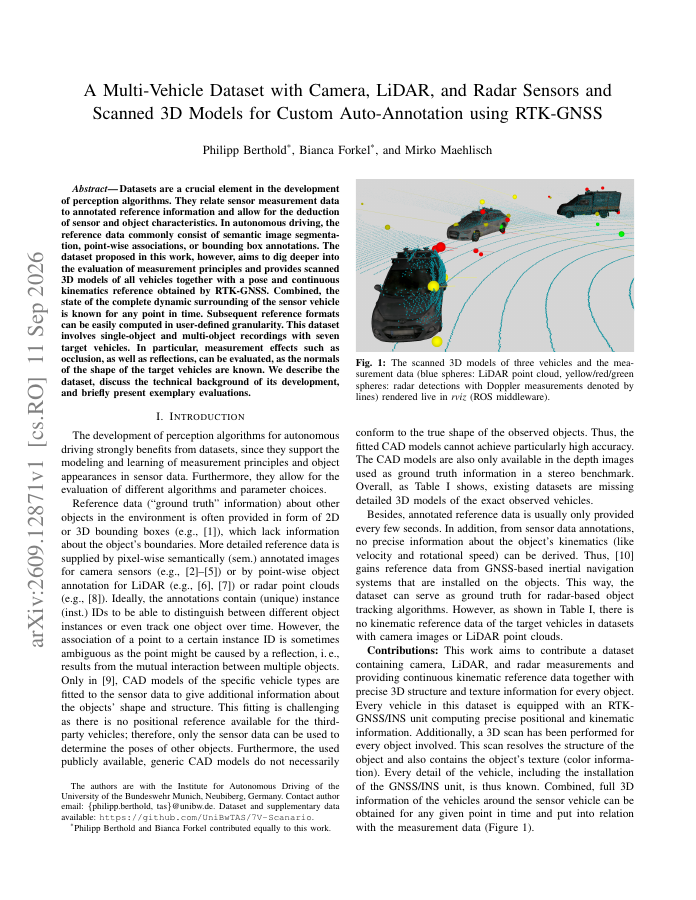
Datasets are a crucial element in the development of perception algorithms. They relate sensor measurement data to annotated reference information and allow for the deduction of sensor and object characteristics.
Trending research and the full catalog - each paper linked to the benchmarks, methods, and models it introduces.
Filtering here covers the 2,000 most recent papers, as much as one page can hold in memory. See the full index of 22,997 papers.
11 Sep 2026
Datasets are a crucial element in the development of perception algorithms. They relate sensor measurement data to annotated reference information and allow for the deduction of sensor and object characteristics.
11 Sep 2026
Dementia is a major and growing global health burden, with Alzheimer's disease (AD) accounting for most cases. Timely and accurate diagnosis is central to managing this burden and increasingly depends on integrating complementary clinical and imaging information.
11 Sep 2026
When providing forecasted probabilities with a predictive model, the ideal model offers perfect calibration: the true probability of the outcome (i.e., the probability that $Y=1$) exactly matches the forecasted probability $f(X)$.
11 Sep 2026
In many settings involving stochastic differential equations (SDEs), including diffusion based generative AI, our aim is to accurately generate samples from a distribution. Typically, this is done by generating i.i.d. samples of the SDE.
11 Sep 2026
Large language models are increasingly benchmarked against classical machine learning for network intrusion detection (NIDS), almost always using same-dataset evaluation, and that protocol turns out to be incomplete.
10 Sep 2026
Generative AI and the practice of "vibe coding" are changing how archaeologists carry out computational research, but their effects on the discipline's range of methods is still understudied.
10 Sep 2026
Long-horizon robot manipulation requires memory, but not necessarily inside the action policy. To address such tasks, current agentic systems often combine VLAs with planners and geometric tools, sometimes using additional depth or calibrated geometry.
10 Sep 2026
In scientific simulation, regular grids, unstructured meshes, and particle-based formats are chosen to represent field data for computational efficiency, geometry/adaptive flexibility, and following motion/deformation, respectively.
10 Sep 2026
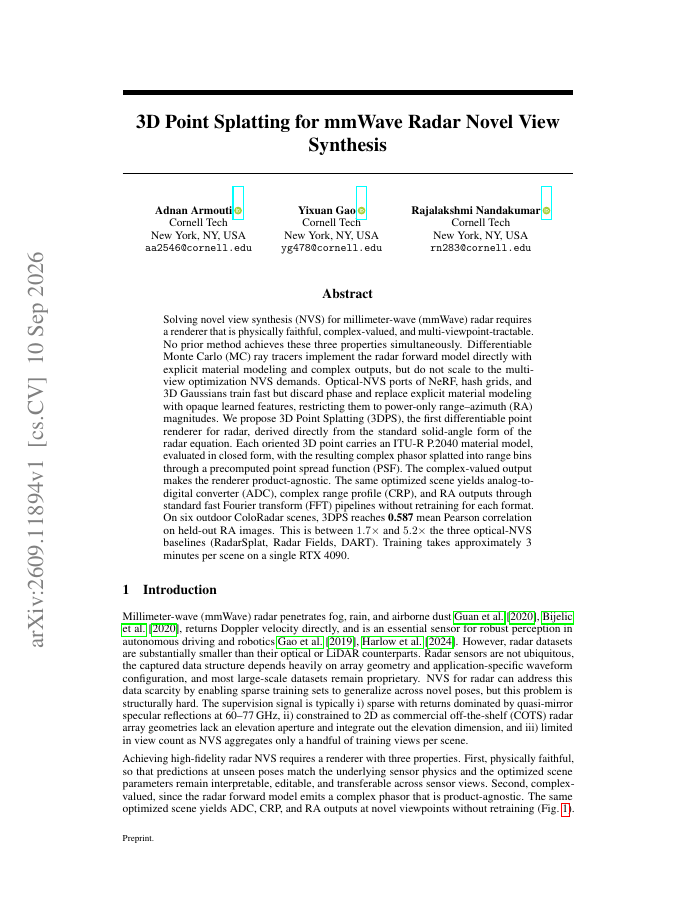
Solving novel view synthesis (NVS) for millimeter-wave (mmWave) radar requires a renderer that is physically faithful, complex-valued, and multi-viewpoint-tractable. No prior method achieves these three properties simultaneously.
10 Sep 2026
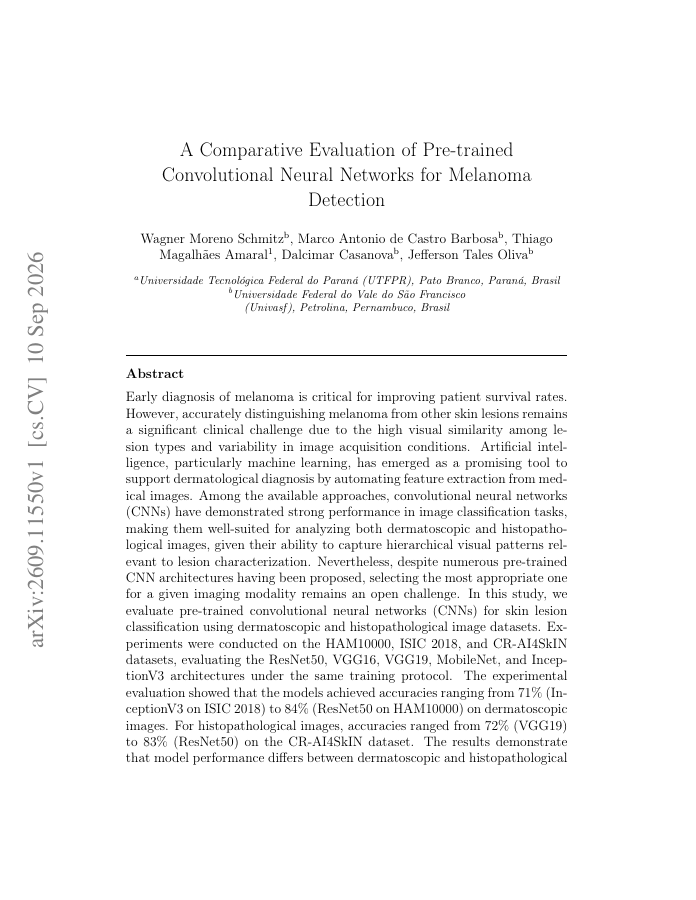
Early diagnosis of melanoma is critical for improving patient survival rates. However, accurately distinguishing melanoma from other skin lesions remains a significant clinical challenge due to the high visual similarity among lesion types and variability in image acquisition…
10 Sep 2026
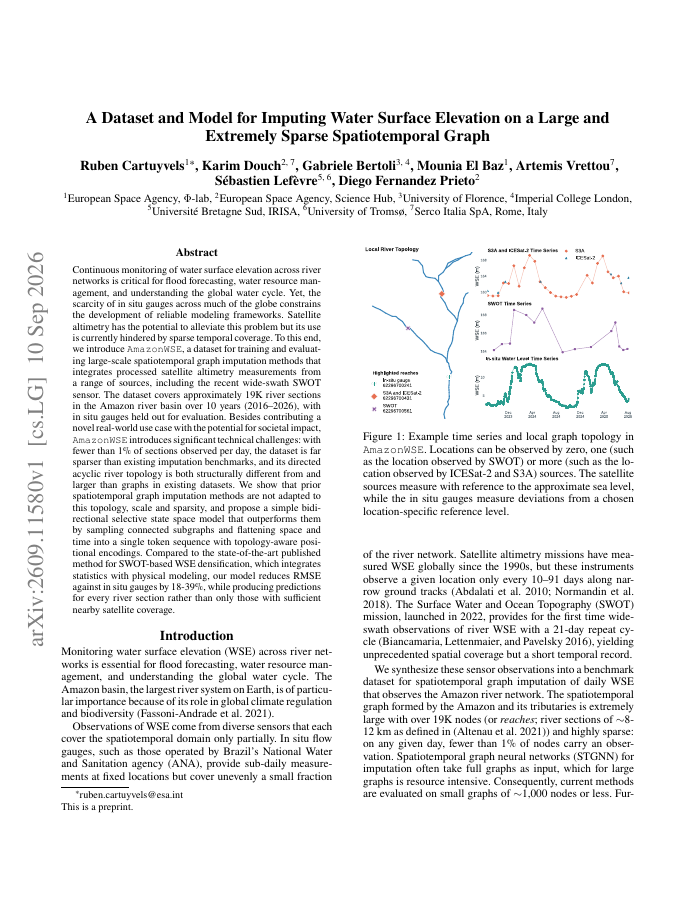
Continuous monitoring of water surface elevation across river networks is critical for flood forecasting, water resource management, and understanding the global water cycle.
10 Sep 2026
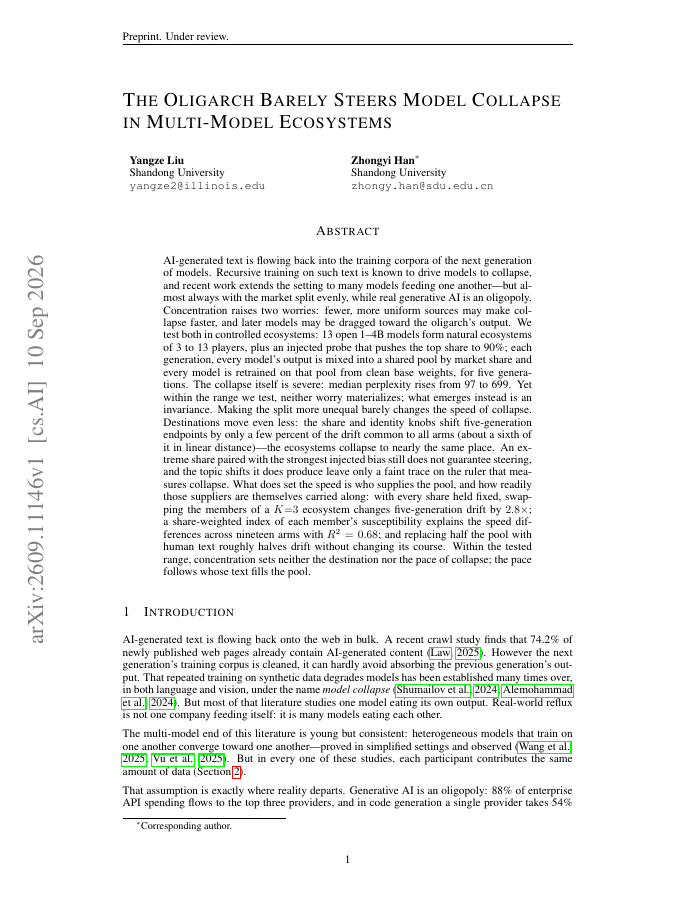
More and more of the text future language models learn from is written by a few of today's models. If one supplier writes most of a shared corpus, does it pull the models trained on it toward its own writing, or change how fast they drift? We retrain eight open models from their…
10 Sep 2026
Traffic flow prediction is a core supporting technology for intelligent transportation systems. It uses historical data to infer future traffic dynamics in specific areas, thereby helping to alleviate congestion and improve resource allocation efficiency.
10 Sep 2026
Feature-based explanations quantify features' influence on model predictions, but are primarily designed for scalar outputs. In many applications, however, outputs are functional or multivariate, such as time-dependent trajectories in demand forecasting.
10 Sep 2026
We propose a mathematical theory of pragmatic information that connects communication, control, and decision-making. Its central notion is the isoteleia mapping, which formalizes equifinality: distinct semantic paths that lead to the same optimal action are treated as…
10 Sep 2026
Artificial neural networks rely on vector-matrix multiplications (VMMs), whose implementation in von Neumann architectures is dominated by costly data movement between memory and processing units.
10 Sep 2026
High-dimensional dense text embeddings and large language models face real obstacles in financial-disclosure analysis: context-window limits, hallucination risk, high computational cost, and the arbitrary rotation of vector spaces across independently trained models.
10 Sep 2026
We propose an all-reflective two-mirror projection system for extreme ultraviolet (EUV) lithography operating at exposure wavelengths of $13.5$~nm (Mo/Si) and $11.2$~nm (Ru/Be), delivering a fourfold ($4\times$) demagnification of the periodic mask pattern at a numerical…
9 Sep 2026
The advance of multimodal large language models (MLLMs) has fundamentally reshaped the paradigm of human-computer interaction, especially speech interaction models capable of seamless conversations.
9 Sep 2026
Large language models (LLMs) now show strong reasoning and coding abilities, raising the prospect that they could assist in developing and optimizing the very infrastructure that powers them.
9 Sep 2026
Large Language Models (LLMs) have achieved remarkable progress across natural language processing (NLP) tasks, yet their capabilities degrade sharply for low-resource languages and dialectally diverse settings.
9 Sep 2026
In continual reinforcement learning, carefully managing the stability-plasticity tradeoff remains a core challenge. Recent work by Abel et al. (2025) formalized this dilemma by defining plasticity as the generalized directed information from an agent's observations to its…
9 Sep 2026
Sparse autoencoders (SAEs) are increasingly used to recover interpretable features from neural-network activations, yet systematic feature co-occurrence can cause distinct features to be absorbed or merged.
9 Sep 2026
In the kernel regime, neural-network learning inherits its preferences from a frozen spectrum. During feature learning, this spectrum evolves, yet networks retain systematic biases toward simple, smooth directions.