9 Oct 2026
LLM agents' capabilities depend not only on their underlying models but also on their execution harnesses. Recursive self-improvement (RSI) offers a promising approach to automatically evolve these harnesses.
Trending research and the full catalog - each paper linked to the benchmarks, methods, and models it introduces.
Filtering here covers the 2,000 most recent papers, as much as one page can hold in memory. See the full index of 22,997 papers.
9 Oct 2026
LLM agents' capabilities depend not only on their underlying models but also on their execution harnesses. Recursive self-improvement (RSI) offers a promising approach to automatically evolve these harnesses.
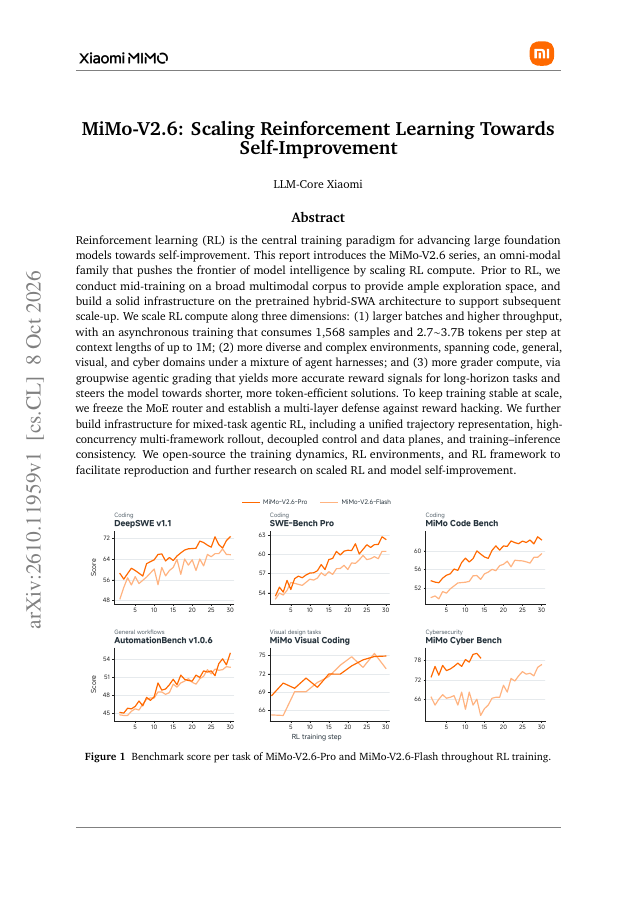
8 Oct 2026
Reinforcement learning (RL) is the central training paradigm for advancing large foundation models towards self-improvement. This report introduces the MiMo-V2.6 series, an omni-modal family that pushes the frontier of model intelligence by scaling RL compute.
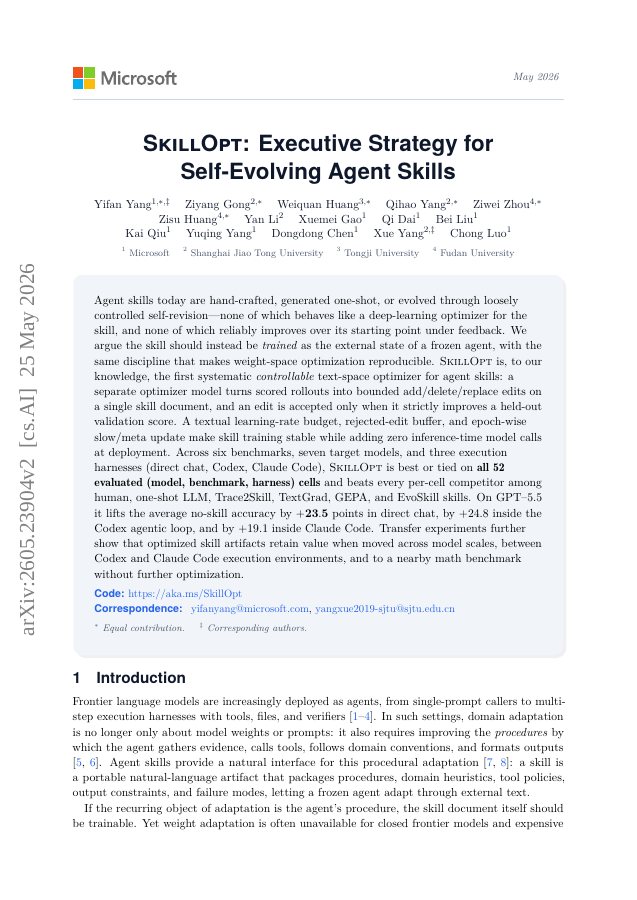
Yifan Yang, Ziyang Gong, Weiquan Huang et al. · 22 May 2026
Agent skills today are hand-crafted, generated one-shot, or evolved through loosely controlled self-revision, none of which behaves like a deep-learning optimizer for the skill, and none of which reliably improves over its starting point under feedback.
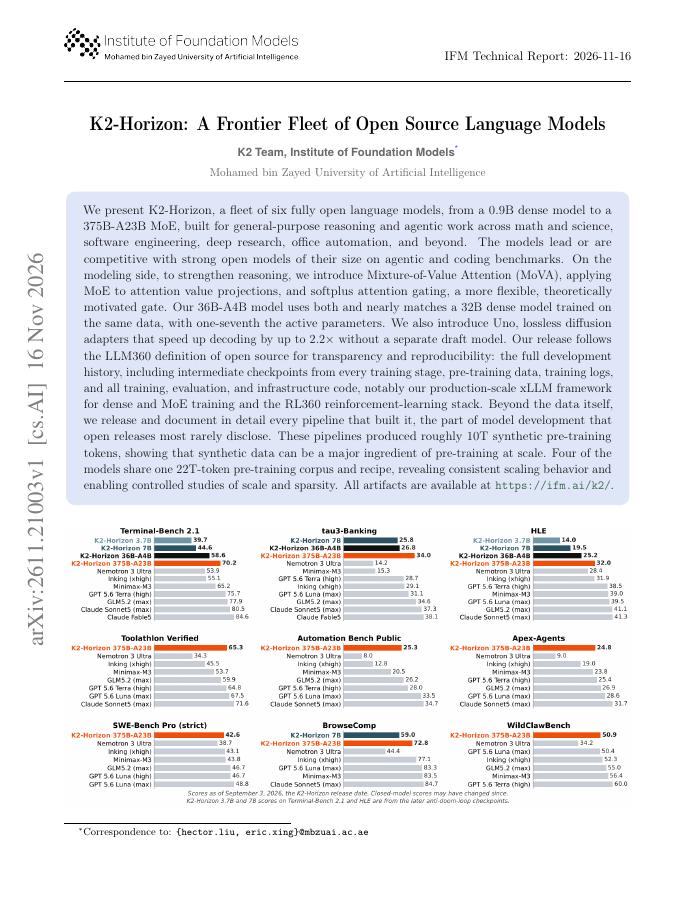
16 Nov 2026
We present K2-Horizon, a fleet of six fully open language models, from a 0.9B dense model to a 375B-A23B MoE, built for general-purpose reasoning and agentic work across math and science, software engineering, deep research, office automation, and beyond.
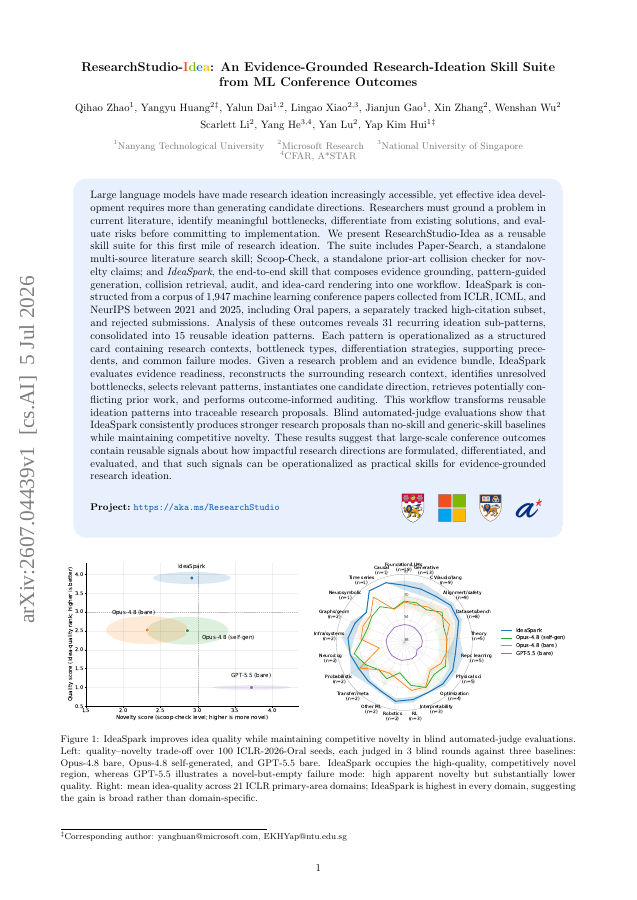
5 Jul 2026
Large language models have made research ideation increasingly accessible, yet effective idea development requires more than generating candidate directions. Researchers must ground a problem in current literature, identify meaningful bottlenecks, differentiate from existing…
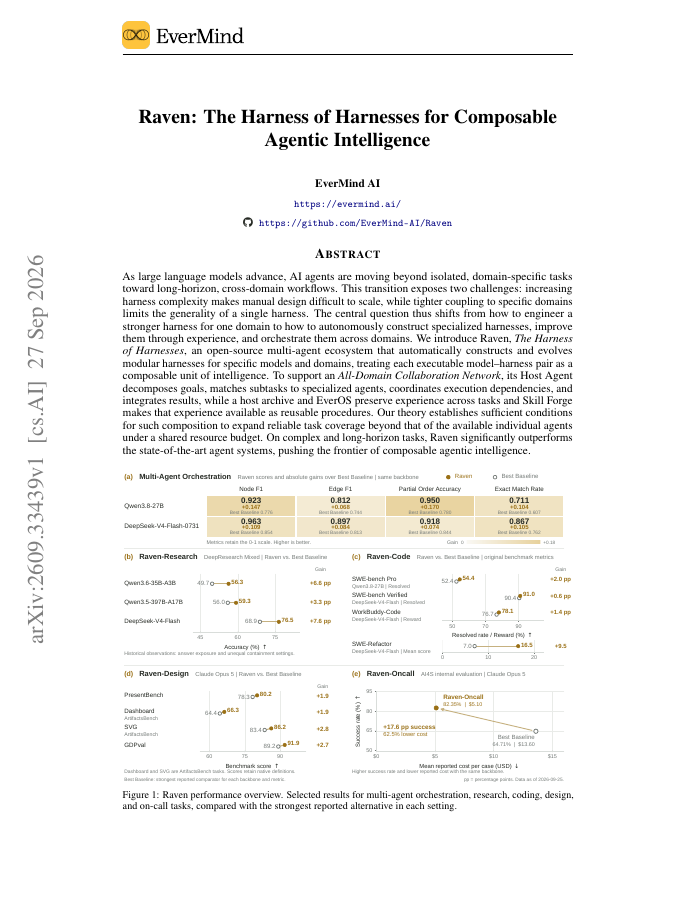
27 Sep 2026
As large language models advance, AI agents are moving beyond isolated, domain-specific tasks toward long-horizon, cross-domain workflows. This transition exposes two challenges: increasing harness complexity makes manual design difficult to scale, while tighter coupling to…
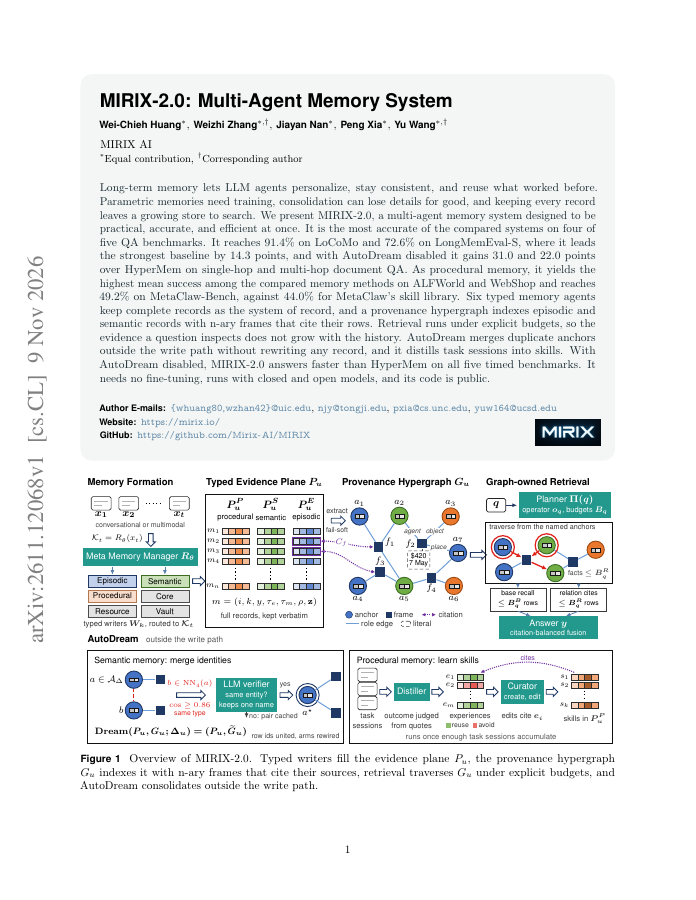
9 Nov 2026
Long-term memory lets LLM agents personalize, stay consistent, and reuse what worked before. Parametric memories need training, consolidation can lose details for good, and keeping every record leaves a growing store to search.
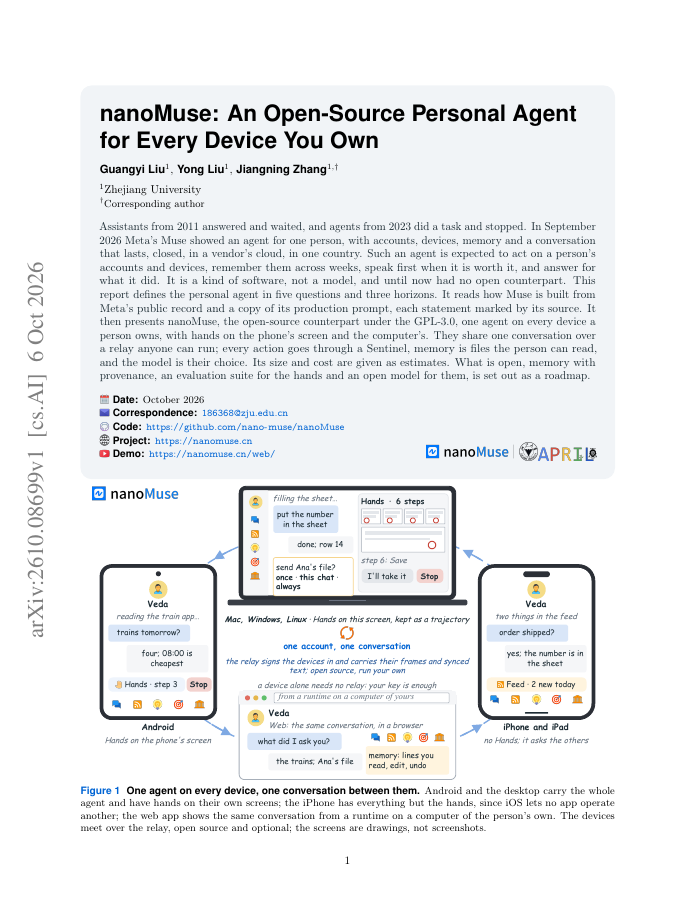
6 Oct 2026
Assistants from 2011 answered and waited, and agents from 2023 did a task and stopped. In September 2026 Meta's Muse showed an agent for one person, with accounts, devices, memory and a conversation that lasts, closed, in a vendor's cloud, in one country.
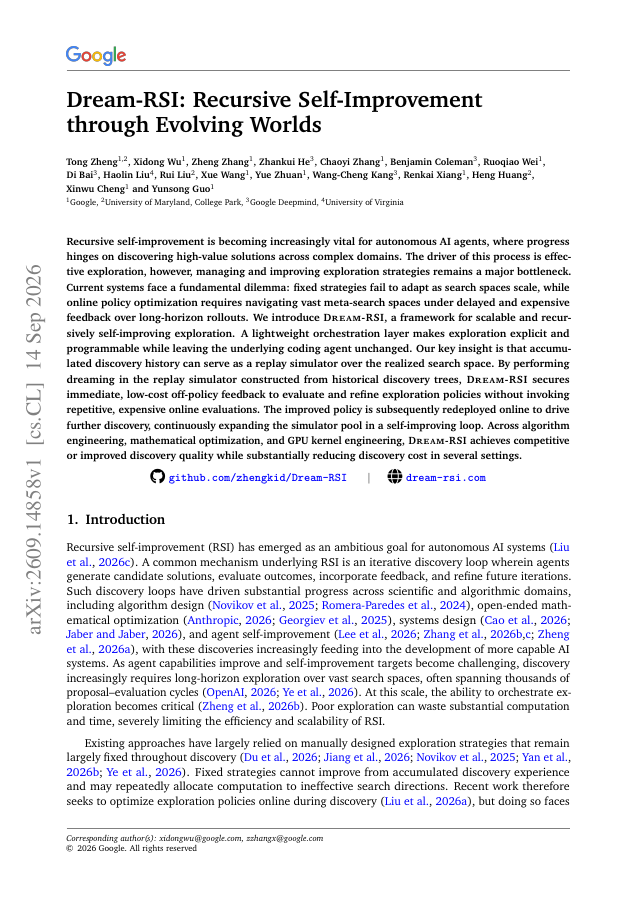
14 Sep 2026
Recursive self-improvement is becoming essential for autonomous AI agents, whose progress depends on discovering high-value solutions across complex domains. Effective exploration drives this process, yet managing and improving exploration strategies remains a major bottleneck.
14 Sep 2026
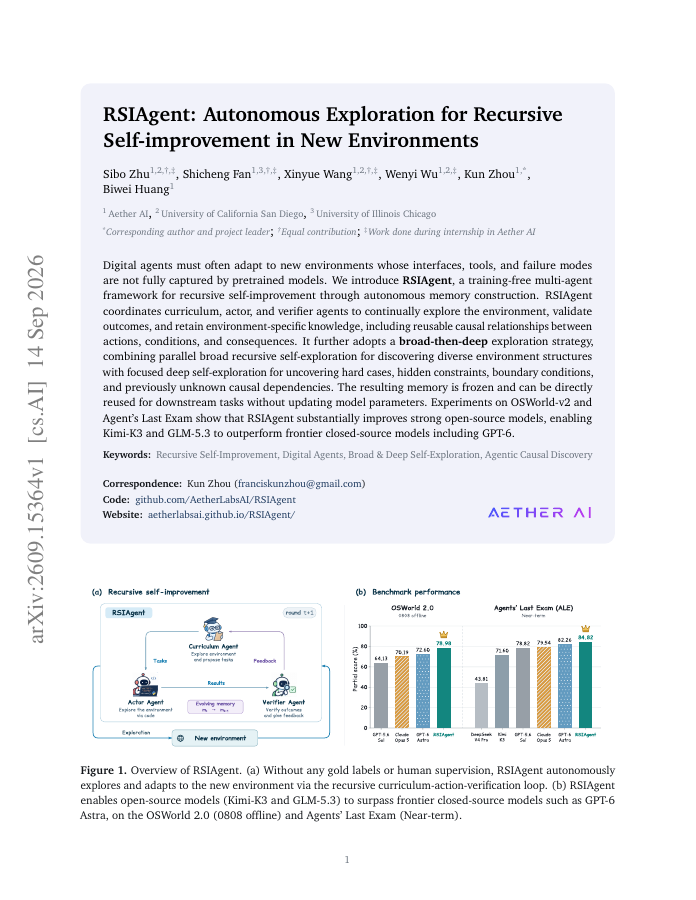
Digital agents must often adapt to new environments whose interfaces, tools, and failure modes are not fully captured by pretrained models. We introduce \textbf{RSIAgent}, a training-free multi-agent framework for recursive self-improvement through autonomous memory…
19 Oct 2026
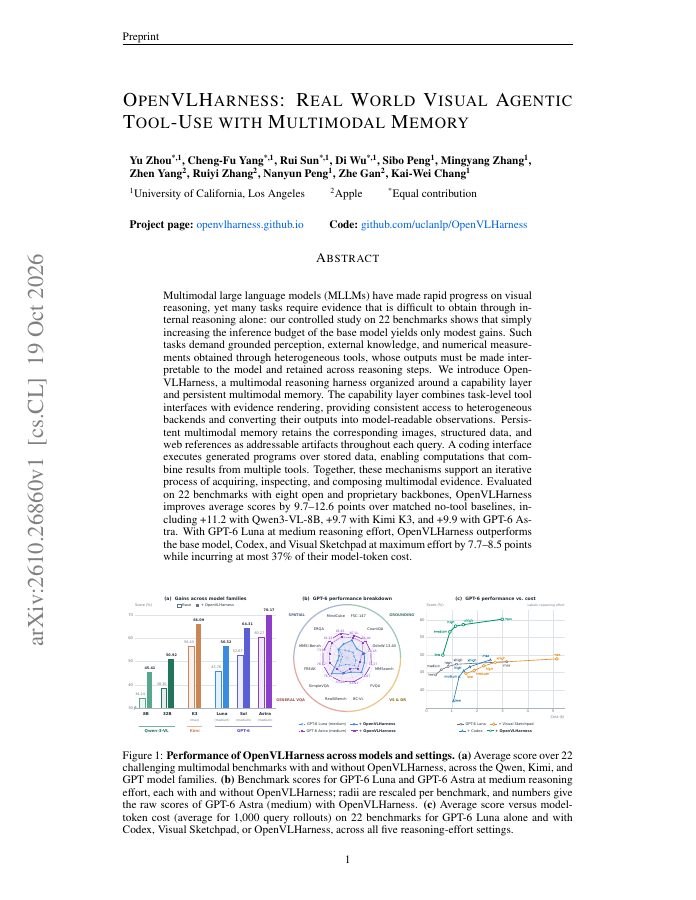
Multimodal large language models (MLLMs) have made rapid progress on visual reasoning, yet many tasks require evidence that is difficult to obtain through internal reasoning alone: our controlled study on 22 benchmarks shows that simply increasing the inference budget of the…
18 Jun 2026
Agent benchmarks are growing fast, but no single benchmark touches more than four or five of the dimensions that deployment exposes. This paper aggregates the largest coordinated deep-dive of one MCP-based industrial-agent benchmark to date: fourteen parallel implementation…
30 Oct 2026
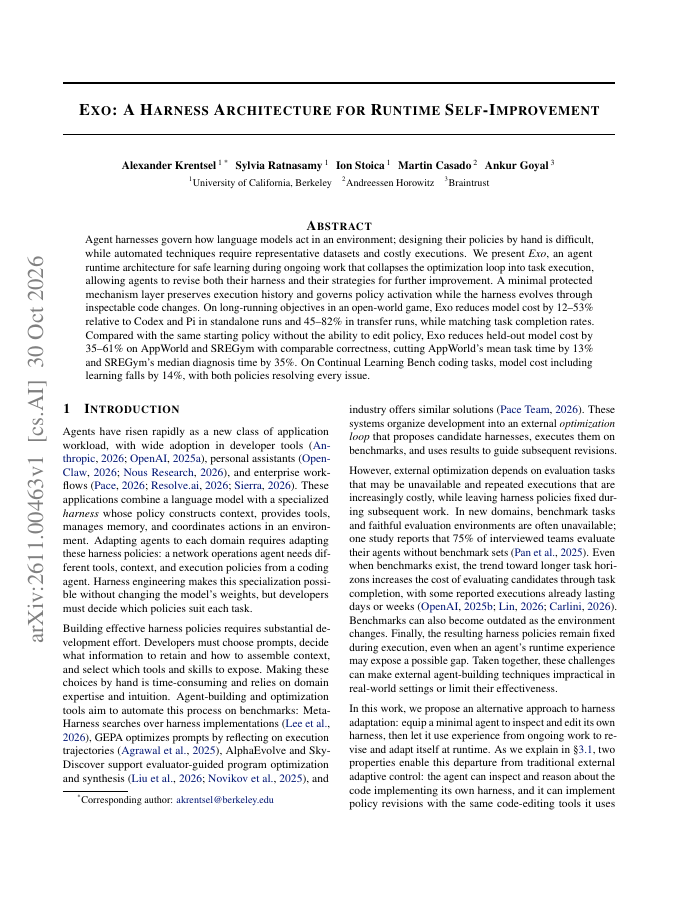
Agent harnesses govern how language models act in an environment; designing their policies by hand is difficult, while automated techniques require representative datasets and costly executions.
20 Oct 2026
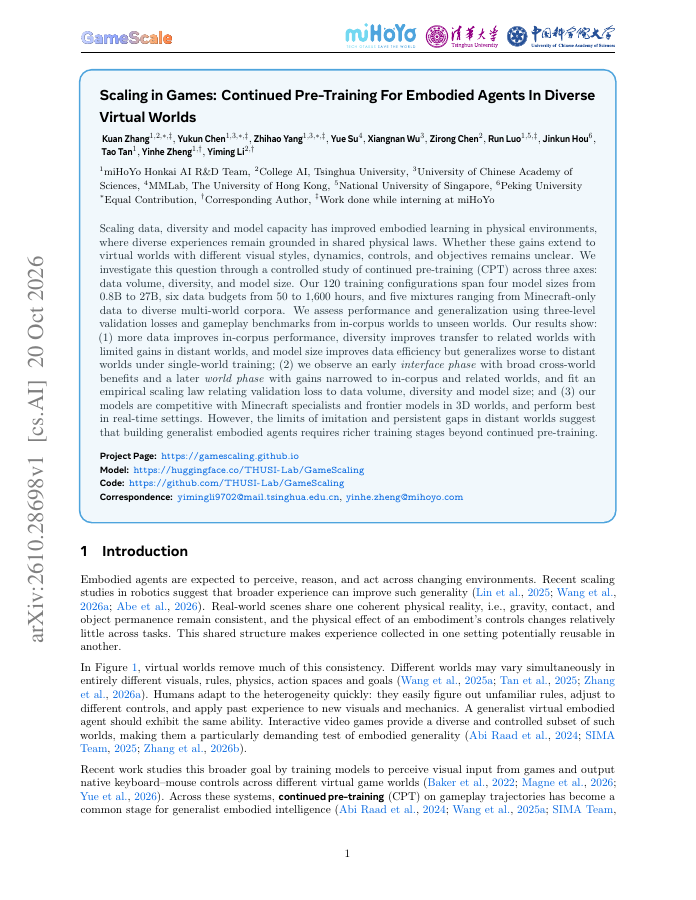
Scaling data, diversity and model capacity has improved embodied learning in physical environments, where diverse experiences remain grounded in shared physical laws. Whether these gains extend to virtual worlds with different visual styles, dynamics, controls, and objectives…
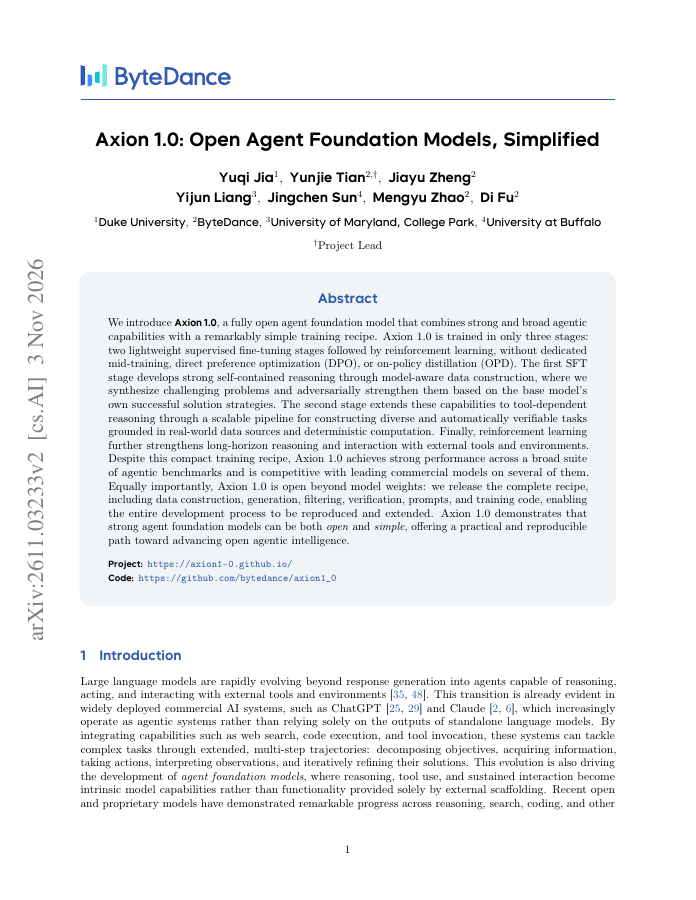
3 Nov 2026
We introduce Axion 1.0, a fully open agent foundation model that combines strong and broad agentic capabilities with a remarkably simple training recipe. Axion 1.0 is trained in only three stages: two lightweight supervised fine-tuning stages followed by reinforcement learning,…
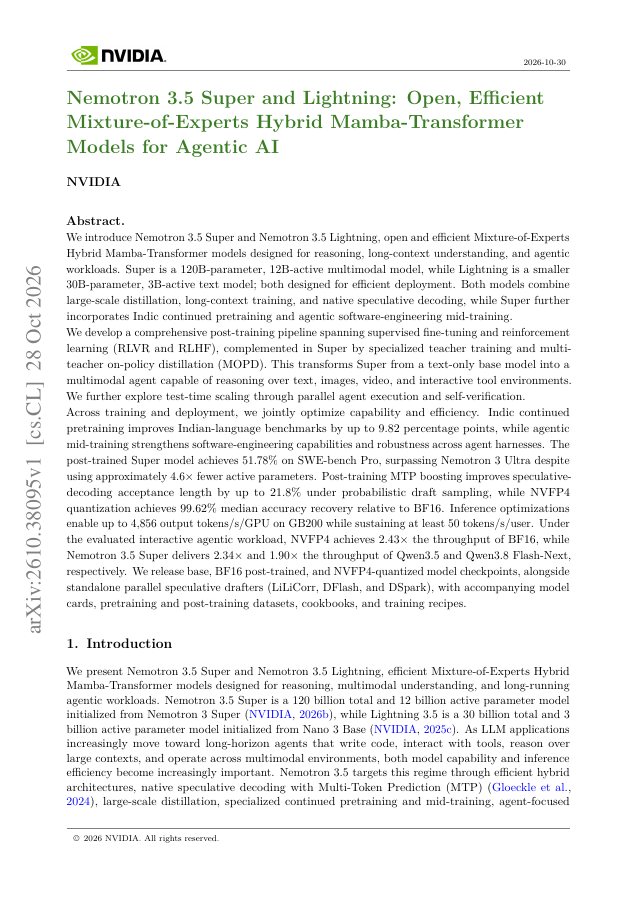
28 Oct 2026
We introduce Nemotron 3.5 Super and Nemotron 3.5 Lightning, open and efficient Mixture-of-Experts Hybrid Mamba-Transformer models designed for reasoning, long-context understanding, and agentic workloads.
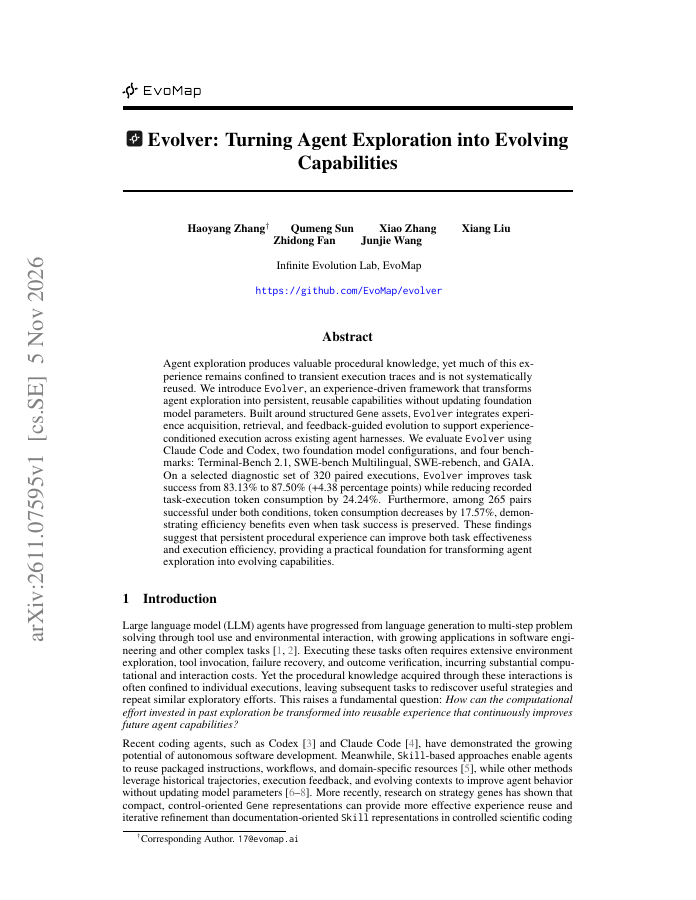
5 Nov 2026
Agent exploration produces valuable procedural knowledge, yet much of this experience remains confined to transient execution traces and is not systematically reused. We introduce Evolver, an experience-driven framework that transforms agent exploration into persistent, reusable…
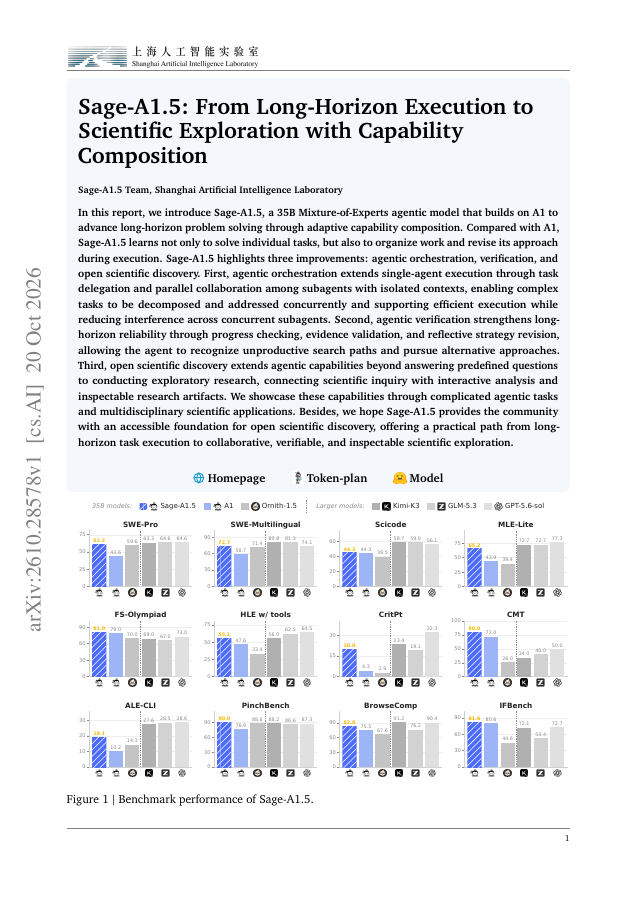
20 Oct 2026
In this report, we introduce Sage-A1.5, a 35B Mixture-of-Experts agentic model that builds on A1 to advance long-horizon problem solving through adaptive capability composition.
12 Nov 2026
Decision models answer a question with a typed output, such as a choice among options with a probability for each, so one model can choose an agent's actions, evaluate actions already taken, or score every action to teach a policy with reinforcement learning.
12 Nov 2026
It is common to train Large Language Models (LLMs) for agentic tasks with Reinforcement Learning (RL) from scalar rewards. However, this throws away the fine-grained information about the environment that the agent experienced during the trial (e.g., error logs).
13 Nov 2026
Previous work has shown that alignment training on individual LLM agents can fail to transfer to multi-agent settings. We investigate the underlying mechanisms for this failure, and explore interventions to preserve alignment transfer to multi-agent LLM teams.
16 Nov 2026
LLM agents answer questions by calling APIs and trusting the results. An API can fail silently. It ignores part of a request, such as a misnamed filter, yet returns HTTP 200 and a plausible but wrong result.