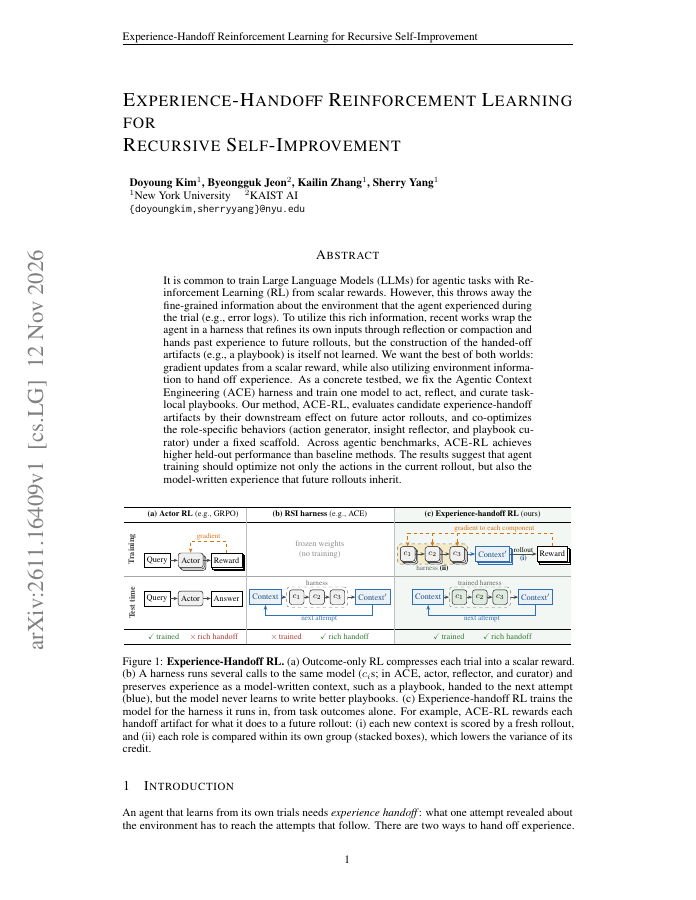
It is common to train Large Language Models (LLMs) for agentic tasks with Reinforcement Learning (RL) from scalar rewards. However, this throws away the fine-grained information about the environment that the agent experienced during the trial (e.g., error logs). To utilize this rich information, recent works wrap the agent in a harness that refines its own inputs through reflection or compaction and hands past experience to future rollouts, but the construction of the handed-off artifacts (e.g., a playbook) is itself not learned. We want the best of both worlds: gradient updates from a scalar reward, while also utilizing environment information to hand off experience. As a concrete testbed, we fix the Agentic Context Engineering (\ace{}) harness and train one model to act, reflect, and curate task-local playbooks. Our method, \acerl{}, evaluates candidate experience-handoff artifacts by their downstream effect on future actor rollouts, and co-optimizes the role-specific behaviors (action generator, insight reflector, and playbook curator) under a fixed scaffold. Across agentic benchmarks, \acerl{} achieves higher held-out performance than baseline methods. The results suggest that agent training should optimize not only the actions in the current rollout, but also the model-written experience that future rollouts inherit.
Experience-Handoff Reinforcement Learning for Recursive Self-Improvement
It is common to train Large Language Models (LLMs) for agentic tasks with Reinforcement Learning (RL) from scalar rewards. However, this throws away the fine-grained information about the environment that the agent experienced during the trial (e.g., error logs).
- Preview
- Year
- 2026
- Stars
- 3
- Hosting
- Full text hostedCC-BY-4.0
Cite
Notes
Only stored in your browser.
Attribution
- Abstract & full text
- arxiv.org/abs/2611.16409CC-BY-4.0
- TL;DR
- Semantic Scholar