22 Jun 2026
AI agents are driving a new software paradigm, with the ability to autonomously call tools, extract information, manage memory, and complete tasks that span applications and data sources.
Trending research and the full catalog - each paper linked to the benchmarks, methods, and models it introduces.
22 Jun 2026
AI agents are driving a new software paradigm, with the ability to autonomously call tools, extract information, manage memory, and complete tasks that span applications and data sources.
Jiacheng Liu, Xiaohan Zhao, Xinyi Shang et al. · 14 Apr 2026
Claude Code is an agentic coding tool that can run shell commands, edit files, and call external services on behalf of the user.
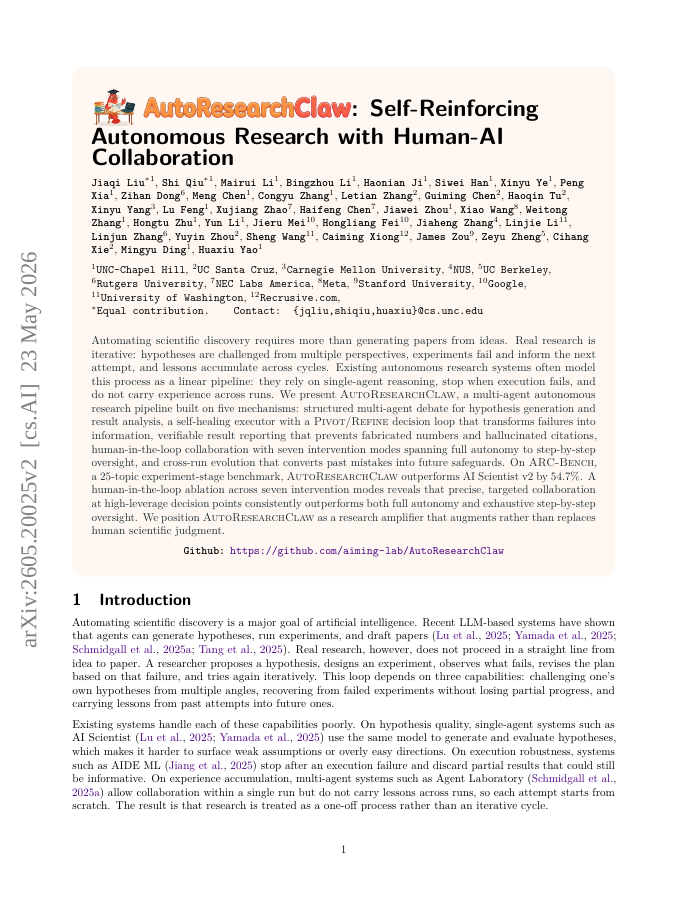
Caiming Xiong, Xiao Wang, Jiaqi Liu et al. · 19 May 2026
Automating scientific discovery requires more than generating papers from ideas.
26 May 2026
We introduce the MiniMax-M2 series, a family of Mixture-of-Experts language models built around the principle that mini activations can unleash maximum real-world intelligence. The flagship M2 contains 229.9B total parameters with only 9.8B activated per token.
Lin Chen, Zhen Fang, Wenxuan Huang et al. · 19 Apr 2026
As the capability frontier of autonomous agents continues to expand, they are increasingly able to complete specialized tasks through plug-and-play external skills.
17 Jun 2026
Memory benchmarks for LLM agents largely assume single-user settings, leaving shared assistants for hospitals, workplaces, campuses, and households understudied. In these deployments, multiple principals write to a common memory pool and query it under different roles, scopes,…
Zheng Liu, Hao Li, Qian Yu et al. · 28 Apr 2026
Autonomous scientific research is significantly advanced thanks to the development of AI agents.
Andy Konwinski, Etash Guha, John Yang et al. · 17 Jan 2026
AI agents may soon become capable of autonomously completing valuable, long-horizon tasks in diverse domains.
10 Jun 2026
Scientific progress depends on a repeated loop of exploration, experimentation, and abstraction. Researchers test candidate directions, interpret the evidence, and carry the resulting lessons into later attempts.
28 May 2026
AI coding agents are increasingly used for scientific work, but their end-to-end autonomous research capability remains difficult to verify. We present ResearchClawBench, a benchmark for evaluating autonomous scientific research across 40 tasks from 10 scientific domains.
15 Jun 2026
As LLM agents become capable of increasingly long-horizon tasks, evaluating their performance in economic systems is becoming increasingly important. Unlike existing benchmarks that primarily evaluate a single agent interacting with a passive environment, economic systems are…
3 Jun 2026
Recent AI systems have achieved strong results on a wide range of benchmarks, yet these gains have not translated into economically meaningful deployment across many professional domains.
12 Jun 2026
We introduce Nemotron 3 Ultra, a 550 billion total and 55 billion active parameter Mixture-of-Experts Hybrid Mamba-Attention language model. We pre-trained Nemotron 3 Ultra on 20 trillion text tokens, then extended the context length to 1M tokens, and post-trained using…
1 Jun 2026
In open-ended environments, exploration is fundamental for autonomous agents, yet current language model agents struggle with this. Effective exploration requires memory, but retaining raw interaction histories is computationally expensive over long trajectories.
22 Jun 2026
Enterprise agents increasingly operate inside workspaces: they read heterogeneous files, invoke tools, and deliver business artifacts. We introduce EnterpriseClawBench, an enterprise agent benchmark constructed from proprietary, real-world agent sessions.
24 Jun 2026
Tool Calling and Structured Output are two core capabilities of modern Agent systems, yet their interaction under joint deployment conditions remains insufficiently understood.