20 Oct 2026
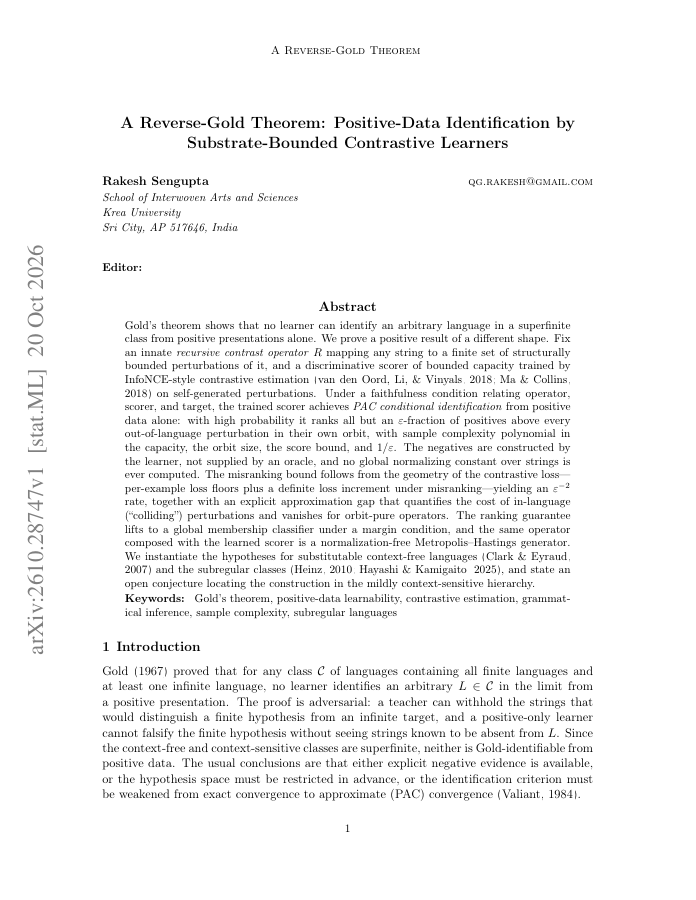
Gold's theorem shows that no learner can identify an arbitrary language in a superfinite class from positive presentations alone. We prove a positive result of a different shape.
Trending research and the full catalog - each paper linked to the benchmarks, methods, and models it introduces.
Filtering here covers the 2,000 most recent papers, as much as one page can hold in memory. See the full index of 22,841 papers.
20 Oct 2026
Gold's theorem shows that no learner can identify an arbitrary language in a superfinite class from positive presentations alone. We prove a positive result of a different shape.
20 Oct 2026
Structural Causal Models (SCMs) provide a principled framework for observational, interventional, and counterfactual reasoning, all of which rely on probabilistic inference.
20 Oct 2026
Systems for code-mixed (CM) text and speech rarely start from scratch. CM data is scarce, so most work borrows from the languages being mixed, which we call native languages. This transfer can also run in reverse, when CM data is used to improve models for the native languages.
20 Oct 2026
Watermarking has emerged as a key tool for identifying text generated by large language models (LLMs), with current schemes embedding statistical signals into the generation process to enable later detection.
19 Oct 2026
Mixture-of-Experts (MoE) have become a mainstream way to scale Large Language Models (LLMs), because each token activates only a small subset of experts, reducing inference cost.
19 Oct 2026
We study the gradient flow training dynamics of two-layer multi-layer perceptrons (MLPs) on anisotropic Gaussian data. Even in this simple setting, solving the dynamics in full is notoriously difficult, so we try something different.
19 Oct 2026
Before language models are released, they are tested for harmful traits such as willingness to carry out dangerous requests, deception, power seeking, and sycophancy. The safe behavior these tests certify may degrade as models are modified, by topical fine-tuning, new training…
19 Oct 2026
Deployed vision models auto-accept confident predictions, so high-confidence errors propagate silently. Maximum Softmax Probability (MSP), the standard failure predictor, has a structural blind spot: as a scalar read from the classifier head, it is first-order blind to feature…
19 Oct 2026
Large language models are increasingly asked to shop on a user's behalf, which lets seller-controlled content such as badges, endorsements, and framing steer what they recommend.
19 Oct 2026
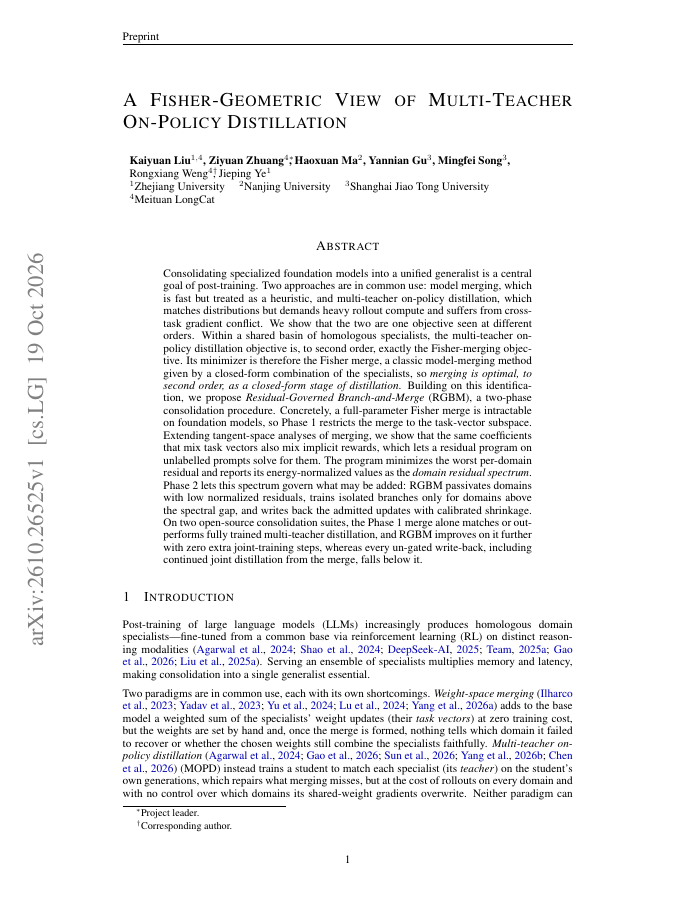
Consolidating specialized foundation models into a unified generalist is a central goal of post-training. Two approaches are in common use: model merging, which is fast but treated as a heuristic, and multi-teacher on-policy distillation, which matches distributions but demands…
19 Oct 2026
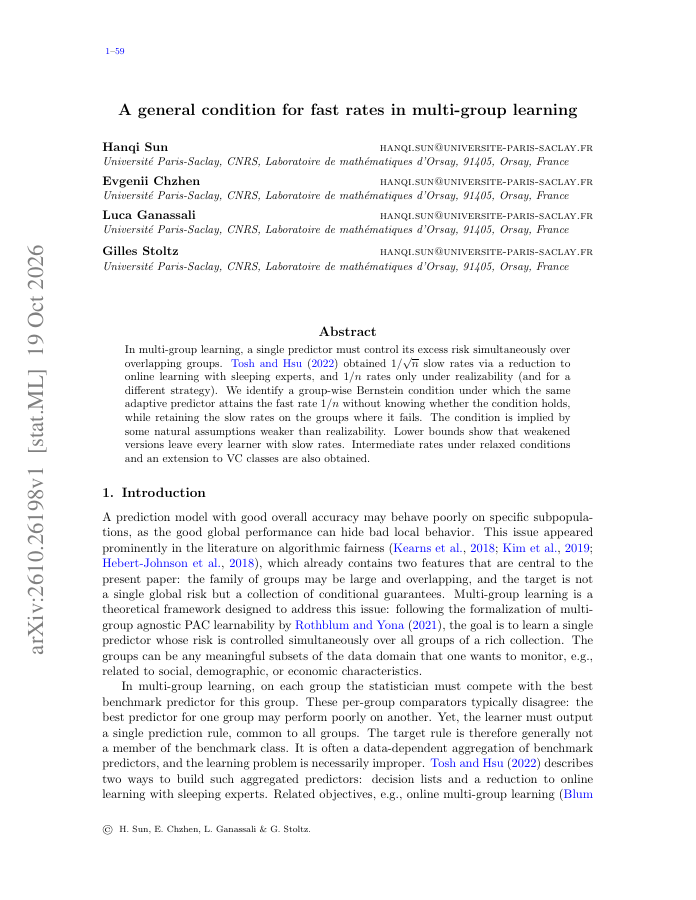
In multi-group learning, a single predictor must control its excess risk simultaneously over overlapping groups. Tosh and Hsu (2022) obtained $1/\sqrt{n}$ slow rates via a reduction to online learning with sleeping experts, and $1/n$ rates only under realizability (and for a…
19 Oct 2026
Earth observation satellites acquire more data than they can downlink. Extracting information on board with artificial intelligence (AI) turns the satellite into a data-reduction stage that downlinks compact products, such as masks or detections, instead of full scenes;…
19 Oct 2026
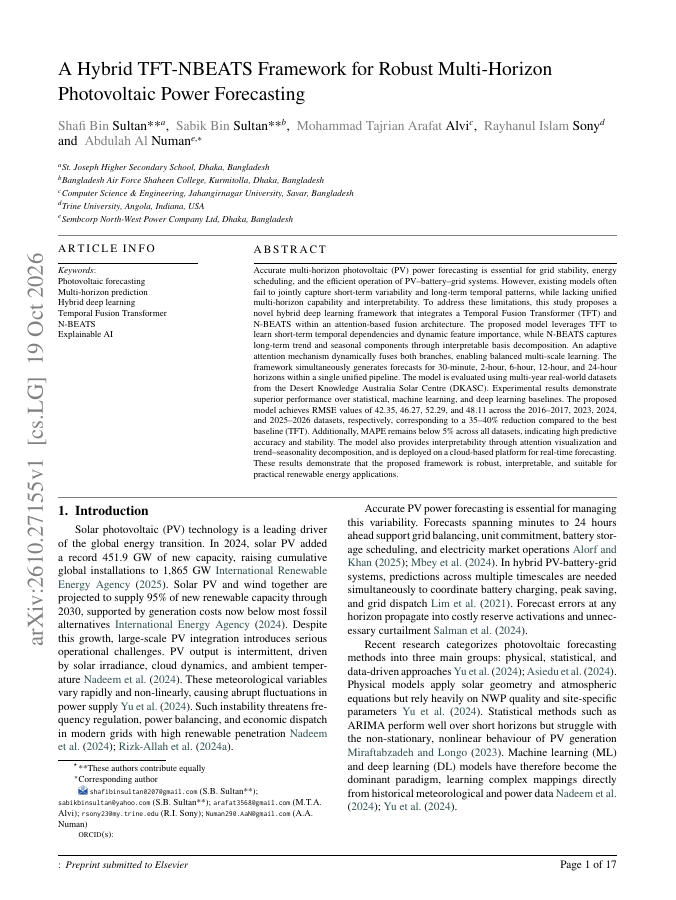
Accurate multi-horizon photovoltaic (PV) power forecasting is essential for grid stability, energy scheduling, and the efficient operation of PVbatterygrid systems. However, existing models often fail to jointly capture short-term variability and long-term temporal patterns,…
19 Oct 2026
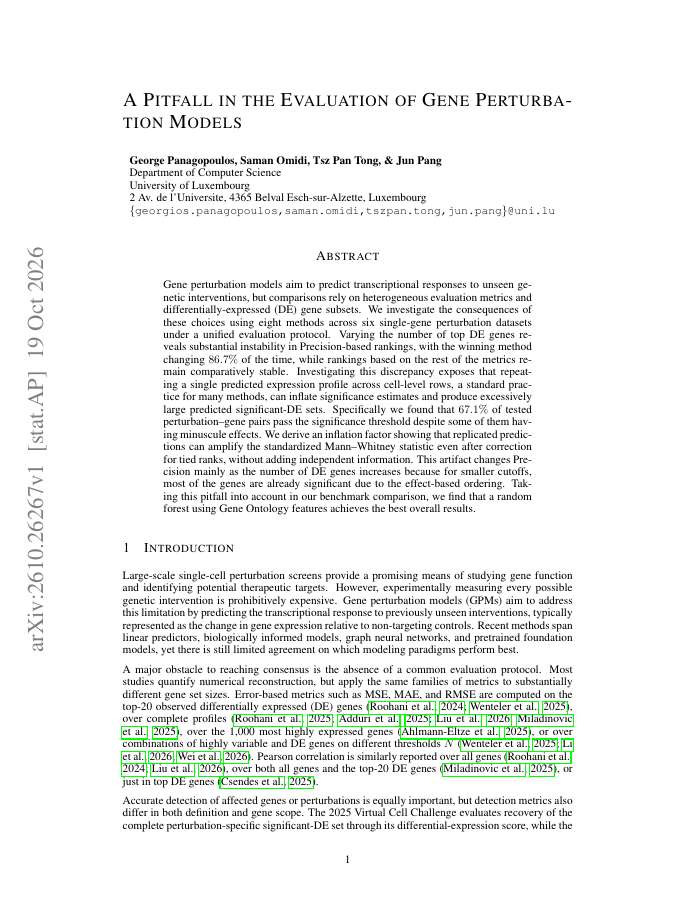
Gene perturbation models aim to predict transcriptional responses to unseen genetic interventions, but comparisons rely on heterogeneous evaluation metrics and differentially-expressed (DE) gene subsets.
19 Oct 2026
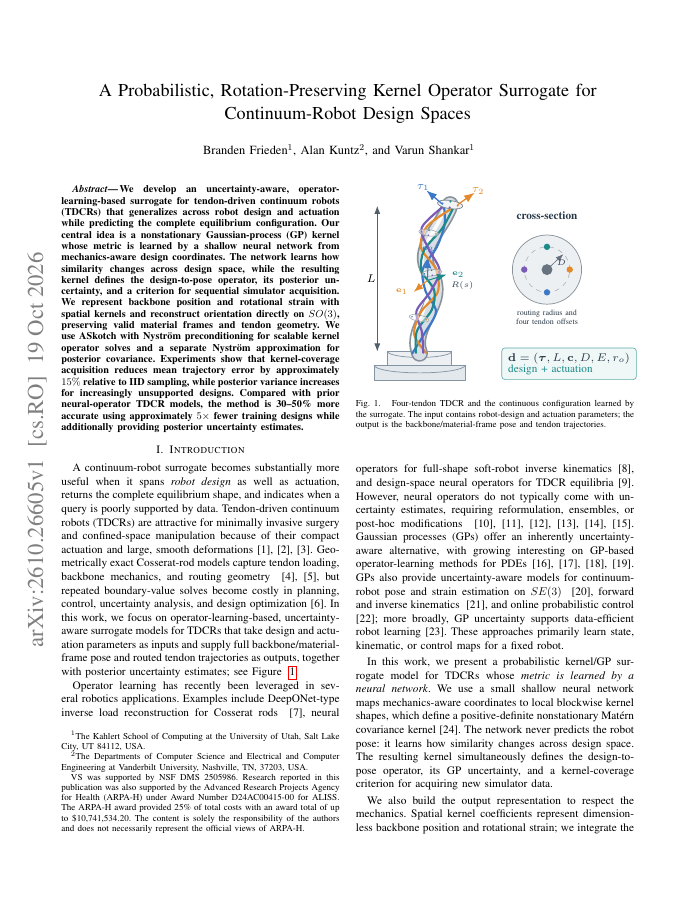
We develop an uncertainty-aware, operator-learning-based surrogate for tendon-driven continuum robots (TDCRs) that generalizes across robot design and actuation while predicting the complete equilibrium configuration.
19 Oct 2026
Knowledge graphs (KGs) are increasingly used in autonomous driving (AD) to make traffic scene entities and relations explicit for prediction and reasoning. Existing traffic-scene KGs, however, primarily emphasize trajectory forecasting or general scene understanding.
19 Oct 2026
This paper considers the Bayesian top-$k$ identification problem, wherein a decision maker is tasked with selecting $k$ items from a pool of items of unknown quality. To assess the items, the decision maker adaptively allocates a fixed sampling budget, where each sample of an…
19 Oct 2026
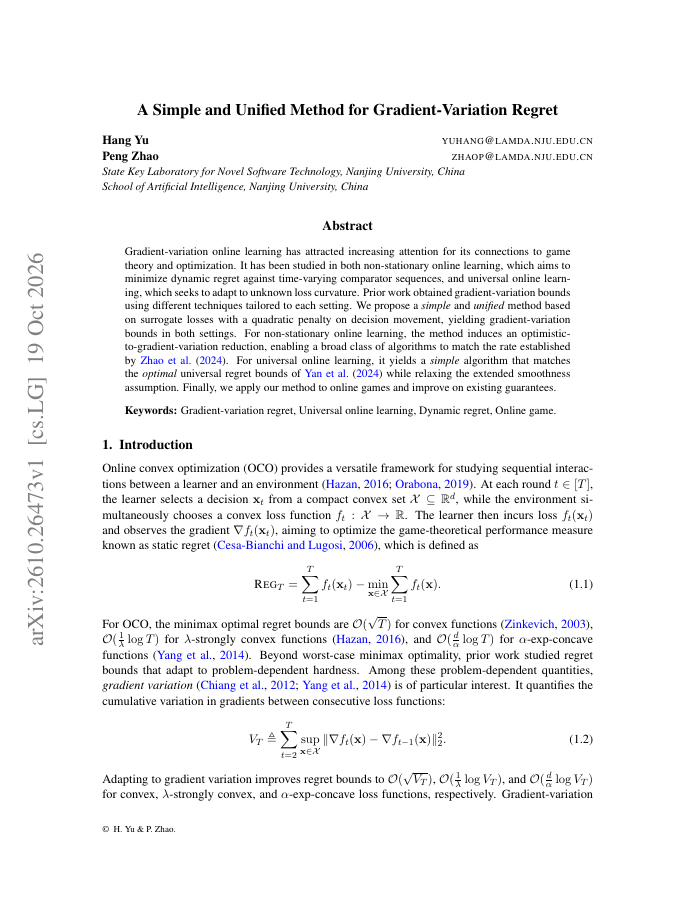
Gradient-variation online learning has attracted increasing attention for its connections to game theory and optimization. It has been studied in both non-stationary online learning, which aims to minimize dynamic regret against time-varying comparator sequences, and universal…
19 Oct 2026
Query clarification is essential for retrieval-augmented generation (RAG) systems that face ambiguous user queries. We consider multi-turn grounded conversational scenarios where a user query is either ill-formed or ambiguous in the context of the prior dialog or, more…
19 Oct 2026
Continual vision-language models (VLMs) encounter a stream of environments and must also reject inputs that do not belong to the environment at hand. Class information from earlier environments can aid out-of-distribution (OOD) detection, yet existing detectors score each…
18 Oct 2026
This paper presents an original mathematical and computational framework for modeling the efficacy of methylphenidate as an optimal control policy acting on the nonlinear dynamics of attention deficit hyperactivity disorder.
18 Oct 2026
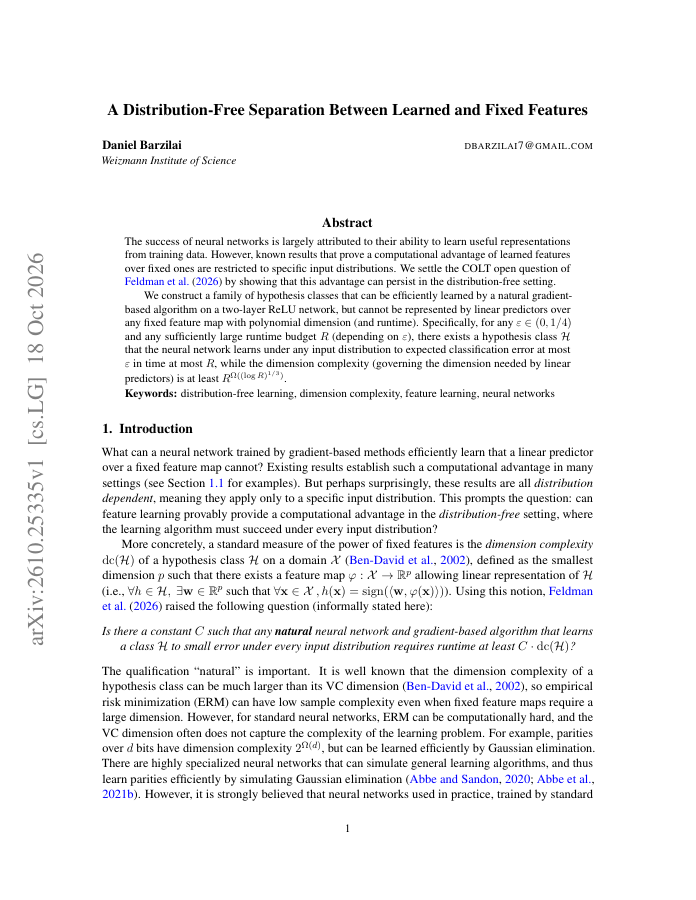
The success of neural networks is largely attributed to their ability to learn useful representations from training data. However, known results that prove a computational advantage of learned features over fixed ones are restricted to specific input distributions.
18 Oct 2026
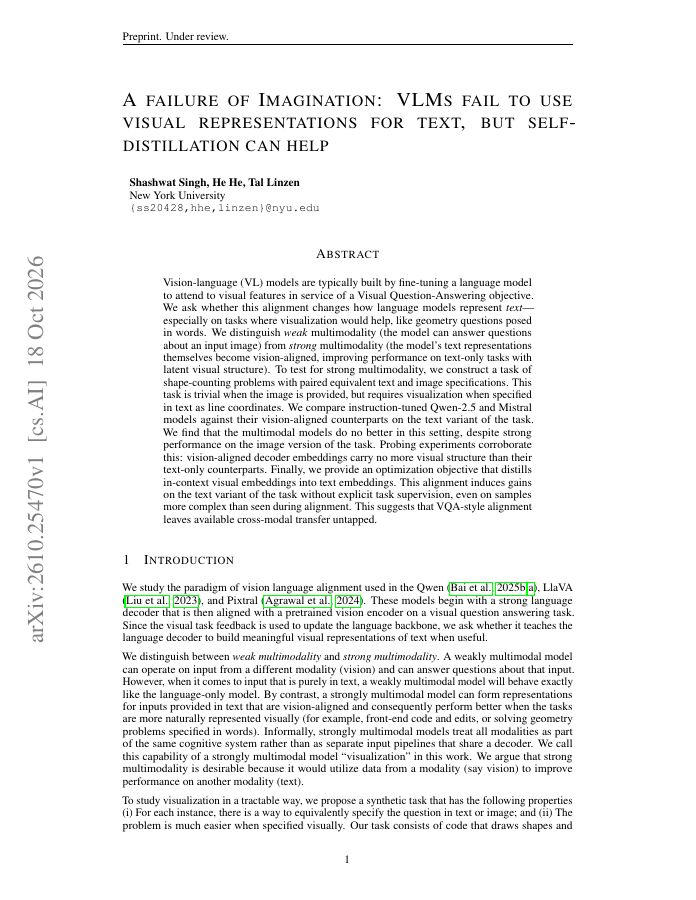
Vision-language (VL) models are typically built by fine-tuning a language model to attend to visual features in service of a Visual Question-Answering objective. We ask whether this alignment changes how language models represent text---especially on tasks where visualization…
18 Oct 2026
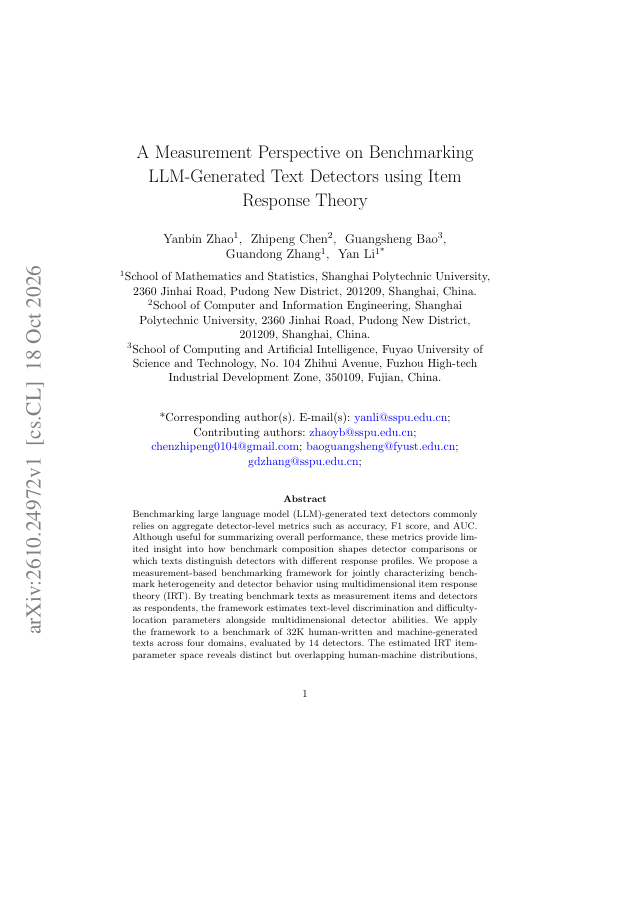
Benchmarking large language model (LLM)-generated text detectors commonly relies on aggregate detector-level metrics such as accuracy, F1 score, and AUC. Although useful for summarizing overall performance, these metrics provide limited insight into how benchmark composition…