10 Sep 2026
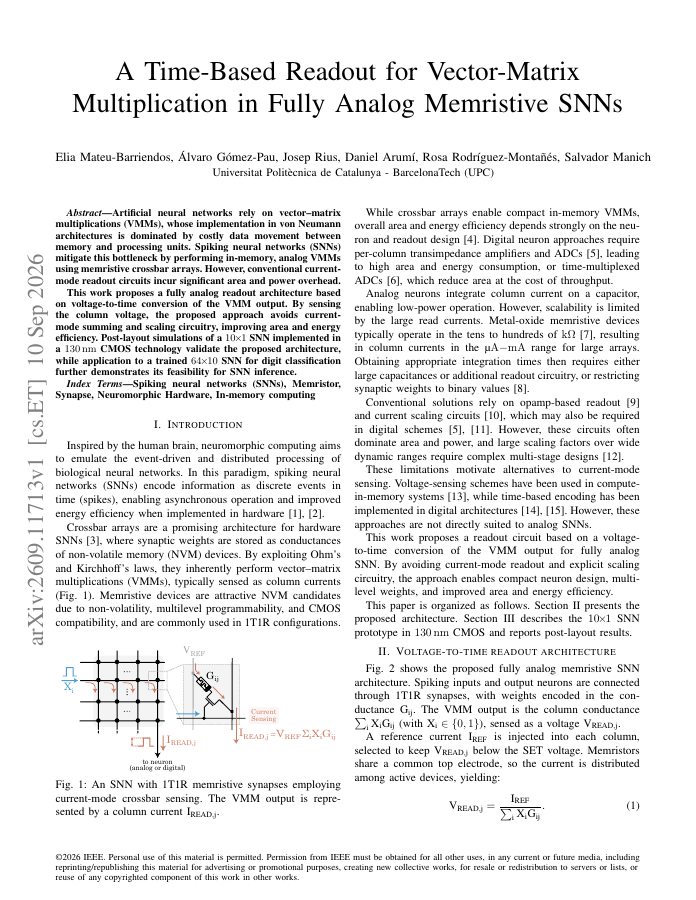
Artificial neural networks rely on vector-matrix multiplications (VMMs), whose implementation in von Neumann architectures is dominated by costly data movement between memory and processing units.
Trending research and the full catalog - each paper linked to the benchmarks, methods, and models it introduces.
Filtering here covers the 2,000 most recent papers, as much as one page can hold in memory. See the full index of 22,712 papers.
10 Sep 2026
Artificial neural networks rely on vector-matrix multiplications (VMMs), whose implementation in von Neumann architectures is dominated by costly data movement between memory and processing units.
10 Sep 2026
High-dimensional dense text embeddings and large language models face real obstacles in financial-disclosure analysis: context-window limits, hallucination risk, high computational cost, and the arbitrary rotation of vector spaces across independently trained models.
10 Sep 2026
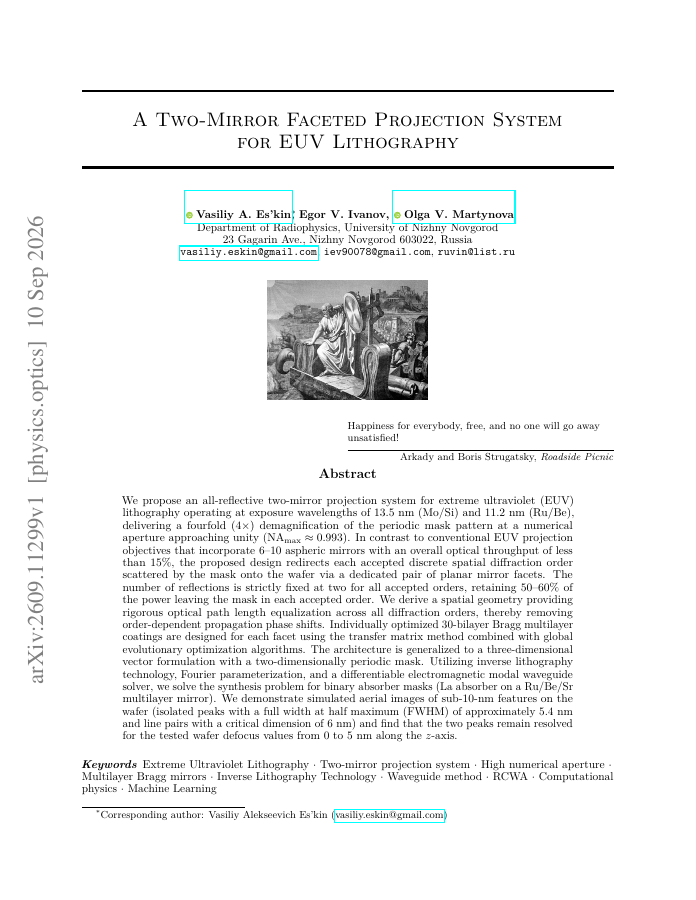
We propose an all-reflective two-mirror projection system for extreme ultraviolet (EUV) lithography operating at exposure wavelengths of $13.5$~nm (Mo/Si) and $11.2$~nm (Ru/Be), delivering a fourfold ($4\times$) demagnification of the periodic mask pattern at a numerical…
10 Sep 2026
Per-token gating of forward/reverse KL losses has become a standard technique for on-policy knowledge distillation (OPD), but existing methods such as EOPD (Jin et al., 2026) and ToDi (Jung et al., 2025) each fix a single gating signal and a single gating direction, and the two…
10 Sep 2026
This paper presents SurgicalRoomAgent, a voice-interactive multi-agent system for smart operating rooms based on large language models (LLMs). The system achieves natural language understanding, device control, intraoperative recording, and surgical report generation through a…
9 Sep 2026
The advance of multimodal large language models (MLLMs) has fundamentally reshaped the paradigm of human-computer interaction, especially speech interaction models capable of seamless conversations.
9 Sep 2026
Large language models (LLMs) now show strong reasoning and coding abilities, raising the prospect that they could assist in developing and optimizing the very infrastructure that powers them.
9 Sep 2026
Large Language Models (LLMs) have achieved remarkable progress across natural language processing (NLP) tasks, yet their capabilities degrade sharply for low-resource languages and dialectally diverse settings.
9 Sep 2026
In continual reinforcement learning, carefully managing the stability-plasticity tradeoff remains a core challenge. Recent work by Abel et al. (2025) formalized this dilemma by defining plasticity as the generalized directed information from an agent's observations to its…
9 Sep 2026
Sparse autoencoders (SAEs) are increasingly used to recover interpretable features from neural-network activations, yet systematic feature co-occurrence can cause distinct features to be absorbed or merged.
9 Sep 2026
In the kernel regime, neural-network learning inherits its preferences from a frozen spectrum. During feature learning, this spectrum evolves, yet networks retain systematic biases toward simple, smooth directions.
9 Sep 2026
The small-sample-size (SSS) problem remains a fundamental challenge in machine learning when labeled data are scarce due to cost, accessibility, or ethical constraints. While numerous approaches have been proposed, existing methods often struggle to maintain stable and…
9 Sep 2026
Time-series foundation models are evaluated almost exclusively on public archives that predate them, so a strong score cannot be separated from having seen the test set during pretraining. The obvious remedy is a hold-out that postdates the models.
9 Sep 2026
The Abstraction and Reasoning Corpus (ARC) benchmarks cognitive generalization, the ability to infer and apply abstract rules from limited examples. This paper presents a multi-stage rule-chaining framework that performs compositional reasoning across symbolic, structural, and…
9 Sep 2026
We prove the gap-entropy conjecture for fixed-confidence best-arm identification with independent unit-variance Gaussian arms, means in $[0,1]$, and a unique optimal arm.
9 Sep 2026
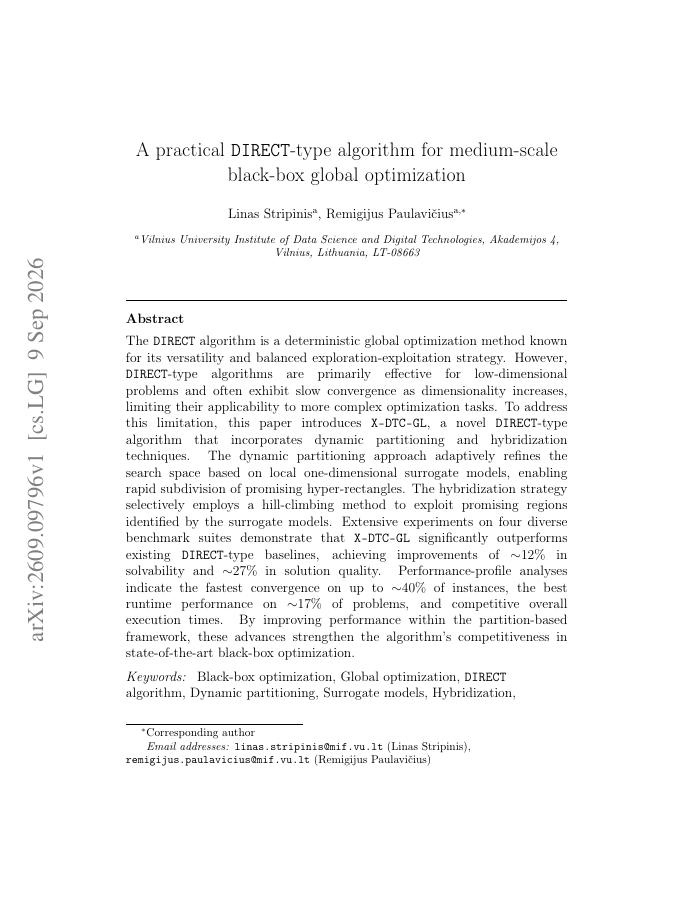
The DIRECT algorithm is a deterministic global optimization method known for its versatility and balanced exploration-exploitation strategy. However, DIRECT-type algorithms are primarily effective for low-dimensional problems and often exhibit slow convergence as dimensionality…
9 Sep 2026
Quantum-inspired classical algorithms have dequantized several quantum machine learning routines by replacing quantum linear-algebra subroutines with classical counterparts.
9 Sep 2026
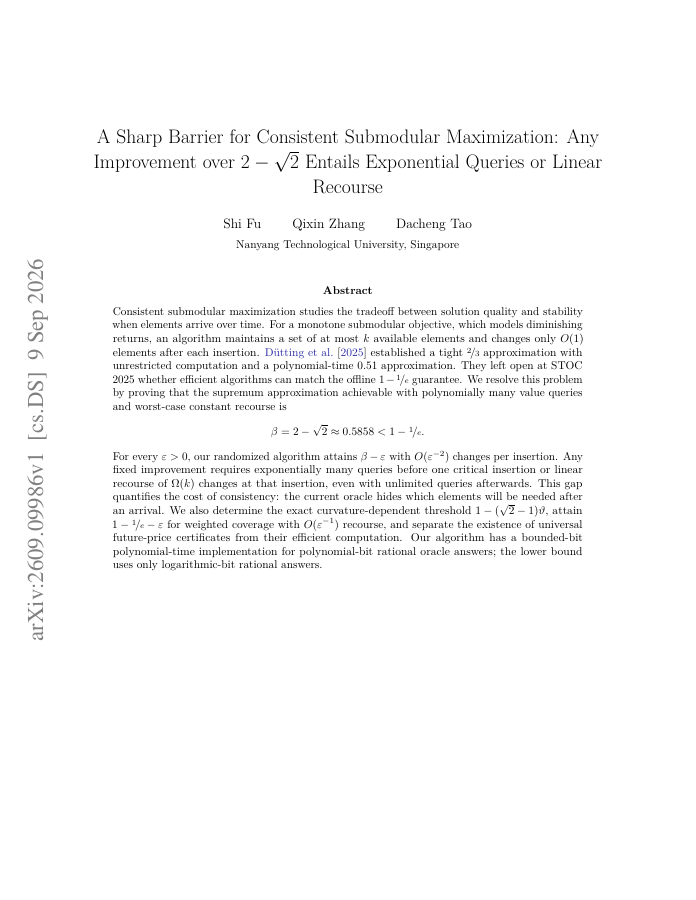
Consistent submodular maximization studies the tradeoff between solution quality and stability when elements arrive over time. For a monotone submodular objective, which models diminishing returns, an algorithm maintains a set of at most $k$ available elements and changes only…
9 Sep 2026
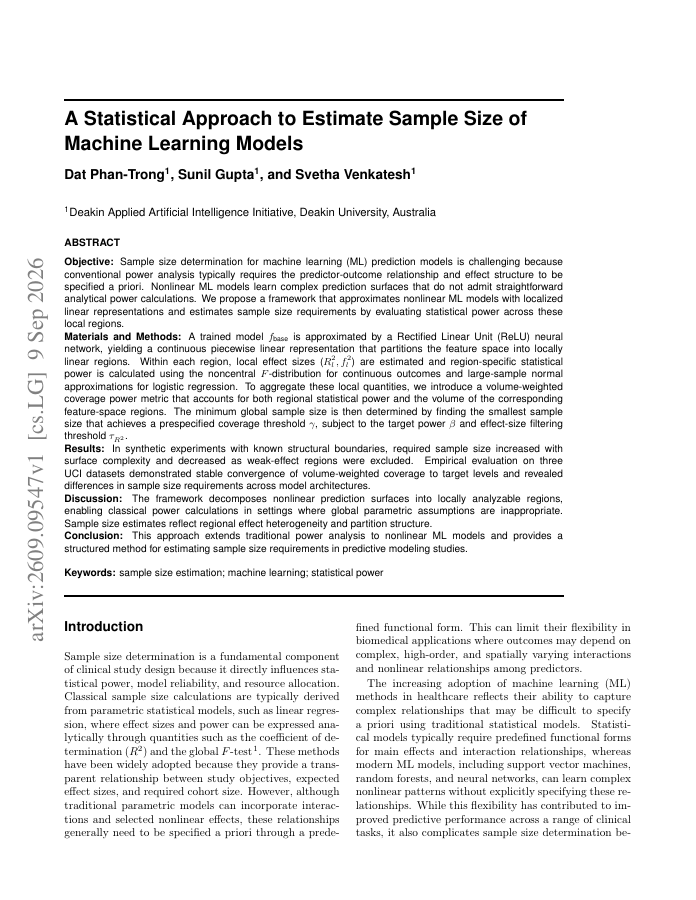
Sample size determination for machine learning (ML) prediction models is challenging because conventional power analysis typically requires the predictor-outcome relationship and effect structure to be specified a priori.
9 Sep 2026
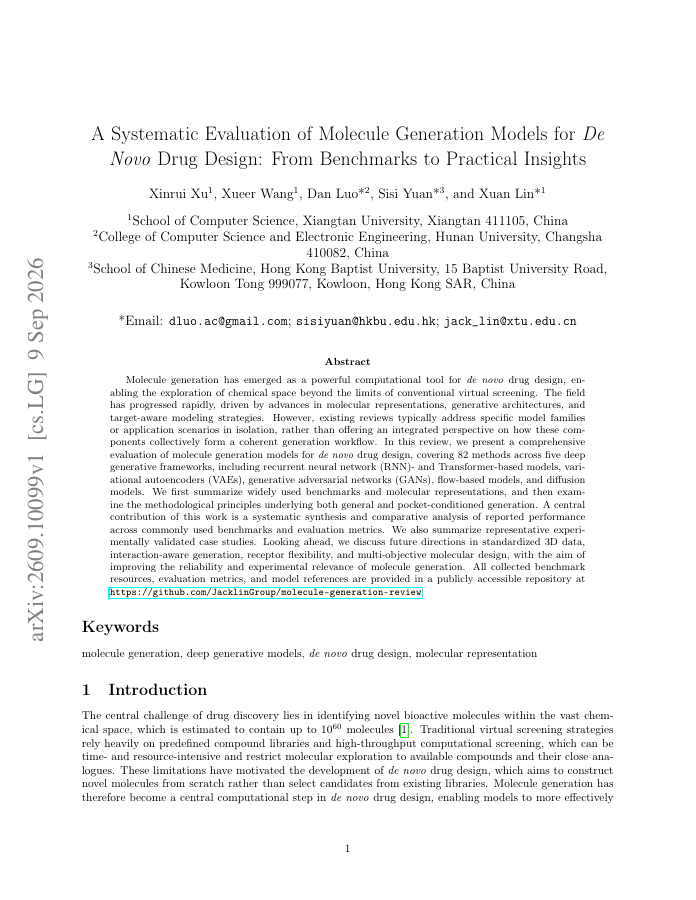
Molecule generation has emerged as a powerful computational tool for de novo drug design, enabling the exploration of chemical space beyond the limits of conventional virtual screening.
9 Sep 2026
Aging clocks quantify biological aging and help characterize individual health status. What protein interactions are important for accurate aging clocks, and are they zeroth-order or higher-order? Addressing these questions requires learning from large molecular datasets…
9 Sep 2026
Although probabilistic statements are ubiquitous, foundational disagreements persist about their understanding, as exemplified by debates between Bayesians and frequentists; moreover, it is unclear when and why acting on them actually leads to desirable outcomes.
9 Sep 2026
Agent developers increasingly compare prompts, tools, policies, and diagnosis algorithms through simulator-grounded verifiers. A verifier can nevertheless make a solver comparison vacuous: if its probes or predicates encode the target identity, an exact optimizer may appear…
8 Sep 2026
Decays of beauty and charm hadrons provide sensitive probes of physics beyond the standard model, including decays with invisible particles, in which part of the final state leaves no reconstructed detector signature.