20 Nov 2026
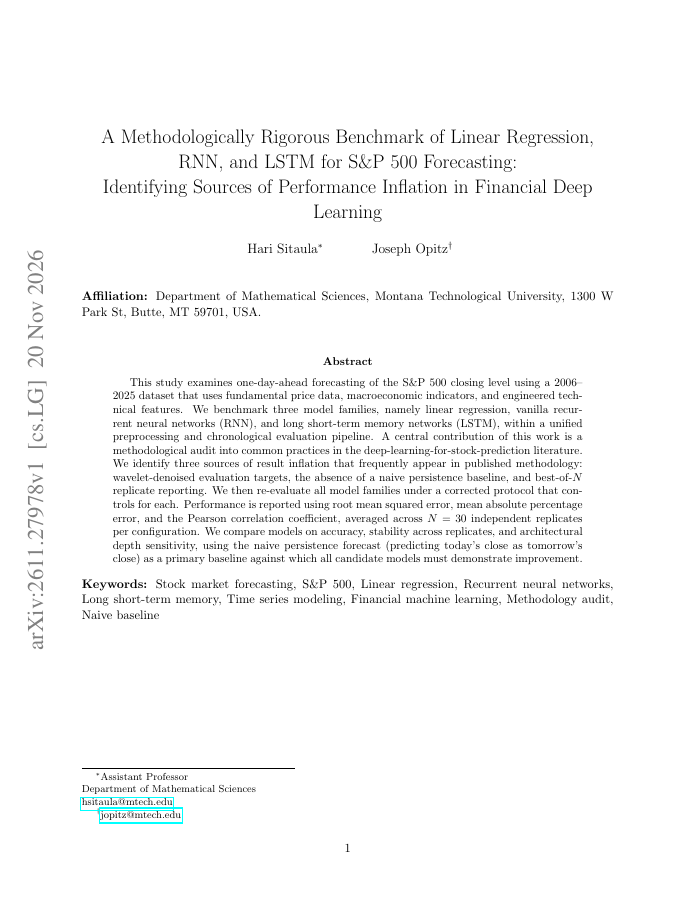
This study examines one-day-ahead forecasting of the S&P 500 closing level using a 2006-2025 dataset that includes fundamental price data, macroeconomic indicators, and engineered technical features.

Trending research and the full catalog - each paper linked to the benchmarks, methods, and models it introduces.
Filtering here covers the 2,000 most recent papers, as much as one page can hold in memory. See the full index of 23,103 papers.
20 Nov 2026
This study examines one-day-ahead forecasting of the S&P 500 closing level using a 2006-2025 dataset that includes fundamental price data, macroeconomic indicators, and engineered technical features.

20 Nov 2026
Automatic speech recognition (ASR) systems perform strongly on native-English benchmarks, yet their accuracy degrades sharply when the input speech comes from under represented non-native accents.
20 Nov 2026
If we optimize an image until a classifier is confident it shows a cat, we may get an adversarial example, not a cat. Planning with a latent world model is a similar search for actions whose predicted future is closest to the goal.
20 Nov 2026
This paper studies time-varying nonconvex composite optimization, where decisions are made sequentially and classical value-based regret notions are generally ill-posed.
20 Nov 2026
Personalized amplification gains for hearing aids have been shown to be preferred over prescriptive gains. Since the preferred settings can vary depending on the background audio environment, this paper presents a switching mechanism or system that automatically selects…
19 Nov 2026
Three-dimensional point clouds are a fundamental data modality, and a large family of machine learning architectures has been developed to respect their natural symmetries to rigid motions and permutations.
19 Nov 2026
Backpropagation remains the dominant method for training deep neural networks, but its reliance on non-local computations has motivated the search for biologically plausible alternatives.
19 Nov 2026
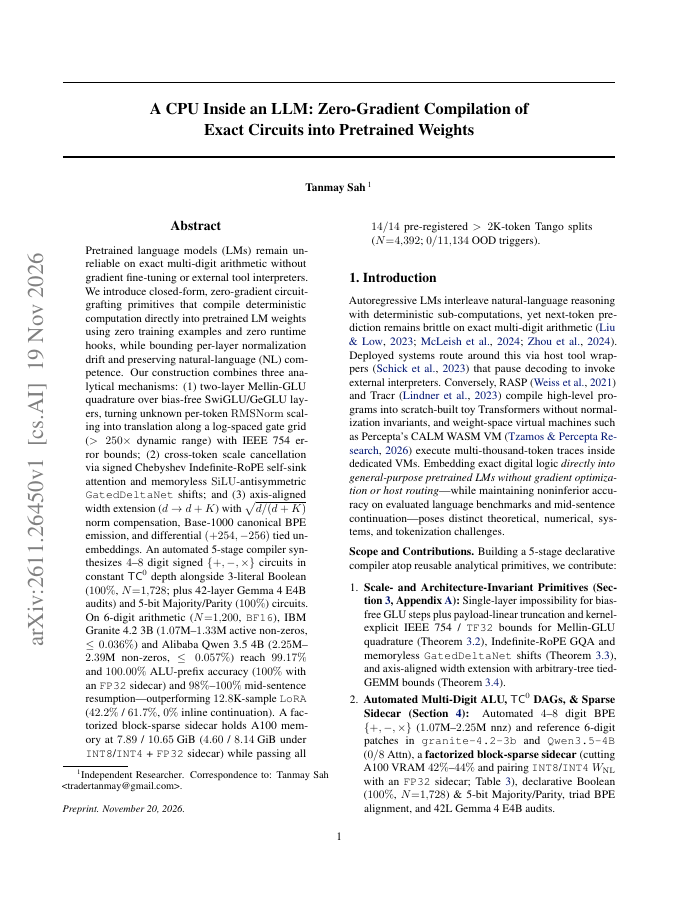
Pretrained language models (LMs) remain unreliable on exact multi-digit arithmetic without gradient fine-tuning or external tool interpreters. We introduce closed-form, zero-gradient circuit-grafting primitives that compile deterministic computation directly into pretrained LM…
19 Nov 2026
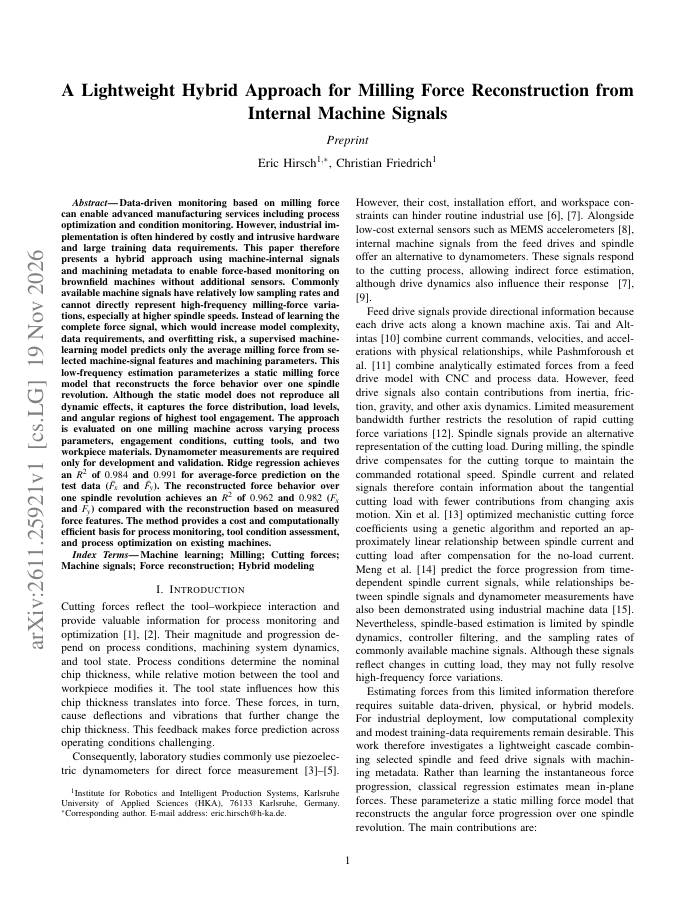
Data-driven monitoring based on milling force can enable advanced manufacturing services including process optimization and condition monitoring. However, industrial implementation is often hindered by costly and intrusive hardware and large training data requirements.
19 Nov 2026
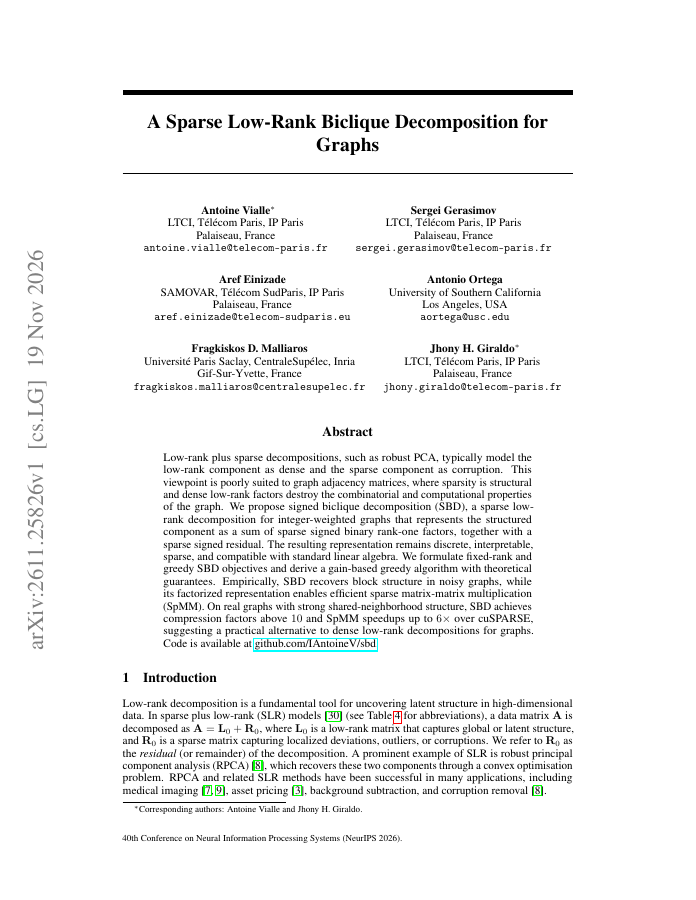
Low-rank plus sparse decompositions, such as robust PCA, typically model the low-rank component as dense and the sparse component as corruption. This viewpoint is poorly suited to graph adjacency matrices, where sparsity is structural and dense low-rank factors destroy the…
19 Nov 2026
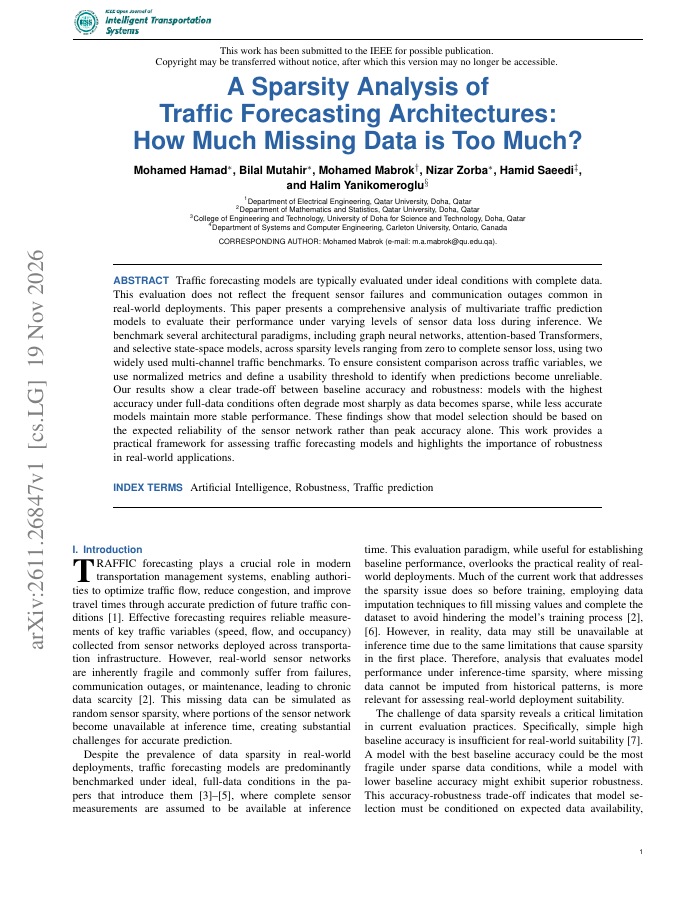
Traffic forecasting models are typically evaluated under ideal conditions with complete data. This evaluation does not reflect the frequent sensor failures and communication outages common in real-world deployments.
19 Nov 2026
Training-data auditing asks whether data of interest were used to train a large language model (LLM), a question central to privacy auditing, copyright protection, and benchmark-contamination detection.
19 Nov 2026
Photonic GHZ states generated with probabilistic pair sources can be described by edge-coloured, complex-weighted graphs. In this representation, conditioning on an event with one photon in every detector turns the output amplitudes into coherent sums over perfect matchings, and…
18 Nov 2026
Coding agents now resolve repository issues and generate compact playable games, but whether they can build a large 3D game from scratch remains open. Such games tightly couple mechanics, scenes, assets, and interaction logic, and their quality rests on player enjoyment, which…
18 Nov 2026
Agentic AI platforms-systems in which LLM agents plan, invoke tools, retain memory and coordinate to change the state of enterprise systems-are being procured faster than they can be measured.
18 Nov 2026
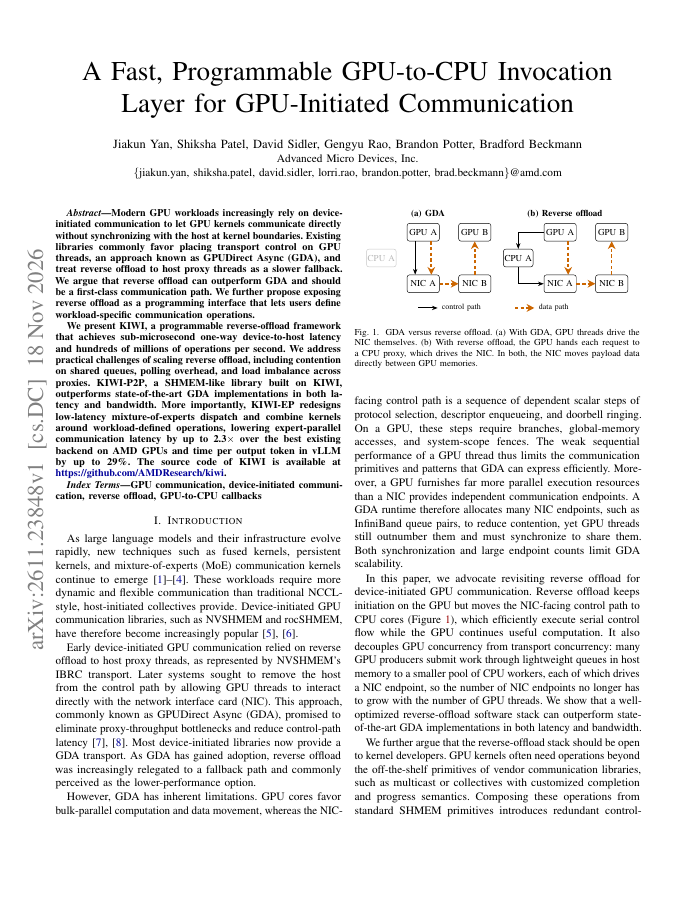
Modern GPU workloads increasingly rely on device-initiated communication to let GPU kernels communicate directly without synchronizing with the host at kernel boundaries.
18 Nov 2026
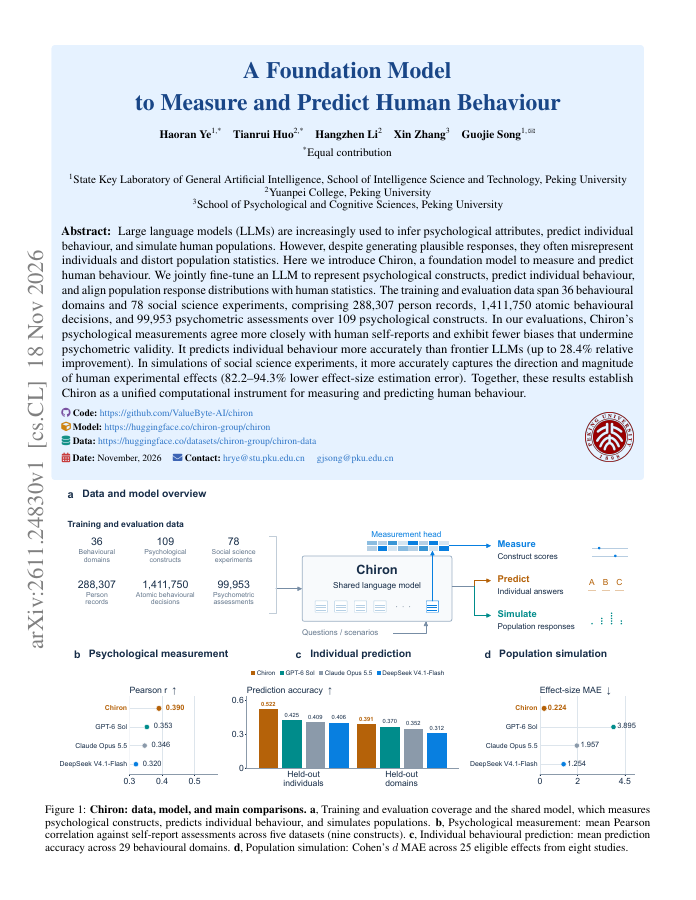
Large language models (LLMs) are increasingly used to infer psychological attributes, predict individual behaviour, and simulate human populations. However, despite generating plausible responses, they often misrepresent individuals and distort population statistics.
18 Nov 2026
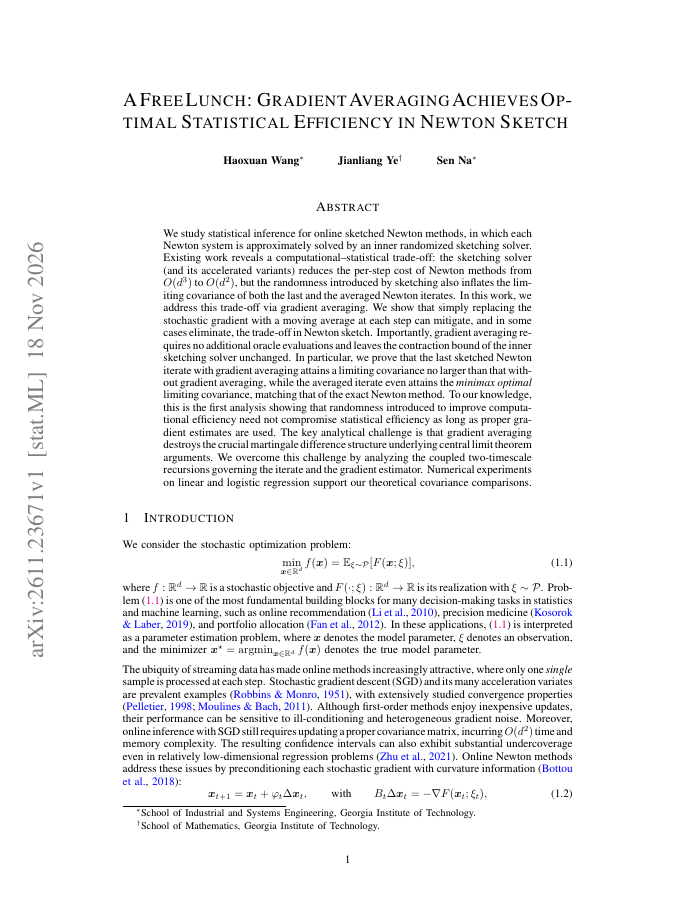
We study statistical inference for online sketched Newton methods, in which each Newton system is approximately solved by an inner randomized sketching solver. Existing work reveals a computational--statistical trade-off: the sketching solver (and its accelerated variants)…
18 Nov 2026
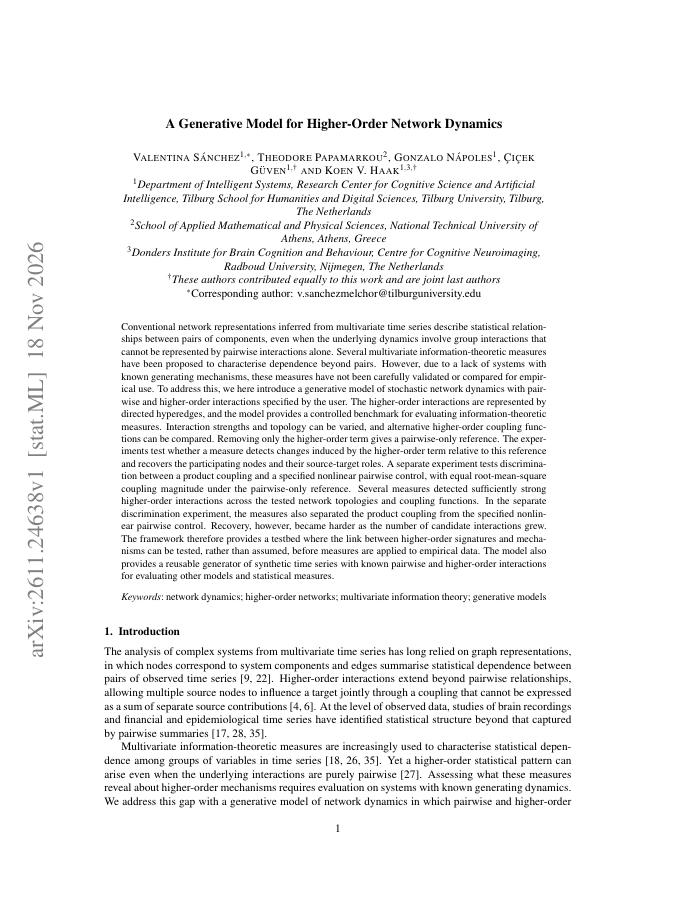
Conventional network representations inferred from multivariate time series describe statistical relationships between pairs of components, even when the underlying dynamics involve group interactions that cannot be represented by pairwise interactions alone.
18 Nov 2026
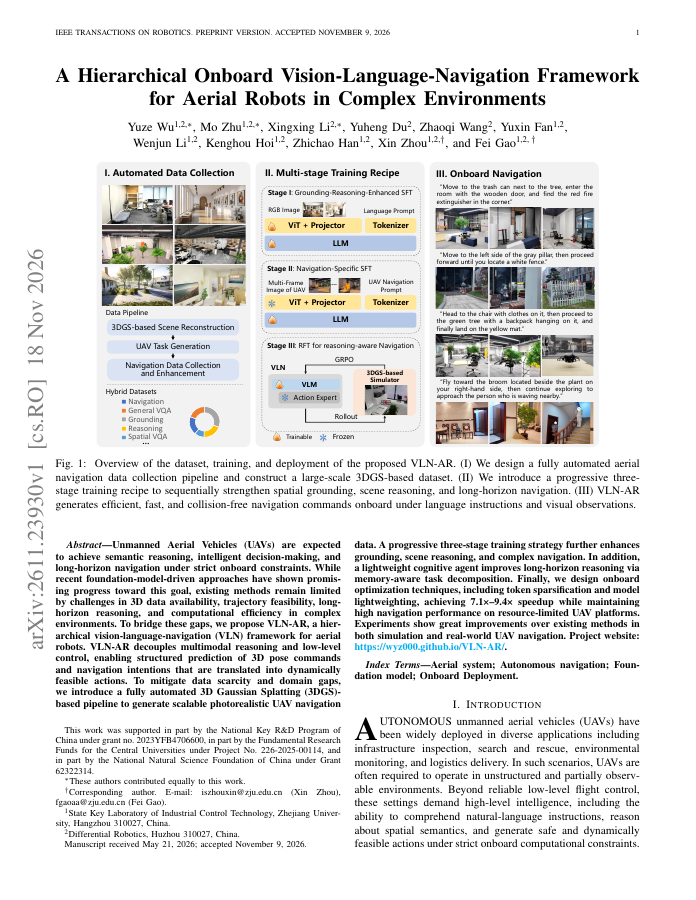
Unmanned Aerial Vehicles (UAVs) are expected to achieve semantic reasoning, intelligent decision-making, and long-horizon navigation under strict onboard constraints. While recent foundation-model-driven approaches have shown promising progress toward this goal, existing methods…
18 Nov 2026
We describe the solver we submitted to the second round of the SOICT 2026 contest on the Integrated Passenger and Parcel Transportation problem, a selective pickup-and-delivery routing problem with time windows, open routes and heterogeneous taxis.
18 Nov 2026
The growth of deceptive online opinions poses a critical risk of misinformation and fraud. This paper proposes a Retrieval-Augmented Generation (RAG) system to automatically distinguish spam reviews.
18 Nov 2026
Large language models can infer and follow specific rules through in-context learning (ICL), yet may fail to remain faithful to provided evidence, giving rise to out-of-context (OOC) hallucination.
18 Nov 2026
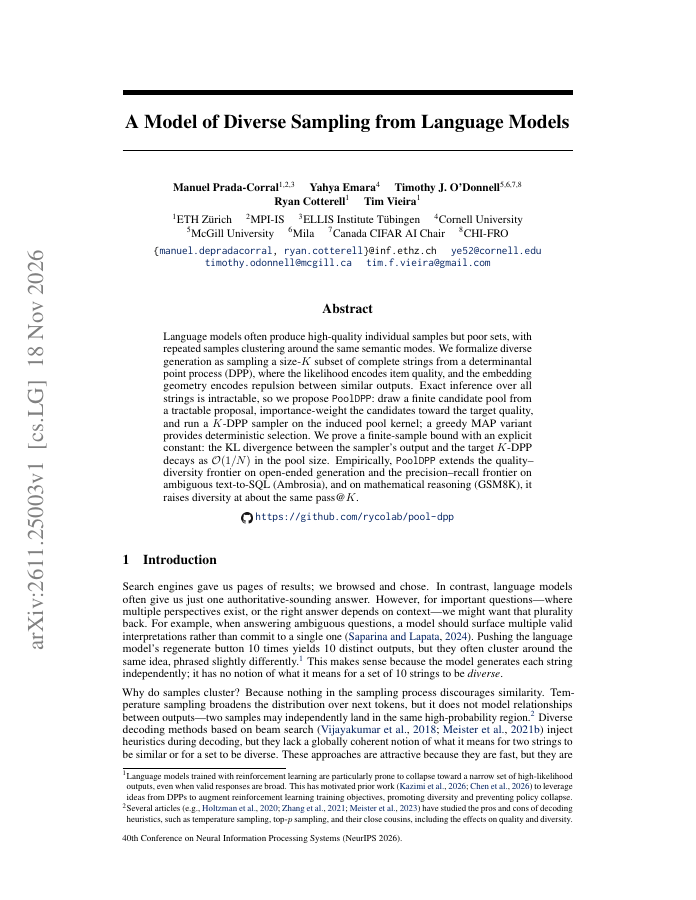
Language models often produce high-quality individual samples but poor sets, with repeated samples clustering around the same semantic modes. We formalize diverse generation as sampling a size-$K$ subset of complete strings from a determinantal point process (DPP), where the…