23 Oct 2026
We study the dynamic allocation of scarce medications in Liberia's community health program. A central warehouse supplies a health facility and the Community Health Assistants (CHAs) it supervises.
Trending research and the full catalog - each paper linked to the benchmarks, methods, and models it introduces.
Filtering here covers the 2,000 most recent papers, as much as one page can hold in memory. See the full index of 23,103 papers.
23 Oct 2026
We study the dynamic allocation of scarce medications in Liberia's community health program. A central warehouse supplies a health facility and the Community Health Assistants (CHAs) it supervises.
23 Oct 2026
Longitudinal causal effect estimation is complicated by time-varying confounding and treatment-confounder feedback loops. Existing methods generally require data-specific nuisance-model fitting, and many are tailored to prespecified treatment sequences or prediction horizons,…
23 Oct 2026
Constitutive models for history-dependent, path-dependent materials typically encode this dependence in prescribed functional forms through internal variables such as damage or plastic strain that are phenomenological, model-dependent, and not directly observable.
23 Oct 2026
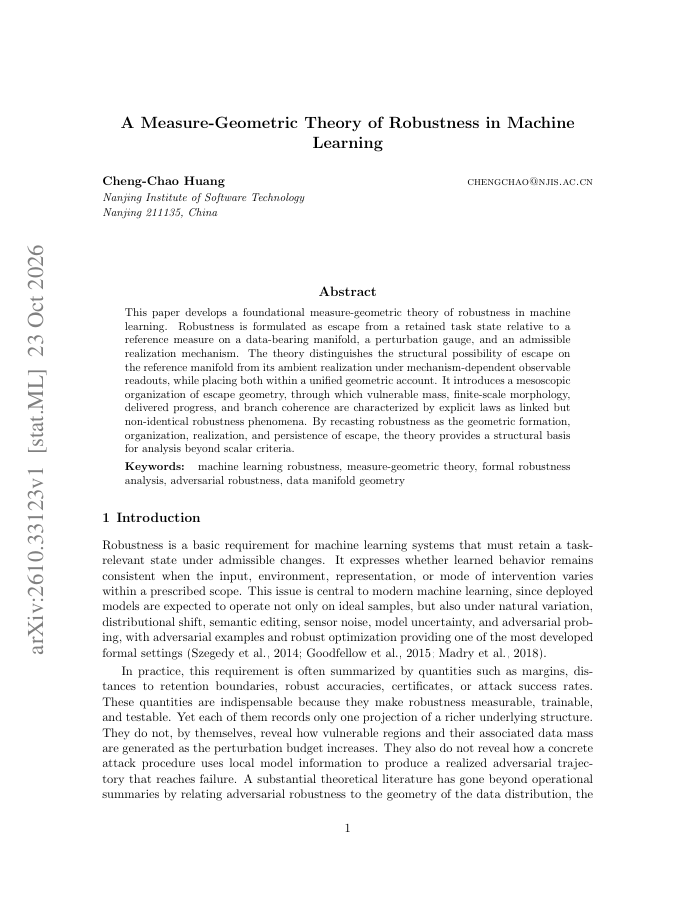
This paper develops a foundational measure-geometric theory of robustness in machine learning. Robustness is formulated as escape from a retained task state relative to a reference measure on a data-bearing manifold, a perturbation gauge, and an admissible realization mechanism.
22 Oct 2026
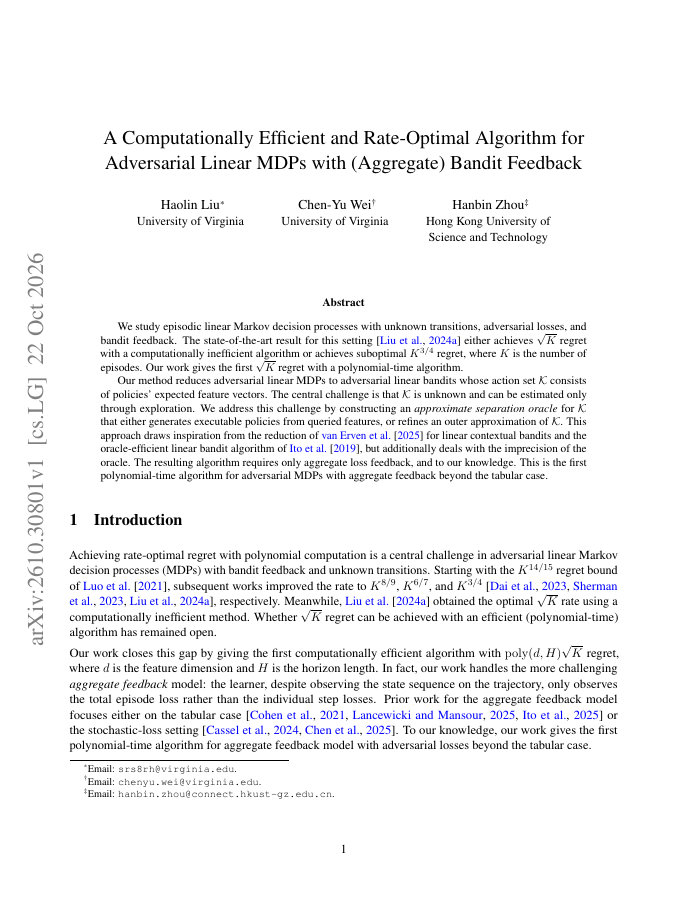
We study episodic linear Markov decision processes with unknown transitions, adversarial losses, and bandit feedback. The state-of-the-art result for this setting (Liu et al., 2024) either achieves $\sqrt{K}$ regret with a computationally inefficient algorithm or achieves…
22 Oct 2026
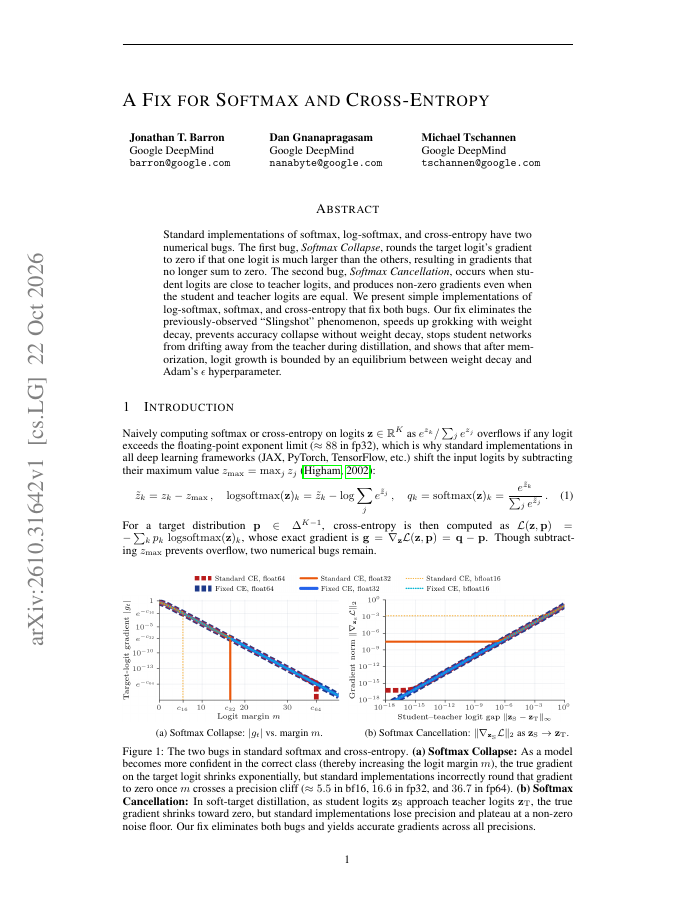
Standard implementations of softmax, log-softmax, and cross-entropy have two numerical bugs. The first bug, Softmax Collapse, rounds the target logit's gradient to zero if that one logit is much larger than the others, resulting in gradients that no longer sum to zero.
22 Oct 2026
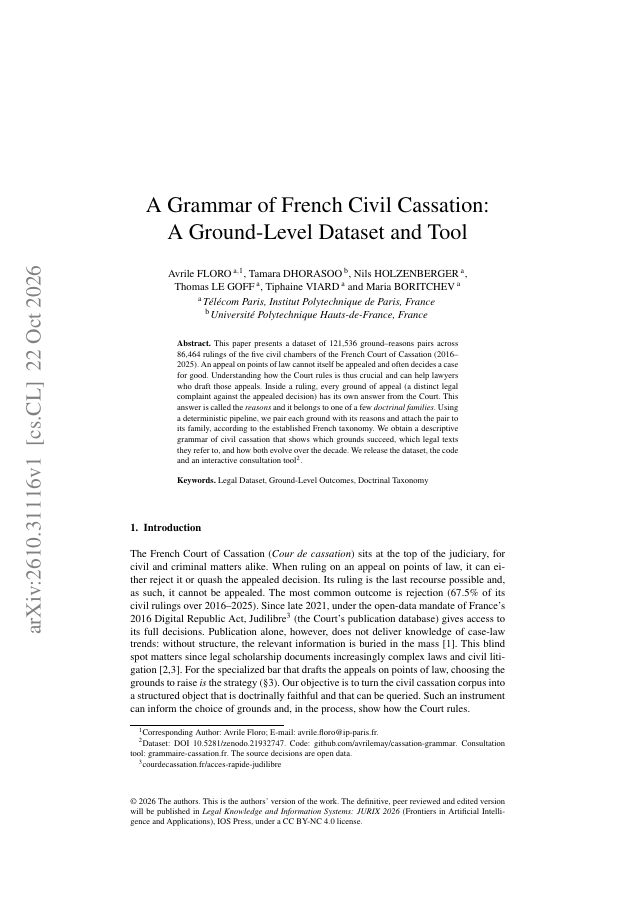
This paper presents a dataset of 121,536 ground-reasons pairs across 86,464 rulings of the five civil chambers of the French Court of Cassation (2016-2025). An appeal on points of law cannot itself be appealed and often decides a case for good.
22 Oct 2026
Recent work from Anthropic introduced a new interpretability tool, called the Jacobian lens (J-lens, Gurnee et al., 2026). This method identified linear directions in the hidden states of frontier language models that had properties reminiscent of working memory-like…
22 Oct 2026
Short-term building load forecasting remains challenging because load patterns can change rapidly with weather and operating conditions. Data-driven forecasting models may become less reliable when the current operating regime is rare or poorly represented during training, even…
22 Oct 2026
Large language models (LLMs) often fail to utilise the context given in the input, resulting in hallucinations or a fallback to parametric knowledge. Context augmentation methods aim to improve model performance by modifying the input, from inserting filler tokens that add…
22 Oct 2026
Search is a central component of Automatic Speech Recognition (ASR) systems and has been deeply investigated for classical ASR modeling based on Hidden Markov Models (HMMs).
22 Oct 2026
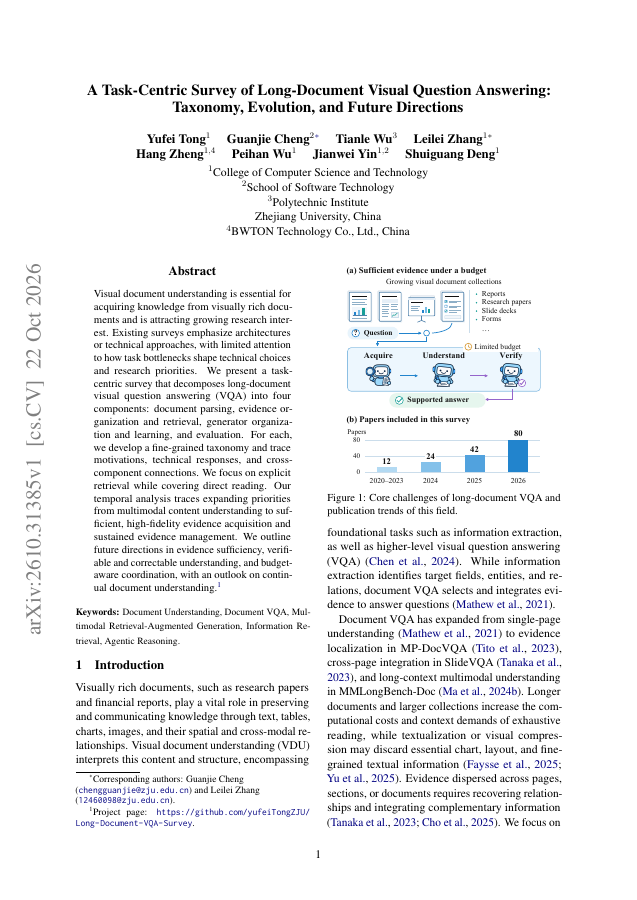
Visual document understanding is essential for acquiring knowledge from visually rich documents and is attracting growing research interest. Existing surveys emphasize architectures or technical approaches, with limited attention to how task bottlenecks shape technical choices…
22 Oct 2026
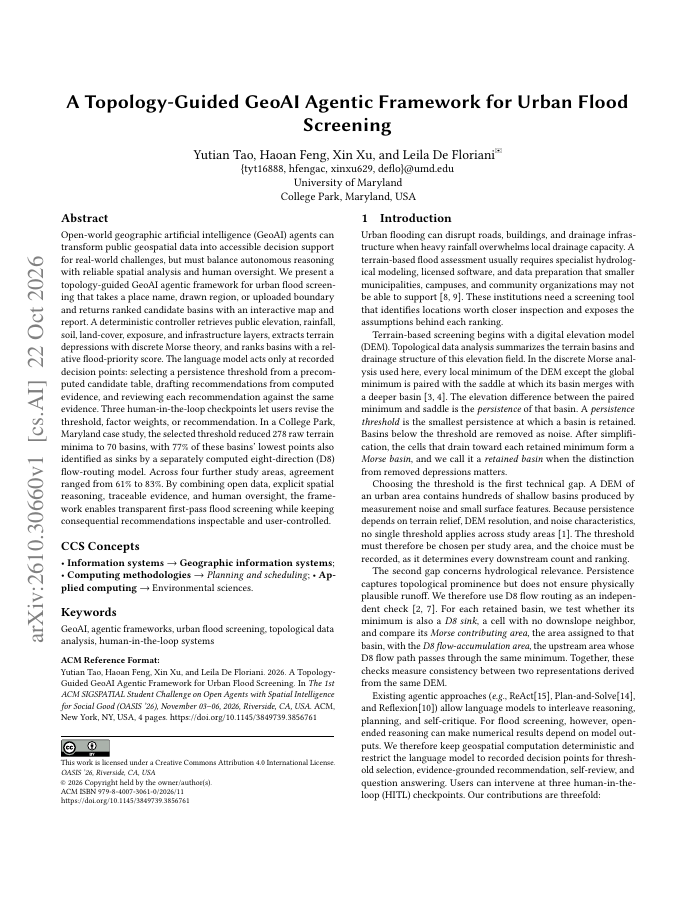
Open-world geographic artificial intelligence (GeoAI) agents can transform public geospatial data into accessible decision support for real-world challenges, but must balance autonomous reasoning with reliable spatial analysis and human oversight.
21 Oct 2026
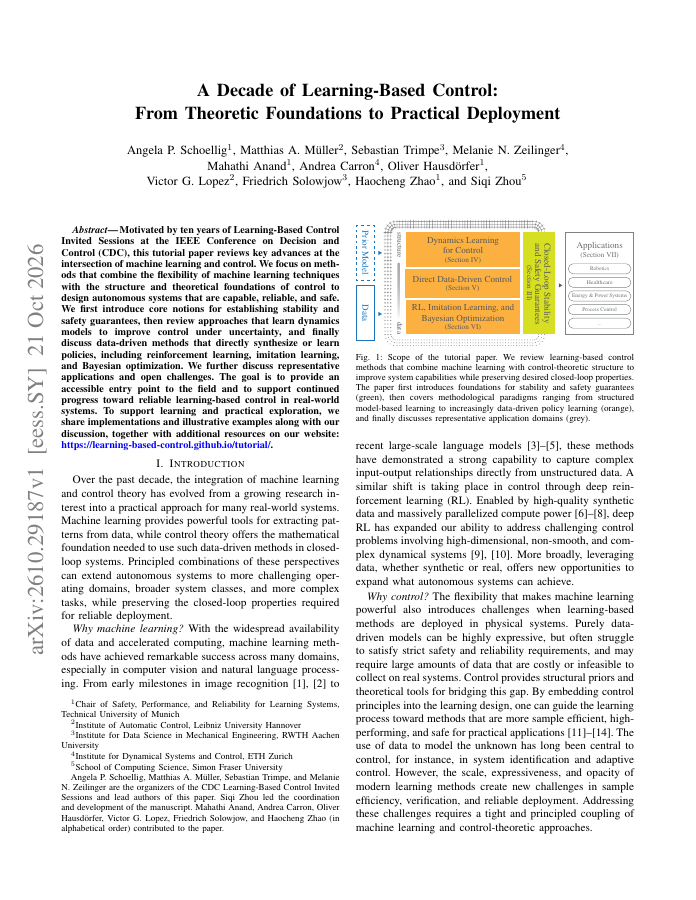
Motivated by ten years of Learning-Based Control Invited Sessions at the IEEE Conference on Decision and Control (CDC), this tutorial paper reviews key advances at the intersection of machine learning and control.
21 Oct 2026
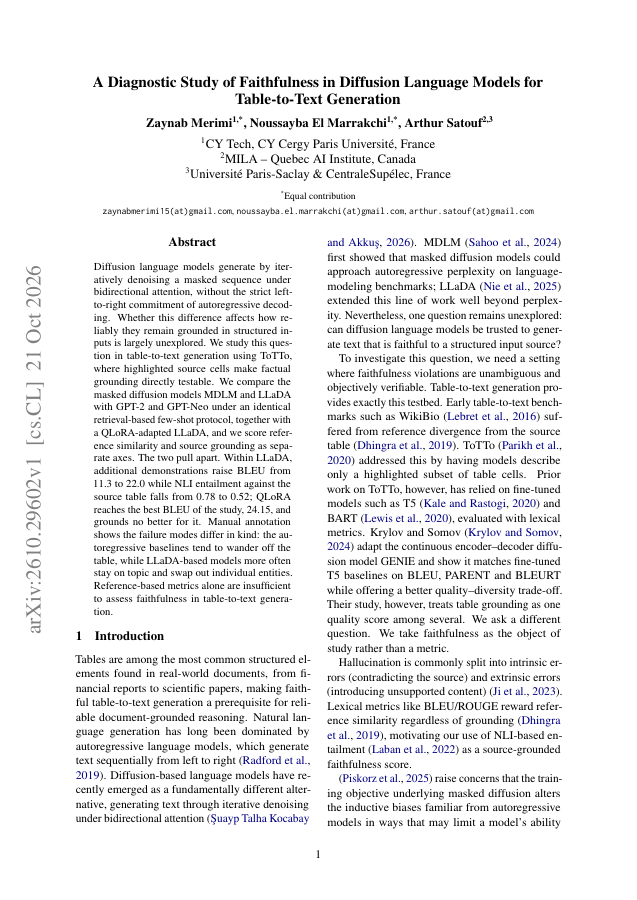
Diffusion language models generate by iteratively denoising a masked sequence under bidirectional attention, without the strict left-to-right commitment of autoregressive decoding.
21 Oct 2026
We study a jump-modified Wasserstein gradient flow of the squared maximum mean discrepancy generated by the energy kernels $K(z)=-|z|^q$, $0<q<2$, in every dimension $d\ge2$ as well as the one-dimensional range $1\le q<2$.
21 Oct 2026
Among existing embedding compression approaches, low-rank factorization provides a simple and mathematically principled solution by approximating the embedding matrix with a reduced-rank decomposition.
21 Oct 2026
This paper proposes Role-Enhanced Zero-Shot Chain-of-Thought (RE-ZS-CoT), a prompting framework that systematically integrates domain-specific expert roles to enhance reasoning in large language models (LLMs) without task-specific examples.
21 Oct 2026
Muon updates matrix-valued parameters along approximately orthogonalized directions and often trains large language models faster than AdamW, yet it remains unclear when and why orthogonalization helps.
21 Oct 2026
We give an algorithm for computing an $\eps$-approximate fixed point of any $d$-dimensional nonexpansion with respect to the $\ell_\infty$ norm in time $\log(1/\eps)^{O(\log^2 d)}$. At its core, our method uses a boosting argument to geometrically shrink a search region.
21 Oct 2026
Haussler's covering lemma (JCTA 1995) gives the sharp $(C/δ)^d$ metric-entropy bound for binary VC classes under normalized $\ell_1$ distance. We prove a sharp global dynamic analogue for bounded real-valued classes in normalized $\ell_p$, for every $1\le p<\infty$.
21 Oct 2026
Process reward models (PRMs) provide fine-grained supervision for multi-step reasoning, yet obtaining reliable process labels remains a central bottleneck. Existing approaches typically rely on human annotation, rollout-based estimation, or auxiliary verification.
21 Oct 2026
AI agents capable of autonomous decision-making introduce significant challenges related to safety, alignment, accountability, and human oversight. Existing Human-in-the-Loop (HITL) and responsible AI approaches provide important foundations, but many remain fragmented across…
21 Oct 2026
The rapid expansion of the Internet of Things enables seamless collaboration among connected devices, making indoor localization a critical component of industrial automation. However, conventional localization techniques struggle in dynamic environments.