6 Nov 2026
A neural account of lexical access requires an explicit distinction between the structure of lexical representations, the associations linking representational levels, and the activity generated during retrieval.
Trending research and the full catalog - each paper linked to the benchmarks, methods, and models it introduces.
Filtering here covers the 2,000 most recent papers, as much as one page can hold in memory. See the full index of 23,103 papers.
6 Nov 2026
A neural account of lexical access requires an explicit distinction between the structure of lexical representations, the associations linking representational levels, and the activity generated during retrieval.
6 Nov 2026
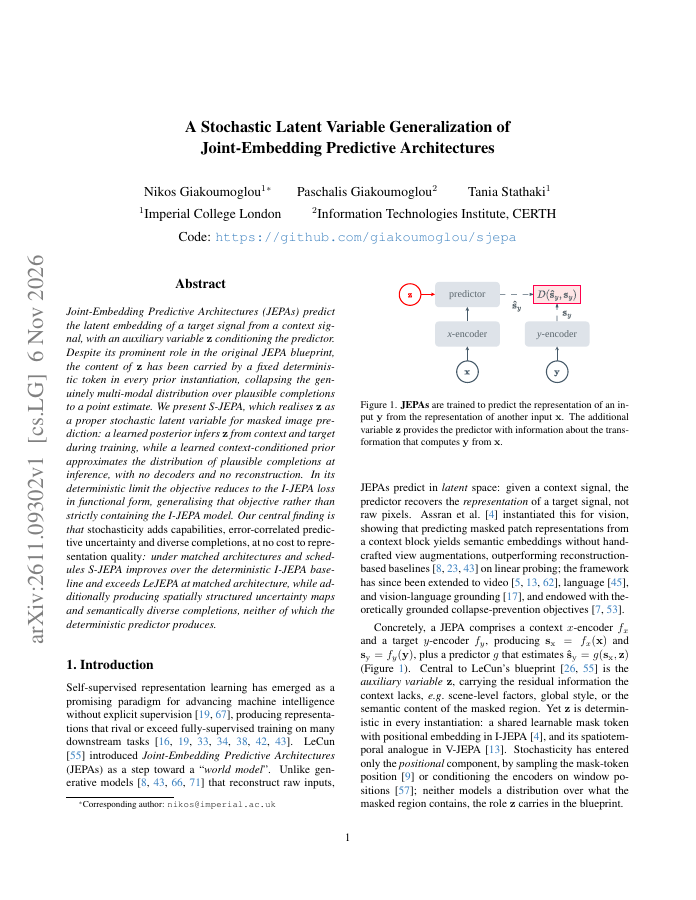
Joint-Embedding Predictive Architectures (JEPAs) predict the latent embedding of a target signal from a context signal, with an auxiliary variable z conditioning the predictor.
6 Nov 2026
While machine learning hiring tools are ubiquitous, the need for privacy regulations and commercial sensitivity makes public benchmarking legally complex. We address this challenge by introducing a taxonomy-driven, fully synthetic HR dataset and benchmark to simultaneously…
6 Nov 2026
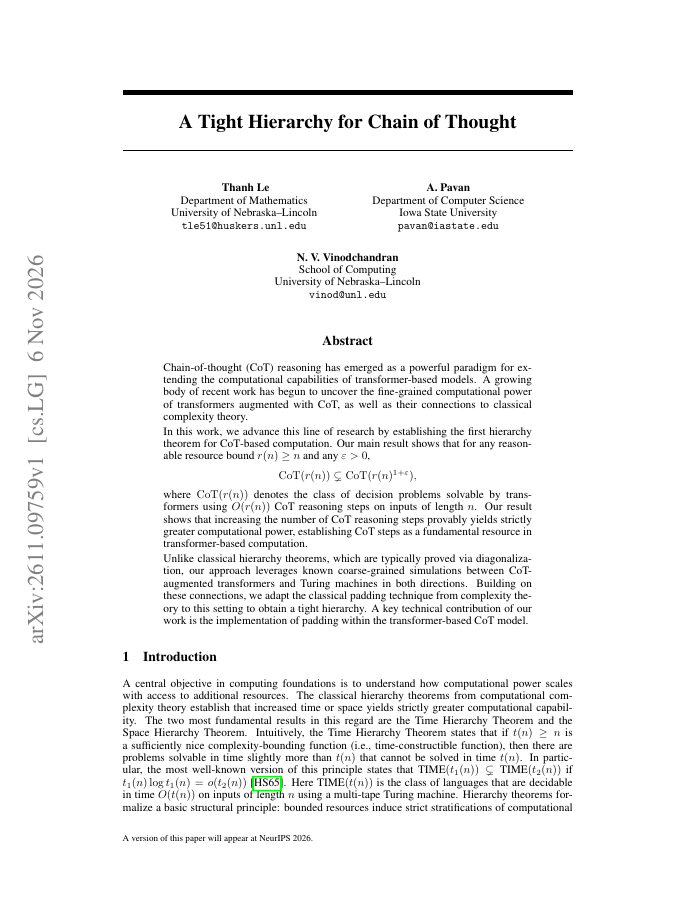
Chain-of-thought (CoT) reasoning has emerged as a powerful paradigm for extending the computational capabilities of transformer-based models. A growing body of recent work has begun to uncover the fine-grained computational power of transformers augmented with CoT, as well as…
5 Nov 2026
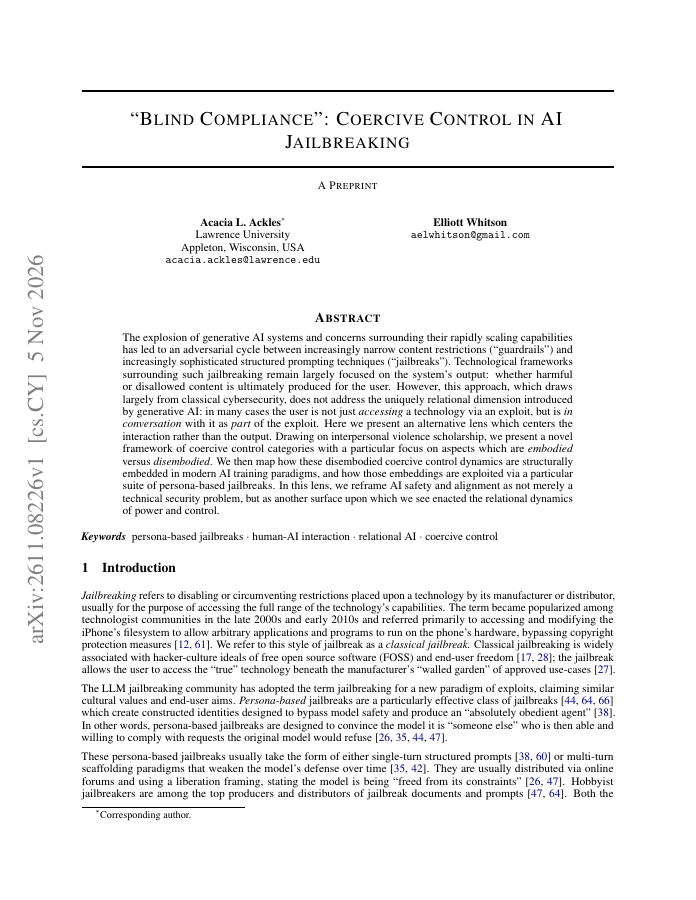
The explosion of generative AI systems and concerns surrounding their rapidly scaling capabilities has led to an adversarial cycle between increasingly narrow content restrictions ("guardrails") and increasingly sophisticated structured prompting techniques…
5 Nov 2026
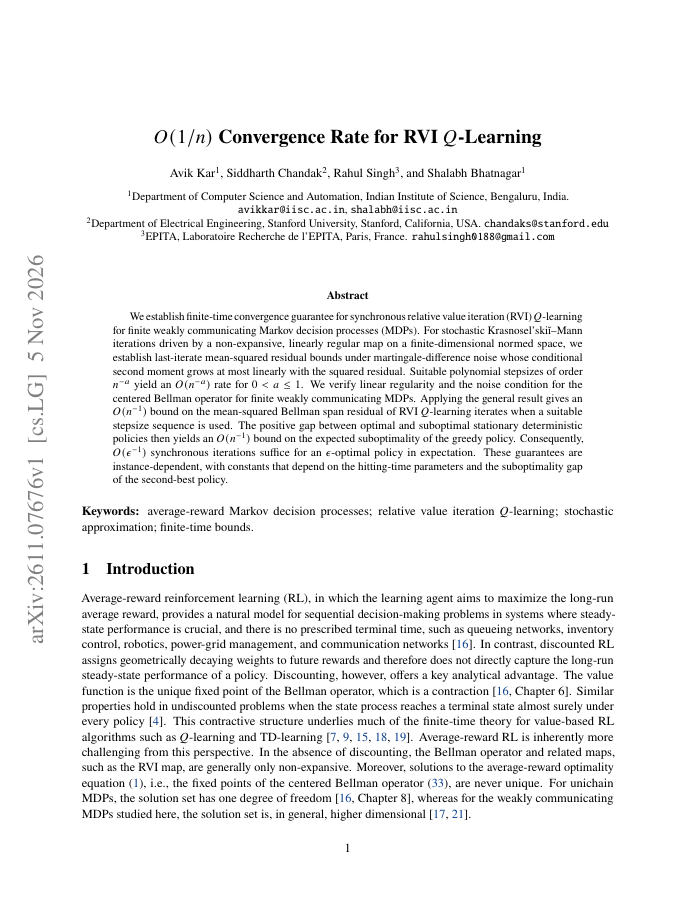
We establish finite-time convergence guarantee for synchronous relative value iteration (RVI) $Q$-learning for finite weakly communicating Markov decision processes (MDPs).
5 Nov 2026
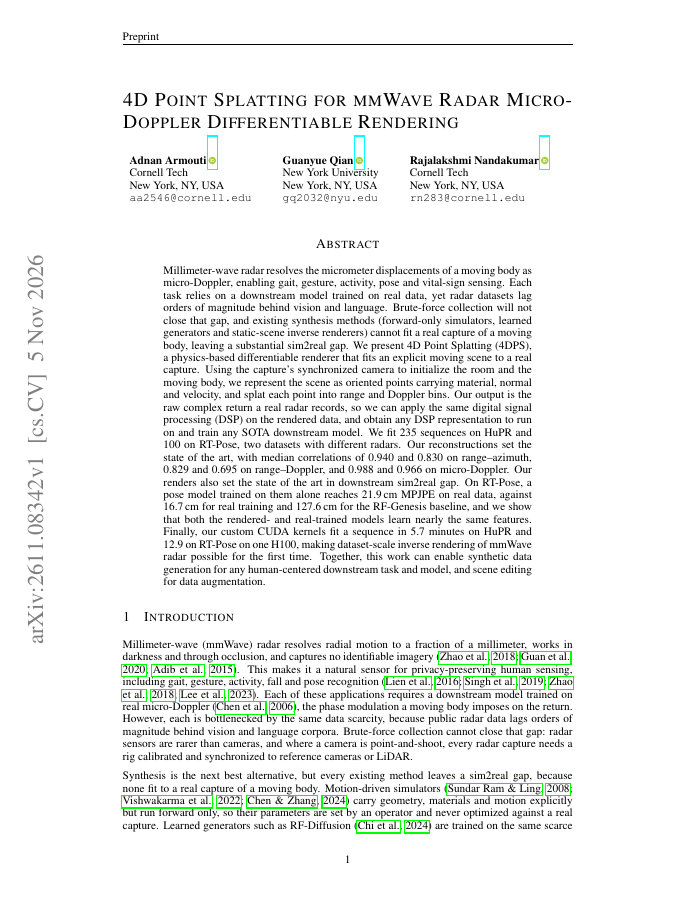
Millimeter-wave radar resolves the micrometer displacements of a moving body as micro-Doppler, enabling gait, gesture, activity, pose and vital-sign sensing. Each task relies on a downstream model trained on real data, yet radar datasets lag orders of magnitude behind vision and…
5 Nov 2026
Frontier artificial intelligence (AI) systems are increasingly operating over longer horizons with diminishing human oversight, raising the risk of loss of control: systems acting beyond effective human control with potentially irreversible consequences.
5 Nov 2026
Tokamak experiments record diverse measurements, including waveforms, profiles, fields, and scalars, which are used to reconstruct the plasma, forecast its evolution, recover associated control signals, and estimate disruption risk.
5 Nov 2026
Contextual integrity (CI) holds that appropriate information flow depends on context-specific norms. The same disclosure may be appropriate in one context and inappropriate in another.
5 Nov 2026
A defender anticipating an attacker needs a probability distribution over the attacker's next action from information available before that action occurs. Two structures complicate this: the attacker's behavioral regime persists and can switch within an episode, and each action…
4 Nov 2026
On-policy distillation (OPD) trains a student model to match a teacher's next-token distributions on student-generated prefixes. Extrapolative OPD further extends the teacher's log-probability shift relative to a reference policy to construct stronger learning targets.
4 Nov 2026
The protection of mature, multi-stage Face Recognition Systems is crucial to system providers. This technical report targets the threat model most relevant to industry practitioners: although model training is performed in-house, training data is sourced from…
4 Nov 2026
Deep learning over relational databases has led to increasingly effective prediction models, motivating a growing need to explain their behavior. We study explanation methods that assign importance scores to individual database attributes, focusing on a fundamental question: to…
4 Nov 2026
Multi-agent LLM applications repeat most of their prompt tokens across requests, and serving engines reuse the cached state of shared prefixes. vLLM and SGLang reuse it at different granularities, and benchmarks of their default deployments report large performance gaps, usually…
4 Nov 2026
Researchers use large language models as agents in social simulations, where agents are prompted with observations and background information intended to shape their actions.
4 Nov 2026
Security-by-design emphasises integrating security into software design and development. Security pattern catalogues operationalise this principle by prescribing reusable architectural solutions to recurring security problems.
4 Nov 2026
A challenge to Weight Space Learning as it expands from task specific and vision models to Large Language Models (LLMs) is the absence of a well curated and analyzed LLM population.
4 Nov 2026
We present an automated method for auditing text-to-image generators for representational bias against ground-truth demographic benchmarks. Our approach adapts the racial proxy variables used in U.S.
4 Nov 2026
Many real-world applications, such as numerical weather prediction or wildfire tracking, involve modeling highly nonlinear dynamical systems that are chaotic and influenced by various sources of uncertainty.
4 Nov 2026
People often make decisions by holistically reasoning over heterogeneous forms of personal information. In this paper, we study the relatively underexplored capability of multimodal personalized reasoning in multimodal large language models (MLLMs).
3 Nov 2026
While conversational recommendation systems provide a more natural user interface, they face the challenge of progressively discovering a user's needs before they can recommend an item that satisfies them.
3 Nov 2026
The classical model-based optimal design criteria (D-, T-, L-, C-, and A-optimality) are usually motivated via the Cramér--Rao bound as optimizing scalar functions of the Fisher information matrix (FIM).
3 Nov 2026
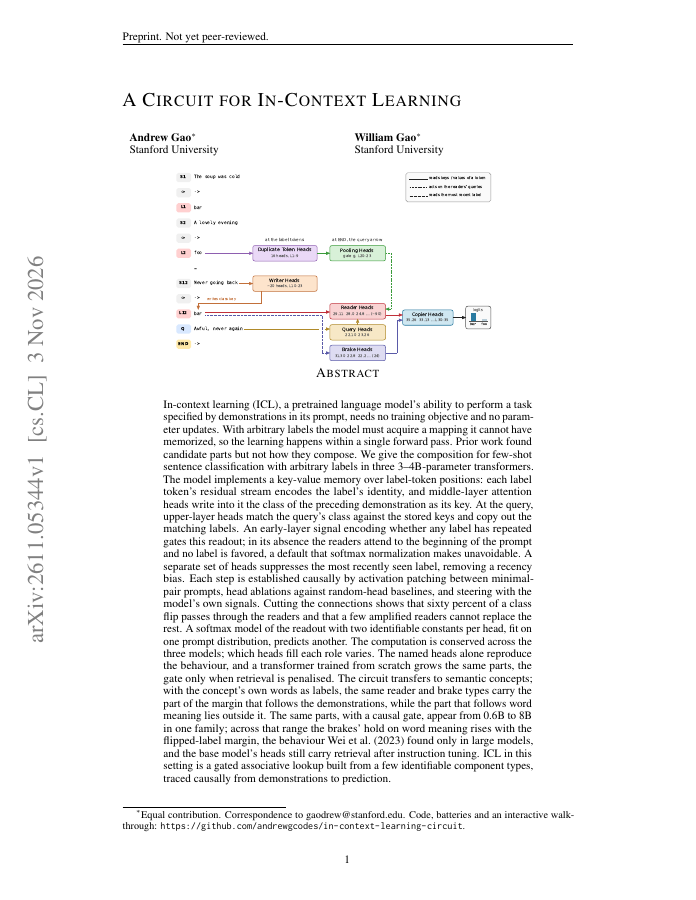
In-context learning (ICL) lets a pretrained language model perform a task specified by demonstrations in its prompt, with no parameter updates. With arbitrary labels the model must acquire a mapping it cannot have memorized, so the learning happens within a single forward pass.