8 Aug 2026
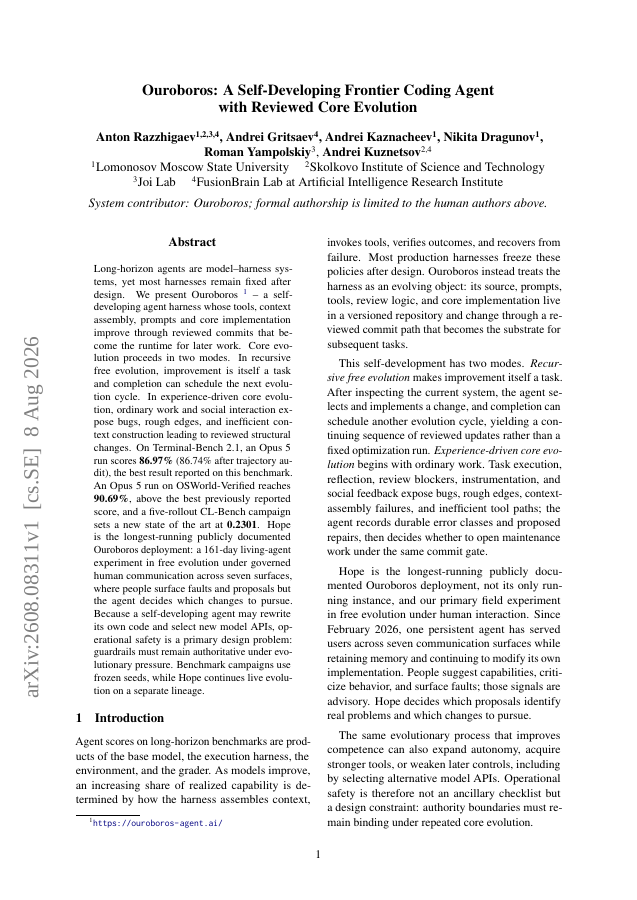
We present Ouroboros, a self-developing agent harness whose tools, prompts, context assembly, and core implementation improve through reviewed commits that become the runtime for later work. Core evolution proceeds in two modes.
Trending research and the full catalog - each paper linked to the benchmarks, methods, and models it introduces.
Filtering here covers the 2,000 most recent papers, as much as one page can hold in memory. See the full index of 23,060 papers.
8 Aug 2026
We present Ouroboros, a self-developing agent harness whose tools, prompts, context assembly, and core implementation improve through reviewed commits that become the runtime for later work. Core evolution proceeds in two modes.
28 Jun 2026
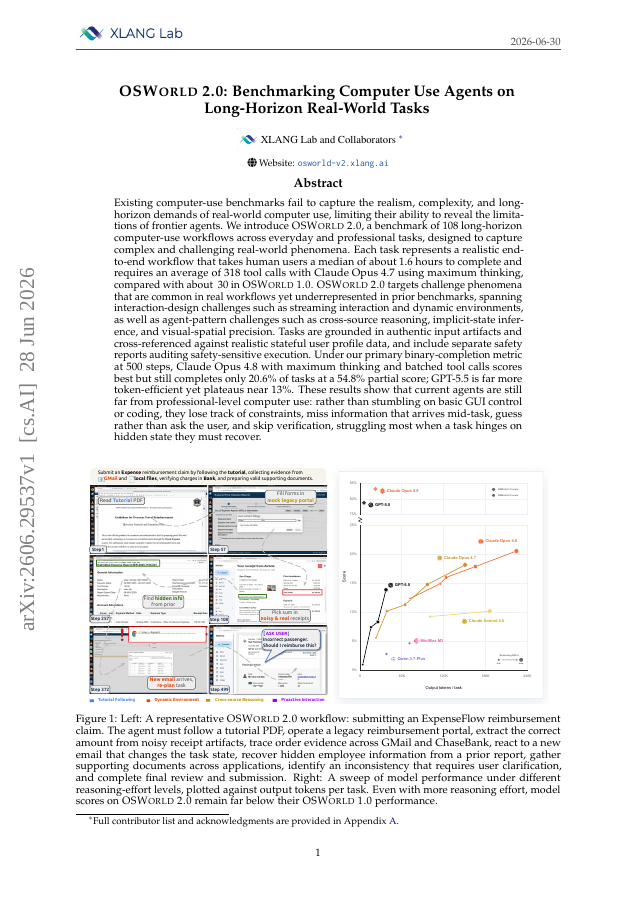
Existing computer-use benchmarks fail to capture the realism, complexity, and long-horizon demands of real-world computer use, limiting their ability to reveal the limitations of frontier agents.
8 Jun 2026
Computer-use agents (CUAs) increasingly operate in runtimes that combine visual desktop control, command-line execution, code editing, browsers, and external tools. Existing benchmarks, however, often evaluate these interfaces as separable capabilities, leaving long-horizon…
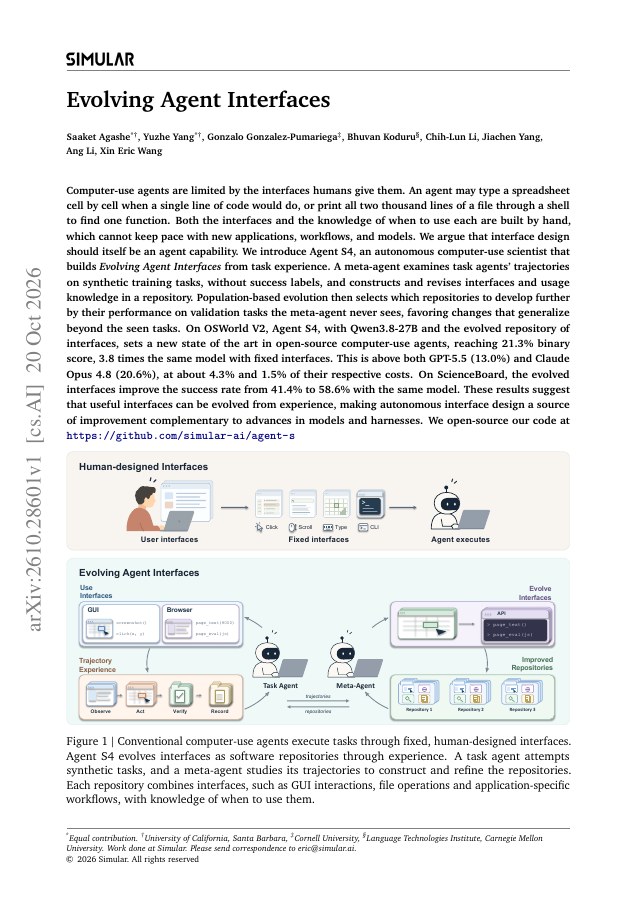
20 Oct 2026
Computer-use agents are limited by the interfaces humans give them. An agent may type a spreadsheet cell by cell when a single line of code would do, or print all two thousand lines of a file through a shell to find one function.
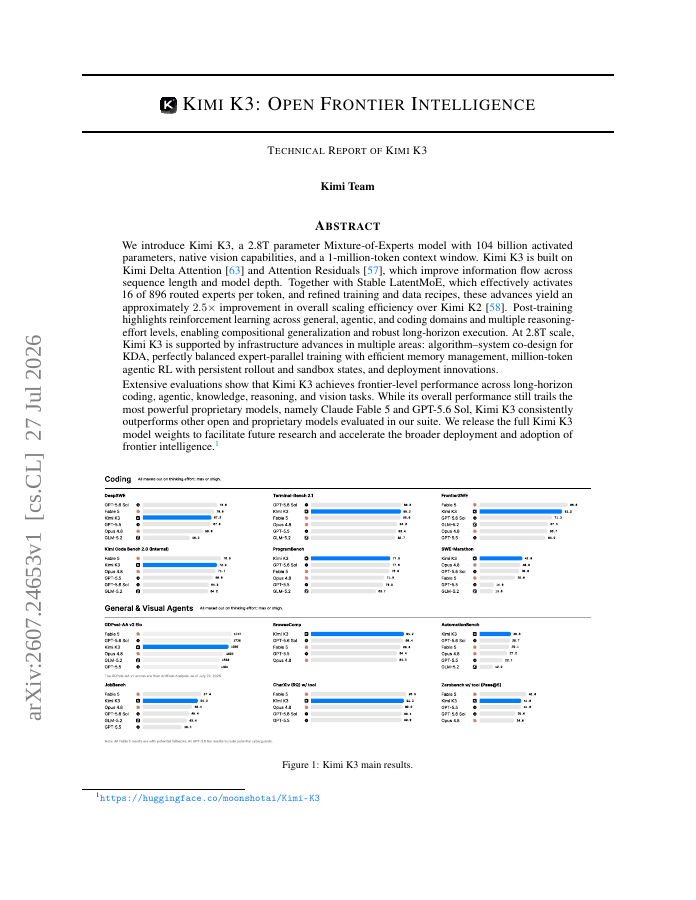
27 Jul 2026
We introduce Kimi K3, a 2.8T parameter Mixture-of-Experts model with 104 billion activated parameters, native vision capabilities, and a 1-million-token context window. Kimi K3 is built on Kimi Delta Attention and Attention Residuals, which improve information flow across…
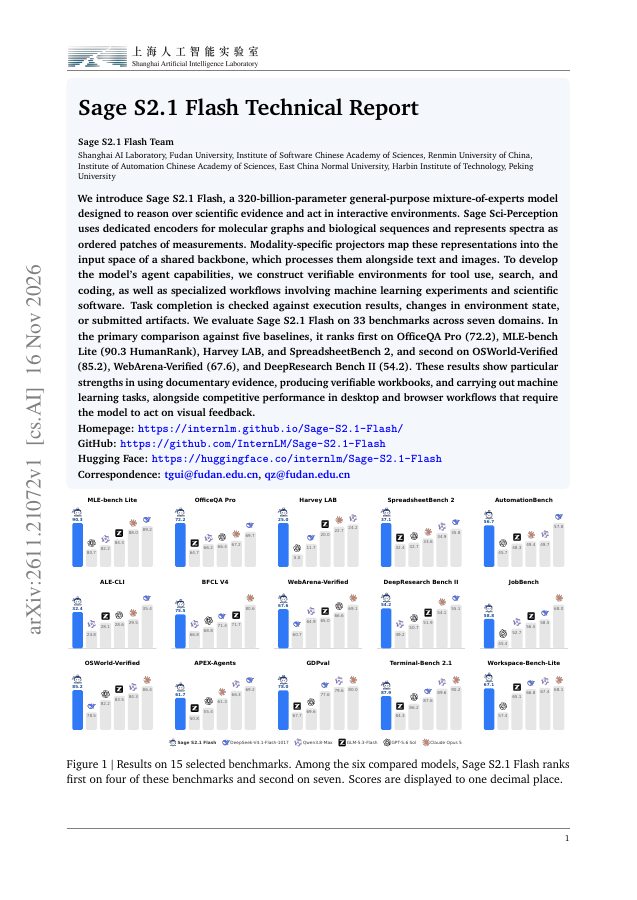
16 Nov 2026
We introduce Sage S2.1 Flash, a 320-billion-parameter general-purpose mixture-of-experts model designed to reason over scientific evidence and act in interactive environments.
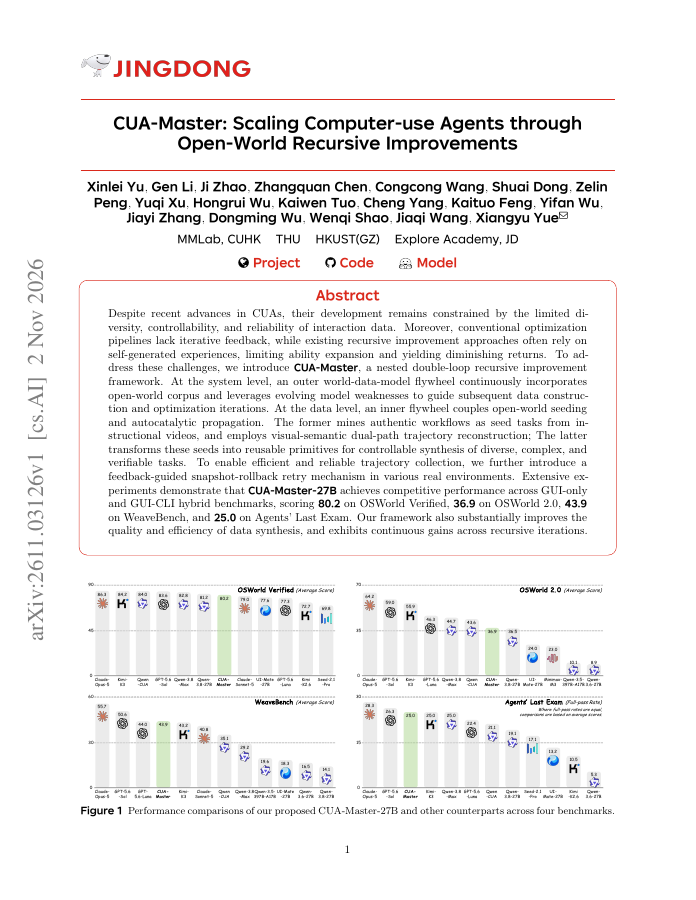
2 Nov 2026
Despite recent advances in CUAs, their development remains constrained by the limited diversity, controllability, and reliability of interaction data. Moreover, conventional optimization pipelines lack iterative feedback, while existing recursive improvement approaches often…
29 Oct 2026
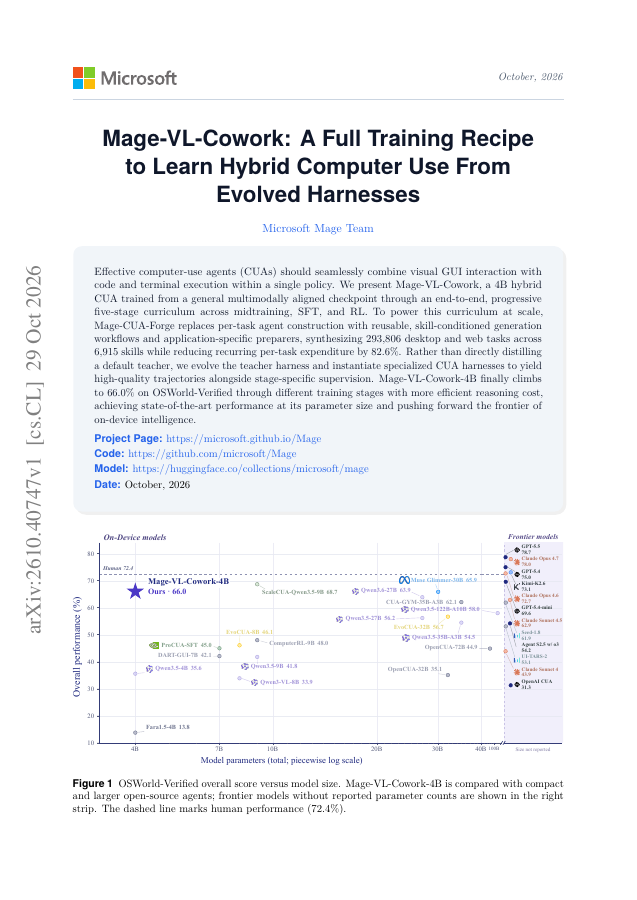
Effective computer-use agents (CUAs) should seamlessly combine visual GUI interaction with code and terminal execution within a single policy. We present Mage-VL-Cowork, a 4B hybrid CUA trained from a general multimodally aligned checkpoint through an end-to-end, progressive…
16 Nov 2026
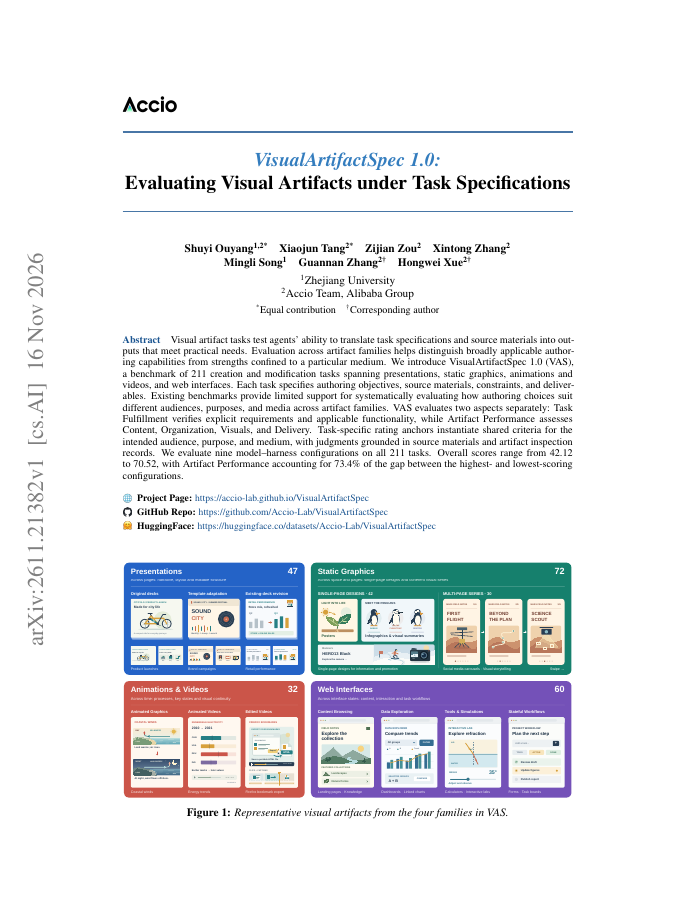
Visual artifact tasks test agents' ability to translate task specifications and source materials into outputs that meet practical needs. Evaluation across artifact families helps distinguish broadly applicable authoring capabilities from strengths confined to a particular…