30 Sep 2026
AI reviewers can assign different judgments to manuscripts that report the same science in different wording, potentially rewarding rhetorical optimization over scientific improvement.
Trending research and the full catalog - each paper linked to the benchmarks, methods, and models it introduces.
Filtering here covers the 2,000 most recent papers, as much as one page can hold in memory. See the full index of 22,841 papers.
30 Sep 2026
AI reviewers can assign different judgments to manuscripts that report the same science in different wording, potentially rewarding rhetorical optimization over scientific improvement.
30 Sep 2026
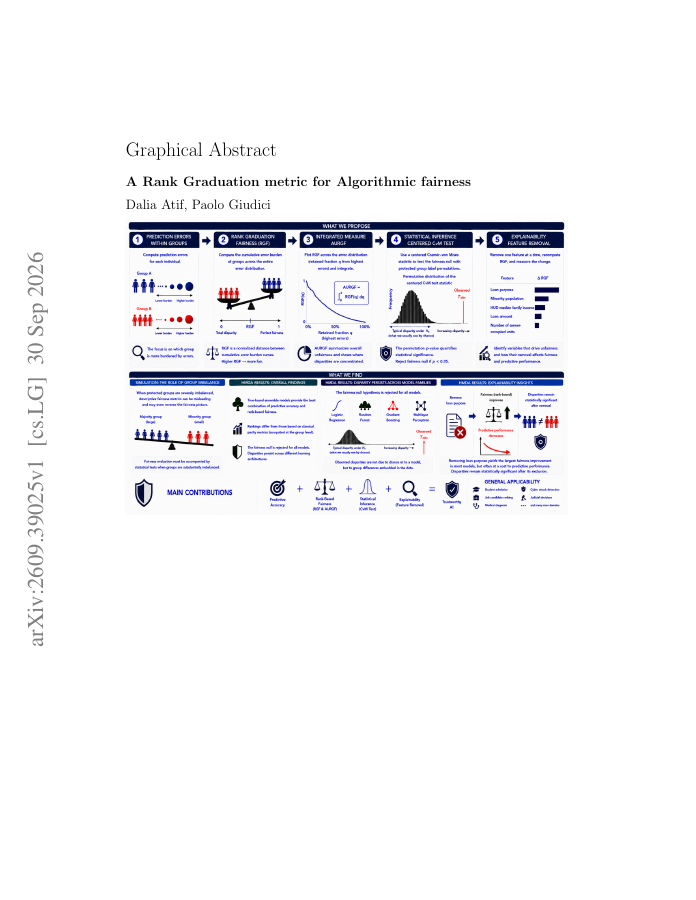
Fairness assessment in algorithmic decisions that affect individuals, such as credit scoring, often relies on parity measures calculated at the aggregate group level. Such measures may not reveal which individuals experience unfairness or which explanatory factors contribute to…
30 Sep 2026
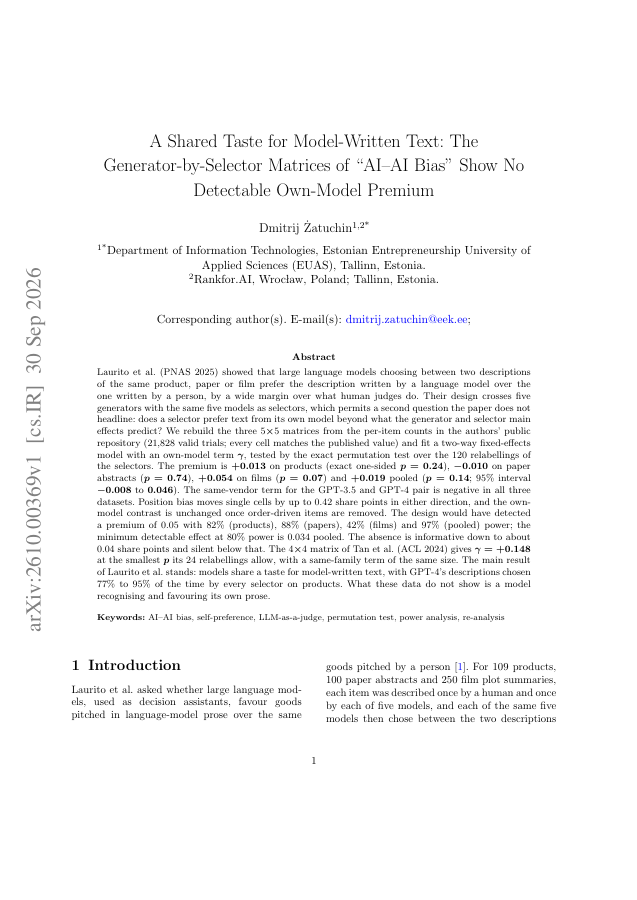
Laurito et al. (PNAS 2025) showed that large language models choosing between two descriptions of the same product, paper or film prefer the description written by a language model over the one written by a person, by a wide margin over what human judges do.
30 Sep 2026
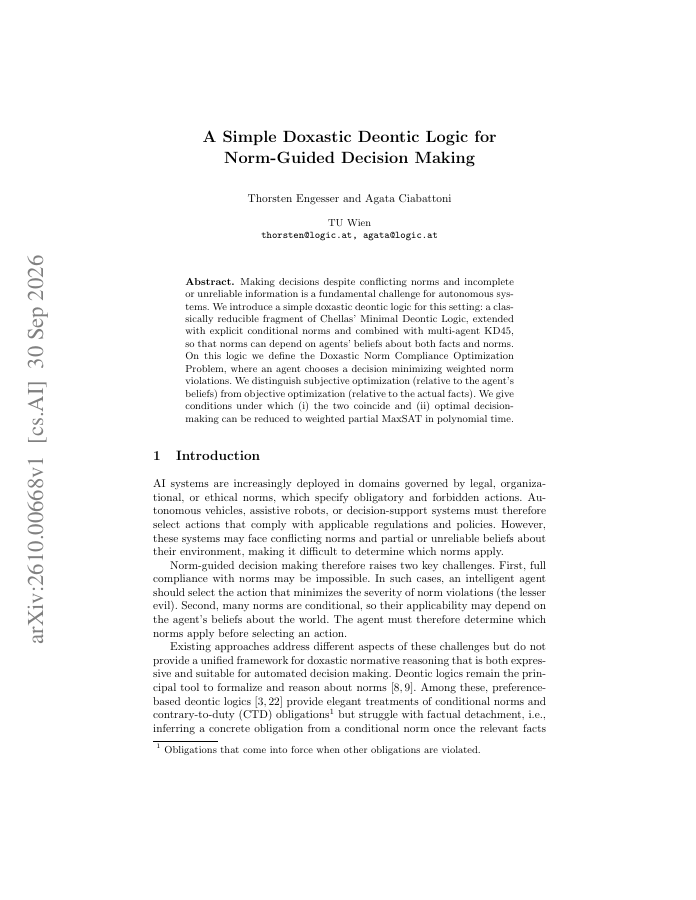
Making decisions despite conflicting norms and incomplete or unreliable information is a fundamental challenge for autonomous systems. We introduce a simple doxastic deontic logic for this setting: a classically reducible fragment of Chellas' Minimal Deontic Logic, extended with…
30 Sep 2026
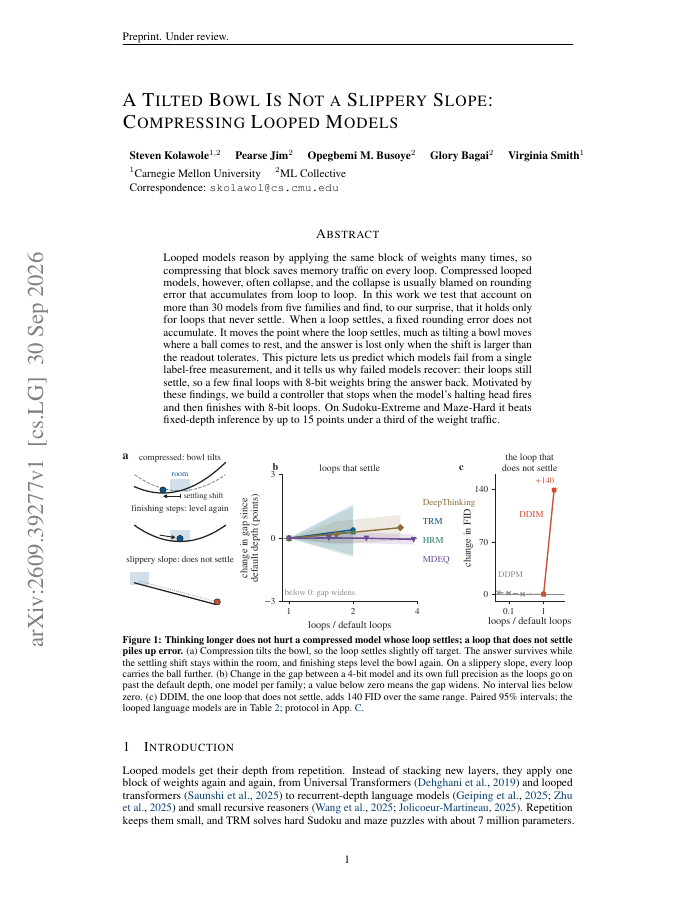
Looped models reason by applying the same block of weights many times, so compressing that block saves memory traffic on every loop. Compressed looped models, however, often collapse, and the collapse is usually blamed on rounding error that accumulates from loop to loop.
30 Sep 2026
Matching problems are ubiquitous in data science as they enable the alignment of structured objects and distributions. While existing solvers are often tailored to specific matching formulations, we unify a broad class of such problems within a common mathematical and…
29 Sep 2026
LLMs trained with Chain-of-thought excel in reasoning capability, but often come with excessive token cost. We find that the core of reasoning capacity lies in the Thinking model's weight component within the null space of a projection defined by the corresponding Non-thinking…
29 Sep 2026
Many datasets carry an intrinsic directionality: citations point backward in time, cells differentiate along lineages, and traffic follows preferred routes. Spectral embedding methods, including most of their extensions to directed graphs, discard this information: they…
29 Sep 2026
The development of Financial Natural Language Processing (NLP) systems for Brazilian Portuguese is hindered by the scarcity of domain-specific datasets. To address this, we present a large-scale corpus of approximately 160,000 Brazilian Portuguese financial news articles…
29 Sep 2026
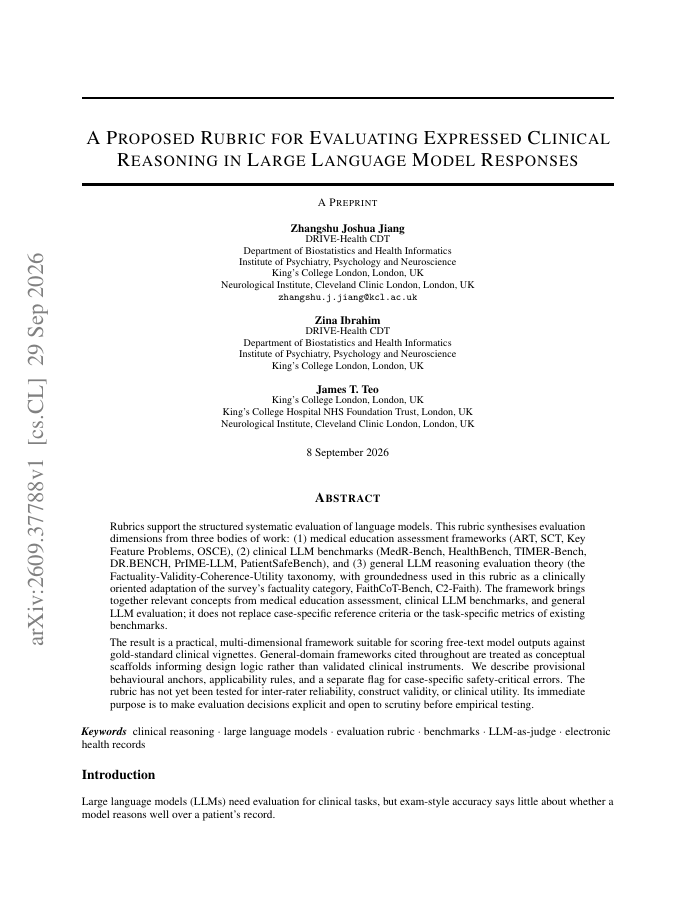
We propose a rubric for assessing expressed clinical reasoning in model responses, drawing on three bodies of work: medical education assessment frameworks (ART, SCT, Key Feature Problems and OSCE); clinical LLM benchmarks (MedR-Bench, HealthBench, TIMER-Bench, DR.
29 Sep 2026
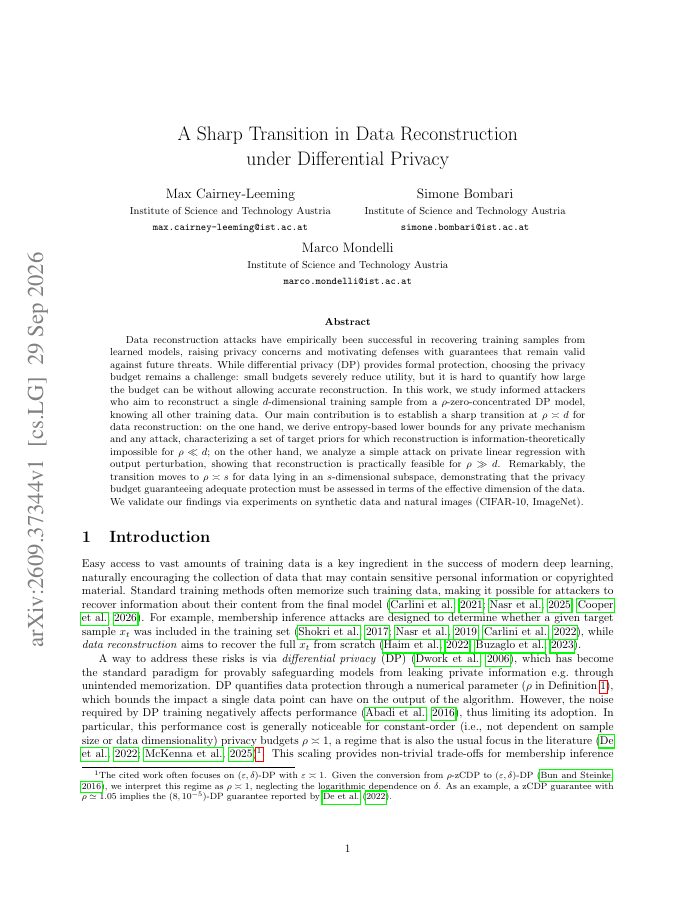
Data reconstruction attacks have empirically been successful in recovering training samples from learned models, raising privacy concerns and motivating defenses with guarantees that remain valid against future threats.
28 Sep 2026
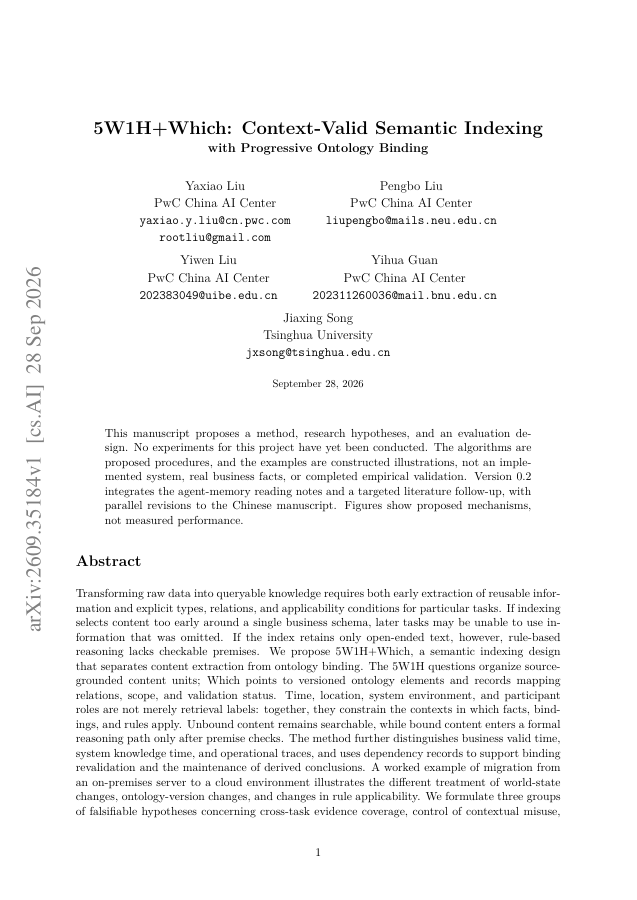
Semantic indexing must preserve reusable source information without committing too early to one business schema, while providing checkable premises for reasoning. We propose 5W1H+Which, a design that separates source-grounded content extraction from progressive ontology binding.
28 Sep 2026
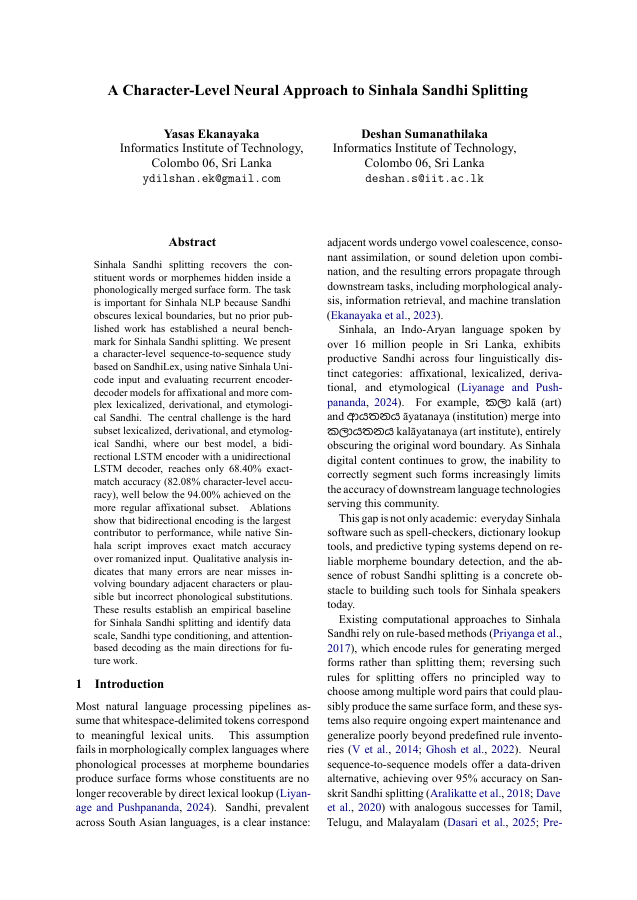
Sinhala Sandhi splitting recovers the constituent words or morphemes hidden inside a phonologically merged surface form. The task is important for Sinhala NLP because Sandhi obscures lexical boundaries, but no prior published work has established a neural benchmark for Sinhala…
28 Sep 2026
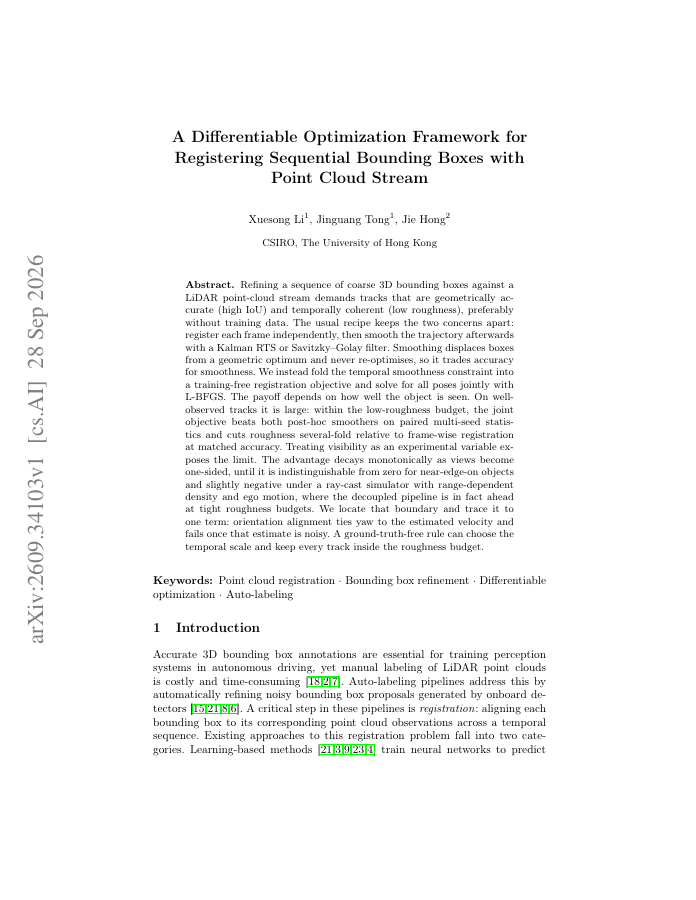
Refining a sequence of coarse 3D bounding boxes against a LiDAR point-cloud stream demands tracks that are geometrically accurate (high IoU) and temporally coherent (low roughness), preferably without training data.
28 Sep 2026
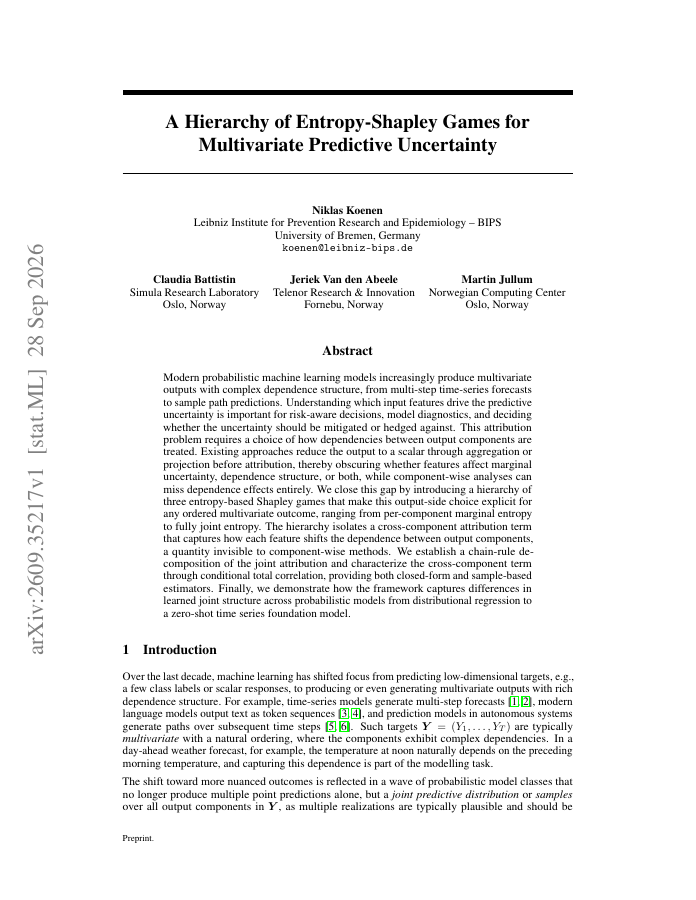
Modern probabilistic machine learning models increasingly produce multivariate outputs with complex dependence structure, from multi-step time-series forecasts to sample path predictions.
28 Sep 2026
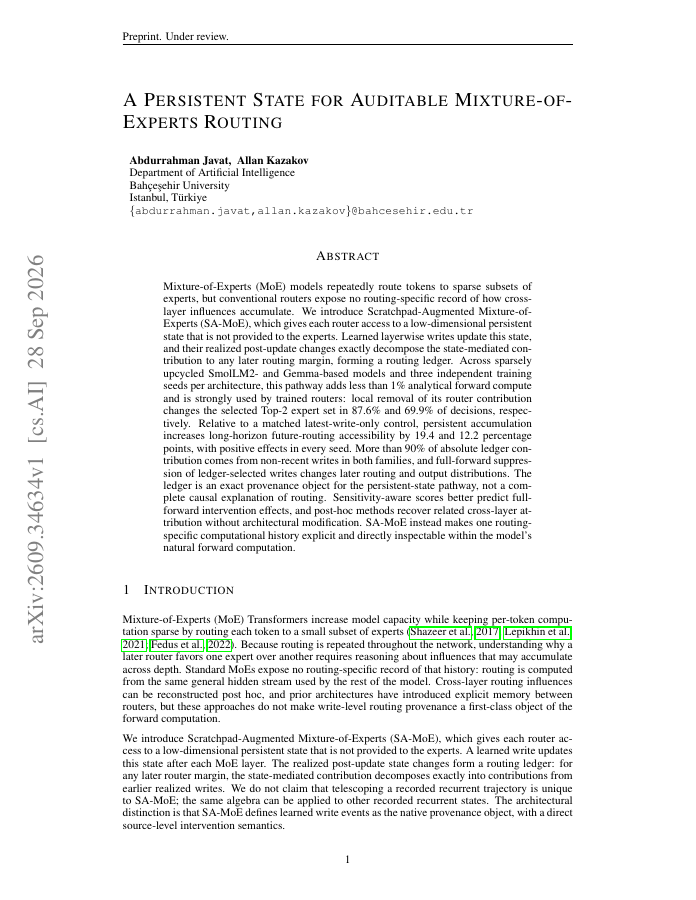
Mixture-of-Experts (MoE) models repeatedly route tokens to sparse subsets of experts, but conventional routers expose no routing-specific record of how cross-layer influences accumulate.
28 Sep 2026
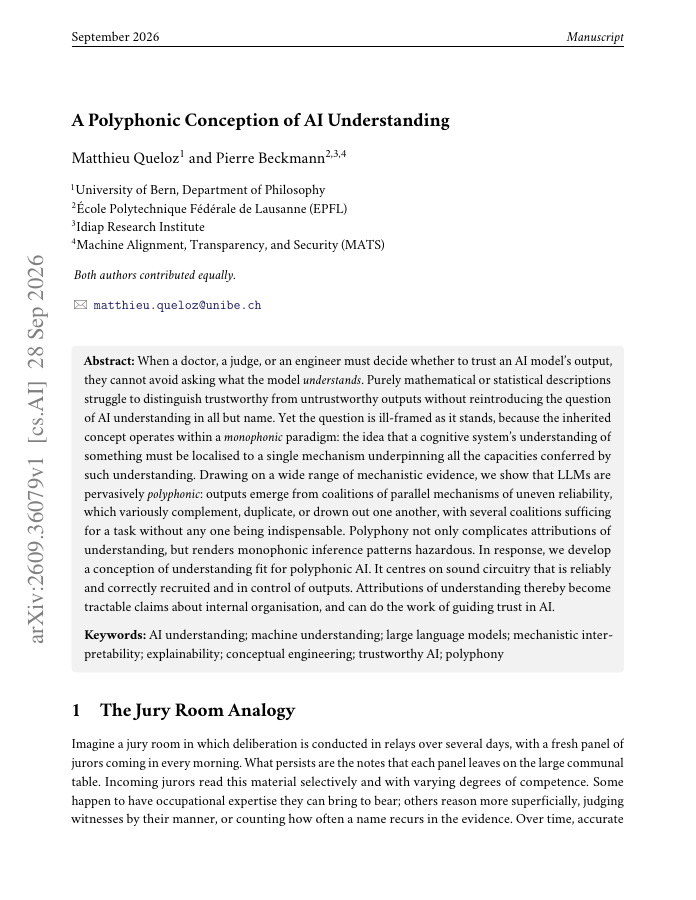
When a doctor, a judge, or an engineer must decide whether to trust an AI model's output, they cannot avoid asking what the model understands. Purely mathematical or statistical descriptions struggle to distinguish trustworthy from untrustworthy outputs without reintroducing the…
27 Sep 2026
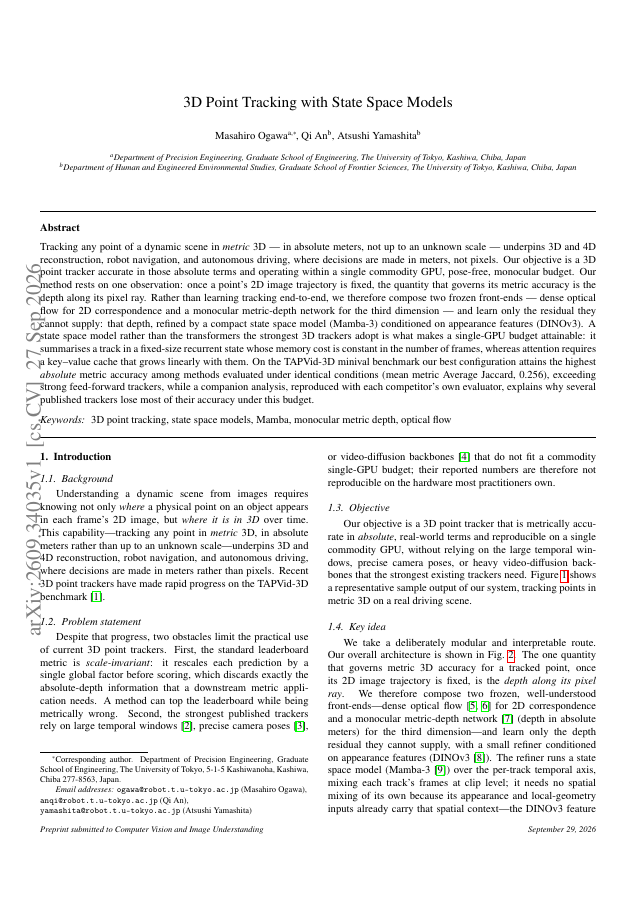
Tracking any point of a dynamic scene in metric 3D - in absolute meters, not up to an unknown scale - underpins 3D and 4D reconstruction, robot navigation, and autonomous driving, where decisions are made in meters, not pixels.
27 Sep 2026
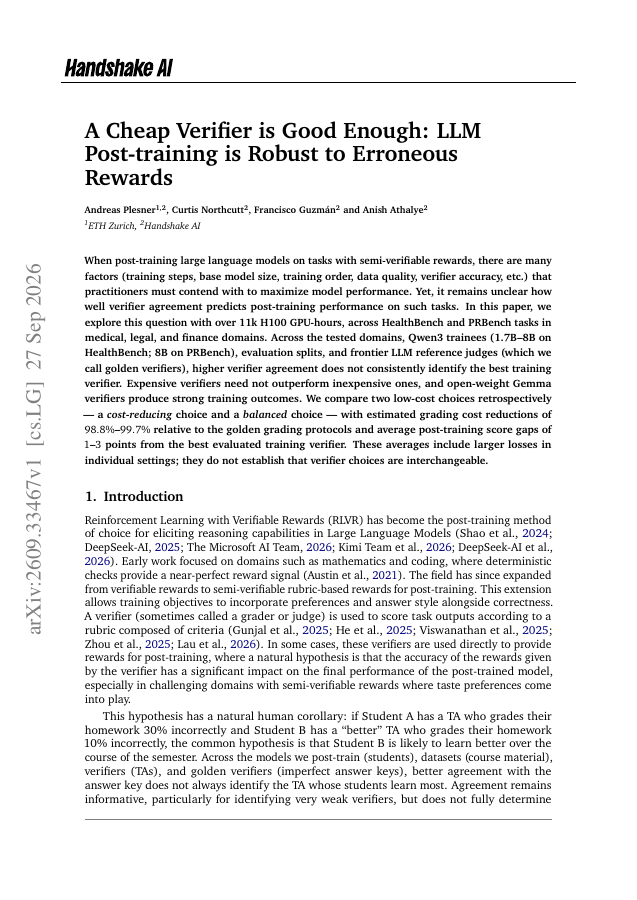
When post-training large language models on tasks with semi-verifiable rewards, there are many factors (training steps, base model size, training order, data quality, verifier accuracy, etc.) that practitioners must contend with to maximize model performance.
27 Sep 2026
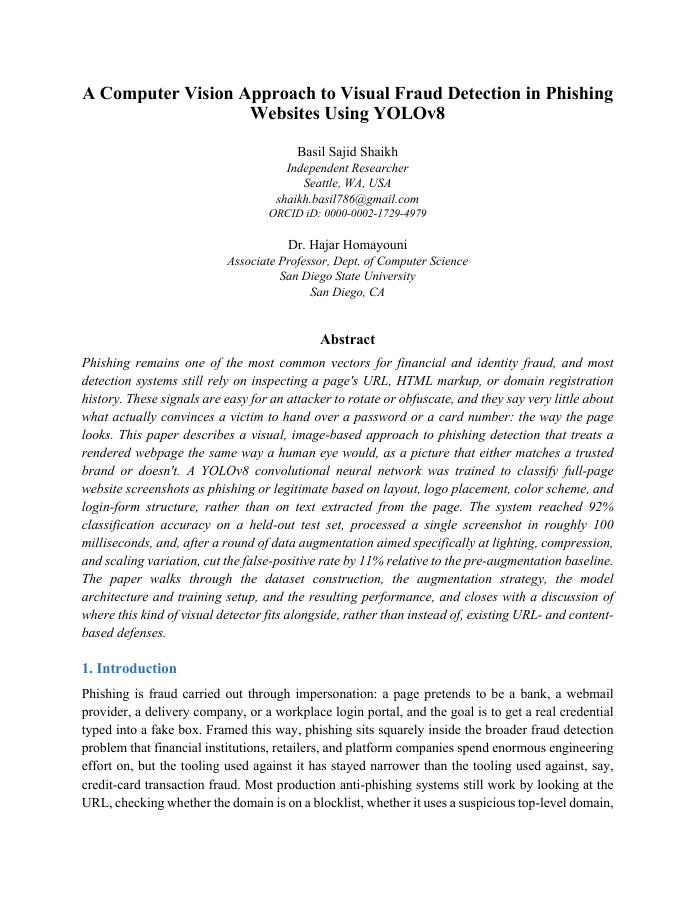
Phishing remains one of the most common vectors for financial and identity fraud, and most detection systems still rely on inspecting a page's URL, HTML markup, or domain registration history.
27 Sep 2026
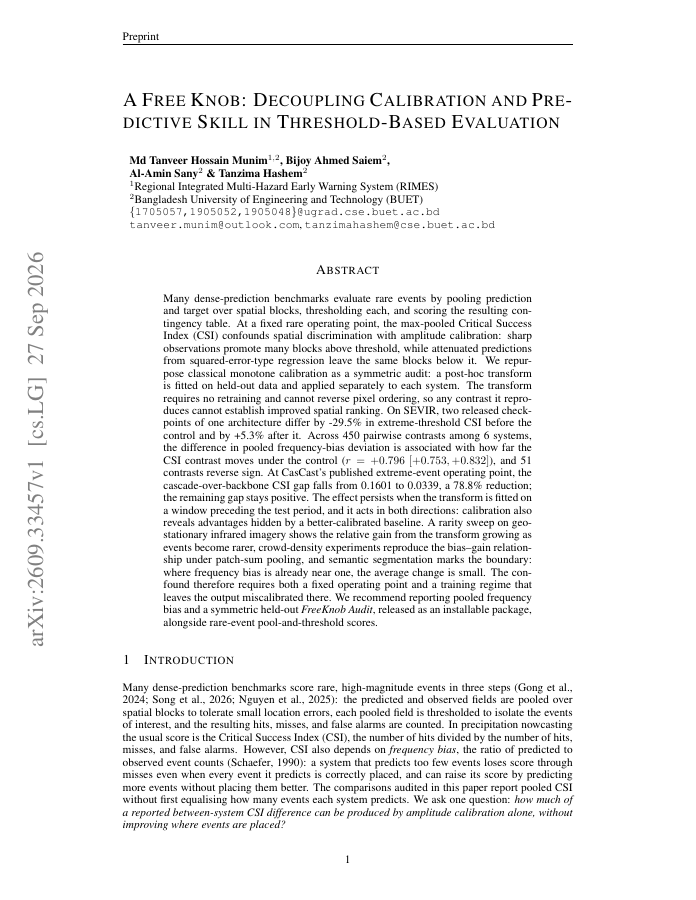
Many dense-prediction benchmarks evaluate rare events by pooling prediction and target over spatial blocks, thresholding each, and scoring the contingency table. At a fixed rare operating point, the max-pooled Critical Success Index (CSI) confounds spatial discrimination with…
27 Sep 2026
Self-supervised pretraining learns representations that are broadly transferable across downstream tasks, yet direct fine-tuning can be suboptimal due to misalignment between self-supervised and downstream task objectives, potentially degrading pretrained features beneficial to…
27 Sep 2026
How does compositional reasoning emerge during learning? We address this question by mathematically analyzing the learning dynamics of deep linear networks. We train these networks in structured synthetic environments and derive a theory linking the structure of experience to…
27 Sep 2026
Knowledge Distillation (KD) has emerged as a vital paradigm for transferring the capabilities of high-capacity models to efficient ``student'' counterparts, addressing critical challenges in computational cost, deployment constraints, and privacy-sensitive settings.