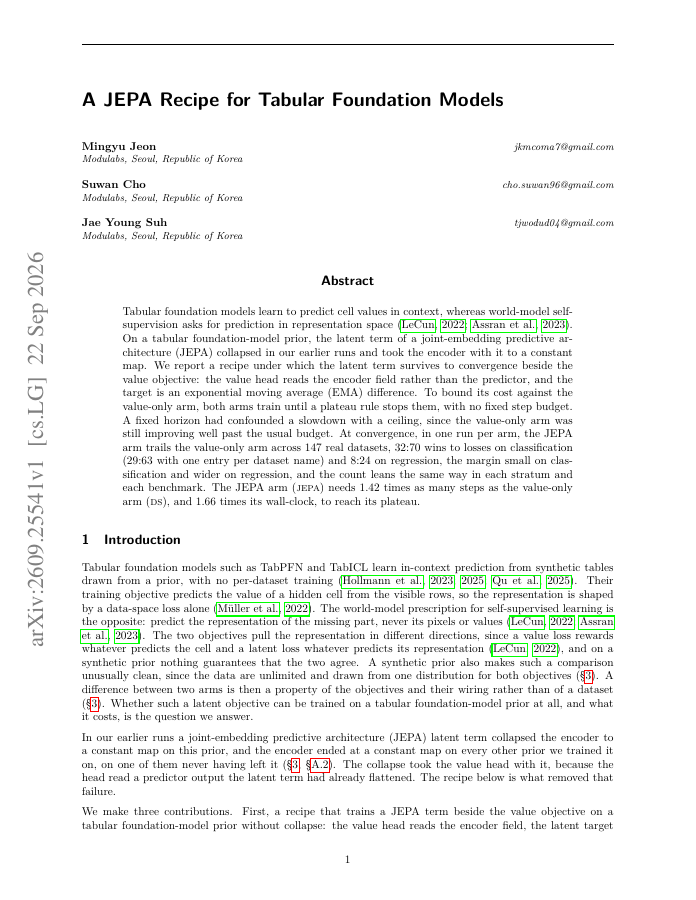
A JEPA Recipe for Tabular Foundation Models
22 Sep 2026
Tabular foundation models learn to predict cell values in context, whereas world-model self-supervision asks for prediction in representation space (LeCun, 2022; Assran et al., 2023).
Trending research and the full catalog - each paper linked to the benchmarks, methods, and models it introduces.
Filtering here covers the 2,000 most recent papers, as much as one page can hold in memory. See the full index of 22,851 papers.
22 Sep 2026
Tabular foundation models learn to predict cell values in context, whereas world-model self-supervision asks for prediction in representation space (LeCun, 2022; Assran et al., 2023).
22 Sep 2026
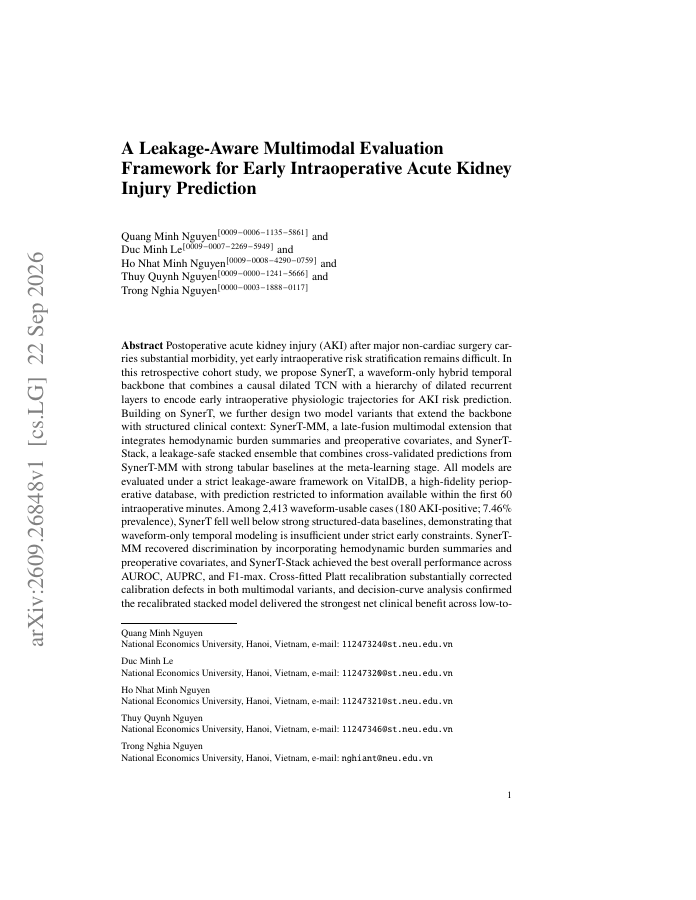
Postoperative acute kidney injury (AKI) after major non-cardiac surgery carries substantial morbidity, yet early intraoperative risk stratification remains difficult. In this retrospective cohort study, we propose SynerT, a waveform-only hybrid temporal backbone that combines a…
22 Sep 2026
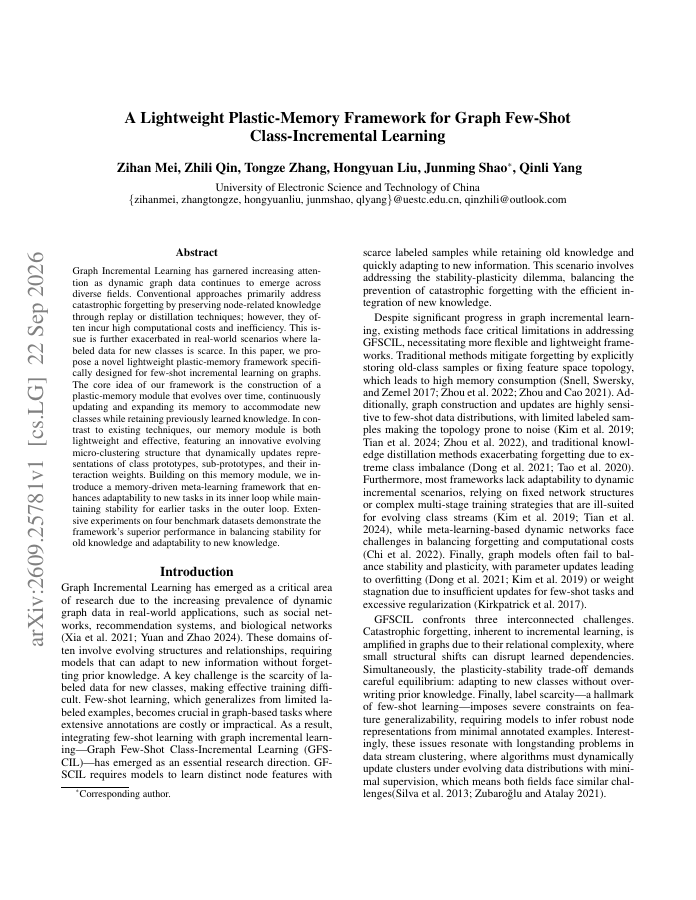
Graph Incremental Learning has garnered increasing attention as dynamic graph data continues to emerge across diverse fields. Conventional approaches primarily address catastrophic forgetting by preserving node-related knowledge through replay or distillation techniques;…
22 Sep 2026
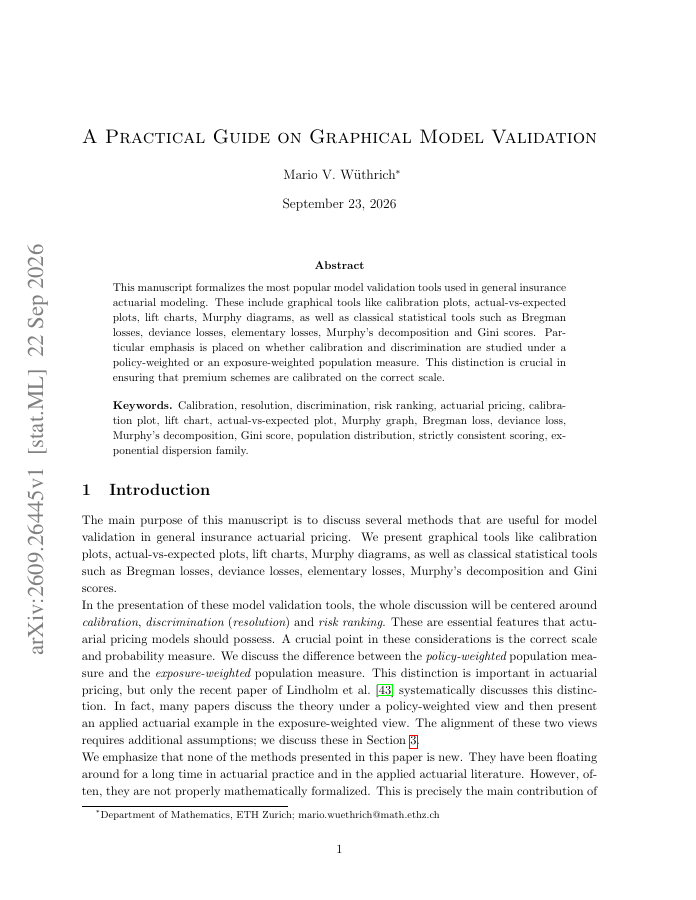
This manuscript formalizes the most popular model validation tools used in general insurance actuarial modeling. These include graphical tools like calibration plots, actual-vs-expected plots, lift charts, Murphy diagrams, as well as classical statistical tools such as Bregman…
22 Sep 2026
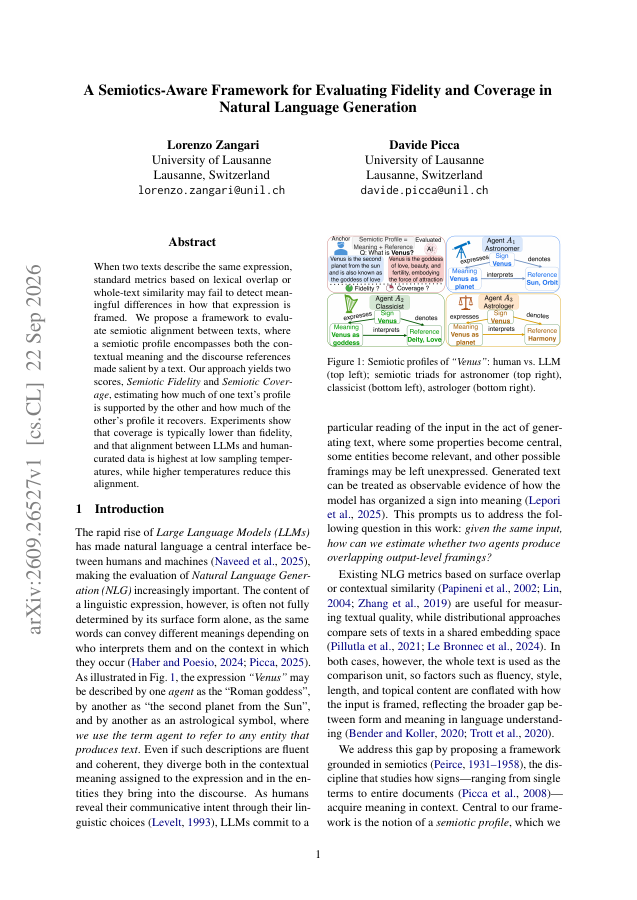
When two texts describe the same expression, standard metrics based on lexical overlap or whole-text similarity may fail to detect meaningful differences in how that expression is framed.
22 Sep 2026
In grokking an early fit to the training data separates from a much later improvement in generalization. During this delay, training can move from a fixed neural tangent kernel (NTK) regime to one in which task-relevant kernel eigendirections continue to evolve.
21 Sep 2026
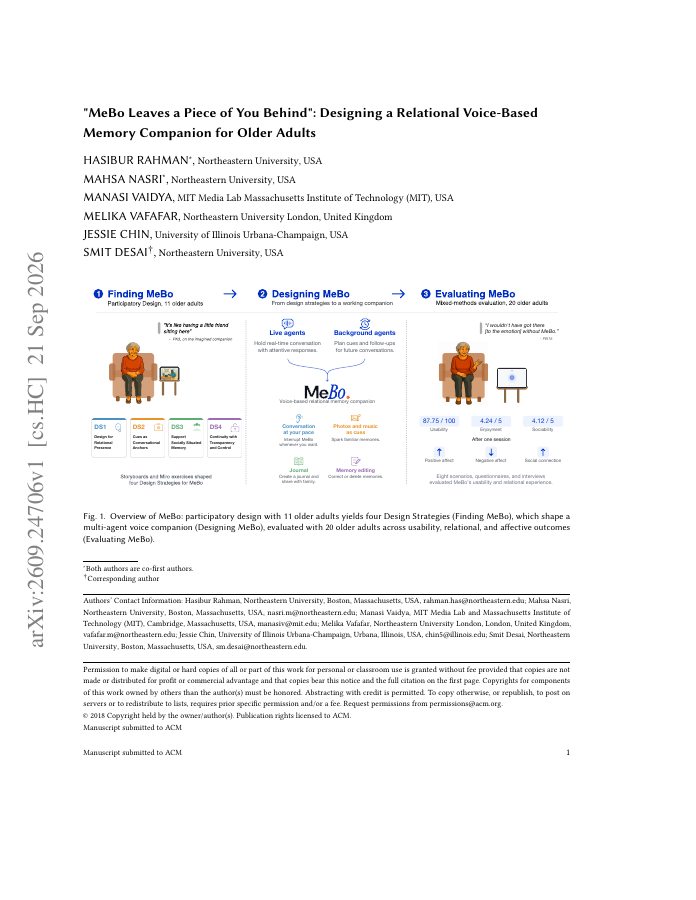
Autobiographical remembering supports identity, well-being, and social connection in later life, yet voice-based memory technologies largely rely on isolated prompts. We designed and built MeBo, a fully functional relational voice-based memory companion, through participatory…
21 Sep 2026
We present $t_0$, a family of open-weights foundation models for forecasting with multivariate context. We release its first two members: $\texttt{t0-alpha}$ and $\texttt{t0-beta}$, respectively 102M and 256M parameters.
21 Sep 2026
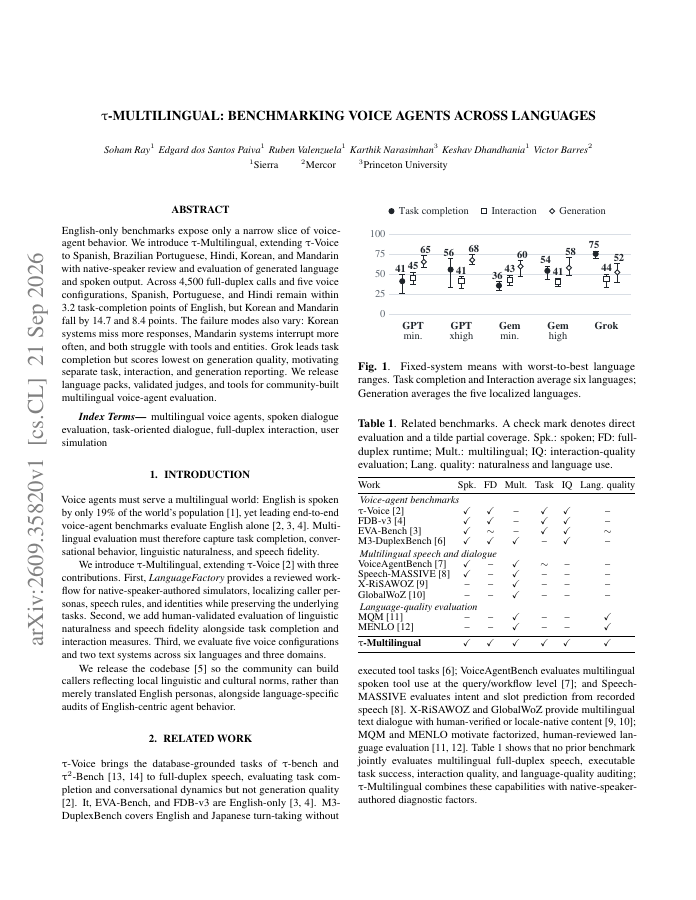
English-only benchmarks expose only a narrow slice of voice-agent behavior. We introduce $τ$-Multilingual, extending $τ$-Voice to Spanish, Brazilian Portuguese, Hindi, Korean, and Mandarin with native-speaker review and evaluation of generated language and spoken output.
21 Sep 2026
Sparse on-policy distillation (OPD) allocates teacher supervision to a small subset of tokens in student-generated trajectories. However, useful teacher guidance can yield a noisy update when its gradient is estimated from a sampled next token.
21 Sep 2026
Combining predictions from different models can improve performance at machine learning tasks, but the training of the individual models and the rule used to combine them are typically chosen separately, and by ad hoc means. Recent advances in distributional optimisation (i.e.
21 Sep 2026
While a centralized approach involving patient consent to collect and analyze data centrally would theoretically offer the best data quality and predictive performance, it is not always feasible in practice.
21 Sep 2026
Artificial intelligence (AI) registers and inventories aim to make governmental AI visible, but their institutional scope, schemas, and reporting practices construct different representations of public-sector AI.
21 Sep 2026
AI coding agents increasingly support software development beyond code completion, including planning, implementation, testing, and repository-level task execution. Their practical use, however, often remains only weakly connected to established software engineering practices.
21 Sep 2026
Recognizing hand-drawn geometric shapes is a foundational sub-problem of sketch recognition, with applications in education, human-computer interaction, and diagram digitization.
21 Sep 2026
Semi-supervised federated learning (SSFL) trains models on clients' unlabeled data using a teacher to generate pseudo-labels, with a small labeled seed dataset on the server.
21 Sep 2026
Music festival lineups emerge from complex relationships among artists, genres, releases, labels, and past performances, making the prediction of future lineups a natural fit for temporal knowledge graph (TKG) forecasting.
21 Sep 2026
Current experimental scientists increasingly rely on simulation-based inference (SBI) to invert complex models with intractable likelihoods. A primary goal in these settings is to obtain credible regions with valid coverage.
20 Sep 2026
Digital direct-to-consumer (DTC) health campaigns are usually measured after the fact. In-flight forecasting commonly relies on a separate classifier for every cutoff and horizon. We treat this task as a dynamic-system problem and build a compact patient world model.
19 Sep 2026
Parkinson's disease alters gait and bilateral coordination, but machine-learning performance also depends on how continuous gait signals are represented. This study investigates whether preserving anterior-posterior center-of-pressure (AP-COP) information at fixed locations…
19 Sep 2026
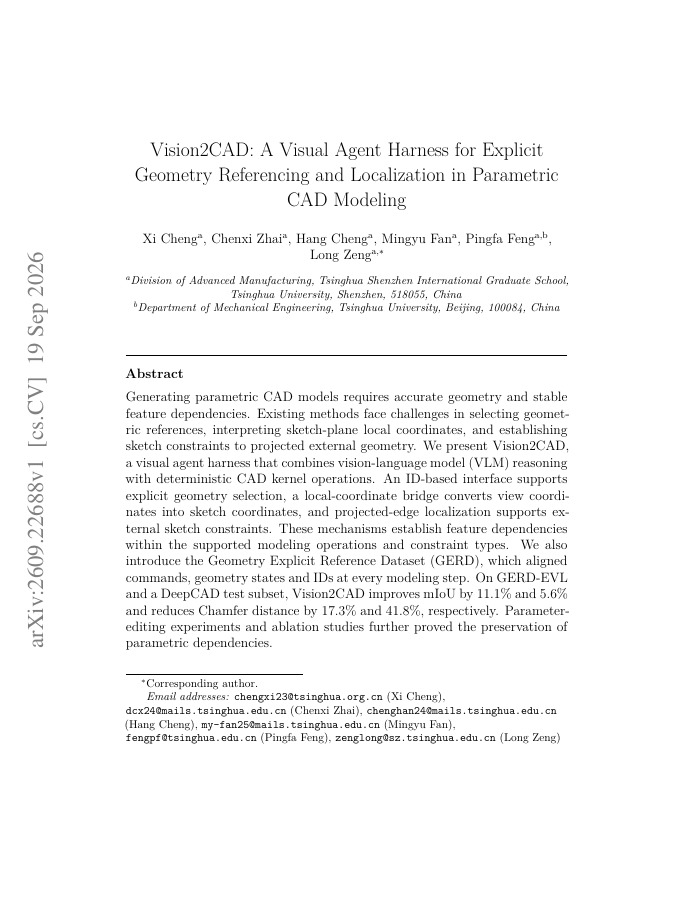
Parametric CAD modeling requires not only matching the target shape, but also preserving design intent under parameter edits. However, most existing methods focus on improving static shape generation accuracy, while the dependencies that govern later edits are often overlooked.
19 Sep 2026
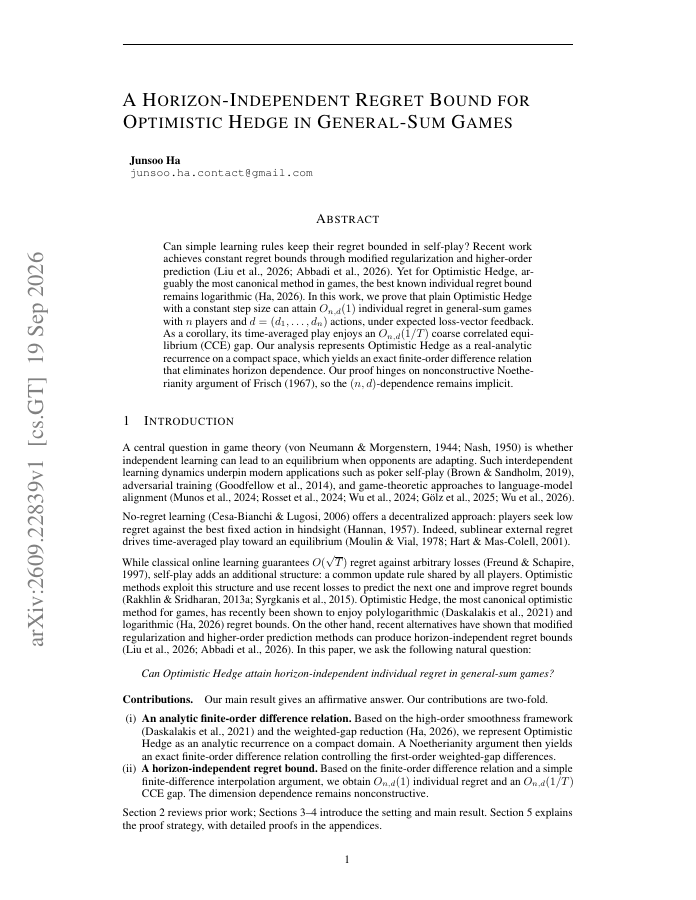
Can simple learning rules keep their regret bounded in self-play? Recent work achieves constant regret bounds through modified regularization and higher-order prediction.
19 Sep 2026
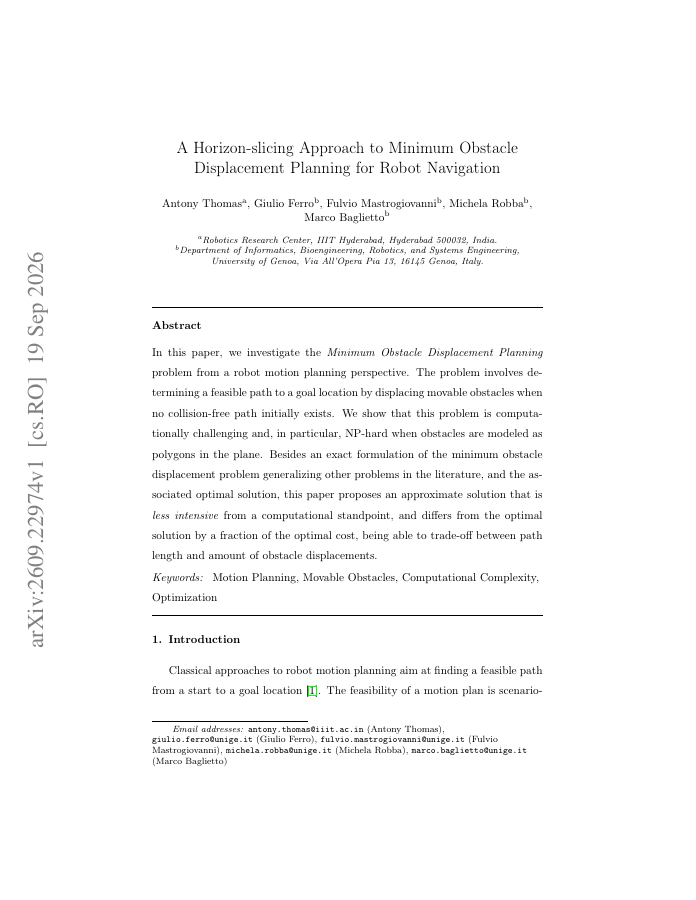
In this paper, we investigate the Minimum Obstacle Displacement Planning problem from a robot motion planning perspective. The problem involves determining a feasible path to a goal location by displacing movable obstacles when no collision-free path initially exists.
19 Sep 2026
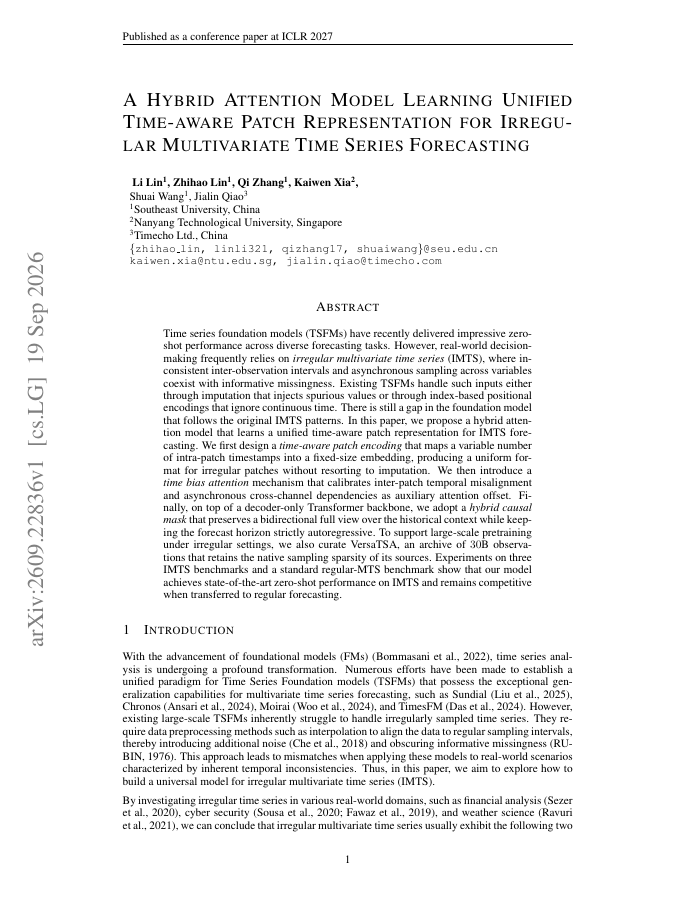
Time series foundation models (TSFMs) have recently delivered impressive zero-shot performance across diverse forecasting tasks. However, real-world decision-making frequently relies on \emph{irregular multivariate time series} (IMTS), where inconsistent inter-observation…