7 Aug 2026
Hanneke, Moran, and Waknine \cite{HannekeMoranWaknine2024} asked how the agnostic PAC learning curve of the direct sum $C^r$ depends on the single-instance learning curve $\epsagn(n\mid C)$ and on $r$.
Trending research and the full catalog - each paper linked to the benchmarks, methods, and models it introduces.
Filtering here covers the 2,000 most recent papers, as much as one page can hold in memory. See the full index of 22,851 papers.
7 Aug 2026
Hanneke, Moran, and Waknine \cite{HannekeMoranWaknine2024} asked how the agnostic PAC learning curve of the direct sum $C^r$ depends on the single-instance learning curve $\epsagn(n\mid C)$ and on $r$.
7 Aug 2026
Predicting failures before they occur remains a major challenge in predictive maintenance, particularly when failures are rare, when equipment of the same family differ in sensor configurations, and when the goal is anticipation rather than diagnosis of an already observed…
6 Aug 2026
We give a negative solution to MAIS-O60. We first construct an example in which an initially active ReLU neuron becomes completely inactive in finite time and thereafter remains frozen at a limit whose Fourier energy is equally distributed among all nonzero real frequency…
6 Aug 2026
Reliable uncertainty estimates are critical in safety-sensitive applications. For such estimates to be useful in practice, it is crucial to understand the sources underlying a model's uncertainty, motivating the disentanglement of total uncertainty into epistemic and aleatoric…
6 Aug 2026
Respiration provides a continuously available window into physiological state and behavior. However, monitoring it outside controlled settings remains challenging because a wearable system must capture small body deformations while remaining comfortable, low power, and robust to…
6 Aug 2026
Residual connections are a fundamental component of transformer architectures, yet the roles of the attention and feed-forward residual pathways remain poorly understood when considered independently.
6 Aug 2026
Post-training adaptation has become central to modern machine learning practice and includes techniques such as retraining, fine-tuning, parameter-efficient adaptation, alignment, retrieval augmentation, model editing, unlearning, calibration, and Multimodal Instruction Tuning.
6 Aug 2026
Large language model (LLM)-driven multi-agent systems typically require multiple model invocations and complex coordination during inference, and their execution strategies directly affect system accuracy, latency, and computational cost.
6 Aug 2026
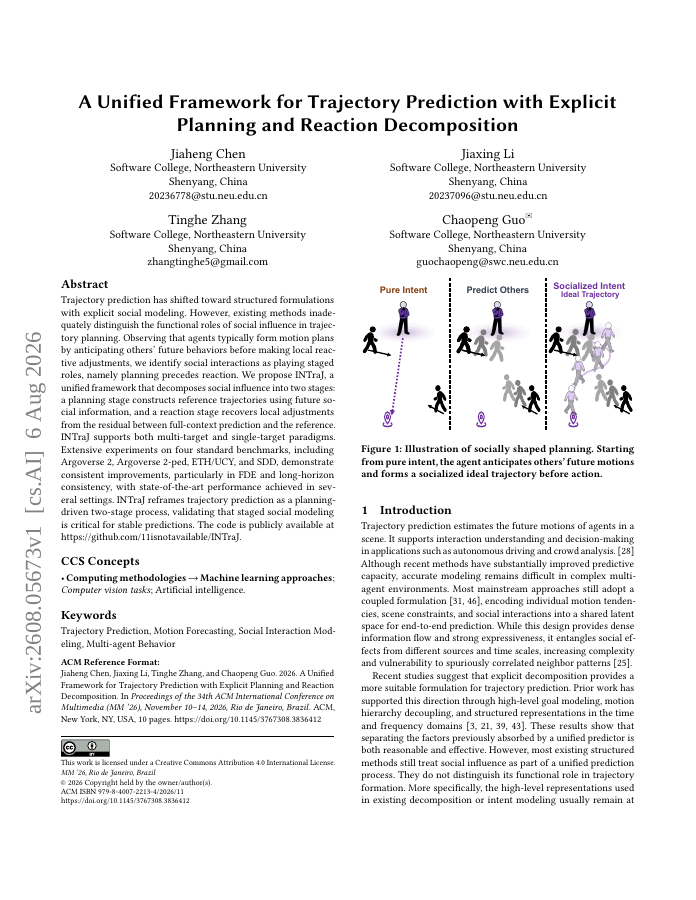
Trajectory prediction has shifted toward structured formulations with explicit social modeling. However, existing methods inadequately distinguish the functional roles of social influence in trajectory planning.
5 Aug 2026
Integrated Sensing and Communication (ISAC) combines sensing and communication to efficiently utilize wireless resources and is emerging as a key paradigm for next-generation wireless networks.
5 Aug 2026
Large Language Models (LLMs) are accelerating biological research, yet this same capability poses a critical biosecurity threat: models that assist in protein engineering can equally be prompted to generate predicted toxin-like sequences, potentially lowering the barrier to…
5 Aug 2026
As AI systems become increasingly integrated into diverse interfaces and applications, model-centric audits are insufficient to address risks arising from interactions among system components and deployment environments.
5 Aug 2026
Prenatal ultrasound imaging is key for assessing fetal health, but AI progress is limited by scarce, privacy-restricted, and hard-to-annotate datasets. We propose a high-resolution fetal ultrasound synthesis framework based on the EDM2 diffusion architecture, trained on multiple…
5 Aug 2026
The emergence of the ISO standard GQL introduces a powerful query language extending first-order logic with controlled recursion, raising the question of its applicability to evaluation of ontology-mediated queries (OMQs).
5 Aug 2026
Multimodal large language model (MLLM) unlearning methods have been proposed to remove private, sensitive, or proprietary information from well-trained models. However, most existing MLLM unlearning methods are designed for one-shot requests and fail to adequately address…
5 Aug 2026
Part-of-speech tagging for low-resource languages remains challenging due to limited annotated data, especially for linguistically complex languages. Gaidhlig (Scottish Gaelic) is a morphologically rich and endangered language with limited digital resources, making it suitable…
5 Aug 2026
We developed a unified covariate-adjusted causal inference framework for estimating the desirability of outcome ranking (DOOR) probability for benefit-risk evaluation in randomized trials and observational studies.
4 Aug 2026
This article analyses narrative mechanisms that are common in dialogues with LLM chatbots. In combination, these mechanisms produce an interactional strategy for maximising user engagement, which we call affirmative narration.
4 Aug 2026
Reasoning-based large language model (LLM) safeguards improve safety classification accuracy by generating explicit rationales before making decisions. However, generating explicit rationales adds substantial decoding overhead to every safety decision, while readable…
4 Aug 2026
Feature selection is a critical step in electronic health record (EHR)-based predictive modeling, where input variables are often high-dimensional, sparse, noisy, and redundant.
4 Aug 2026
For a Markov kernel $T$ with an invariant probability measure $π$, we give a self-contained proof of the Markov chain convergence theorem via a criterion called asymptotic equivalence with the target.
4 Aug 2026
Pretrained large language models (LLMs) have demonstrated in-context learning (ICL) capabilities for numerical inference over sequences serialized as text. Prior work has identified and characterized this form of numerical inference primarily through output-level evaluations…
4 Aug 2026
Diffusion policies have shown strong performance in learning complex, multi-modal behaviors for robotic manipulation. However, their application to contact-rich disassembly tasks remains limited by a key trade-off: the iterative denoising process introduces inference latencies…
4 Aug 2026
Sign language recognition (SLR) enhances communication between hearing and hearing-impaired individuals. Although deep learning (DL) has achieved promising performance in SLR, its high computational cost limits deployment on edge devices.