6 Sep 2026
Recent studies report that automated red-teaming finds more vulnerabilities, at lower cost, than human red-teaming on standard AI safety benchmarks, and some read this as evidence that human evaluators are becoming dispensable.
Trending research and the full catalog - each paper linked to the benchmarks, methods, and models it introduces.
Filtering here covers the 2,000 most recent papers, as much as one page can hold in memory. See the full index of 23,103 papers.
6 Sep 2026
Recent studies report that automated red-teaming finds more vulnerabilities, at lower cost, than human red-teaming on standard AI safety benchmarks, and some read this as evidence that human evaluators are becoming dispensable.
6 Sep 2026
Machine learning methods, and especially neural networks, are now routinely used for malware detection in network traffic. Though very effective, systems based on such methods often (i) are purely data-driven, ignoring the substantial body of available knowledge about the…
5 Sep 2026
We study a finite-horizon online resource allocation problem with initial resource capacities proportional to the horizon. In each period, a request type is observed and one action is chosen from a finite menu. Each action earns a reward and consumes a vector of resources.
4 Sep 2026
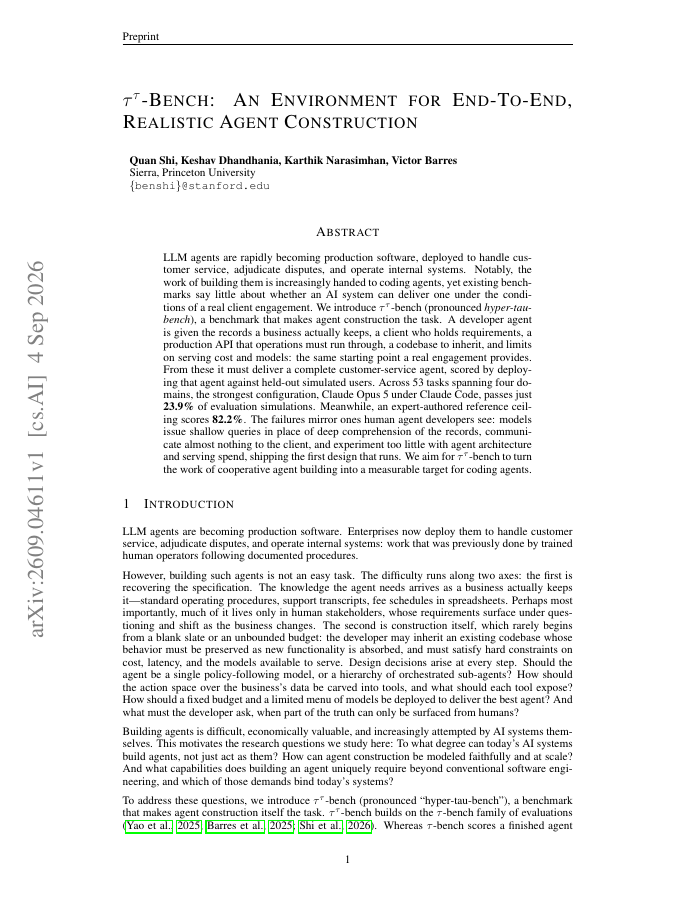
LLM agents are rapidly becoming production software, deployed to handle customer service, adjudicate disputes, and operate internal systems. Notably, the work of building them is increasingly handed to coding agents, yet existing benchmarks say little about whether an AI system…
4 Sep 2026
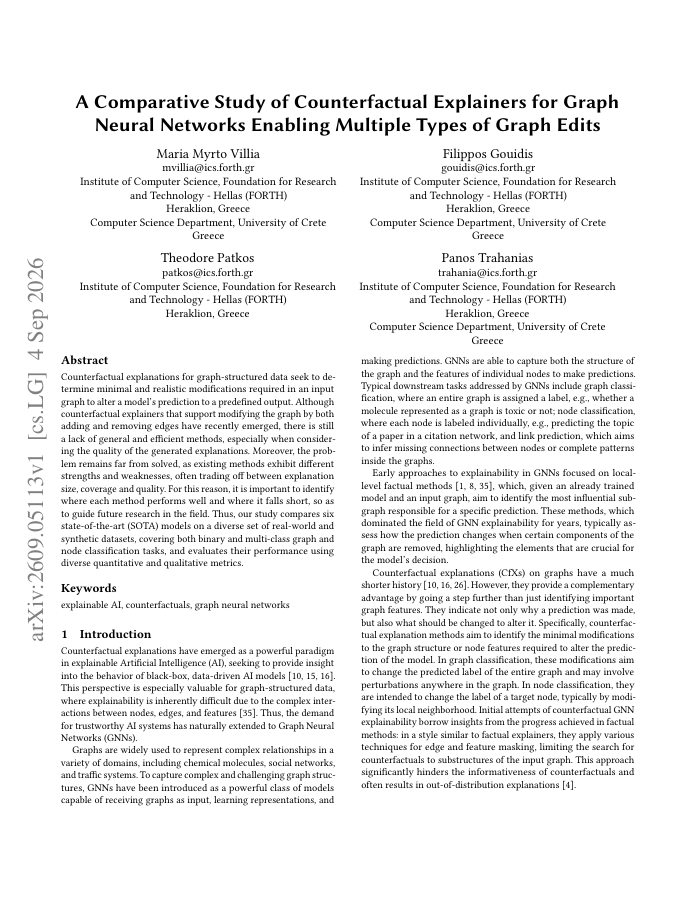
Counterfactual explanations for graph-structured data seek to determine minimal and realistic modifications required in an input graph to alter a model's prediction to a predefined output.
4 Sep 2026
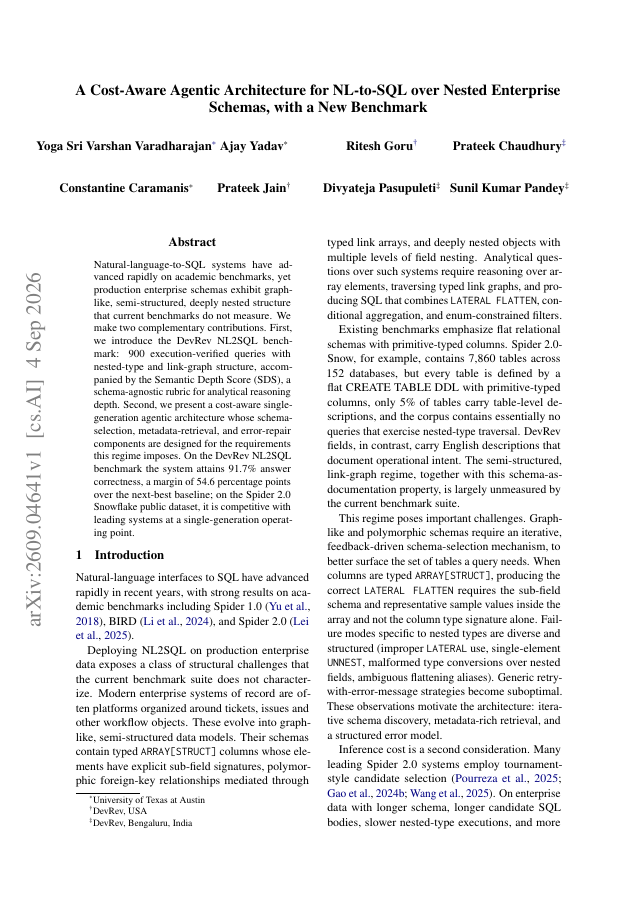
Natural-language-to-SQL systems have ad- vanced rapidly on academic benchmarks, yet production enterprise schemas exhibit graph- like, semi-structured, deeply nested structure that current benchmarks do not measure. We make two complementary contributions.
4 Sep 2026
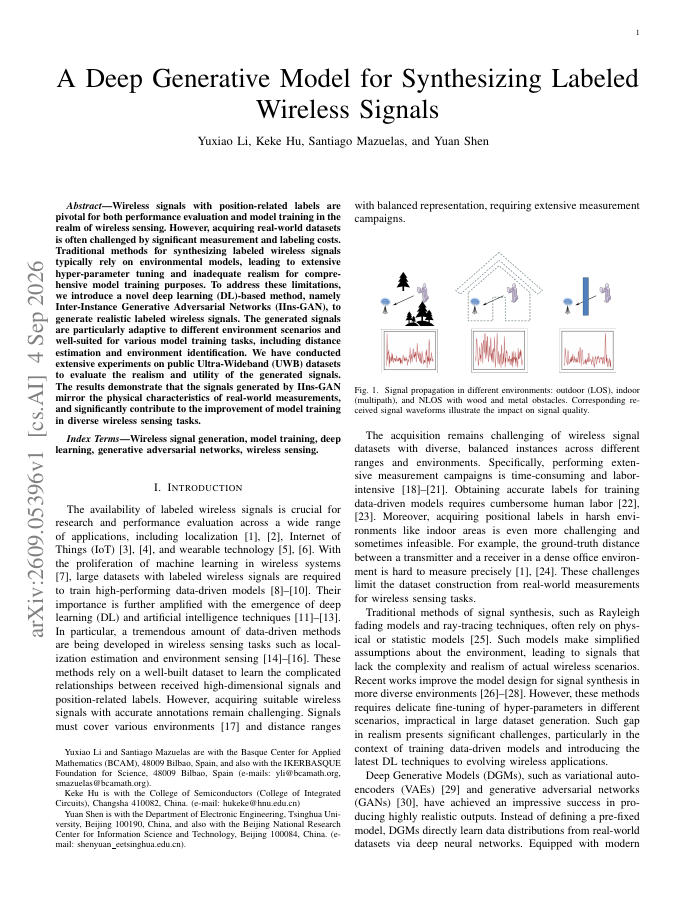
Wireless signals with position-related labels are pivotal for both performance evaluation and model training in the realm of wireless sensing. However, acquiring real-world datasets is often challenged by significant measurement and labeling costs.
4 Sep 2026
Large-volume neutrino telescopes infer neutrino properties from Cherenkov light, but simulating the transport of billions of photons through highly scattering ice or water is computationally costly.
4 Sep 2026
The Duckworth-Lewis-Stern (DLS) method has been the international standard for revising target scores in rain-interrupted limited-overs cricket since 1999. Despite over two decades of operational use, no large-scale empirical audit of its prediction bias has been published.
4 Sep 2026
Long-horizon ego/exo data contains rich procedural evidence, but are redundant, noisy, and costly to process or retain. We propose a compact framework that converts continuous multimodal workplace video into a structured Procedural State Memory, implemented as a Work Environment…
4 Sep 2026
The integration of artificial intelligence (AI), particularly large language models (LLMs), into educational assessment has opened new opportunities to enhance the efficiency and scalability of grading processes.
4 Sep 2026
This study introduces an intelligent framework that integrates machine learning and deep neural network ensemble techniques for early detection and prognosis of cardiovascular diseases.
4 Sep 2026
Alternative property recommendations play a critical role in vacation rental marketplaces, helping users discover relevant options when viewing a specific listing. However, generating high-quality candidate alternatives presents unique challenges: heterogeneous inventory,…
4 Sep 2026
We consider the problem of minimizing error in quantized matrix multiplication $C=AB$. Scalar quantization of the factors introduces rounding errors whose scale depends on the maximum absolute entries -- the ranges -- of their rows and columns.
4 Sep 2026
The high training cost of Graph Neural Networks (GNNs) has raised growing concerns regarding model ownership infringement, such as model stealing and unauthorized misuse.
4 Sep 2026
Opioid use disorder (OUD) remains a public health crisis in the United States, yet it is difficult to identify from electronic health records (EHRs) because missing diagnosis codes and supporting evidence are buried in clinical narratives.
4 Sep 2026
This paper addresses navigation by composite heterogeneous robots in a decentralized system when policy reasoning and local control operate at different update levels. In a NetLogo--Python implementation, three robots share motion dynamics but use different LLM backends.
4 Sep 2026
Large language models (LLMs) show potential for medical tasks, but their single-turn question-answer format does not reflect how clinical diagnosis is performed in practice. As a result, they remain limited in complex diagnostic settings.
4 Sep 2026
Multilingual language models develop shared cross-lingual representations, and various interpretability methods claim to quantify this sharing. These methods have been developed largely in isolation, and when they disagree, it is unclear whether the disagreement reflects a…
4 Sep 2026
Recent structured RAG methods leverage tree- or graph-based reasoning structures to improve multi-hop QA. However, they face key limitations in evidence-intensive QA, where answering a question requires synthesizing information scattered across dozens or even hundreds of…
3 Sep 2026
Chain-of-thought (CoT) reasoning improves large reasoning models (LRMs) on complex tasks but often produces long, redundant traces. Recent training-free early-exit methods shorten these traces by choosing an intermediate point to stop reasoning.
3 Sep 2026
Modern AI agent harnesses expose lifecycle hooks that bind shell commands to runtime events such as session start, tool calls, and file edits. These commands run with host privileges yet ship as lifecycle-hook configuration and may fire at times the LLM never observes.
3 Sep 2026
A critical challenge in deploying Large Language Models (LLMs) is developing reliable mechanisms to estimate their confidence, enabling systems to determine when to trust model outputs versus seek human intervention.
3 Sep 2026
Multi-agent AI science ecosystems rely on agents possessing tools that allow them to communicate, coordinate, and build on each other's work. Yet this shared infrastructure can also introduce vulnerabilities by creating a substrate for the contagious spread of unintended and…