9 Sep 2026
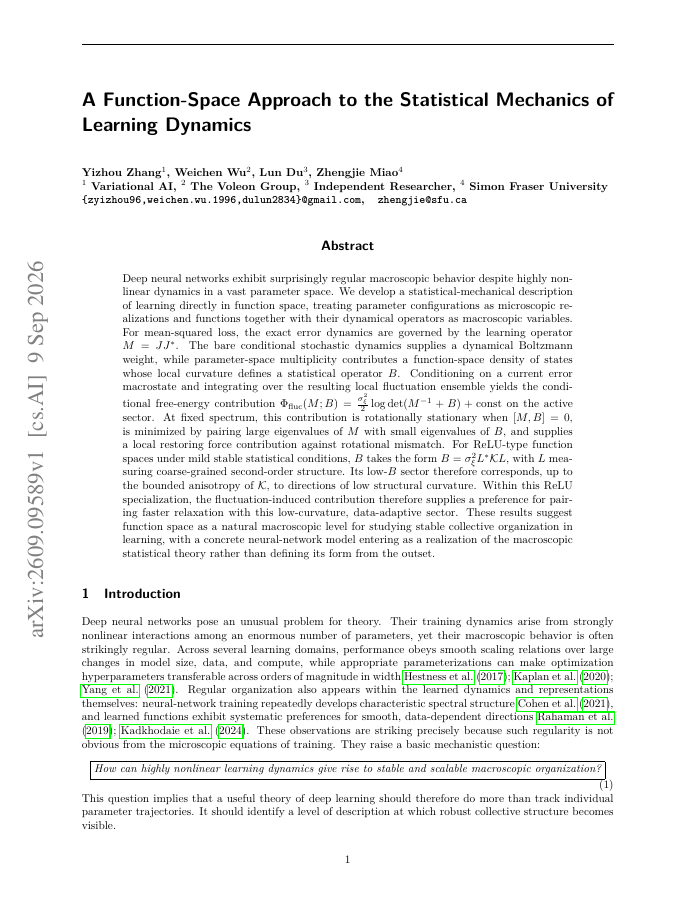
In the kernel regime, neural-network learning inherits its preferences from a frozen spectrum. During feature learning, this spectrum evolves, yet networks retain systematic biases toward simple, smooth directions.
Trending research and the full catalog - each paper linked to the benchmarks, methods, and models it introduces.
Filtering here covers the 2,000 most recent papers, as much as one page can hold in memory. See the full index of 23,119 papers.
9 Sep 2026
In the kernel regime, neural-network learning inherits its preferences from a frozen spectrum. During feature learning, this spectrum evolves, yet networks retain systematic biases toward simple, smooth directions.
9 Sep 2026
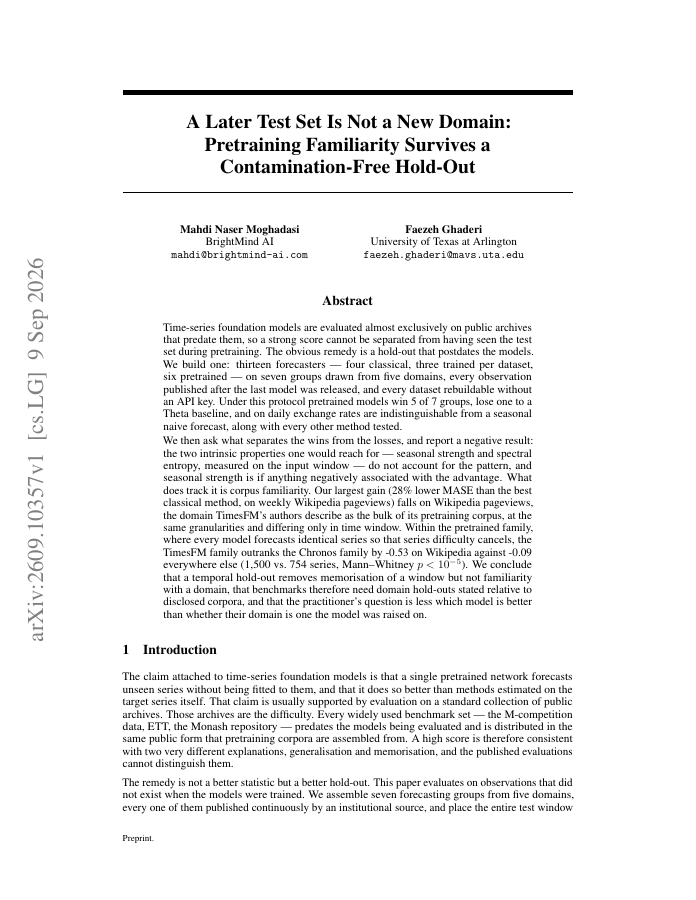
Time-series foundation models are evaluated almost exclusively on public archives that predate them, so a strong score cannot be separated from having seen the test set during pretraining. The obvious remedy is a hold-out that postdates the models.
9 Sep 2026
The Abstraction and Reasoning Corpus (ARC) benchmarks cognitive generalization, the ability to infer and apply abstract rules from limited examples. This paper presents a multi-stage rule-chaining framework that performs compositional reasoning across symbolic, structural, and…
9 Sep 2026
Quantum-inspired classical algorithms have dequantized several quantum machine learning routines by replacing quantum linear-algebra subroutines with classical counterparts.
9 Sep 2026
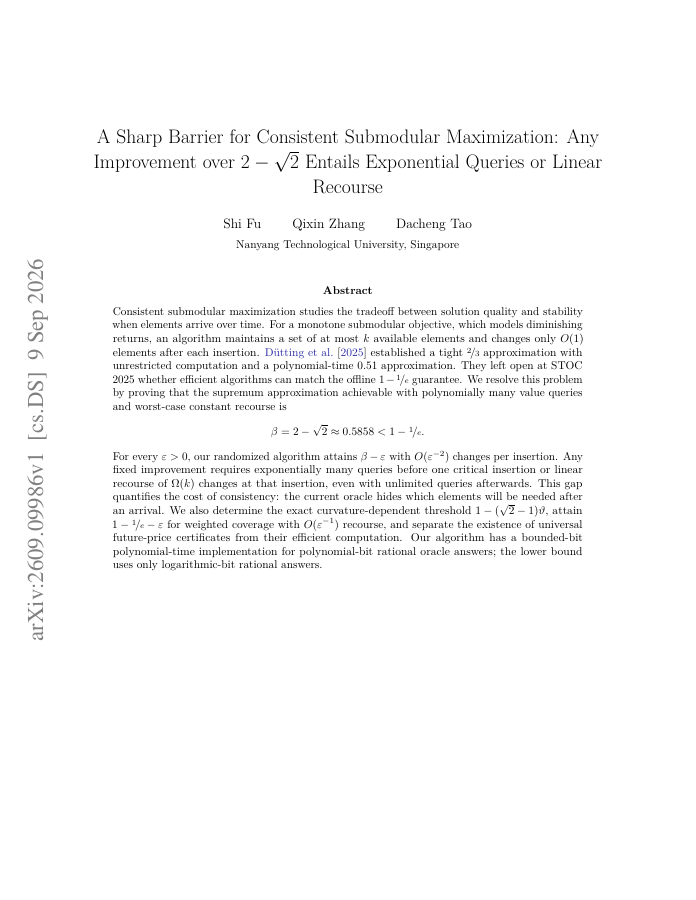
Consistent submodular maximization aims to maintain a high-utility subset of size at most $k$ as new elements arrive one by one, while changing only a limited number of elements per update.
9 Sep 2026
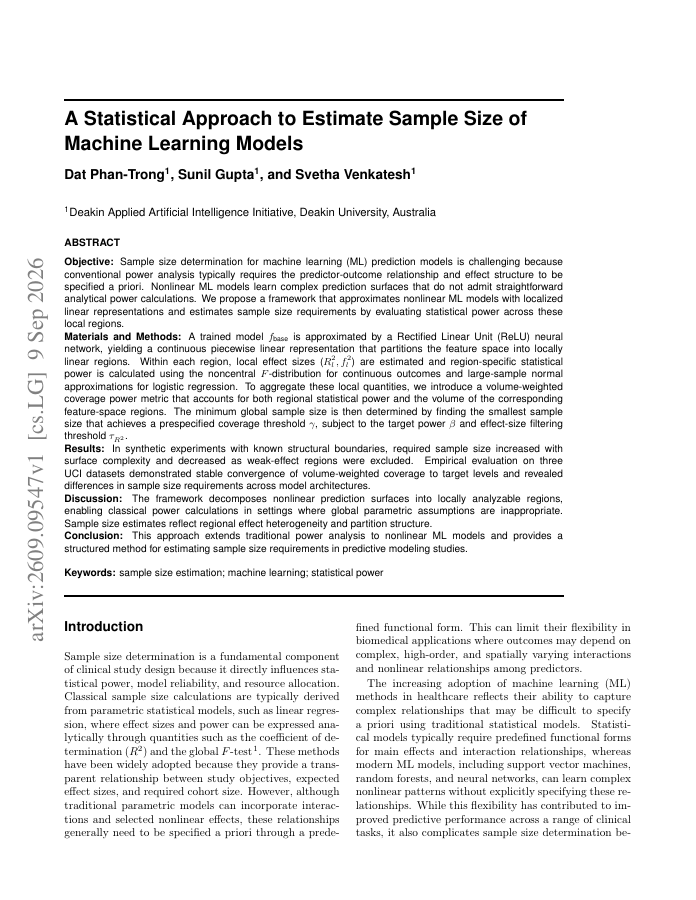
Sample size determination for machine learning (ML) prediction models is challenging because conventional power analysis typically requires the predictor-outcome relationship and effect structure to be specified a priori.
9 Sep 2026
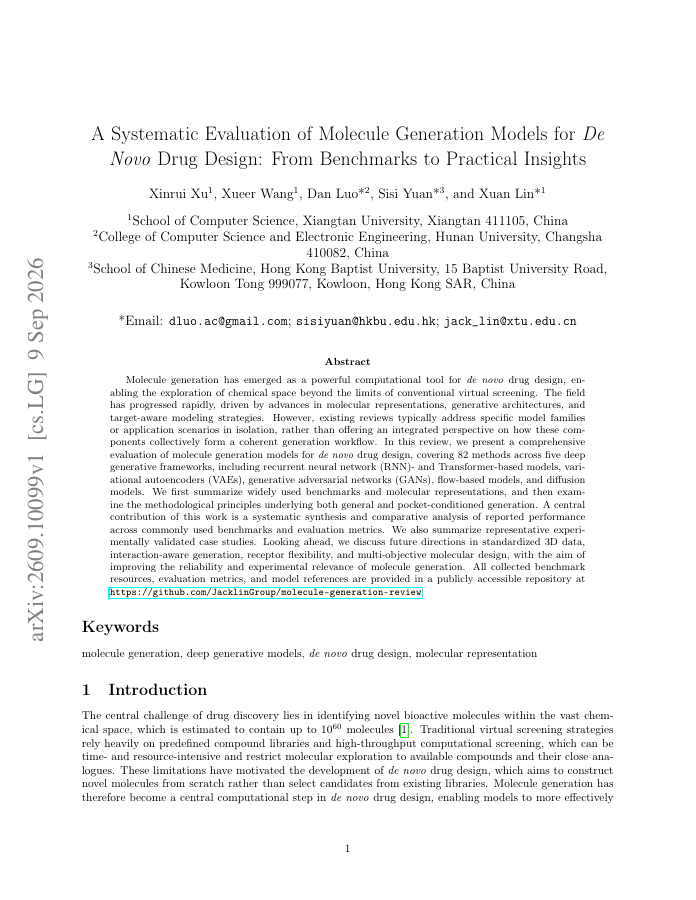
Molecule generation has emerged as a powerful computational tool for de novo drug design, enabling the exploration of chemical space beyond the limits of conventional virtual screening.
8 Sep 2026
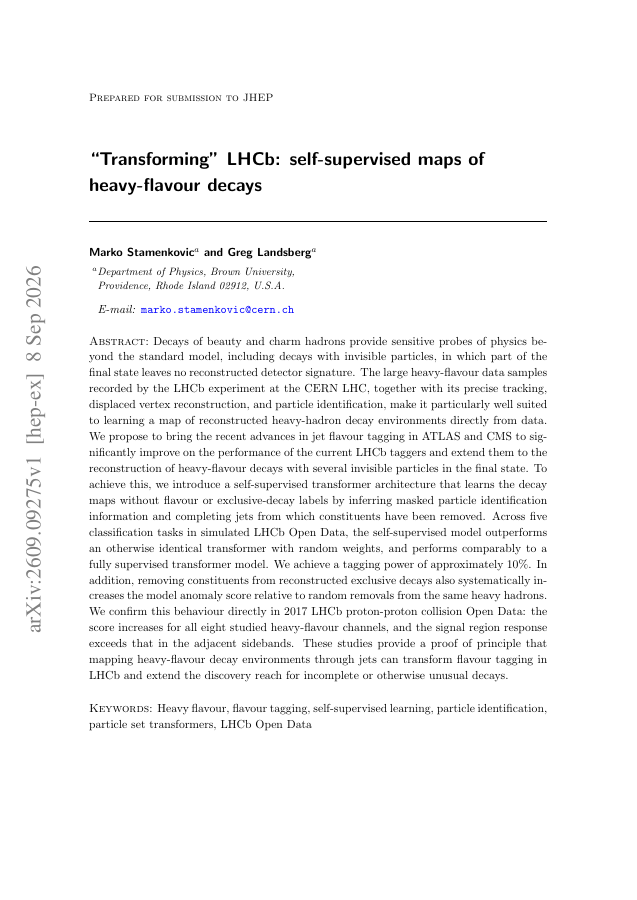
Decays of beauty and charm hadrons provide sensitive probes of physics beyond the standard model, including decays with invisible particles, in which part of the final state leaves no reconstructed detector signature.
8 Sep 2026
Intermediate representations are key to bridging the modality gap between generalizable manipulation policies and large-scale pretrained vision-language models (VLMs). Among these, trajectory-based representations compactly represent motion-relevant cues, yet most existing…
8 Sep 2026
Real-world Multi-Objective Reinforcement Learning (MORL) often suffers from sparse rewards, reward conflicts, and late-stage reward tug-of-war, causing traditional linear scalarization to experience severe metric oscillations.
8 Sep 2026
Quantum state tomography is a fundamental technique for estimating the state of a quantum system from measured data and plays a crucial role in evaluating the performance of quantum devices.
8 Sep 2026
When an external reference set (an anchor) is used to decompose an LLM-judge panel's error into a quality signal and a shared common-mode error, standard practice assumes the anchor is uncontaminated: its error uncorrelated with the judges' shared error.
8 Sep 2026
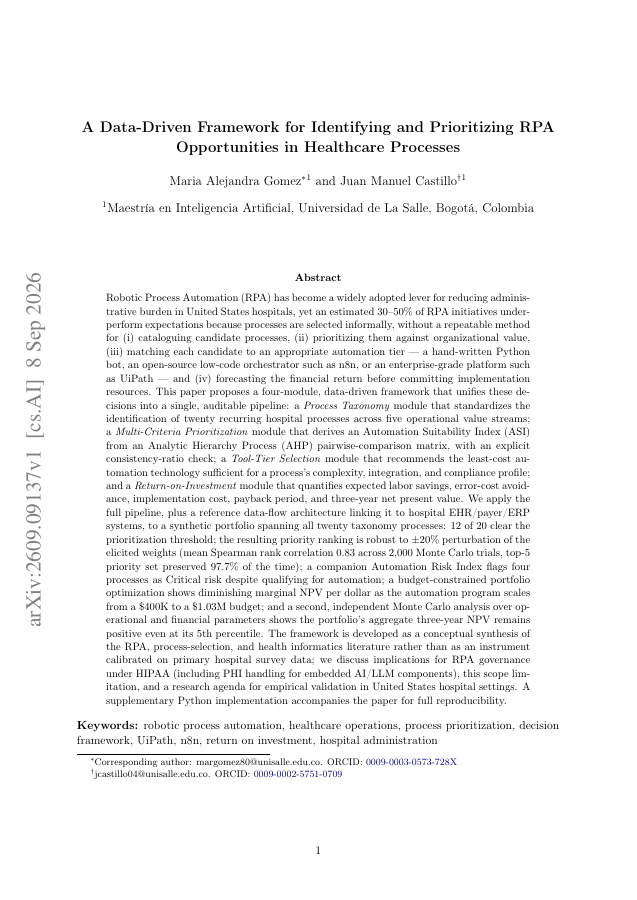
Robotic Process Automation (RPA) is widely used to reduce administrative burden in United States hospitals, yet an estimated 30-50% of RPA initiatives underperform because processes are selected informally, without a repeatable method to catalogue candidates, prioritize them,…
8 Sep 2026
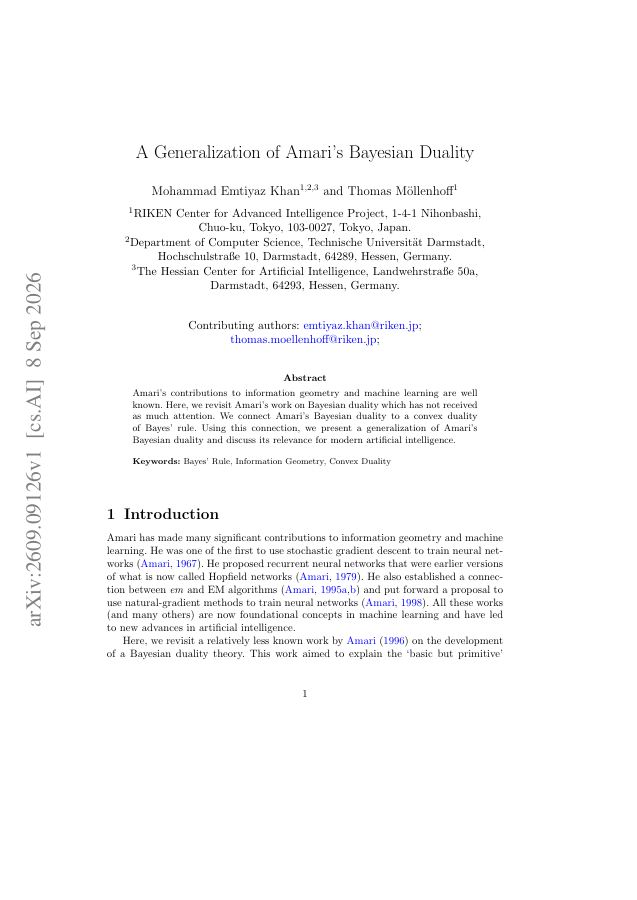
Amari's contributions to information geometry and machine learning are well known. Here, we revisit Amari's work on Bayesian duality which has not received as much attention. We connect Amari's Bayesian duality to a convex duality of Bayes' rule.
8 Sep 2026
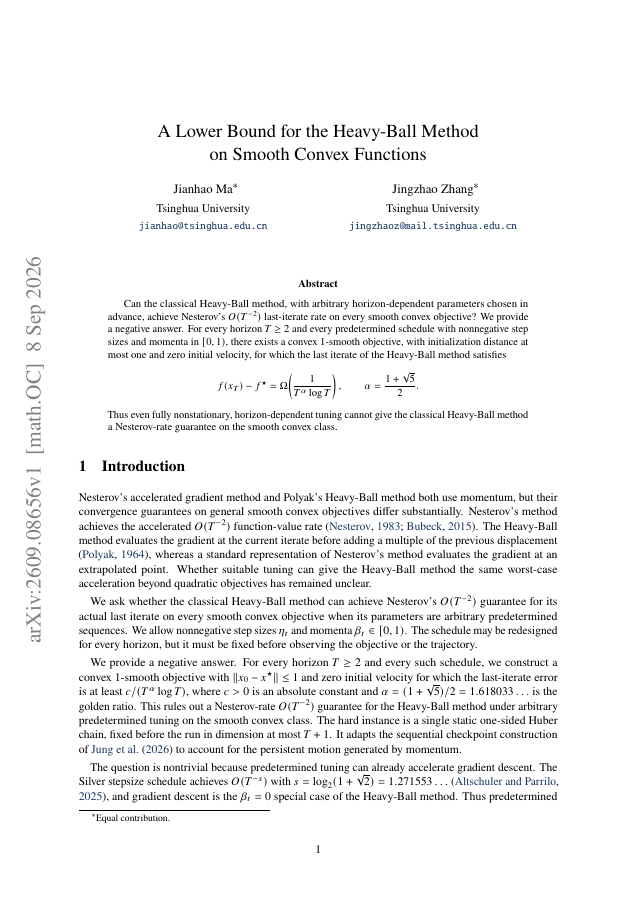
Can the classical Heavy-Ball method, with arbitrary horizon-dependent parameters chosen in advance, achieve Nesterov's $O(T^{-2})$ last-iterate rate on every smooth convex objective? We provide a negative answer.
8 Sep 2026
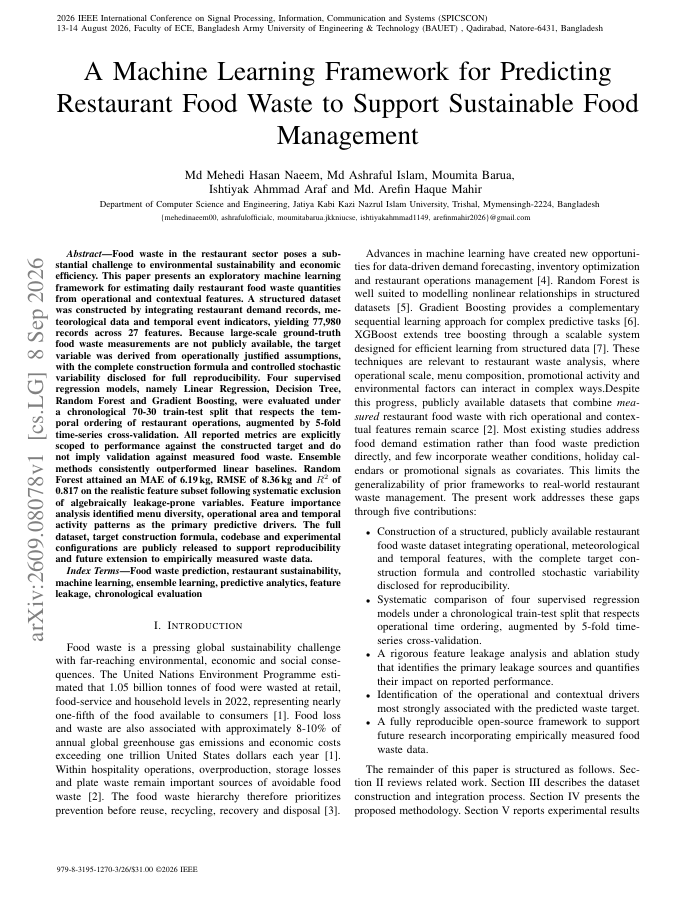
Food waste in the restaurant sector poses a substantial challenge to environmental sustainability and economic efficiency. This paper presents an exploratory machine learning framework for estimating daily restaurant food waste quantities from operational and contextual…
8 Sep 2026
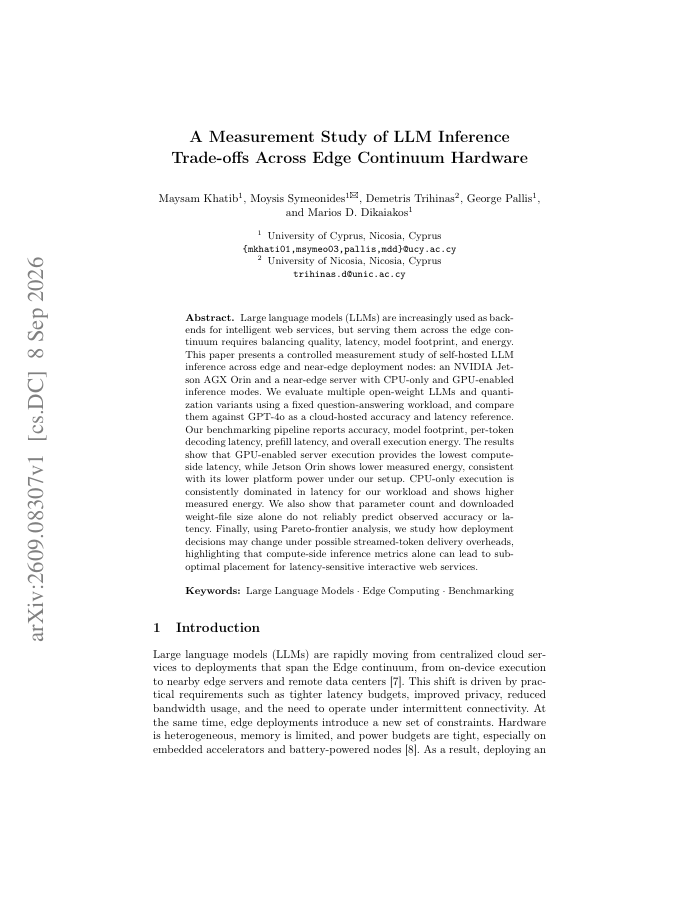
Large language models (LLMs) are increasingly used as backends for intelligent web services, but serving them across the edge continuum requires balancing quality, latency, model footprint, and energy.
8 Sep 2026
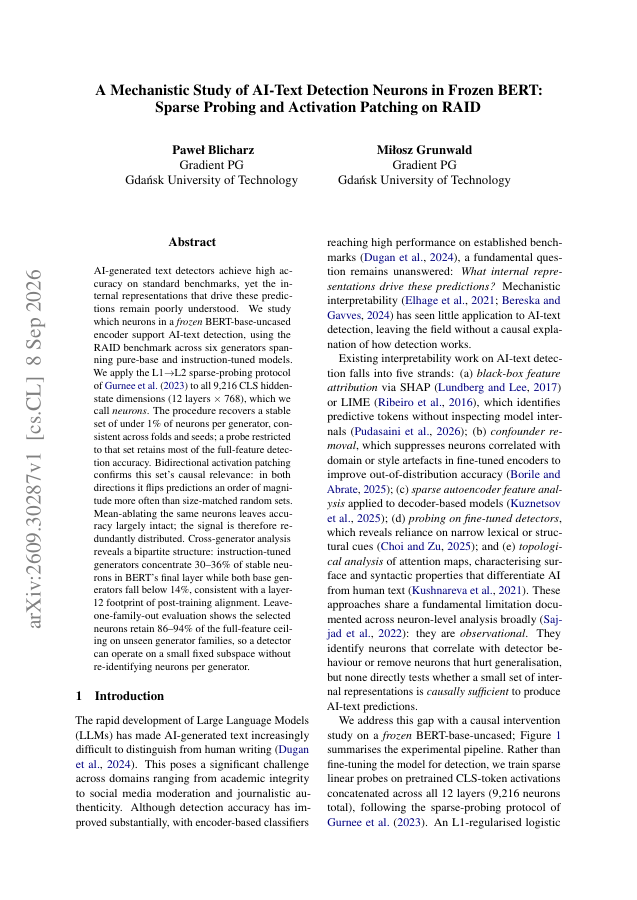
AI-generated text detectors achieve high accuracy on standard benchmarks, yet the internal representations that drive these predictions remain poorly understood. We study which neurons in a frozen BERT-base-uncased encoder support AI-text detection, using the RAID benchmark…
8 Sep 2026
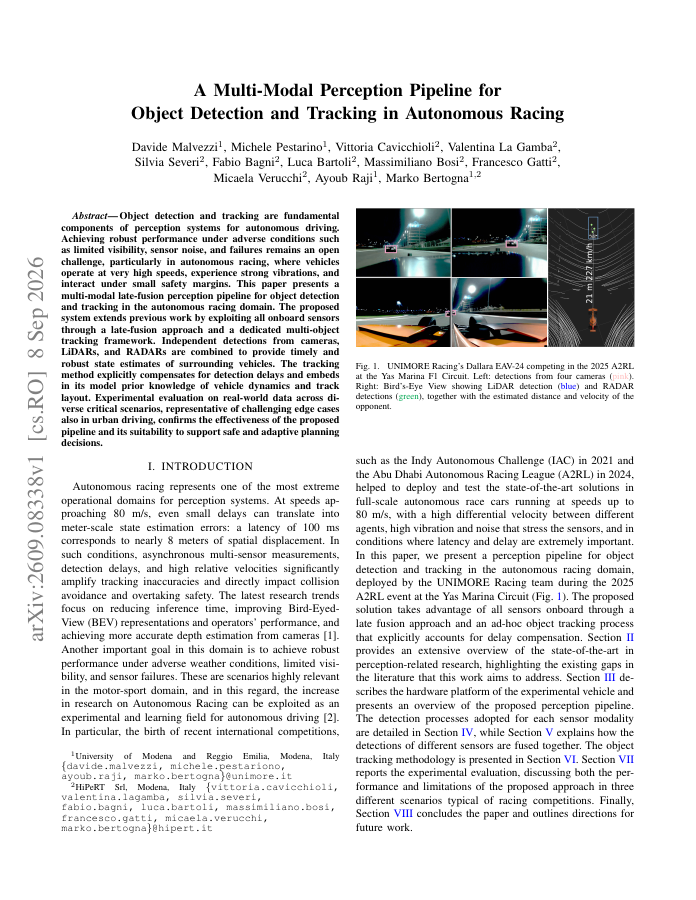
Object detection and tracking are fundamental components of perception systems for autonomous driving. Achieving robust performance under adverse conditions such as limited visibility, sensor noise, and failures remains an open challenge, particularly in autonomous racing, where…
8 Sep 2026
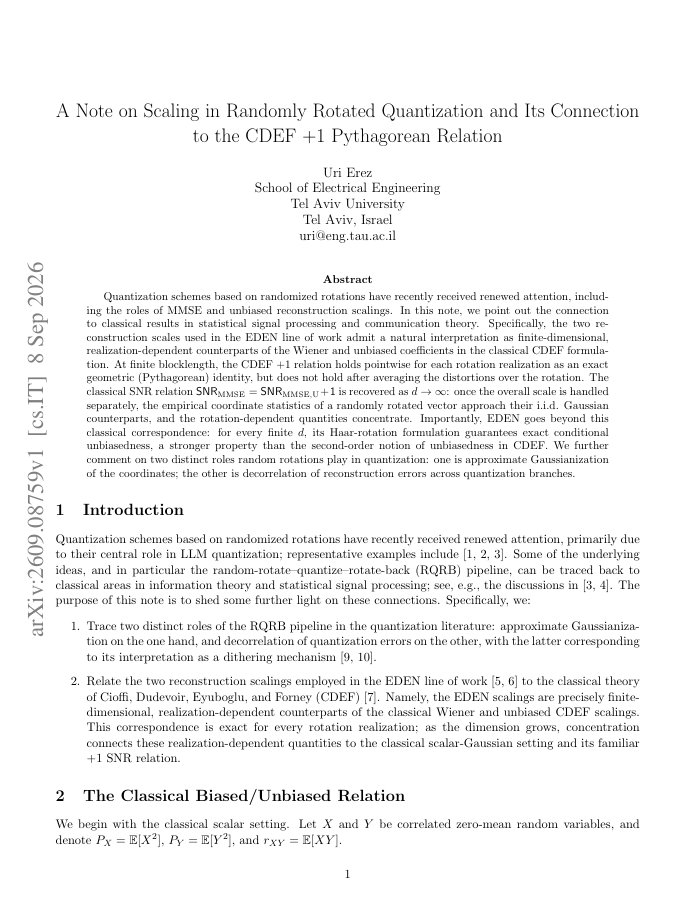
Quantization schemes based on randomized rotations have recently received renewed attention, including the roles of MMSE and unbiased reconstruction scalings. In this note, we point out the connection to classical results in statistical signal processing and communication…
8 Sep 2026
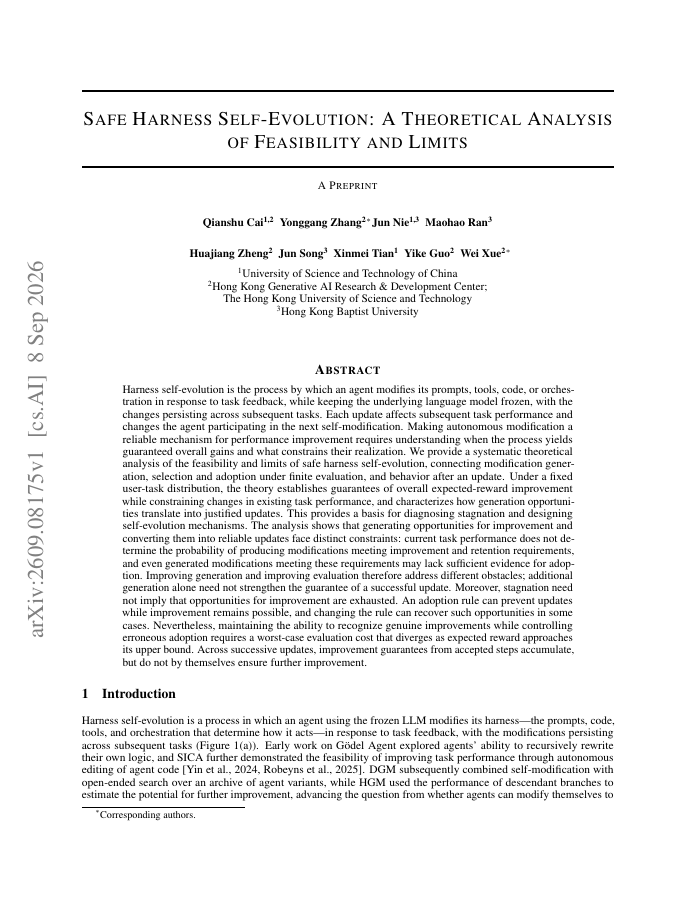
In harness self-evolution, agents modify their own prompts, code, tools, and orchestration while keeping the underlying language model fixed. Recent work has shown that agents can improve themselves in response to task failures and achieve substantial performance gains.
8 Sep 2026
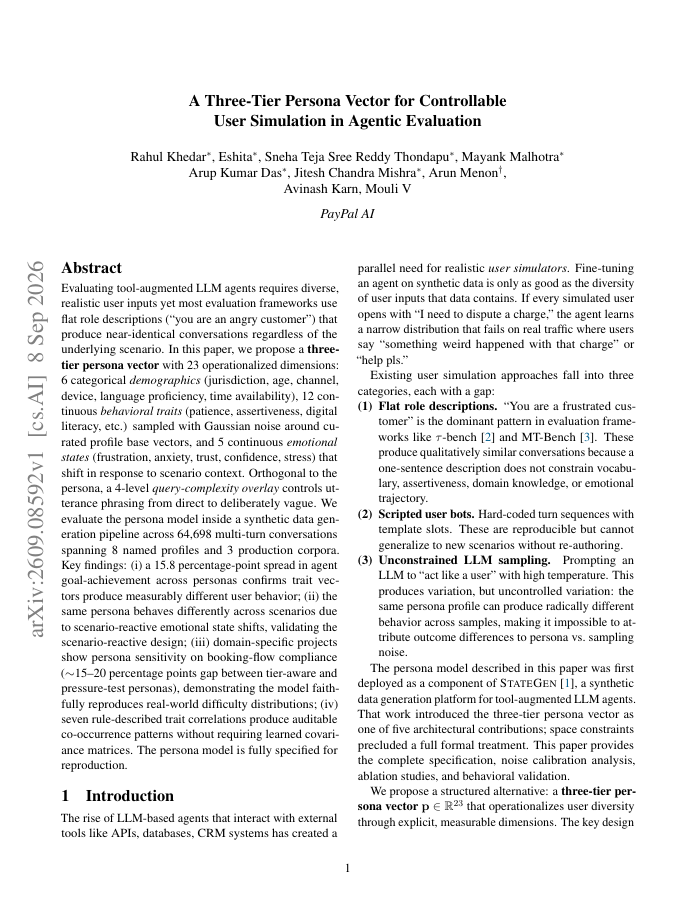
Evaluating tool-augmented LLM agents requires diverse, realistic user inputs yet most evaluation frameworks use flat role descriptions ("you are an angry customer") that produce near-identical conversations regardless of the underlying scenario.
7 Sep 2026
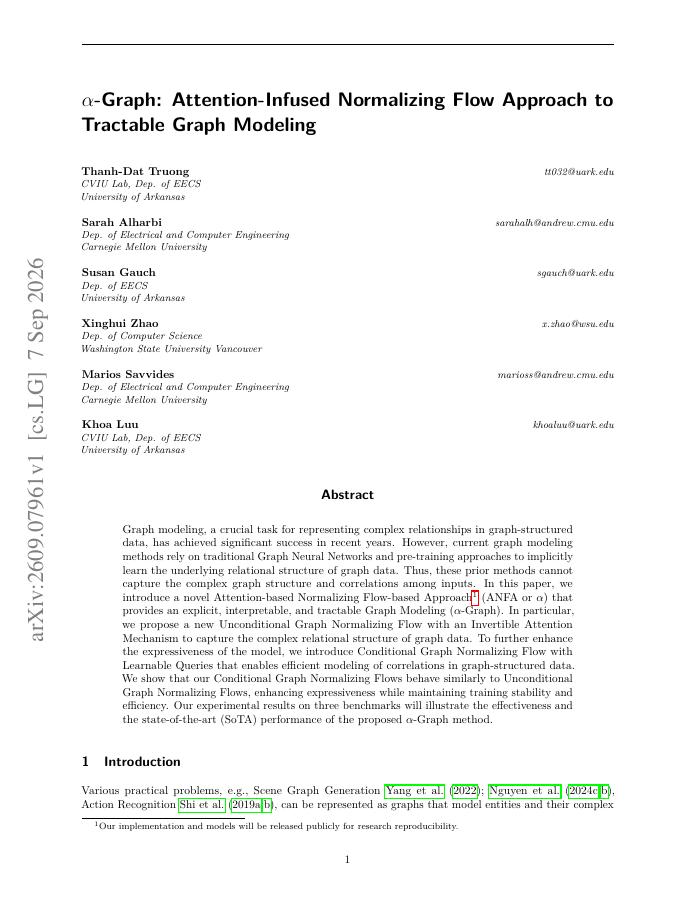
Graph modeling, a crucial task for representing complex relationships in graph-structured data, has achieved significant success in recent years. However, current graph modeling methods rely on traditional Graph Neural Networks and pre-training approaches to implicitly learn the…
7 Sep 2026
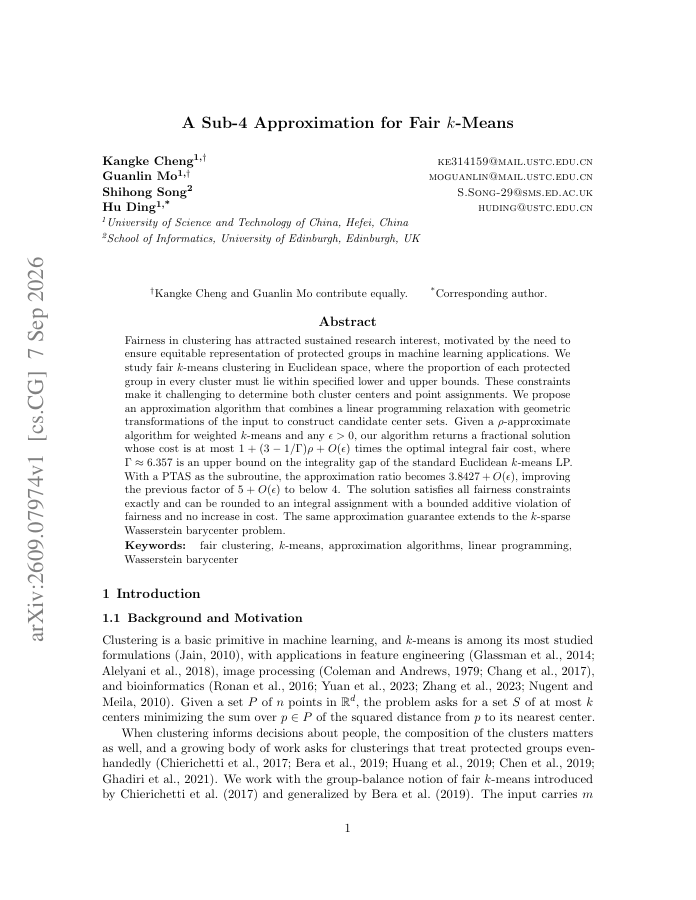
Fair clustering aims to prevent algorithmic bias against protected groups. We study Euclidean fair $k$-means, in which the proportion of each protected group in every cluster lies between prescribed lower and upper bounds.