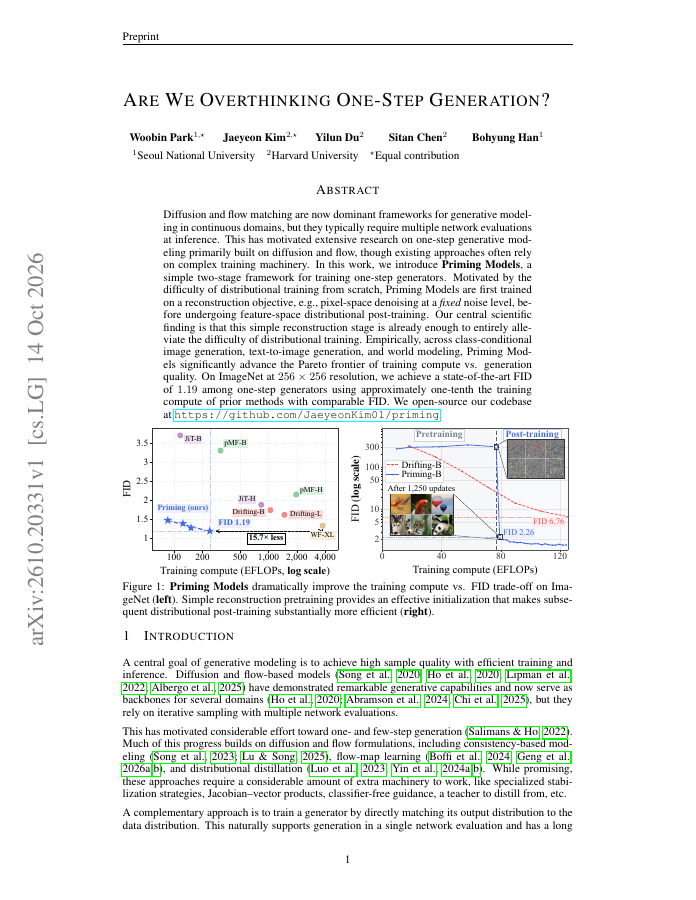
Are We Overthinking One-Step Generation?
14 Oct 2026
Diffusion and flow matching are now dominant frameworks for generative modeling in continuous domains, but they typically require multiple network evaluations at inference.
Trending research and the full catalog - each paper linked to the benchmarks, methods, and models it introduces.
Filtering here covers the 2,000 most recent papers, as much as one page can hold in memory. See the full index of 22,841 papers.
14 Oct 2026
Diffusion and flow matching are now dominant frameworks for generative modeling in continuous domains, but they typically require multiple network evaluations at inference.
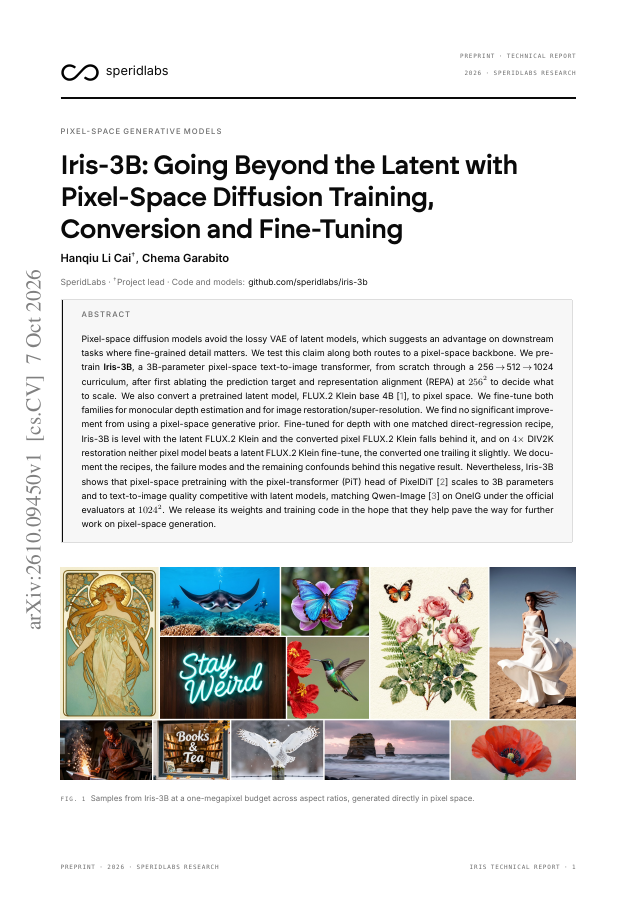
7 Oct 2026
Pixel-space diffusion models avoid the lossy VAE of latent models, which suggests an advantage on downstream tasks where fine-grained detail matters. We test this claim along both routes to a pixel-space backbone.
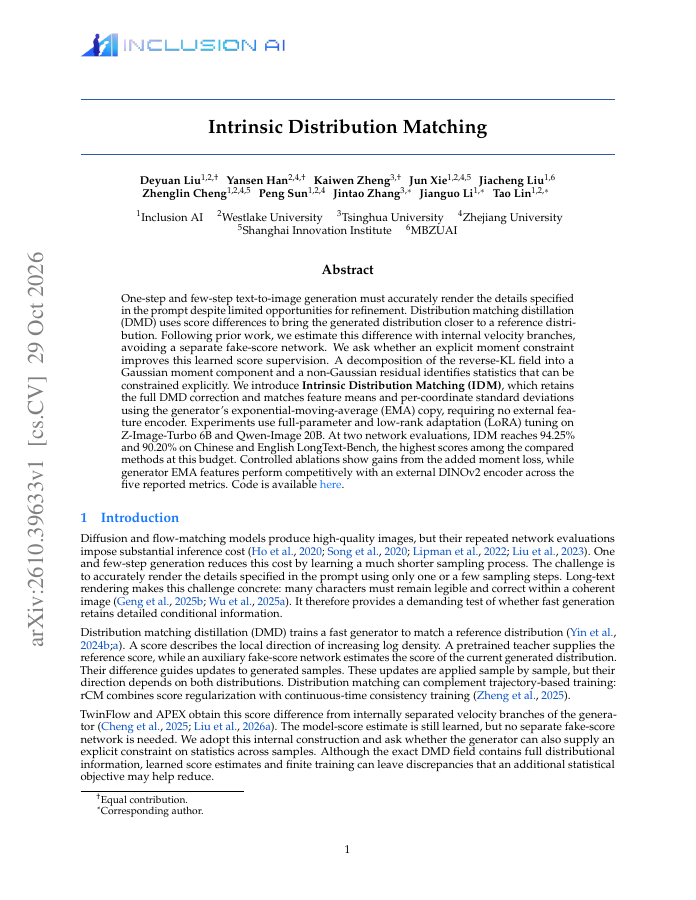
29 Oct 2026
One-step and few-step text-to-image generation must accurately render the details specified in the prompt despite limited opportunities for refinement. Distribution matching distillation (DMD) uses score differences to bring the generated distribution closer to a reference…
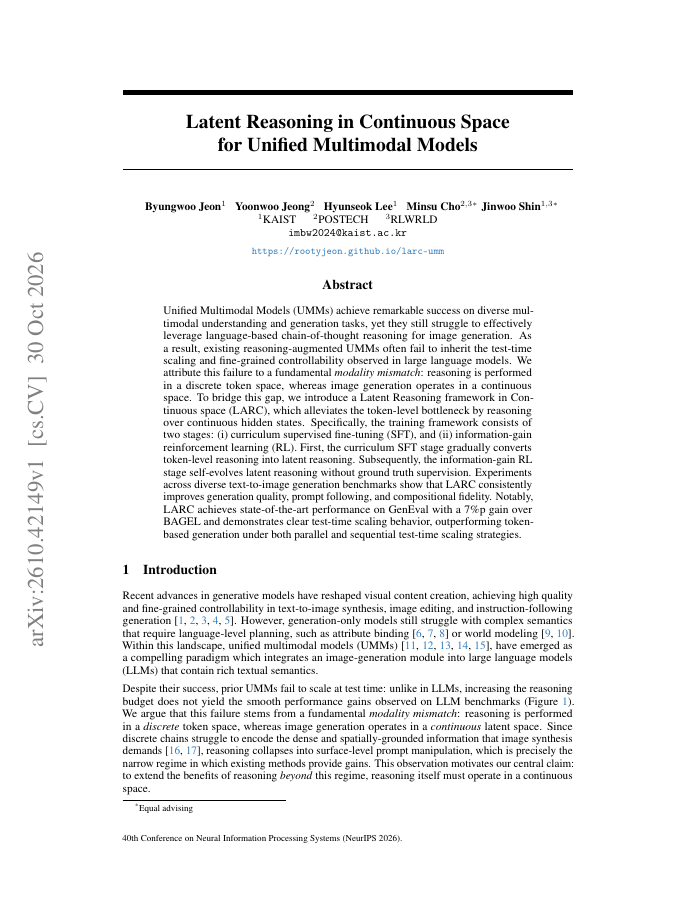
30 Oct 2026
Unified Multimodal Models (UMMs) achieve remarkable success on diverse multimodal understanding and generation tasks, yet they still struggle to effectively leverage language-based chain-of-thought reasoning for image generation.
29 Oct 2026
Autoregressive (AR) image generators are powerful in principle but inflexible in practice: training with a fixed raster-scan order hardcodes a single factorization of the image distribution into the model, leaving it unable to inpaint, outpaint, or edit at inference time.
29 Oct 2026
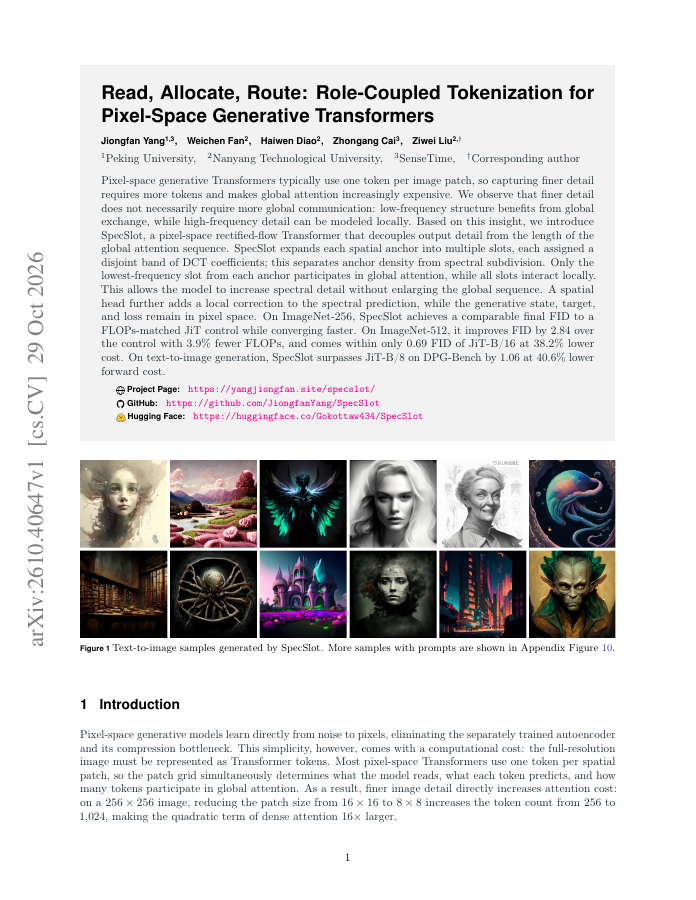
Pixel-space generative Transformers typically use one token per image patch, so capturing finer detail requires more tokens and makes global attention increasingly expensive.