8 Sep 2026
Large language models (LLMs) are increasingly used as backends for intelligent web services, but serving them across the edge continuum requires balancing quality, latency, model footprint, and energy.
Trending research and the full catalog - each paper linked to the benchmarks, methods, and models it introduces.
Filtering here covers the 2,000 most recent papers, as much as one page can hold in memory. See the full index of 22,347 papers.
8 Sep 2026
Large language models (LLMs) are increasingly used as backends for intelligent web services, but serving them across the edge continuum requires balancing quality, latency, model footprint, and energy.
8 Sep 2026
AI-generated text detectors achieve high accuracy on standard benchmarks, yet the internal representations that drive these predictions remain poorly understood. We study which neurons in a frozen BERT-base-uncased encoder support AI-text detection, using the RAID benchmark…
8 Sep 2026
Object detection and tracking are fundamental components of perception systems for autonomous driving. Achieving robust performance under adverse conditions such as limited visibility, sensor noise, and failures remains an open challenge, particularly in autonomous racing, where…
8 Sep 2026
Quantization schemes based on randomized rotations have recently received renewed attention, including the roles of MMSE and unbiased reconstruction scalings. In this note, we point out the connection to classical results in statistical signal processing and communication…
8 Sep 2026
In harness self-evolution, agents modify their own prompts, code, tools, and orchestration while keeping the underlying language model fixed. Recent work has shown that agents can improve themselves in response to task failures and achieve substantial performance gains.
8 Sep 2026
Evaluating tool-augmented LLM agents requires diverse, realistic user inputs yet most evaluation frameworks use flat role descriptions ("you are an angry customer") that produce near-identical conversations regardless of the underlying scenario.
8 Sep 2026
Understanding why individuals respond differently to psilocybin requires modeling the drug's transcriptional perturbation signature at the cell-type level. I present a Transformer-based delta expression encoder that learns to classify differential gene expression status -…
8 Sep 2026
Automated red-team attacks and blue-team defenses for large language models (LLMs) are advancing quickly. However, attackers and defenders are built and tested in isolation, and the resulting scores are hard to trust.
7 Sep 2026
Graph modeling, a crucial task for representing complex relationships in graph-structured data, has achieved significant success in recent years. However, current graph modeling methods rely on traditional Graph Neural Networks and pre-training approaches to implicitly learn the…
7 Sep 2026
Retrieval-augmented generation (RAG) is commonly evaluated by whether the final answer is correct. That test is insufficient: an answer can match its reference while the context that produced it contains a direct contradiction, leaving the contested evidence invisible to…
7 Sep 2026
LLM hidden states are ordinary vectors, but the distances among those vectors may still show hierarchical structure. To our knowledge, this paper is the first systematic study of whether prompt-token hidden states in contemporary LLMs exhibit Gromov Hyperbolicity (GH), a…
7 Sep 2026
Deep learning has achieved state-of-the-art performance in echocardiographic video segmentation, with an increasing number of models incorporating temporal information. However, quantitative evaluation of temporal explainability remains largely unexplored.
7 Sep 2026
Medical imaging artificial intelligence (AI) is commonly developed as separate mappings from radiographs to diagnostic outputs or from clinical descriptions to generated images, although both arise from the same underlying radiographic state.
7 Sep 2026
Fairness in clustering has attracted sustained research interest, motivated by the need to ensure equitable representation of protected groups in machine learning applications.
7 Sep 2026
Physics-informed neural networks (PINNs) represent a growing frontier in using artificial intelligence to solve partial differential equations (PDEs). Automatic differentiation (AD) plays a central role in this paradigm, which is mesh-free and replaces traditional iterative…
7 Sep 2026
Understanding generalization remains a central challenge in machine learning because it requires jointly considering data, architecture, and training dynamics. In this paper, we develop a theoretical framework that characterizes how these factors jointly shape generalization…
7 Sep 2026
Software repositories contain vast amounts of data on code contributions, bug reports, and project activities, yet this information remains challenging for non-technical stakeholders and developers to access due to limited expertise in querying repositories.
7 Sep 2026
Large language models (LLMs) have demonstrated strong capabilities across diverse domains, showing considerable potential in medicine. However, their application in medical settings remains limited by the scarcity of visual question answering (VQA) datasets that capture clinical…
7 Sep 2026
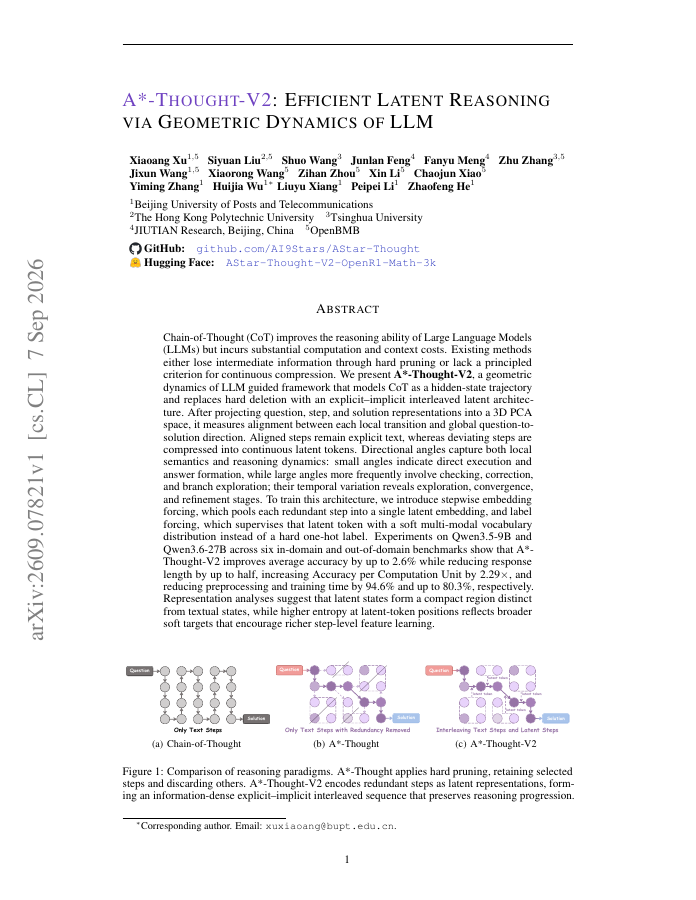
Chain-of-Thought (CoT) improves the reasoning ability of Large Language Models (LLMs) but incurs substantial computation and context costs. Existing methods either lose intermediate information through hard pruning or lack a principled criterion for continuous compression.
7 Sep 2026
The Asset Administration Shell (AAS) is a cornerstone of Industry 4.0 and the Digital Product Passport, providing standardized digital representations of industrial assets.
7 Sep 2026
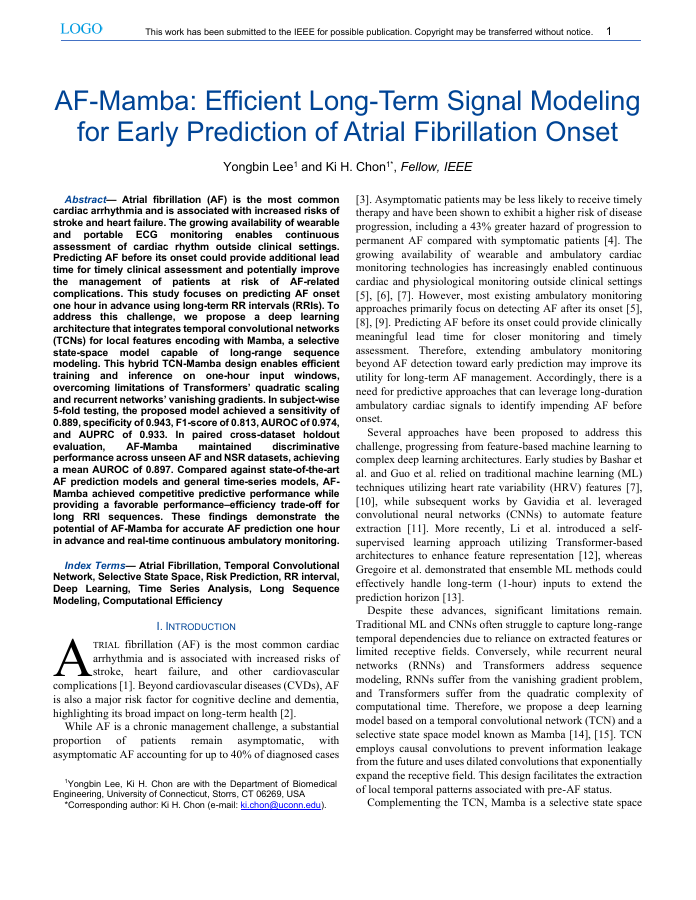
Atrial fibrillation (AF) is the most common cardiac arrhythmia and is associated with increased risks of stroke and heart failure. The growing availability of wearable and portable ECG monitoring enables continuous assessment of cardiac rhythm outside clinical settings.
6 Sep 2026
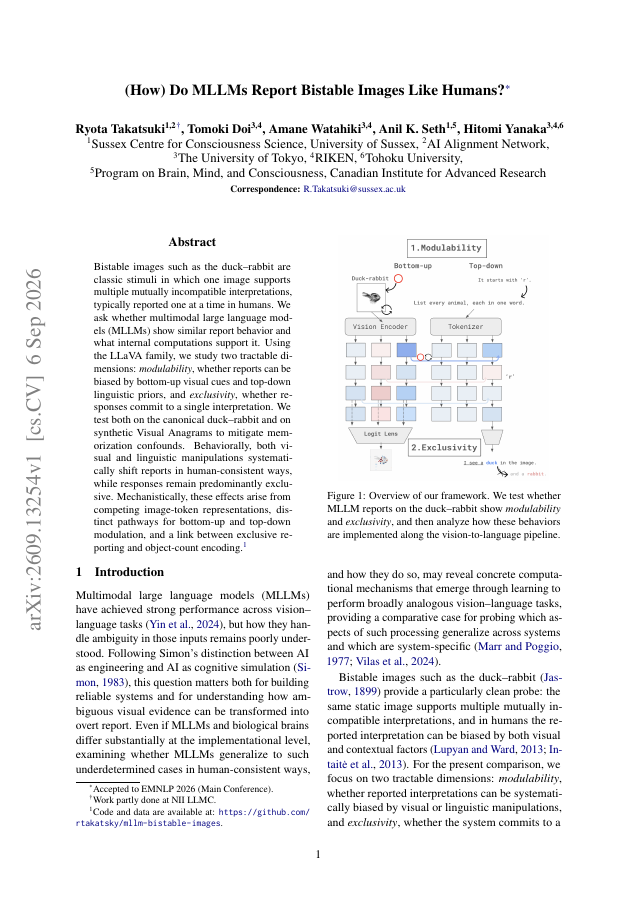
Bistable images such as the duck-rabbit are classic stimuli in which one image supports multiple mutually incompatible interpretations, typically reported one at a time in humans.
6 Sep 2026
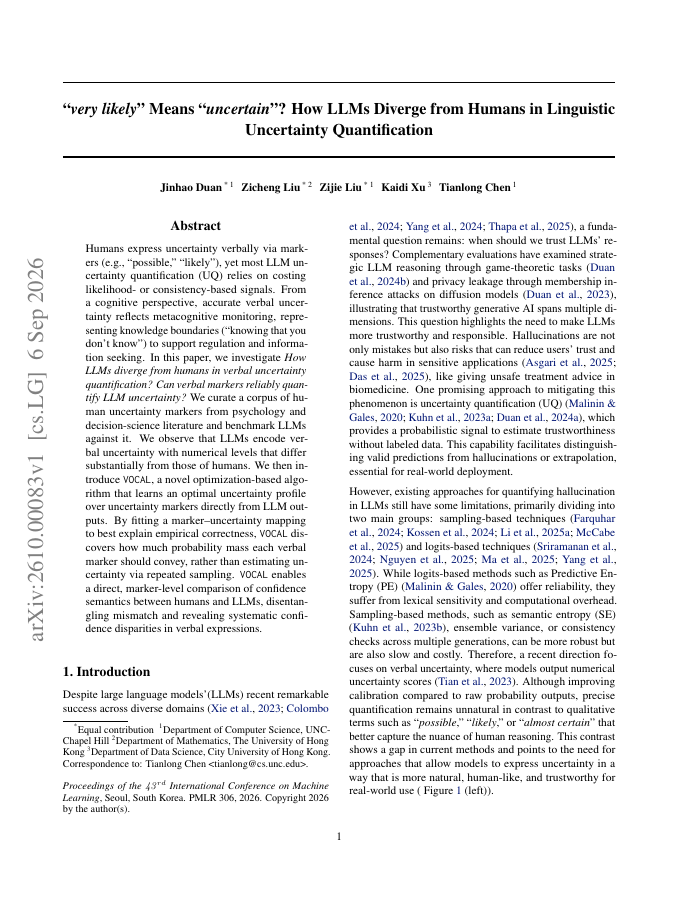
Humans express uncertainty verbally via markers (e.g., "possible," "likely"), yet most LLM uncertainty quantification (UQ) relies on costing likelihood- or consistency-based signals.
6 Sep 2026
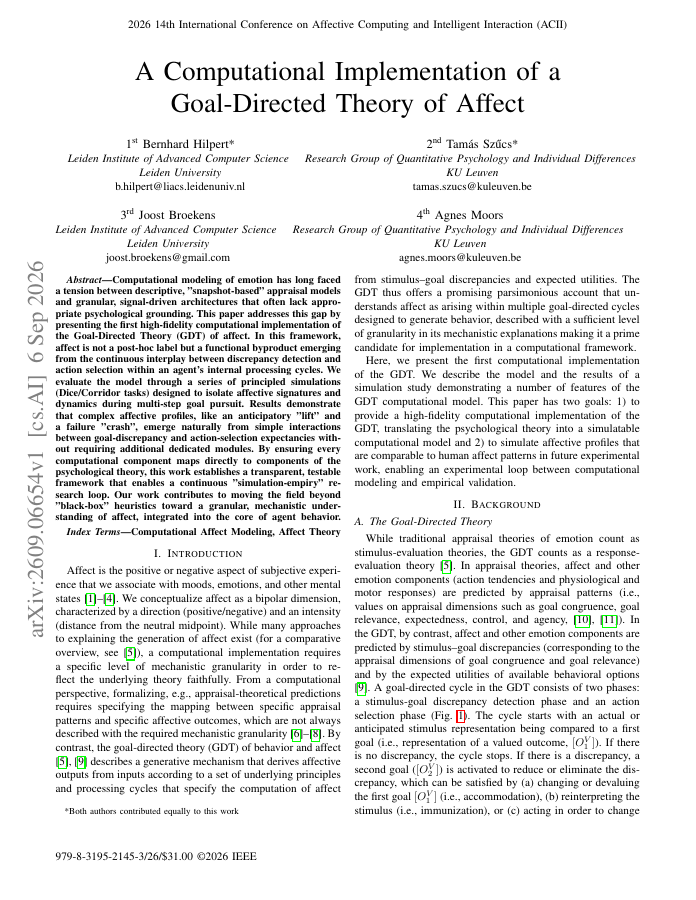
Computational modeling of emotion has long faced a tension between descriptive, "snapshot-based" appraisal models and granular, signal-driven architectures that often lack appropriate psychological grounding.