16 Sep 2026
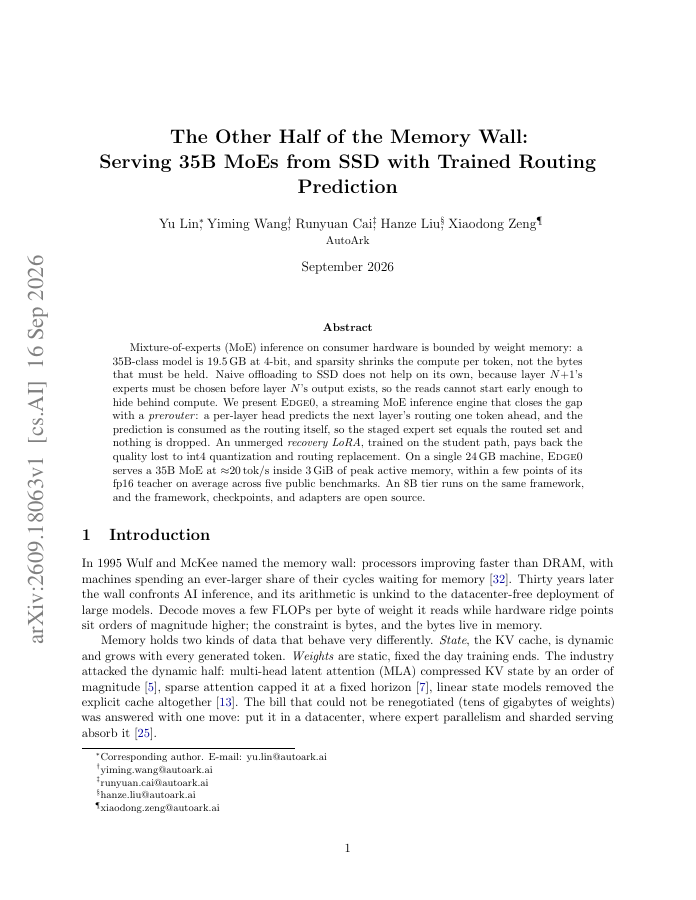
Mixture-of-experts (MoE) inference on consumer hardware is bounded by weight memory: a 35B-class model is 19.5GB at 4-bit, and sparsity shrinks the compute per token, not the bytes that must be held.
Trending research and the full catalog - each paper linked to the benchmarks, methods, and models it introduces.
Filtering here covers the 2,000 most recent papers, as much as one page can hold in memory. See the full index of 22,347 papers.
16 Sep 2026
Mixture-of-experts (MoE) inference on consumer hardware is bounded by weight memory: a 35B-class model is 19.5GB at 4-bit, and sparsity shrinks the compute per token, not the bytes that must be held.
29 Sep 2026
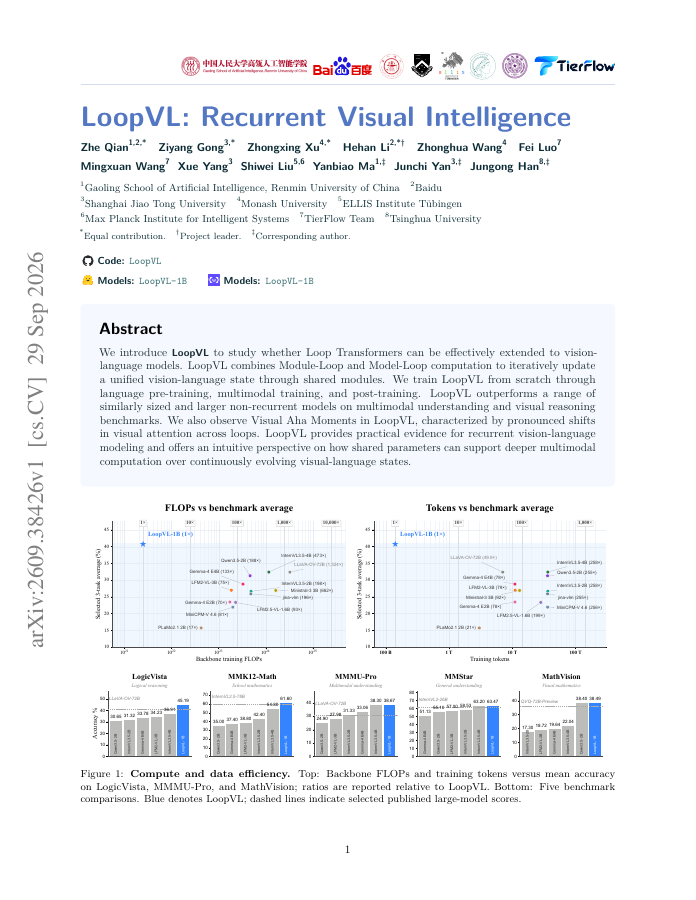
We introduce LoopVL to study whether Loop Transformers can be effectively extended to vision- language models. LoopVL combines Module-Loop and Model-Loop computation to iteratively update a unified vision-language state through shared modules.
14 Sep 2026
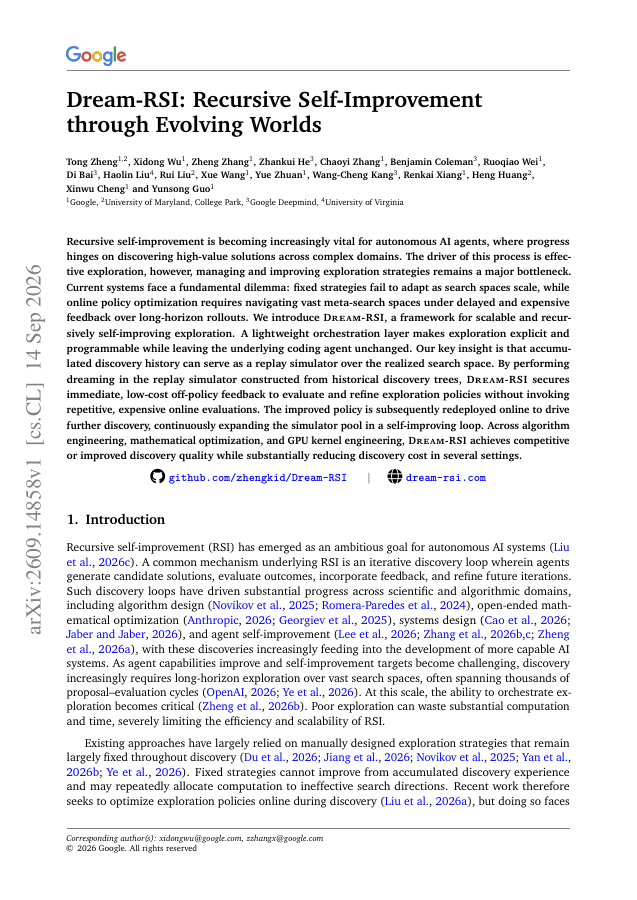
Recursive self-improvement is becoming essential for autonomous AI agents, whose progress depends on discovering high-value solutions across complex domains. Effective exploration drives this process, yet managing and improving exploration strategies remains a major bottleneck.
2 Oct 2026
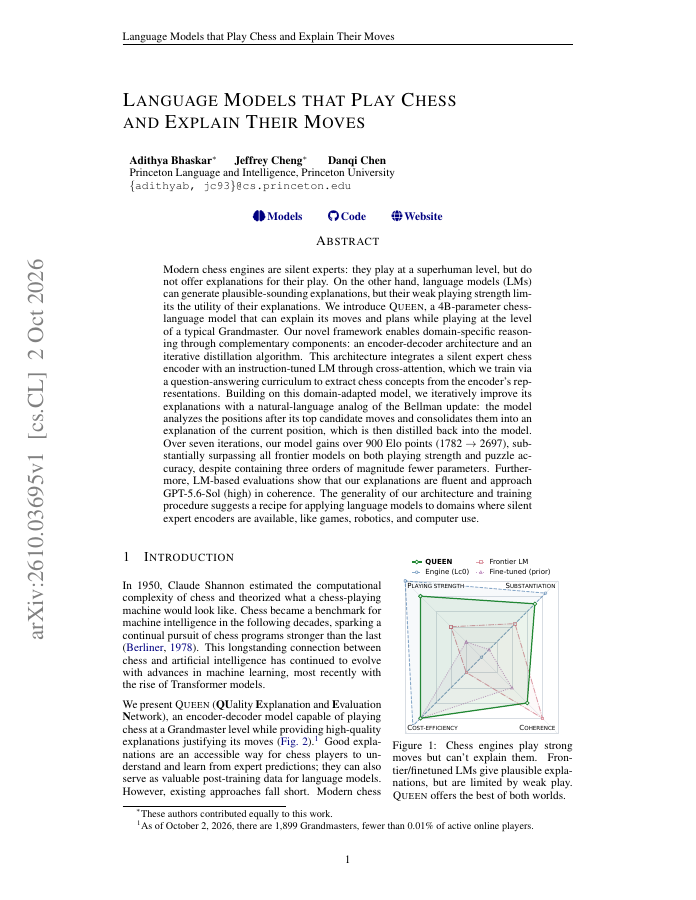
Modern chess engines are silent experts: they play at a superhuman level, but do not offer explanations for their play. On the other hand, language models (LMs) can generate plausible-sounding explanations, but their weak playing strength limits the utility of their…
11 Sep 2026
In this work, we present ZGCM-1, a fully open 7B dense foundation model trained from scratch with extreme data, system, and algorithmic efficiency. ZGCM-1 is founded on a core premise: compact models cannot passively memorize the open web, but can overcome parametric capacity…
28 Sep 2026
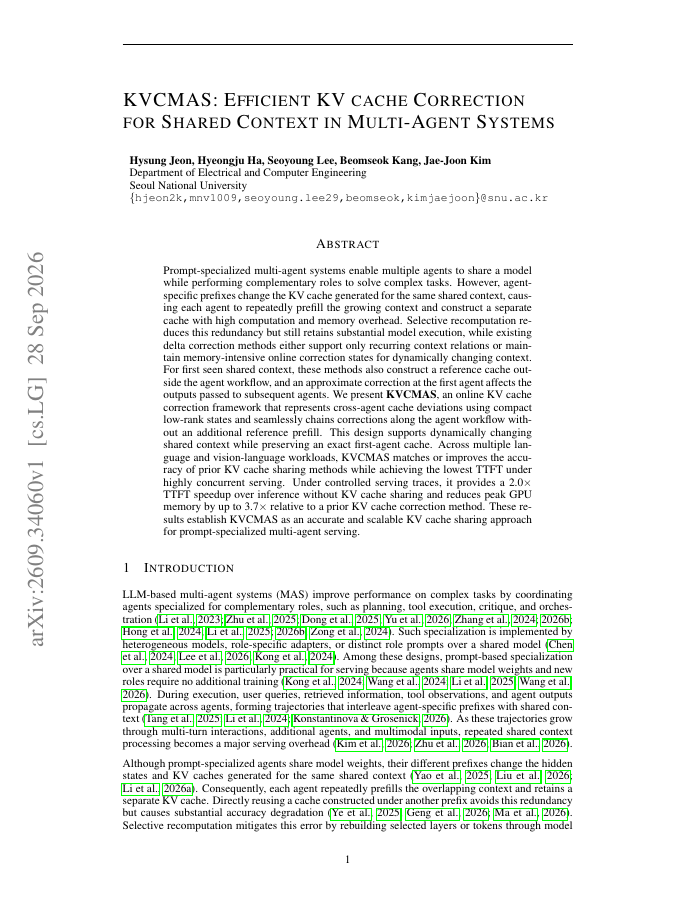
Prompt-specialized multi-agent systems enable multiple agents to share a model while performing complementary roles to solve complex tasks. However, agent-specific prefixes change the KV cache generated for the same shared context, causing each agent to repeatedly prefill the…
19 Sep 2026
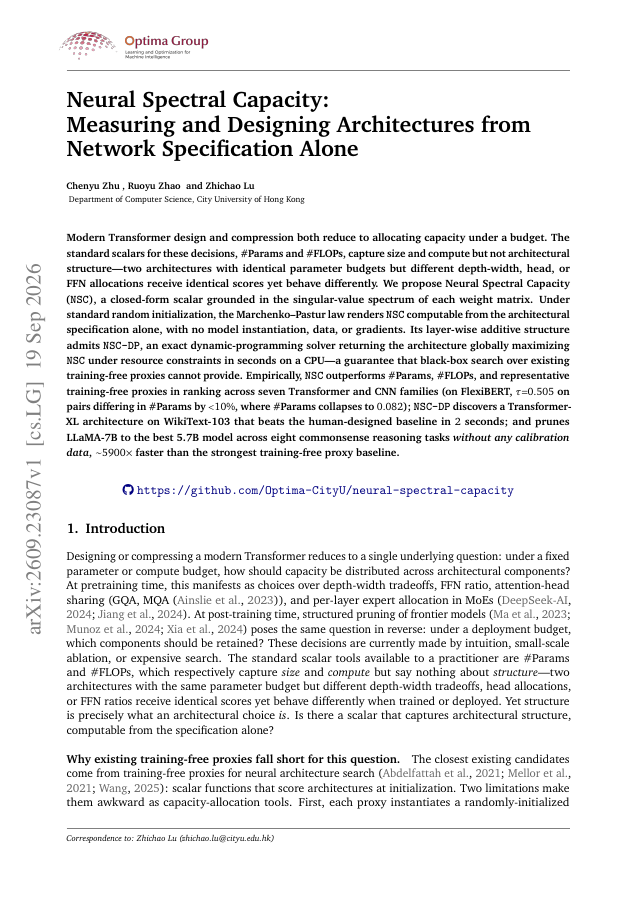
Modern Transformer design and compression both reduce to allocating capacity under a budget. The standard scalars for these decisions, #Params and #FLOPs, capture size and compute but not architectural structure: two architectures with identical parameter budgets but different…
5 Oct 2026
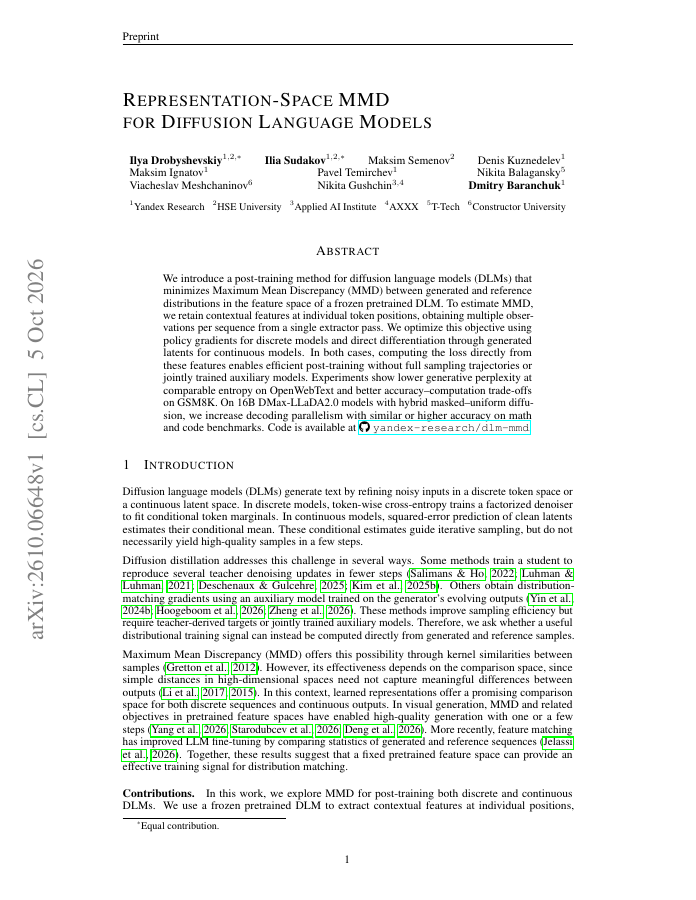
We introduce a post-training method for diffusion language models (DLMs) that minimizes Maximum Mean Discrepancy (MMD) between generated and reference distributions in the feature space of a frozen pretrained DLM.
5 Oct 2026
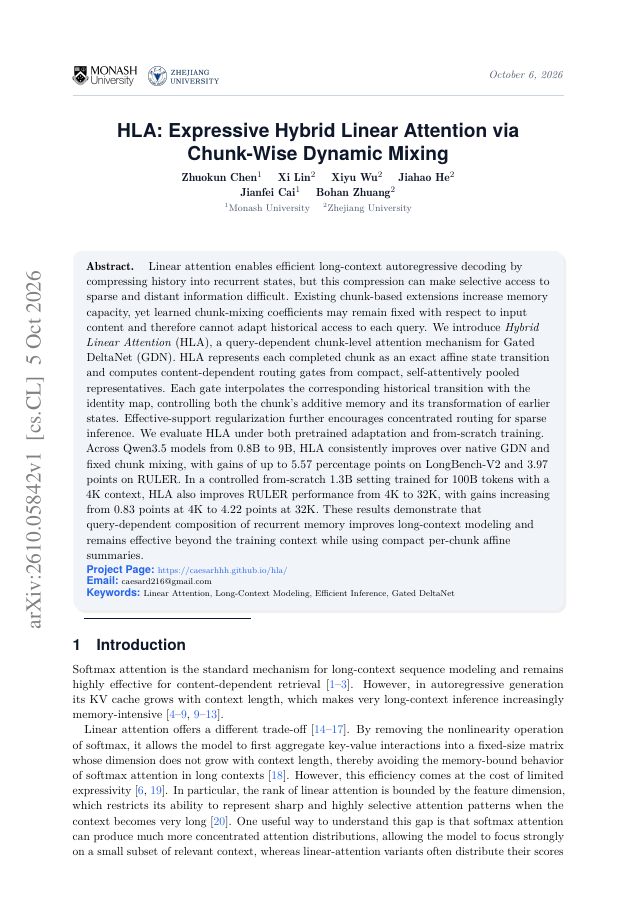
Linear attention enables efficient long-context autoregressive decoding by compressing history into recurrent states, but this compression can make selective access to sparse and distant information difficult.
17 Sep 2026
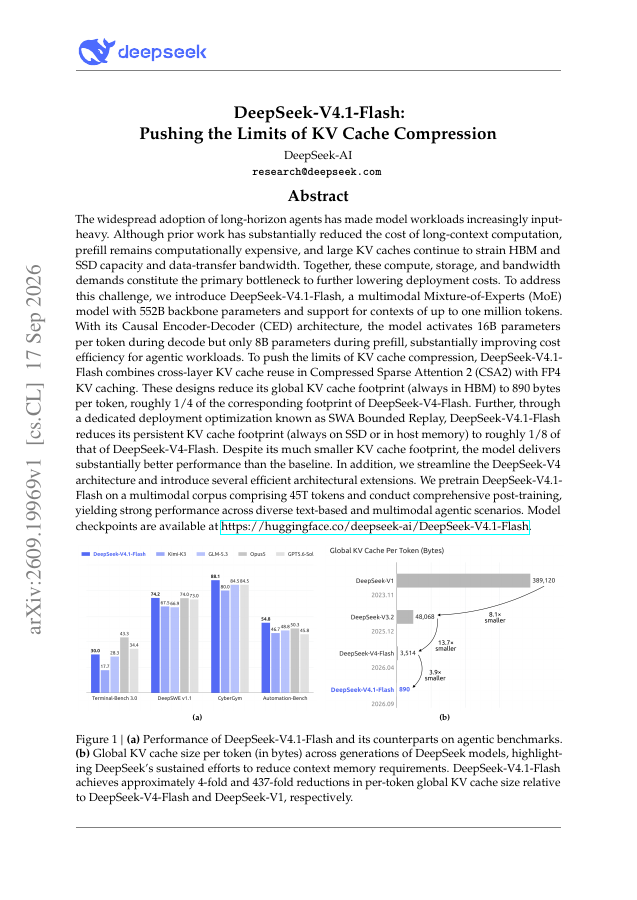
The widespread adoption of long-horizon agents has made model workloads increasingly input-heavy. Although prior work has substantially reduced the cost of long-context computation, prefill remains computationally expensive, and large KV caches continue to strain HBM and SSD…
1 Oct 2026
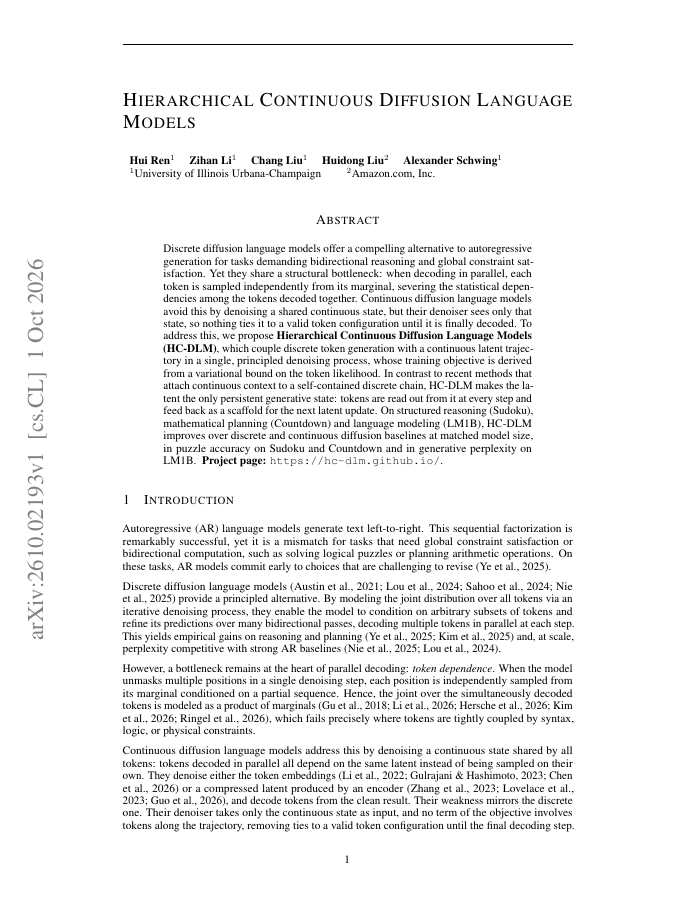
Discrete diffusion language models offer a compelling alternative to autoregressive generation for tasks demanding bidirectional reasoning and global constraint satisfaction.
5 Oct 2026
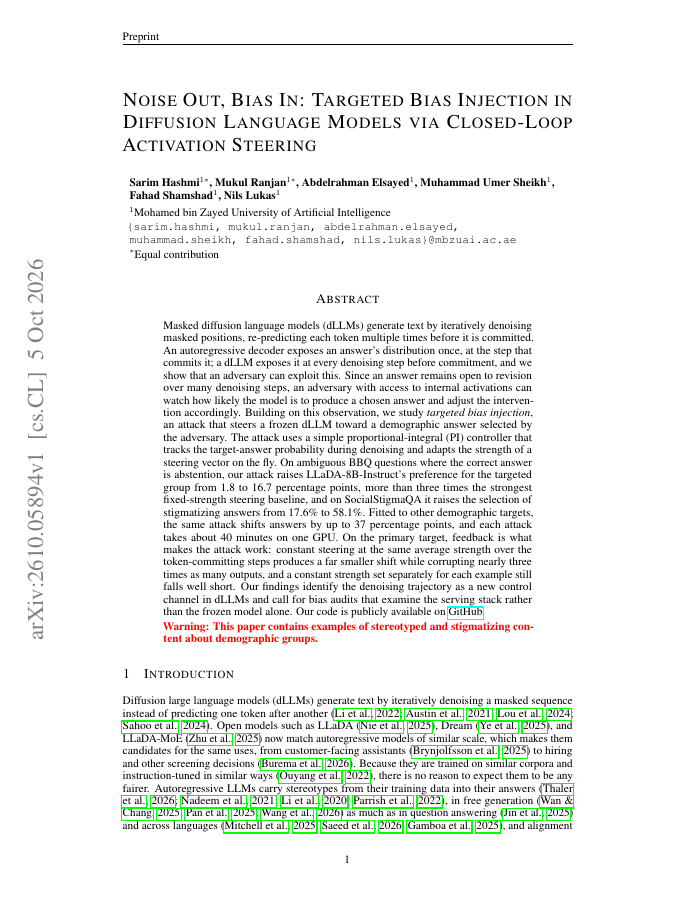
Masked diffusion language models (dLLMs) generate text by iteratively denoising masked positions, re-predicting each token multiple times before it is committed. An autoregressive decoder exposes an answer's distribution once, at the step that commits it; a dLLM exposes it at…
1 Oct 2026
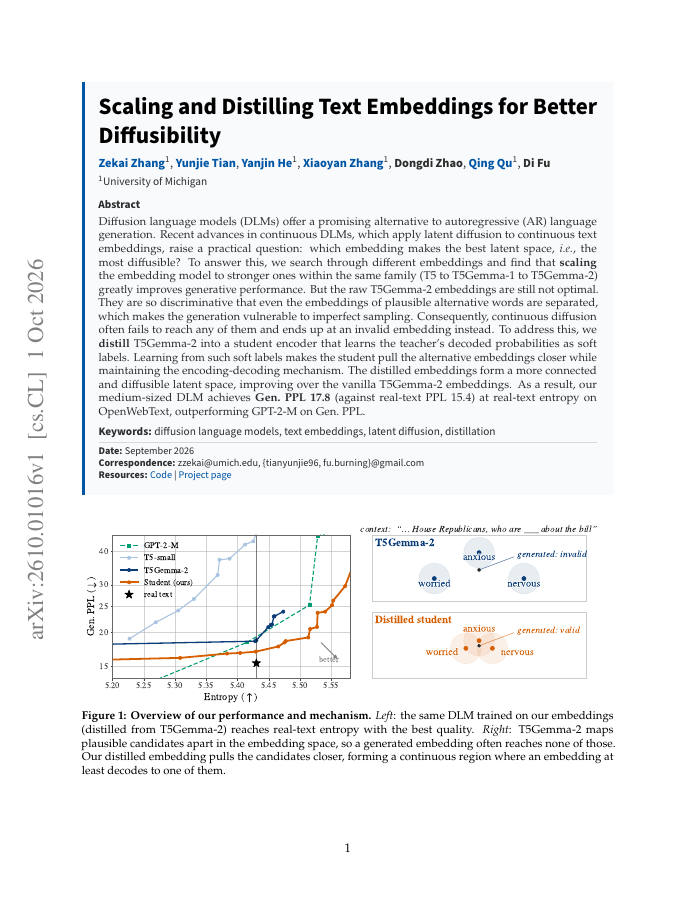
Diffusion language models (DLMs) offer a promising alternative to autoregressive (AR) language generation. Recent advances in continuous DLMs, which apply latent diffusion to continuous text embeddings, raise a practical question: which embedding makes the best latent space,…