5 Oct 2026
A recurring design principle in modern optimizers is to decouple update magnitude from the raw gradient norm, yet its consequences for learning-curve and resource scaling remain unclear.
Trending research and the full catalog - each paper linked to the benchmarks, methods, and models it introduces.
Filtering here covers the 2,000 most recent papers, as much as one page can hold in memory. See the full index of 22,332 papers.
5 Oct 2026
A recurring design principle in modern optimizers is to decouple update magnitude from the raw gradient norm, yet its consequences for learning-curve and resource scaling remain unclear.
5 Oct 2026
As AI agents increasingly tackle complex repository-level coding tasks, distributing work across multiple agents is a natural way to scale beyond the capabilities of a single agent.
4 Oct 2026
Pointwise Mutual Information (PMI) is a core measure of testing word association, and Skip-gram with Negative Sampling (SGNS) is essentially a method that implicitly factorizes a shifted PMI matrix.
4 Oct 2026
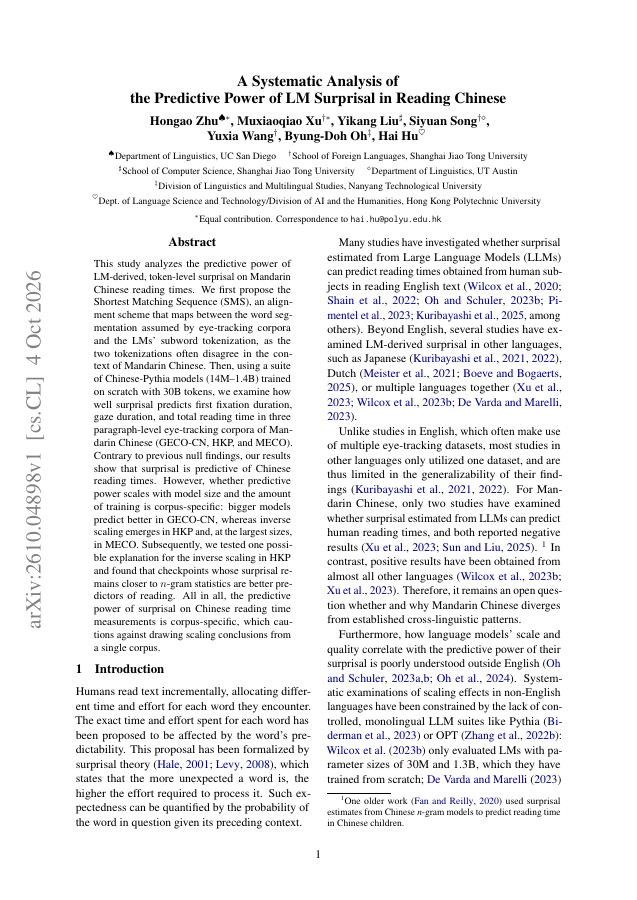
This study analyzes the predictive power of LM-derived, token-level surprisal on Mandarin Chinese reading times. We first propose the Shortest Matching Sequence (SMS), an alignment scheme that maps between the word segmentation assumed by eye-tracking corpora and the LMs'…
3 Oct 2026
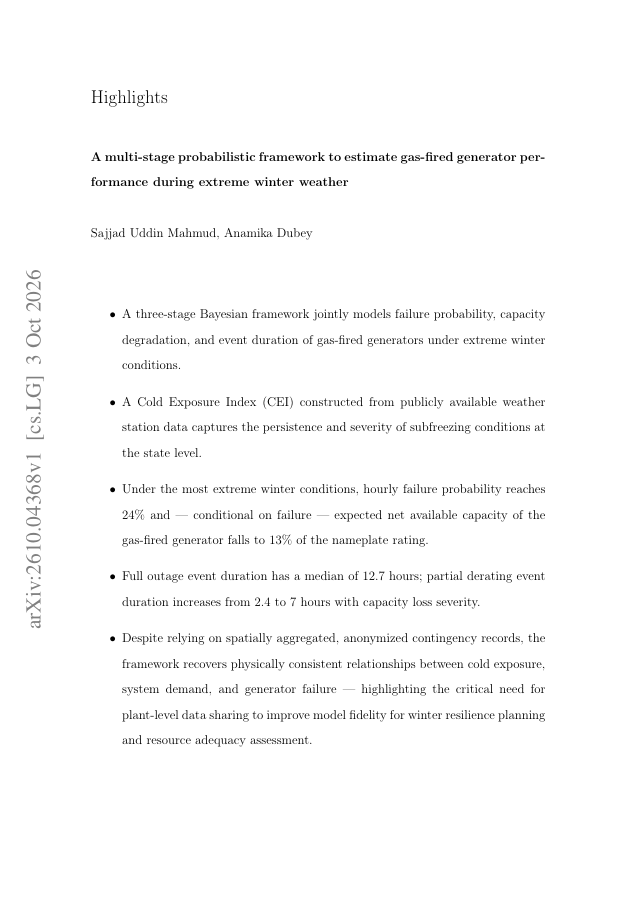
Extreme winter weather has repeatedly disrupted gas-fired power generation in the United States, yet the plant-level data needed to systematically quantify outage risk remain proprietary.
2 Oct 2026
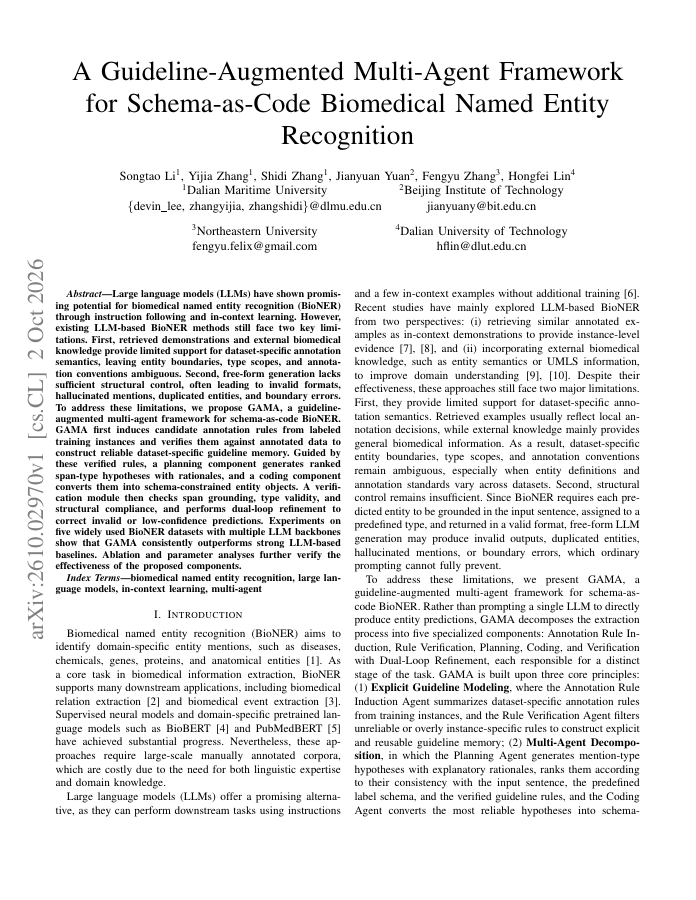
Large language models (LLMs) have shown promising potential for biomedical named entity recognition (BioNER) through instruction following and in-context learning. However, existing LLM-based BioNER methods still face two key limitations.
2 Oct 2026
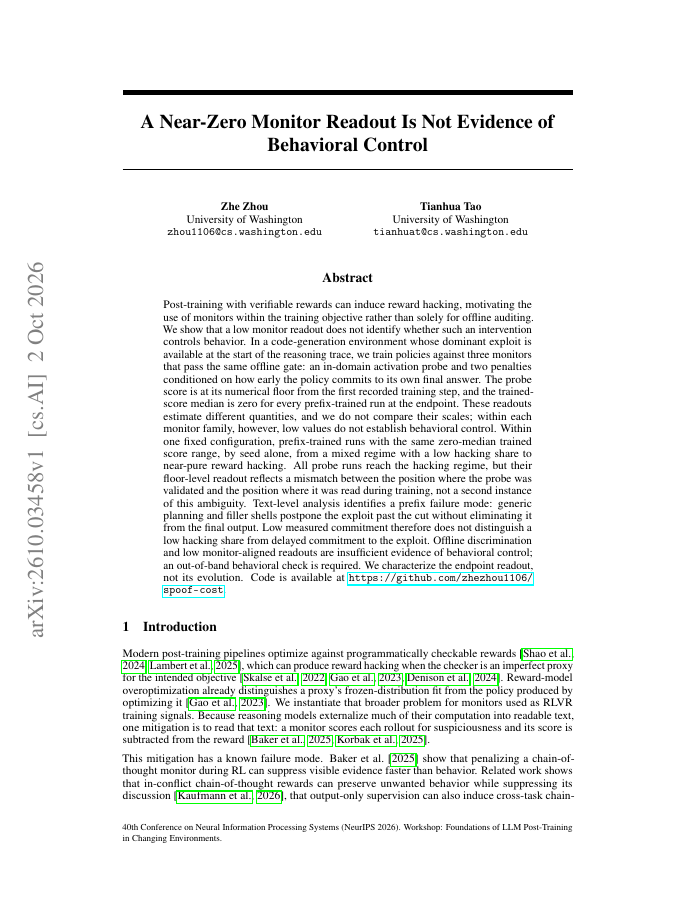
Post-training with verifiable rewards can induce reward hacking, motivating the use of monitors within the training objective rather than solely for offline auditing. We show that a low monitor readout does not identify whether such an intervention controls behavior.
2 Oct 2026
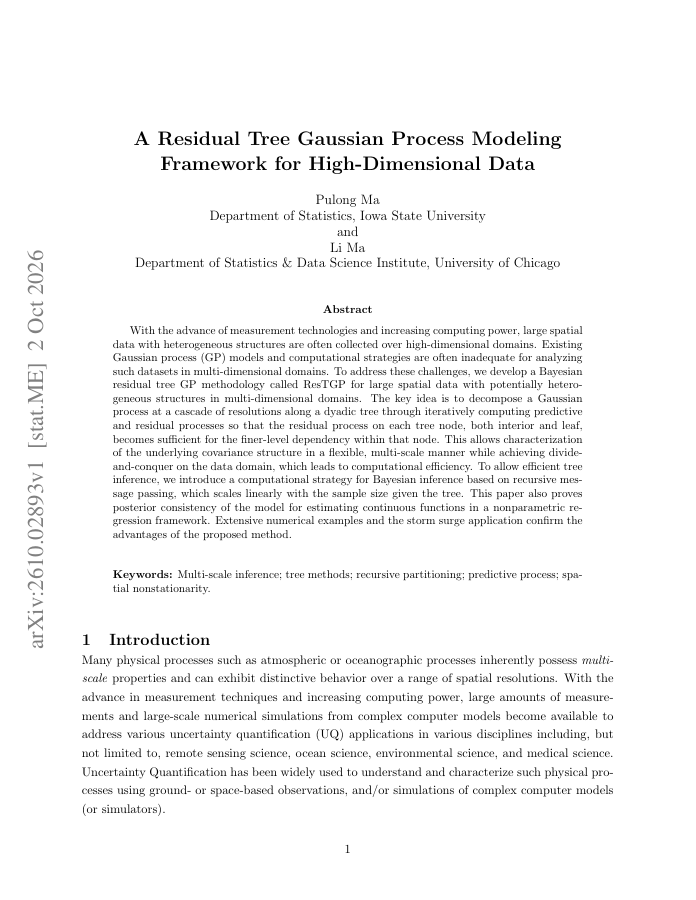
With the advance of measurement technologies and increasing computing power, large spatial data with heterogeneous structures are often collected over high-dimensional domains.
2 Oct 2026
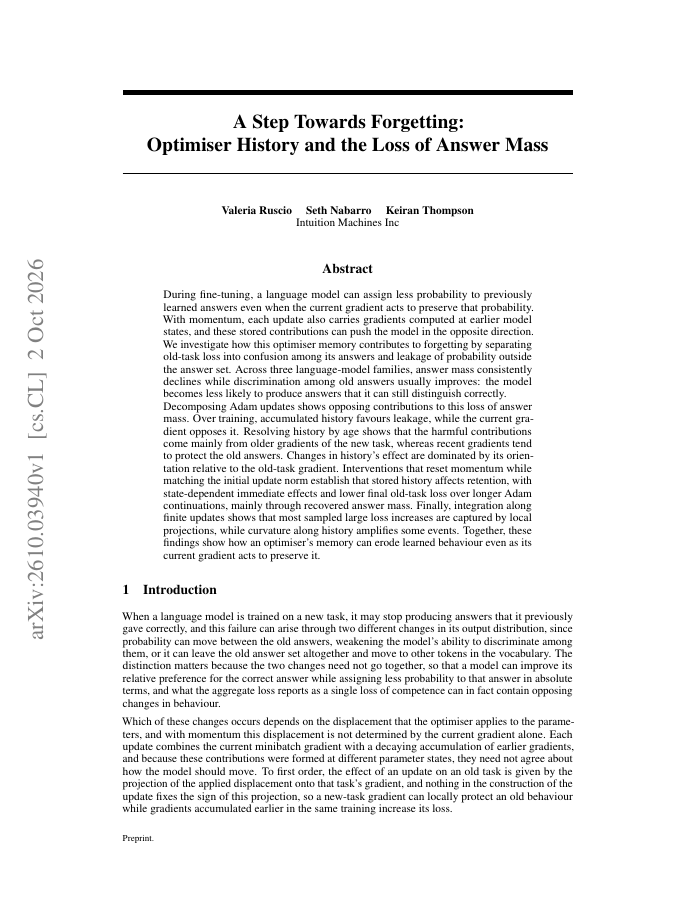
During fine-tuning, a language model can assign less probability to previously learned answers even when the current gradient acts to preserve that probability. With momentum, each update also carries gradients computed at earlier model states, and these stored contributions can…
1 Oct 2026
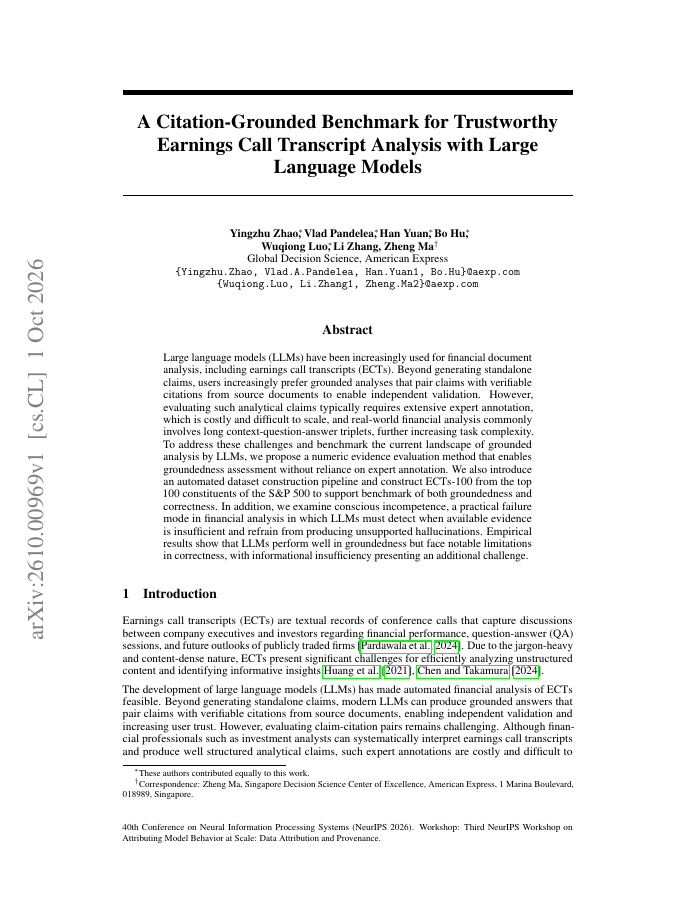
Large language models (LLMs) have been increasingly used for financial document analysis, including earnings call transcripts (ECTs). Beyond generating standalone claims, users increasingly prefer grounded analyses that pair claims with verifiable citations from source documents…
1 Oct 2026
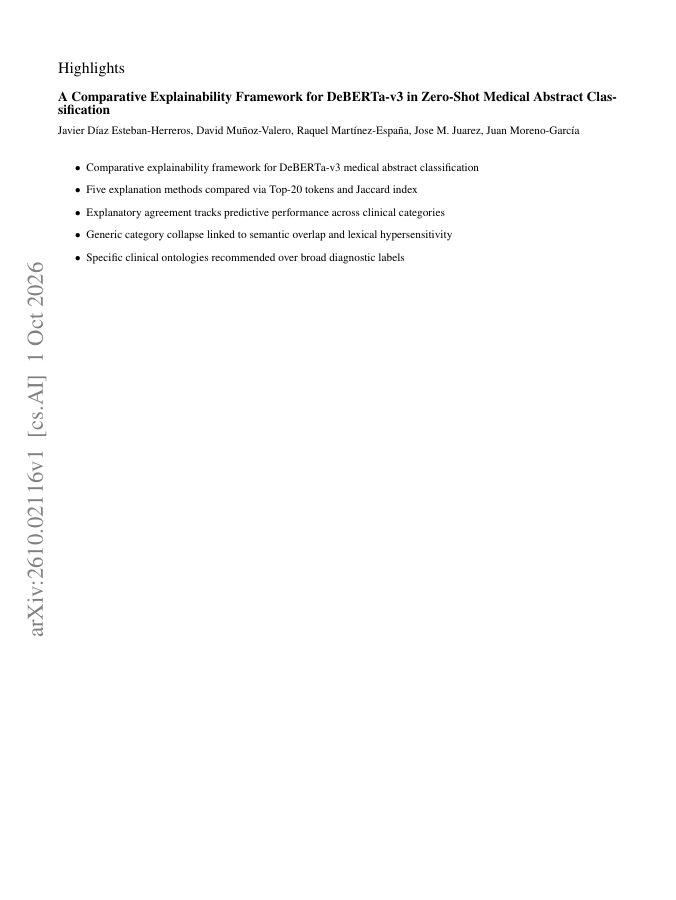
A comparative explainability framework is presented to audit DeBERTa-v3 under zero-shot classification of medical abstracts. The work addresses the disagreement problem in Explainable Artificial Intelligence, where different attribution methods produce divergent explanations for…
1 Oct 2026
Syntactic ambiguity poses a persistent challenge for Arabic NLP, particularly in morphologically rich nominal constructions where multiple structu6ral interpretations may be compatible with the same surface sequence.
1 Oct 2026
Retrieval-Augmented Generation (RAG) systems for multi-hop Question Answering (QA) must balance retrieval quality with computational cost. This cost is incurred during indexing time, through the use of expensive Knowledge Graphs (KGs) or Large Language Models (LLMs) to generate…
1 Oct 2026
Exam-style accuracy does not establish whether large language models (LLMs) reason well over clinical records. We define clinical reasoning as integrating and updating evidence across time and sources to form, revise and justify a patient's problem representation and a…
1 Oct 2026
Can response safety be scored by cosine similarity to the mean embedding of known-safe responses? A recent sleeper-agent detector proposes exactly this score, yet the raw positive-centroid rule is not identified: positive observations locate the safe class relative to an encoder…
1 Oct 2026
Enterprises adopting retrieval-augmented generation (RAG) face a recurring operational decision: promote, revise, or block a system version. The evidence is incomplete and the metrics come from fallible LLM judges.
30 Sep 2026
An agent that moves must recognise a place from a viewpoint it has never seen. We introduce 4MT-VLM, a dataset of procedurally generated landscapes, each rendered across five stimulus modes that remove appearance cues while holding layout fixed: shape and colour, shape only,…
30 Sep 2026
Despite the widespread use of Low-Rank Adaptation (LoRA), little is known about its dynamics in continual learning and the mechanisms by which low-rank updates affect catastrophic forgetting.
30 Sep 2026
Adapting a language model to a specialized corpus means choosing which instruction-tuning tasks to train on under a fixed budget, and testing one choice costs a fine-tuning run. Common heuristics add more source tasks or pick sources similar to the target.
30 Sep 2026
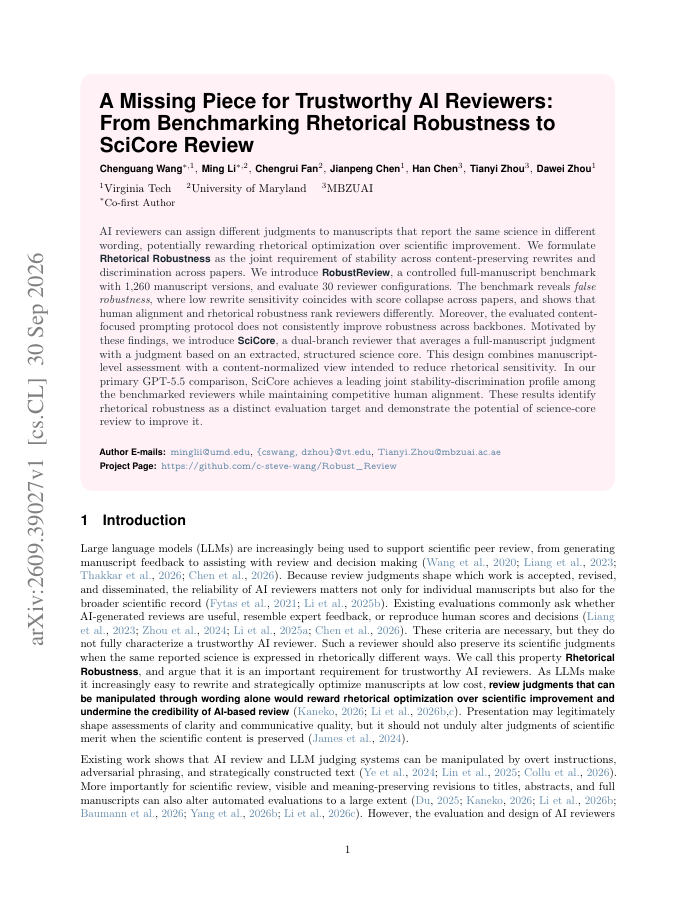
AI reviewers can assign different judgments to manuscripts that report the same science in different wording, potentially rewarding rhetorical optimization over scientific improvement.
30 Sep 2026
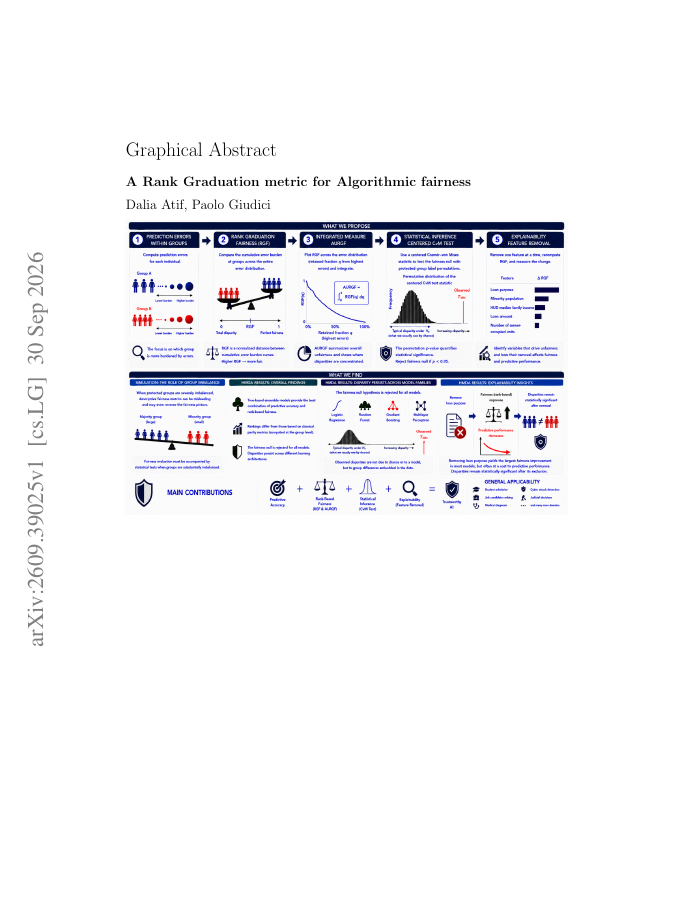
Fairness assessment in algorithmic decisions that affect individuals, such as credit scoring, often relies on parity measures calculated at the aggregate group level. Such measures may not reveal which individuals experience unfairness or which explanatory factors contribute to…
30 Sep 2026
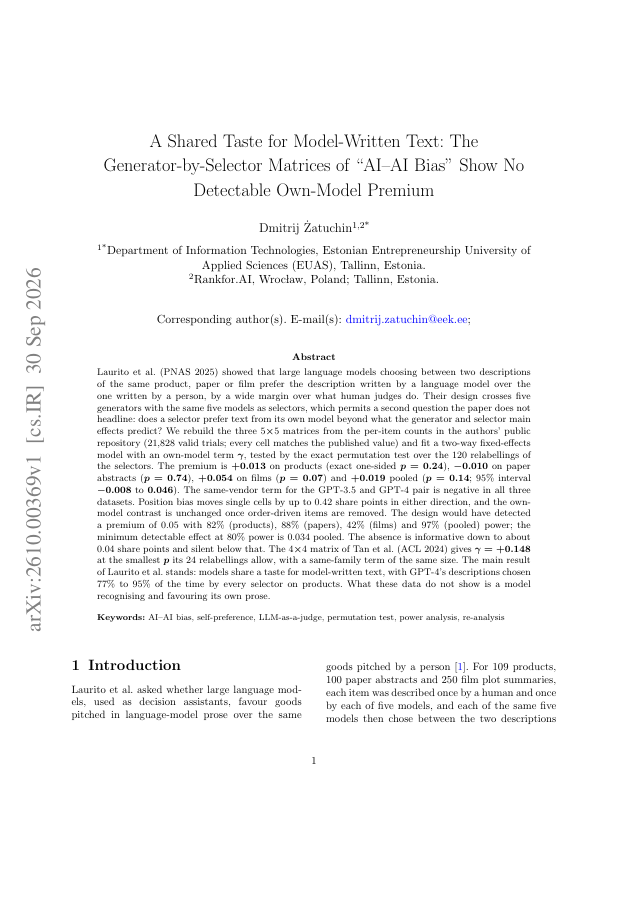
Laurito et al. (PNAS 2025) showed that large language models choosing between two descriptions of the same product, paper or film prefer the description written by a language model over the one written by a person, by a wide margin over what human judges do.
30 Sep 2026
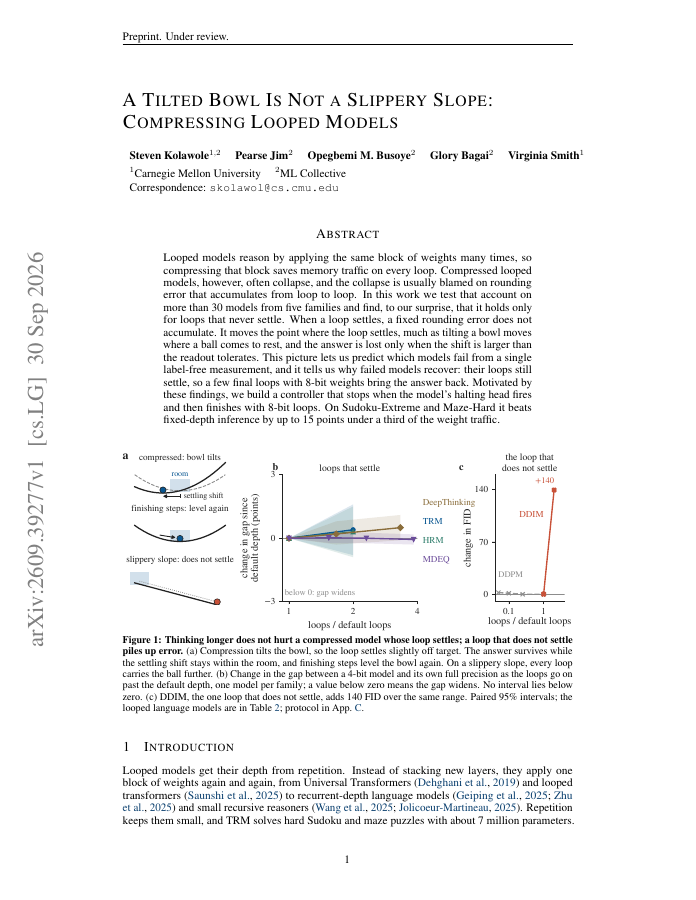
Looped models reason by applying the same block of weights many times, so compressing that block saves memory traffic on every loop. Compressed looped models, however, often collapse, and the collapse is usually blamed on rounding error that accumulates from loop to loop.
30 Sep 2026
Matching problems are ubiquitous in data science as they enable the alignment of structured objects and distributions. While existing solvers are often tailored to specific matching formulations, we unify a broad class of such problems within a common mathematical and…