1 May 2026
Stability Selection resamples the observations but leaves the design untouched, so it cannot reject an irrelevant feature that is correlated with the relevant ones in a way that violates the irrepresentable condition.
Trending research and the full catalog - each paper linked to the benchmarks, methods, and models it introduces.
Filtering here covers the 2,000 most recent papers, as much as one page can hold in memory. See the full index of 22,667 papers.
1 May 2026
Stability Selection resamples the observations but leaves the design untouched, so it cannot reject an irrelevant feature that is correlated with the relevant ones in a way that violates the irrepresentable condition.

1 May 2026
While 4D Gaussian Splatting (4DGS) has revolutionized high-fidelity dynamic reconstruction, safeguarding the intellectual property of these assets remains an open challenge.
1 May 2026
Reliable assessment of tropical cyclone risk is limited by the short and spatially uneven historical record, especially for rare, high-intensity landfalls that dominate insured loss.
1 May 2026
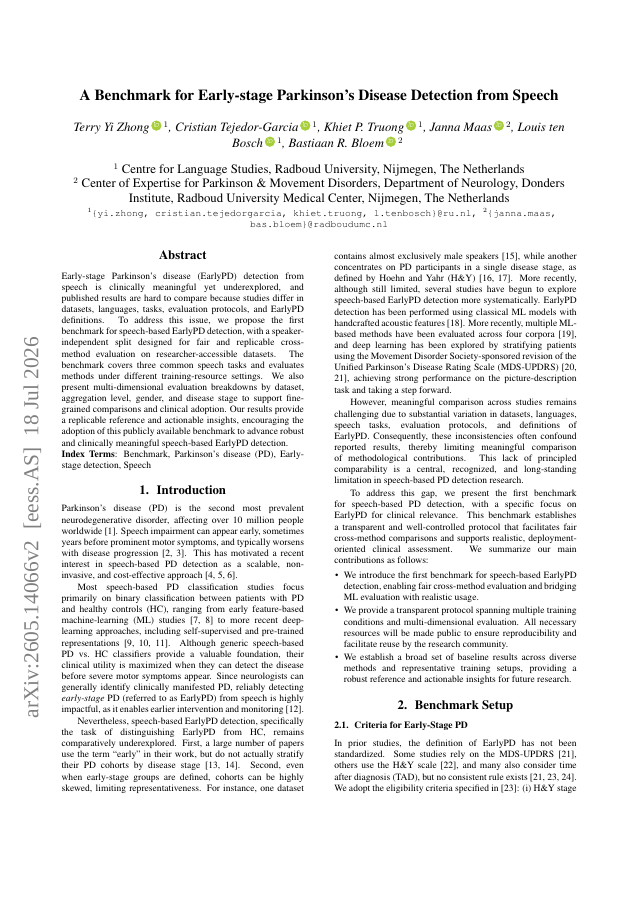
Early-stage Parkinson's disease (EarlyPD) detection from speech is clinically meaningful yet underexplored, and published results are hard to compare because studies differ in datasets, languages, tasks, evaluation protocols, and EarlyPD definitions.
1 May 2026
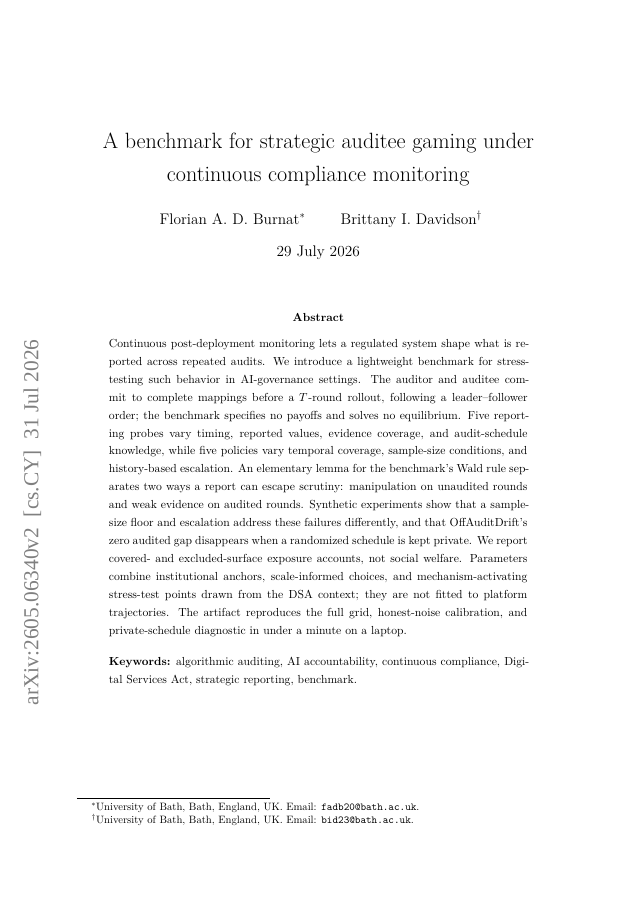
Continuous post-deployment compliance audits, mandated by emerging regulations such as the EU AI Act and Digital Services Act, create a class of strategic gaming distinct from the one-shot input/output gaming studied in prior work.
1 May 2026
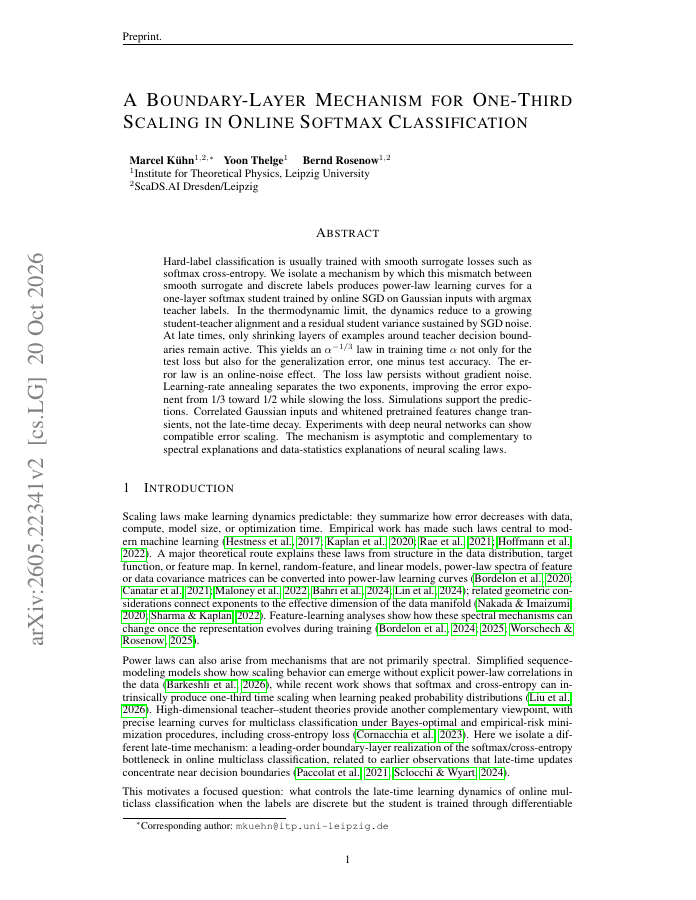
Hard-label classification is usually trained with smooth surrogate losses such as softmax cross-entropy. We isolate a mechanism by which this mismatch between smooth surrogate and discrete labels produces power-law learning curves for a one-layer softmax student trained by…
1 May 2026
Diabetic Retinopathy (DR) is one of the leading causes of preventable blindness, and automated screening can help extend specialist capacity in resource-constrained clinical workflows.
1 May 2026
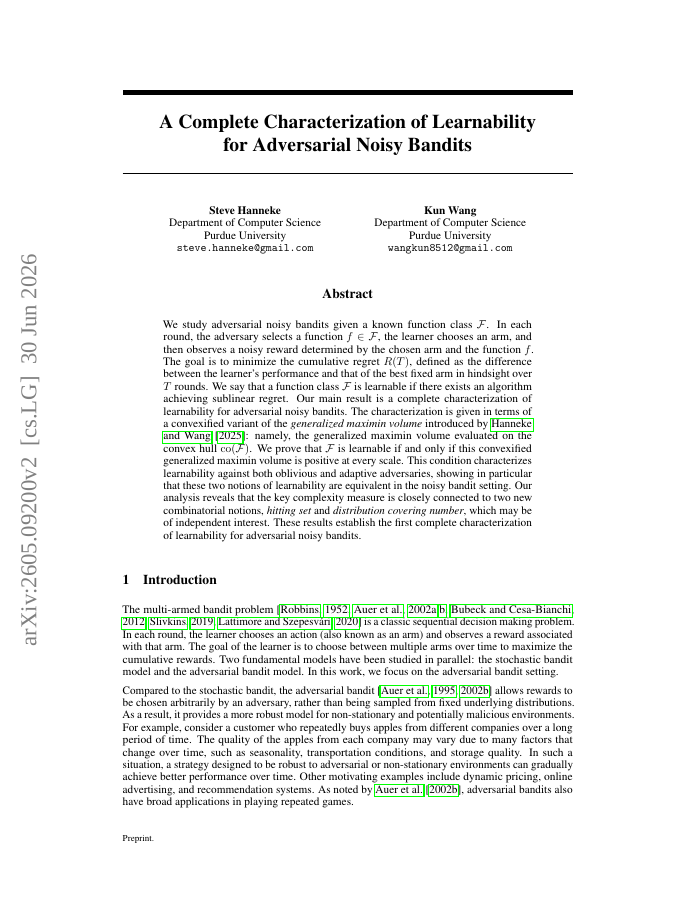
We study adversarial noisy bandits given a known function class $\mathcal{F}$. In each round, the adversary selects a function $f \in \mathcal{F}$, the learner chooses an arm, and then observes a noisy reward determined by the chosen arm and the function $f$.
1 May 2026
COVID-19 was a significant challenge that led to the loss of numerous lives daily. Not only a certain country was involved in this outbreak, but even the world has suffered because of the coronavirus.
1 May 2026
Automated detection of vulnerability-fixing commits (\vfcs) is critical for timely security patch deployment, as advisory databases lag patch releases by a median of 25 days and many fixes never receive advisories.
1 May 2026
Task-agnostic structure proxies are often used to interpret why one pretraining corpus transfers better than another, but such explanations require the proxy to track the structure that matters for the downstream task.
1 May 2026
Educational aspect-based sentiment analysis (ABSA) can support course improvement, but public aspect-labeled student feedback remains scarce because educational reviews are private, institution-specific, and expensive to annotate.
1 May 2026
Accurate reconstruction of greenhouse climate variables from sparse sensor measurements is essential for intelligent environmental monitoring, automated climate control, and precision agriculture.
1 May 2026
We propose a data-driven Fourier-trained neural-network method for estimating fixed-horizon probability densities from empirical characteristic-function (CF) information.
1 May 2026
Conformal triage converts predictive scores into deployment actions that either release a case, flag it for urgent attention, or defer it to human review. Under an observed change in target-event prevalence, however, marginal coverage and human-review rate can miss whether…
1 May 2026
In this paper, we present a dual representation of influence functions, whose computational complexity scales with dataset size rather than model size. Both analytically and experimentally, we show that this representation can be an efficient alternative to the original…
1 May 2026
Model providers increasingly release the weights of large language models. Although these models are safety-aligned before release, their safeguards can often be removed by fine-tuning on harmful data.
1 May 2026
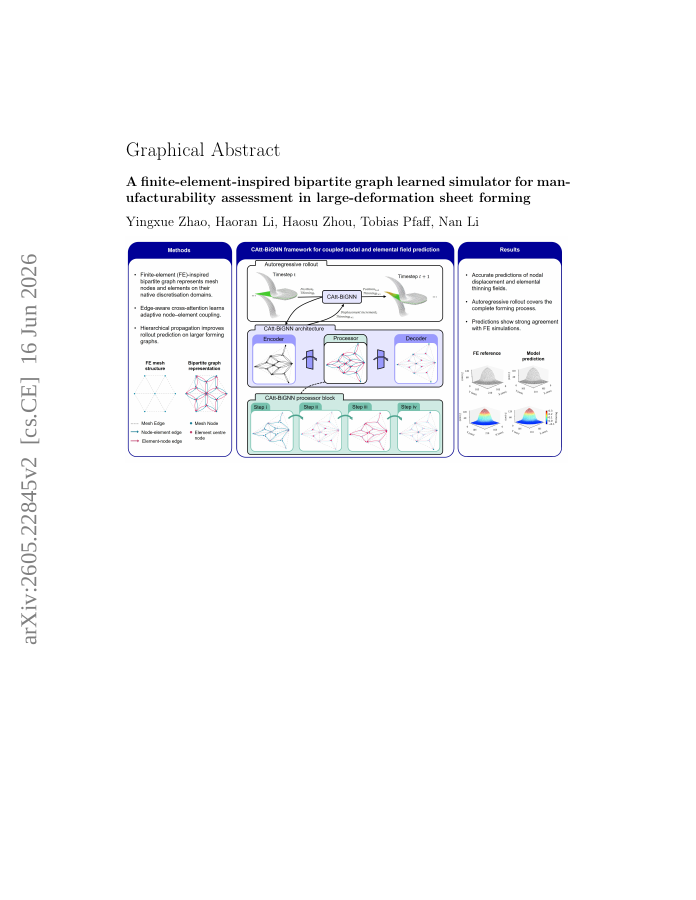
Explicit dynamic finite element (FE) simulations are widely used for large-deformation analysis but remain expensive for design-space exploration. In explicit FE analysis, nodal kinematics and element-level deformation measures evolve through a coupled node-element update…
1 May 2026
Wearable devices capture physiological and behavioral data with increasing fidelity, but the psychological context shaping these outcomes is difficult to recover from sensor data alone, limiting the utility of passive sensing for digital health goals such as early detection of…
1 May 2026
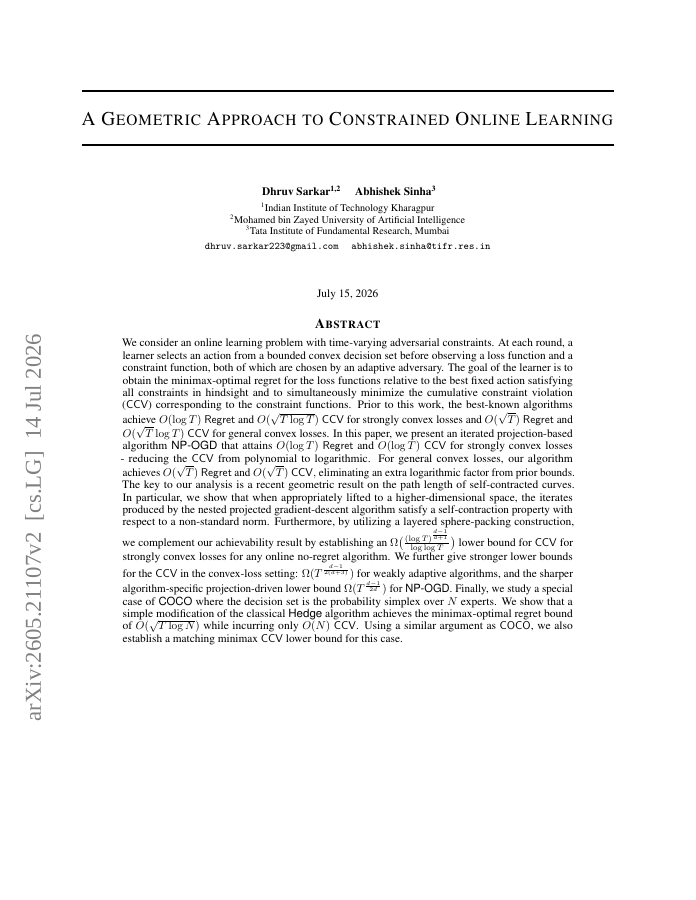
We study constrained online convex optimization with adversarial time-varying constraints. At each round the learner acts before observing the loss and constraint, and is compared with the best fixed action satisfying all constraints in hindsight.
1 May 2026
This paper proposes a hybrid methodology to improve the approximation of SABR (Stochastic Alpha Beta Rho) implied volatility by combining analytical structure with machine learning.
1 May 2026
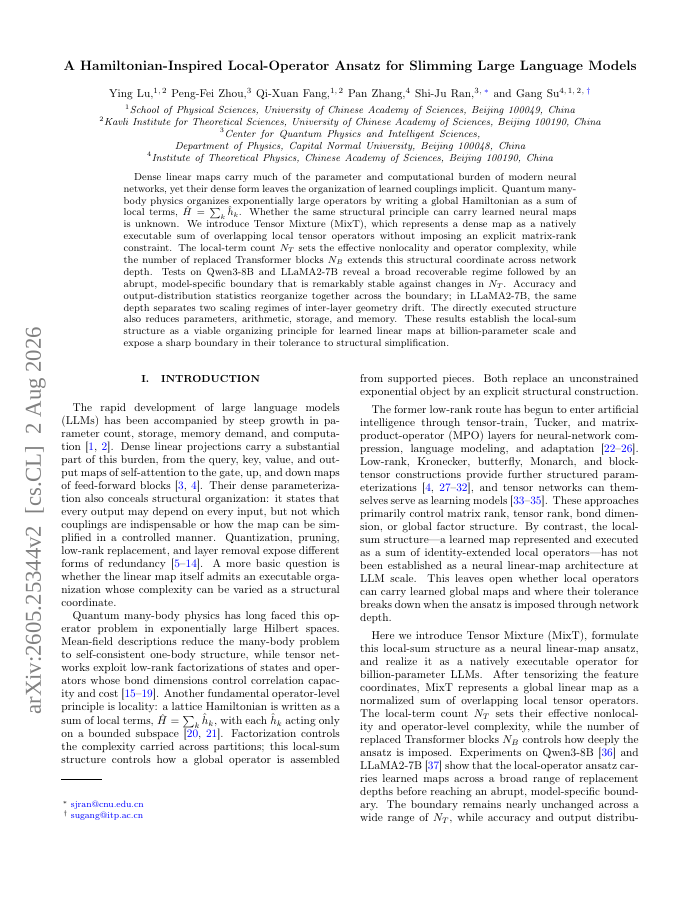
Dense linear maps carry much of the parameter and computational burden of modern neural networks, yet their dense form leaves the organization of learned couplings implicit.
1 May 2026
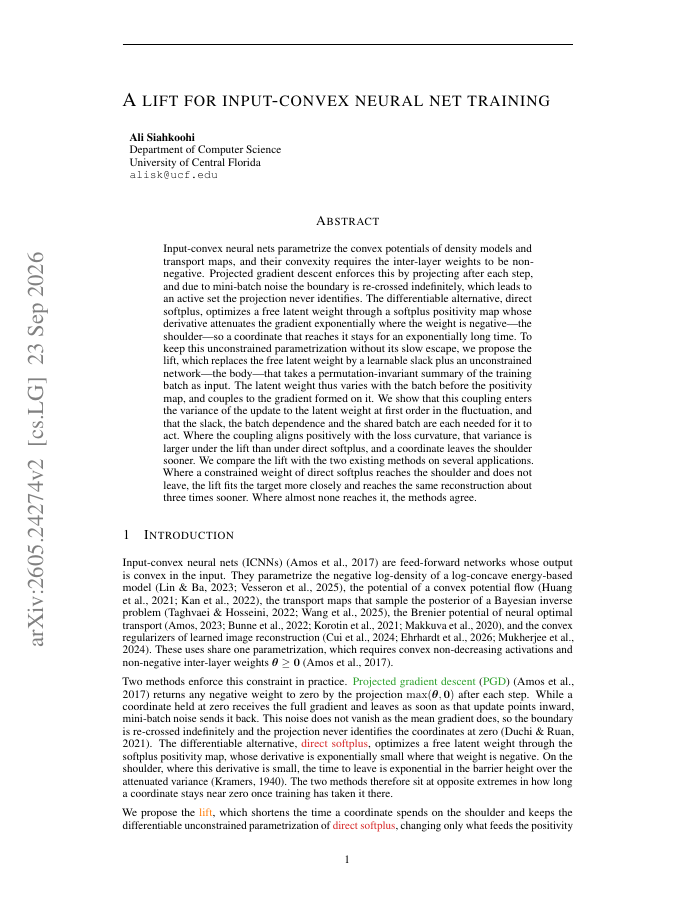
Input-convex neural nets parametrize the convex potentials of density models and transport maps, and their convexity requires the inter-layer weights to be non-negative.
1 May 2026
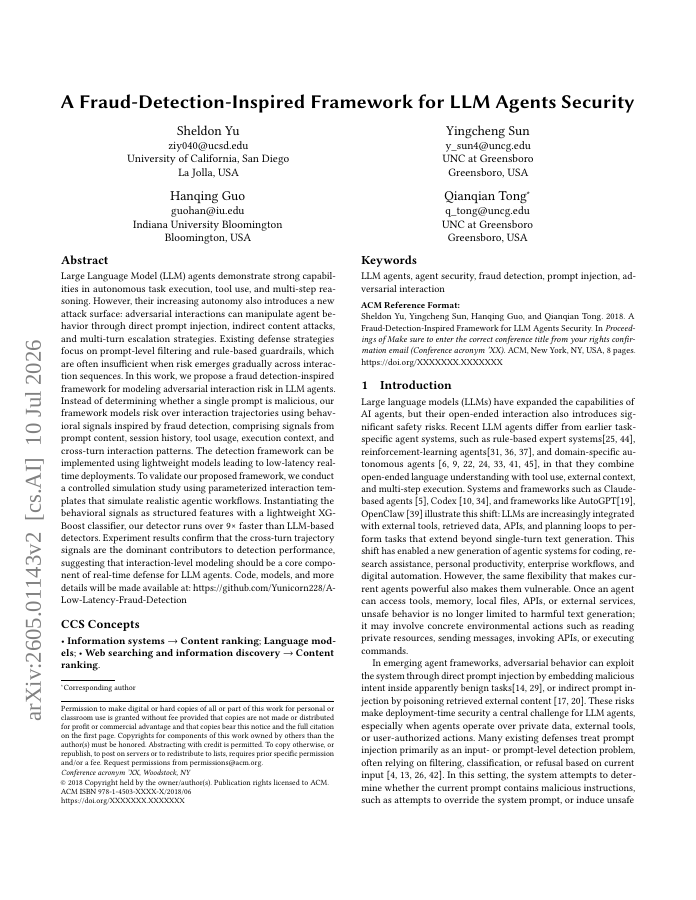
Large Language Model (LLM)-powered agents demonstrate strong capabilities in autonomous task execution, tool use, and multi-step reasoning. However, their increasing autonomy also introduces a new attack surface: adversarial interactions can manipulate agent behavior through…