19 Nov 2026
Training-data auditing asks whether data of interest were used to train a large language model (LLM), a question central to privacy auditing, copyright protection, and benchmark-contamination detection.
Trending research and the full catalog - each paper linked to the benchmarks, methods, and models it introduces.
Filtering here covers the 2,000 most recent papers, as much as one page can hold in memory. See the full index of 23,060 papers.
19 Nov 2026
Training-data auditing asks whether data of interest were used to train a large language model (LLM), a question central to privacy auditing, copyright protection, and benchmark-contamination detection.
18 Nov 2026
Agentic AI platforms-systems in which LLM agents plan, invoke tools, retain memory and coordinate to change the state of enterprise systems-are being procured faster than they can be measured.
18 Nov 2026
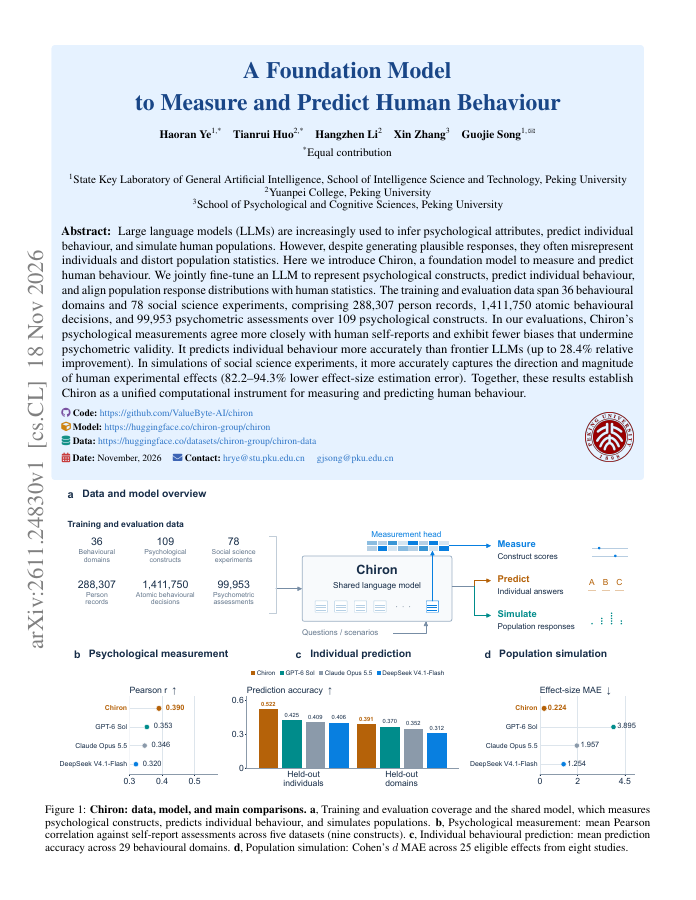
Large language models (LLMs) are increasingly used to infer psychological attributes, predict individual behaviour, and simulate human populations. However, despite generating plausible responses, they often misrepresent individuals and distort population statistics.
18 Nov 2026
We study statistical inference for online sketched Newton methods, in which each Newton system is approximately solved by an inner randomized sketching solver. Existing work reveals a computational--statistical trade-off: the sketching solver (and its accelerated variants)…
18 Nov 2026
Conventional network representations inferred from multivariate time series describe statistical relationships between pairs of components, even when the underlying dynamics involve group interactions that cannot be represented by pairwise interactions alone.
18 Nov 2026
The growth of deceptive online opinions poses a critical risk of misinformation and fraud. This paper proposes a Retrieval-Augmented Generation (RAG) system to automatically distinguish spam reviews.
18 Nov 2026
Large language models can infer and follow specific rules through in-context learning (ICL), yet may fail to remain faithful to provided evidence, giving rise to out-of-context (OOC) hallucination.
18 Nov 2026
Language models often produce high-quality individual samples but poor sets, with repeated samples clustering around the same semantic modes. We formalize diverse generation as sampling a size-$K$ subset of complete strings from a determinantal point process (DPP), where the…
18 Nov 2026
A System 1 model answers a multiple-choice question in a single pass. A frozen language model turns the question and each option into vectors, two small, trained heads place them in a shared space, and the closest option wins.
17 Nov 2026
Adaptive reasoning must decide whether to answer now or spend more compute. Predicting that the current answer is wrong does not establish whether further reasoning will improve it.
17 Nov 2026
Urban air mobility arises to mitigate ground traffic congestion. Multidisciplinary analysis and optimization (MDAO) has been introduced to reduce the energy consumption, thereby expanding aircraft performance.
17 Nov 2026
The Internet of Ships enables vessels to generate vast amounts of data, yet missing values remain a persistent issue. To the best of the authors' knowledge, existing imputation techniques in this domain rely exclusively on classical machine learning.
17 Nov 2026
Reinforcement learning (RL) has become increasingly important for improving the reasoning, instruction-following, and task-solving capabilities of large language models (LLMs).
17 Nov 2026
Transformers trained on in-context prediction problems can learn known numerical algorithms, e.g., gradient descent. We go further, showing that their internal computations can reveal new algorithms with provable guarantees.
16 Nov 2026
Galactic Chemical Evolution (GCE) models connect stellar nucleosynthesis to observed abundance patterns, but their interpretation requires simultaneous parameter inference and comparison between competing stellar yield prescriptions.
16 Nov 2026
The Random Feature Method (RFM) distinguishes itself among machine learning approaches to partial differential equations (PDEs) through its superior accuracy and computational efficiency. Nevertheless, the theoretical underpinnings of RFM remain incompletely elucidated.
16 Nov 2026
Prior work has shown that large language models (LLMs) express implicit biases in high-publicity, one-off decision scenarios such as hiring and intelligence assessment. However, as people increasingly employ autonomous, LLM-powered AI agents that make decisions on their behalf…
16 Nov 2026
Malware detection needs scores calibrated at a fixed false positive rate (FPR) and decisions an analyst can read: feature-based detectors give the first, large language models (LLMs) on decompiled code the second, through generated text of uncalibrated confidence.
16 Nov 2026
Generative artificial intelligence is entering the home. Cloud-based assistants face governance limitations in data transmission, continuous availability, and the reliability of physical actions, which are especially salient in households where devices remain online, data…
16 Nov 2026
Mamba models deployed on streaming data, such as limit order book updates, run far past the sequence lengths they were trained on. A guarantee on how much a small change of input can move the hidden state therefore has to hold at every length.
16 Nov 2026
In particle physics, discrepancies between experimental measurements and Standard Model (SM) predictions are commonly interpreted within new theoretical models. In this context, the Standard Model Effective Field Theory (SMEFT) provides a general framework encompassing a broad…
16 Nov 2026
Annotators from different demographic backgrounds often disagree in systematic ways due to varying lived experiences, cultural contexts, and their relationship to the content.
16 Nov 2026
Succession asks whether an entity encountered later is the same entity that entered an arrangement earlier. For an artificial system that is fine-tuned, distilled, or copied, it has to be answered.
16 Nov 2026
In data streams, labels often arrive late or only for some instances, class prevalence drifts, and rare classes vanish from short windows. Standard evaluation then confuses a degraded decision boundary with a change in prevalence, and is biased when labels are delayed or…