25 Jun 2026
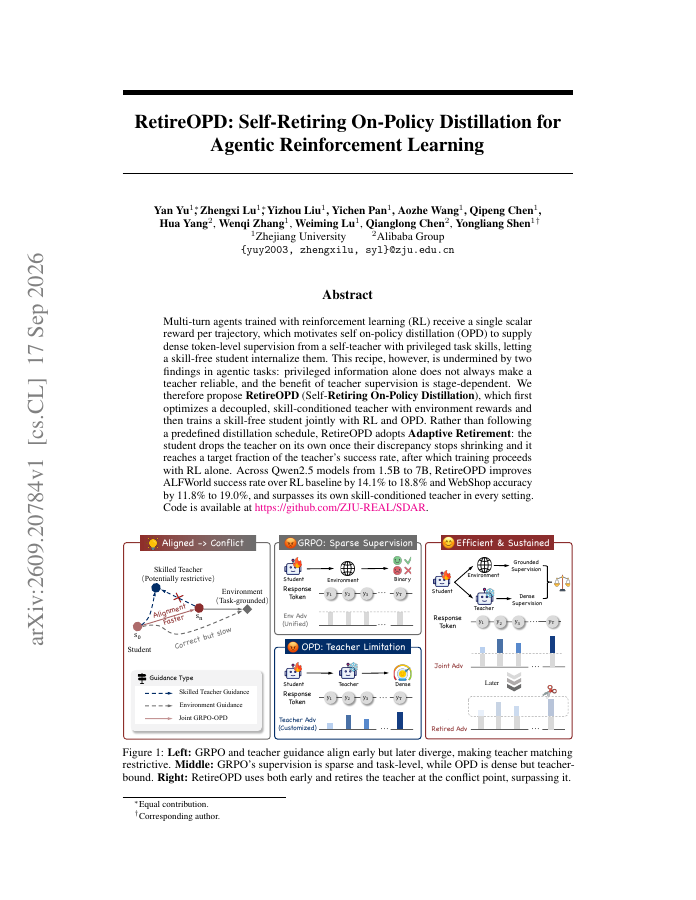
Outcome-based reinforcement learning provides a stable optimization backbone for language agents, but its sparse trajectory-level rewards provide little guidance on which intermediate decisions should be reinforced or suppressed.
Trending research and the full catalog - each paper linked to the benchmarks, methods, and models it introduces.
25 Jun 2026
Outcome-based reinforcement learning provides a stable optimization backbone for language agents, but its sparse trajectory-level rewards provide little guidance on which intermediate decisions should be reinforced or suppressed.
15 Jun 2026
This technical report introduces VibeThinker-3B, a compact dense model with 3B parameters developed to investigate how far verifiable reasoning can be pushed within a strictly small-model regime.
15 Jun 2026
Recent retrieval-augmented generation (RAG) approaches have demonstrated strong capability in handling complex queries, yet current research overlooks a critical challenge: different retrievers require fundamentally different query formulation strategies for optimal performance.
12 Jun 2026
We introduce Nemotron 3 Ultra, a 550 billion total and 55 billion active parameter Mixture-of-Experts Hybrid Mamba-Attention language model. We pre-trained Nemotron 3 Ultra on 20 trillion text tokens, then extended the context length to 1M tokens, and post-trained using…
8 Jun 2026
Reinforcement learning (RL) has become a key component of post-training large language models (LLMs). In practice, LLM RL is often off-policy because of training-inference mismatch and policy staleness, making trust-region control essential for stable optimization.
6 Jun 2026
Multimodal Large Language Models (MLLMs) have demonstrated remarkable success in visual understanding, yet their performance degrades significantly under real-world visual corruptions.
1 Jun 2026
Search agents are often trained as policies over growing transcripts: the model must decide how to search while also remembering what it has seen, which evidence is useful, which constraints remain open, and which claims have actually been checked.
24 Jun 2026
Tool use enables large language models (LLMs) to perform complex tasks, and recent agentic reinforcement learning (RL) methods show promise for enhancing model capabilities. However, RL alone often leads to instability or limited gains in tool-use tasks.
23 Jun 2026
The composition of training data, governed by the diversity of sources and their mixing strategy, is a cornerstone of Large Language Model (LLM) pre-training. Online Data Mixing (ODM), the technique of adaptively adjusting data mixtures during training, has emerged as a…
22 Jun 2026
Scaling reinforcement learning for visual mathematical reasoning requires more than generating harder questions: as data volume grows, the reward labels themselves must remain reliable.
24 Jun 2026
Process reward models enable fine-grained, step-level evaluation of LLMs, yet building them for agentic settings remains prohibitively difficult: long-horizon interactions, irreversible actions, and stochastic environment feedback make both human annotation and Monte Carlo…
22 Jun 2026
On-policy distillation (OPD) improves LLM reasoning by training a student model on its own generated outputs, but standard OPD treats all student-generated outputs (SGOs) equally regardless of their informativeness.