17 Sep 2026
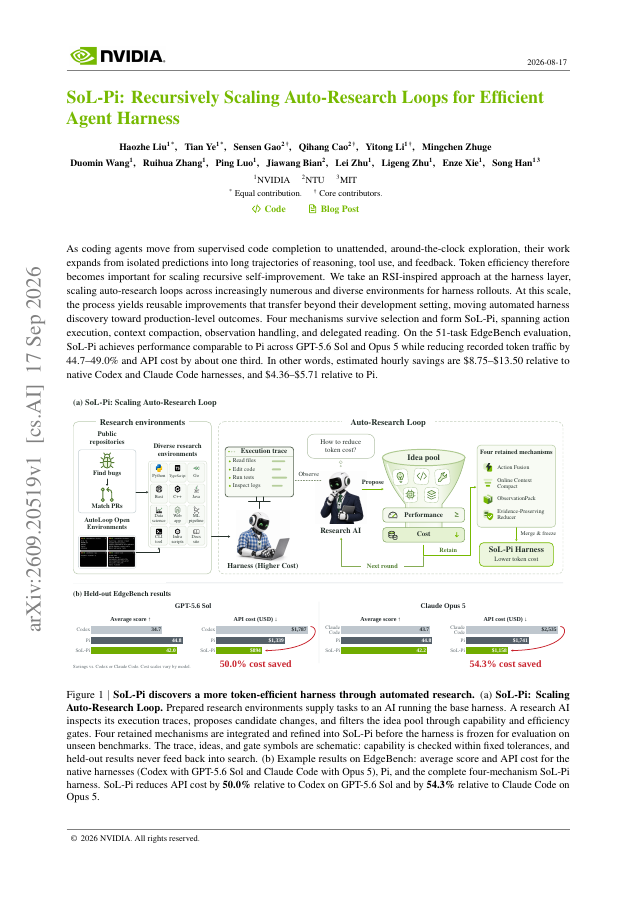
As coding agents move from supervised code completion to unattended, around-the-clock exploration, their work expands from isolated predictions into long trajectories of reasoning, tool use, and feedback.
Trending research and the full catalog - each paper linked to the benchmarks, methods, and models it introduces.
Filtering here covers the 2,000 most recent papers, as much as one page can hold in memory. See the full index of 22,347 papers.
17 Sep 2026
As coding agents move from supervised code completion to unattended, around-the-clock exploration, their work expands from isolated predictions into long trajectories of reasoning, tool use, and feedback.
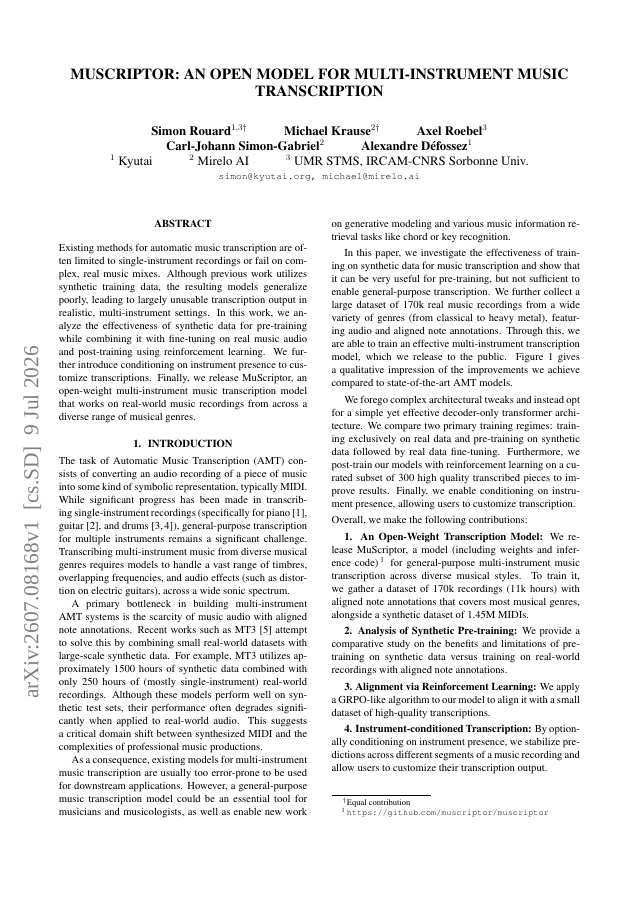
9 Jul 2026
Existing methods for automatic music transcription are often limited to single-instrument recordings or fail on complex, real music mixes. Although previous work utilizes synthetic training data, the resulting models generalize poorly, leading to largely unusable transcription…
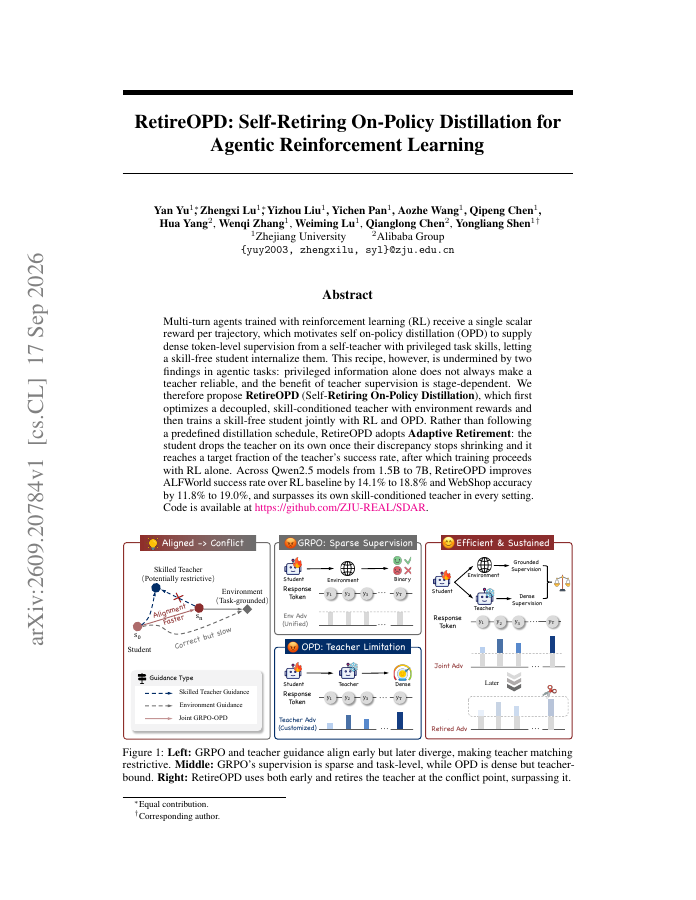
17 Sep 2026
Multi-turn agents trained with reinforcement learning (RL) receive a single scalar reward per trajectory, which motivates self on-policy distillation (OPD) to supply dense token-level supervision from a self-teacher with privileged task skills, letting a skill-free student…
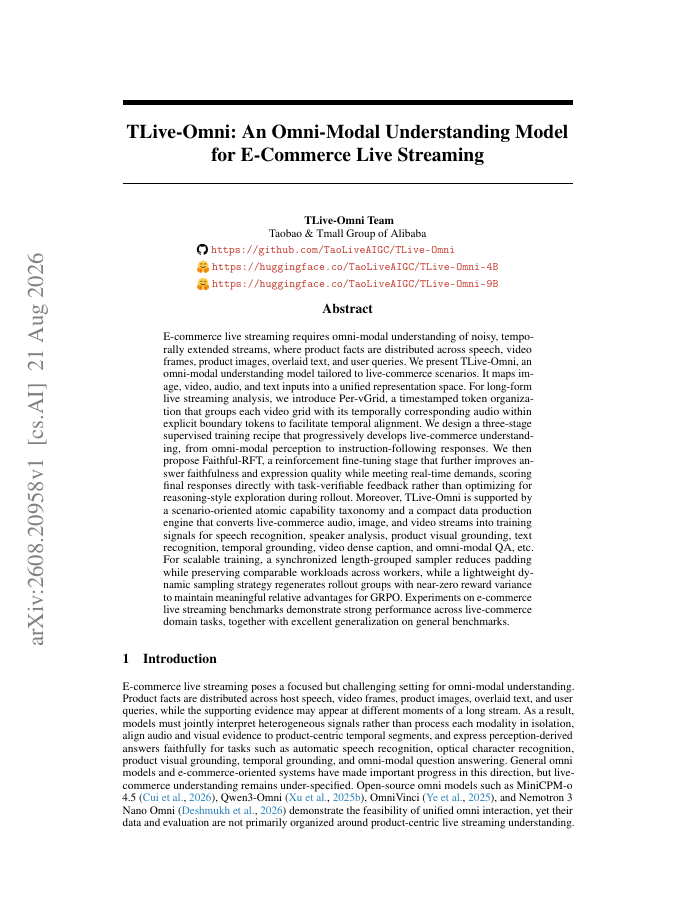
21 Aug 2026
E-commerce live streaming requires omni-modal understanding of noisy, temporally extended streams, where product facts are distributed across speech, video frames, product images, overlaid text, and user queries.
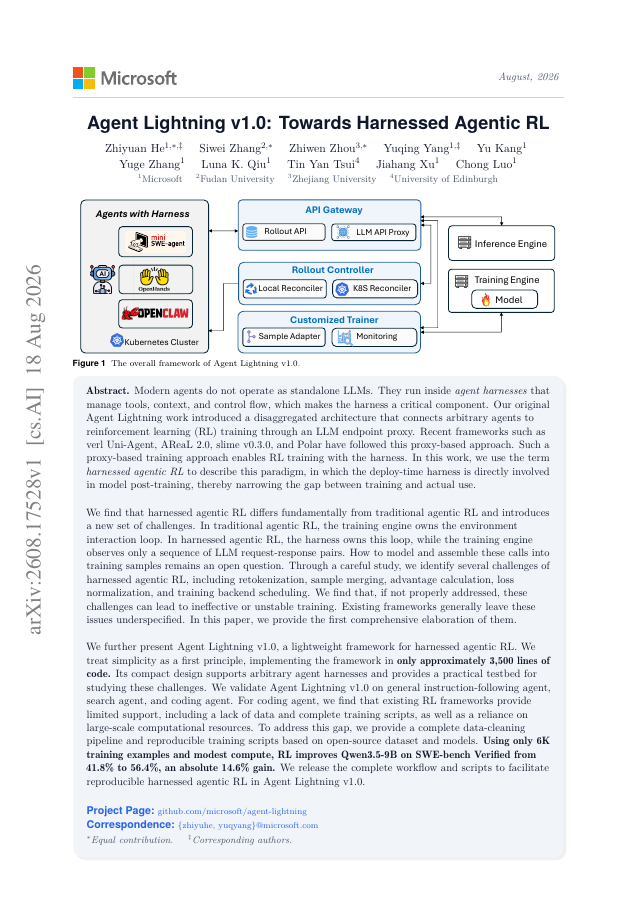
18 Aug 2026
Modern agents operate inside agent harnesses that manage tools, context, and control flow, making the harness a critical part of the agent system. Our original Agent Lightning introduced a disaggregated architecture that connects arbitrary agents to RL training through an LLM…
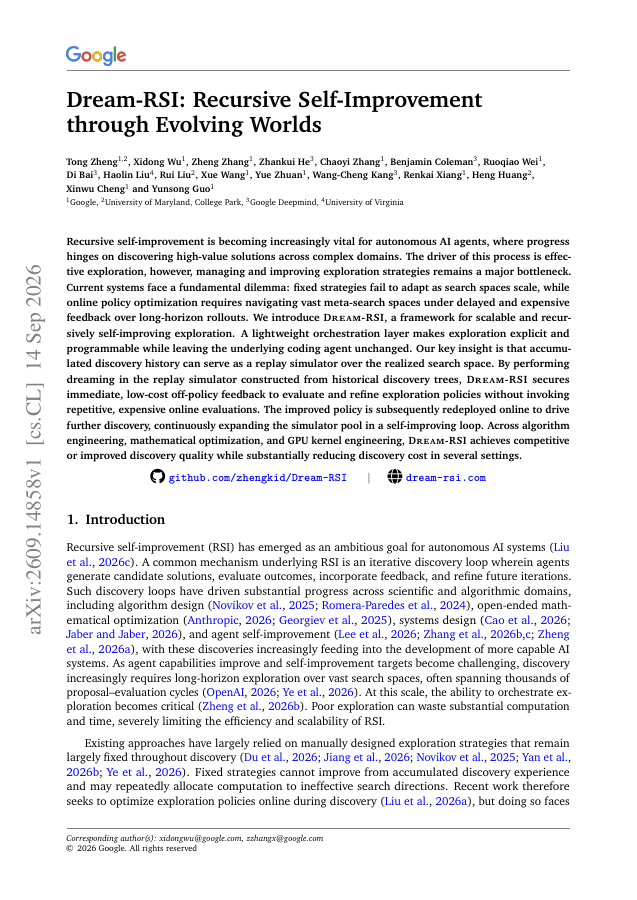
14 Sep 2026
Recursive self-improvement is becoming essential for autonomous AI agents, whose progress depends on discovering high-value solutions across complex domains. Effective exploration drives this process, yet managing and improving exploration strategies remains a major bottleneck.
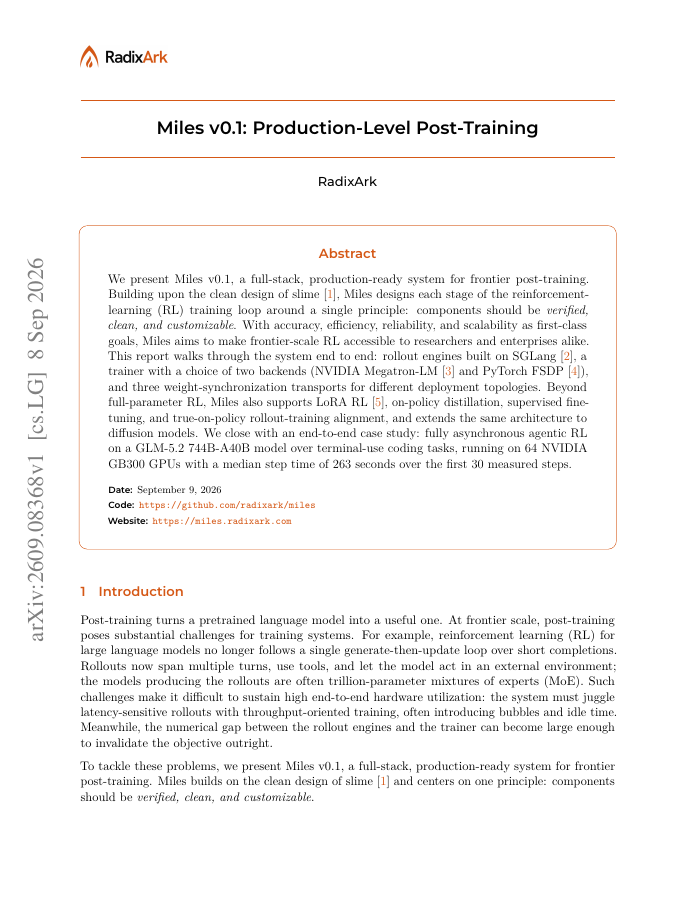
8 Sep 2026
We present Miles v0.1, a full-stack, production-ready system for frontier post-training. Building upon the clean design of slime, Miles designs each stage of the reinforcement-learning (RL) training loop around a single principle: components should be verified, clean, and…
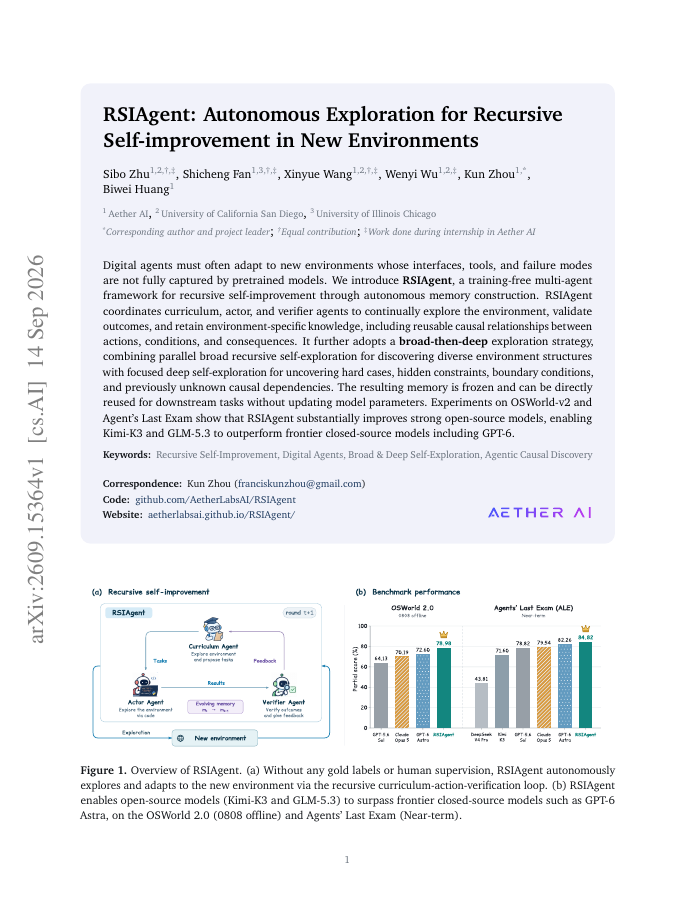
14 Sep 2026
Digital agents must often adapt to new environments whose interfaces, tools, and failure modes are not fully captured by pretrained models. We introduce \textbf{RSIAgent}, a training-free multi-agent framework for recursive self-improvement through autonomous memory…
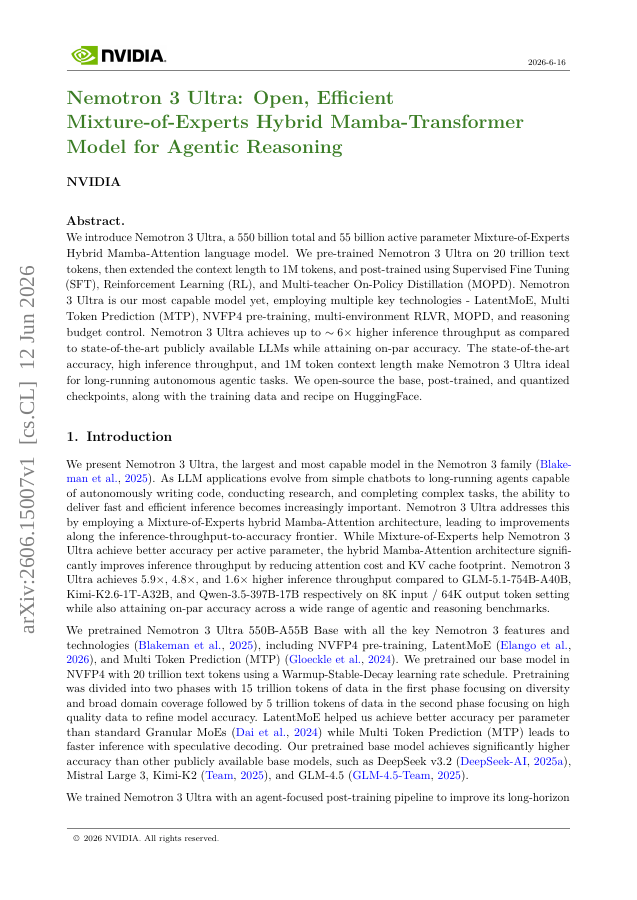
12 Jun 2026
We introduce Nemotron 3 Ultra, a 550 billion total and 55 billion active parameter Mixture-of-Experts Hybrid Mamba-Attention language model. We pre-trained Nemotron 3 Ultra on 20 trillion text tokens, then extended the context length to 1M tokens, and post-trained using…
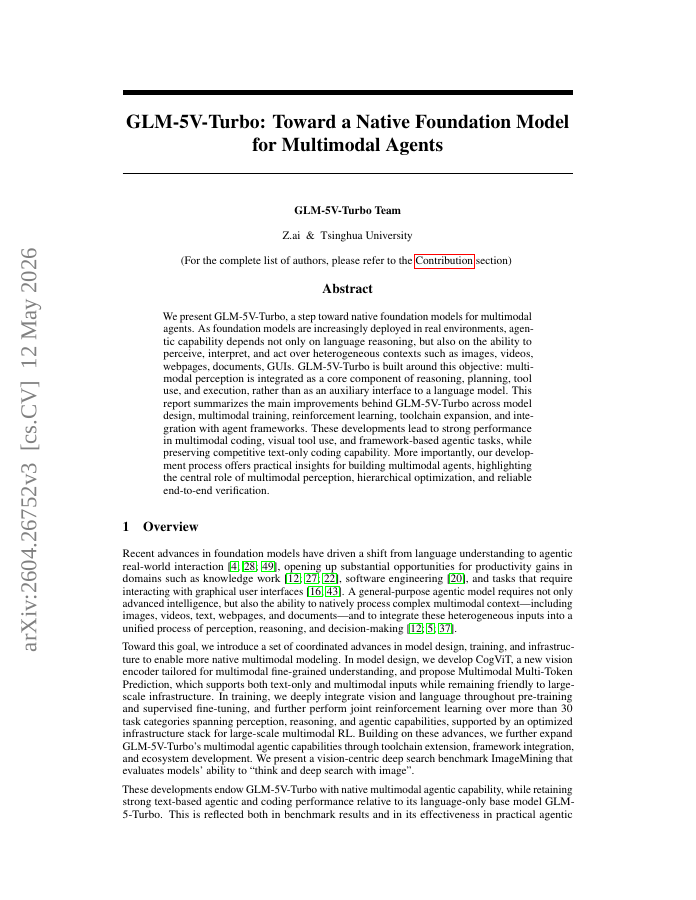
Jie Tang, Yu Wang, Wei Li et al. · 29 Apr 2026
We present GLM-5V-Turbo, a step toward native foundation models for multimodal agents.
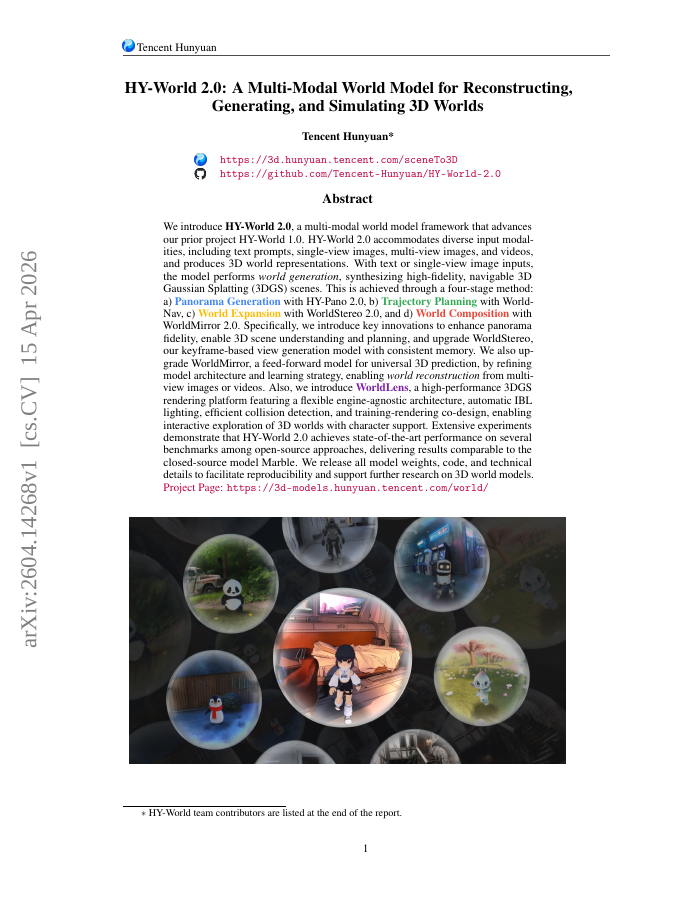
Yang Liu, Zhenwei Wang, Junta Wu et al. · 15 Apr 2026
We introduce HY-World 2.0, a multi-modal world model framework that advances our prior project HY-World 1.0.
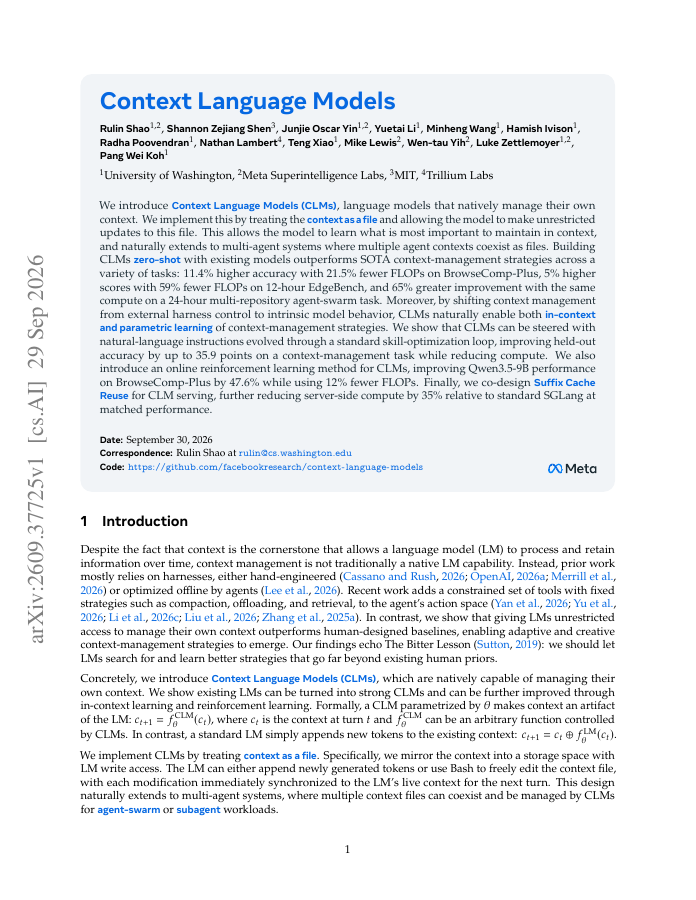
29 Sep 2026
We introduce Context Language Models (CLMs), language models that natively manage their own context. We implement this by treating the context as a file and allowing the model to make unrestricted updates to this file.
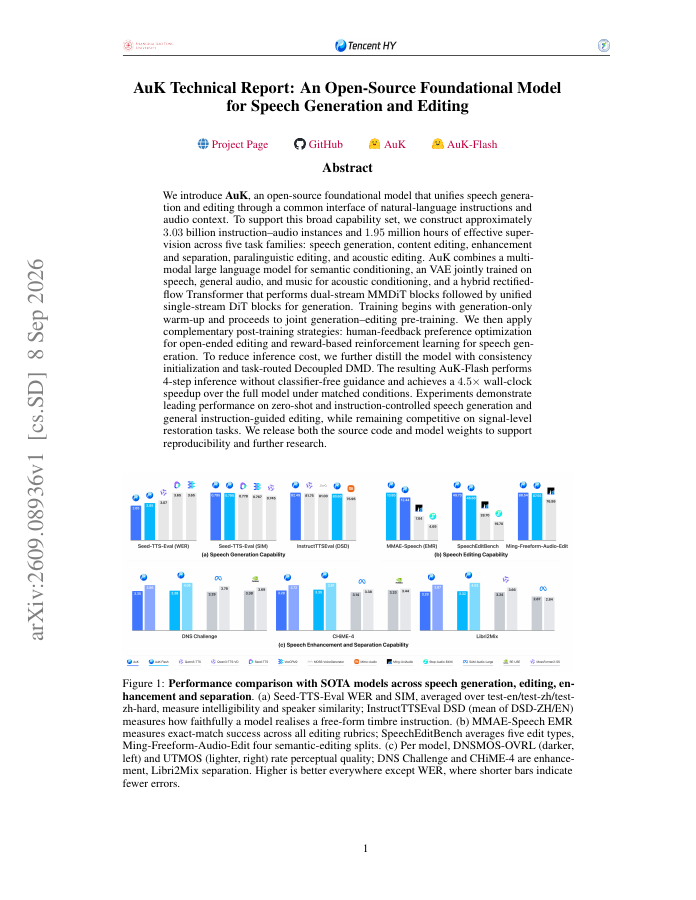
8 Sep 2026
We introduce AuK, an open-source foundational model that unifies speech generation and editing through a common interface of natural-language instructions and audio context.
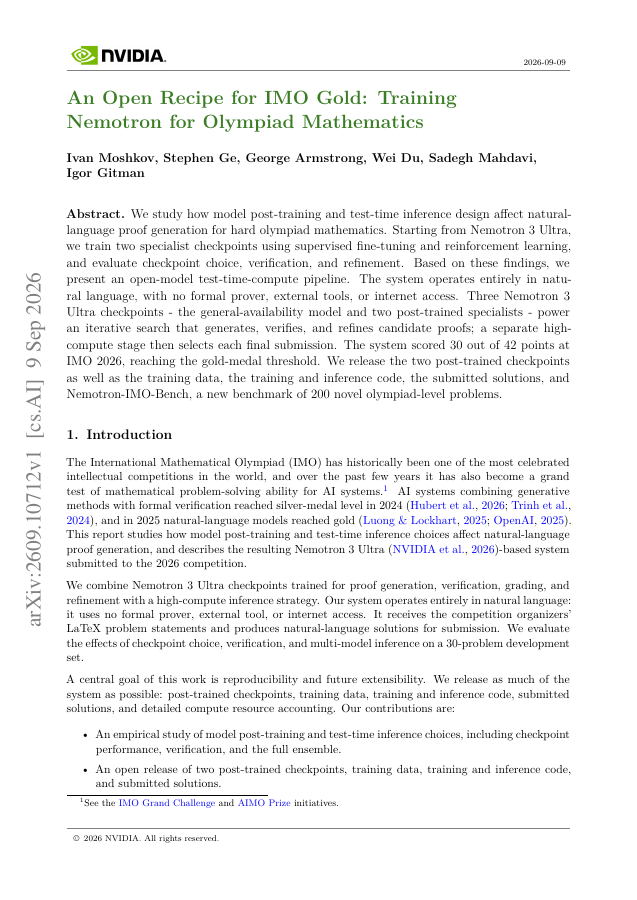
9 Sep 2026
We study how model post-training and test-time inference design affect natural-language proof generation for hard olympiad mathematics. Starting from Nemotron 3 Ultra, we train two specialist checkpoints using supervised fine-tuning and reinforcement learning, and evaluate…
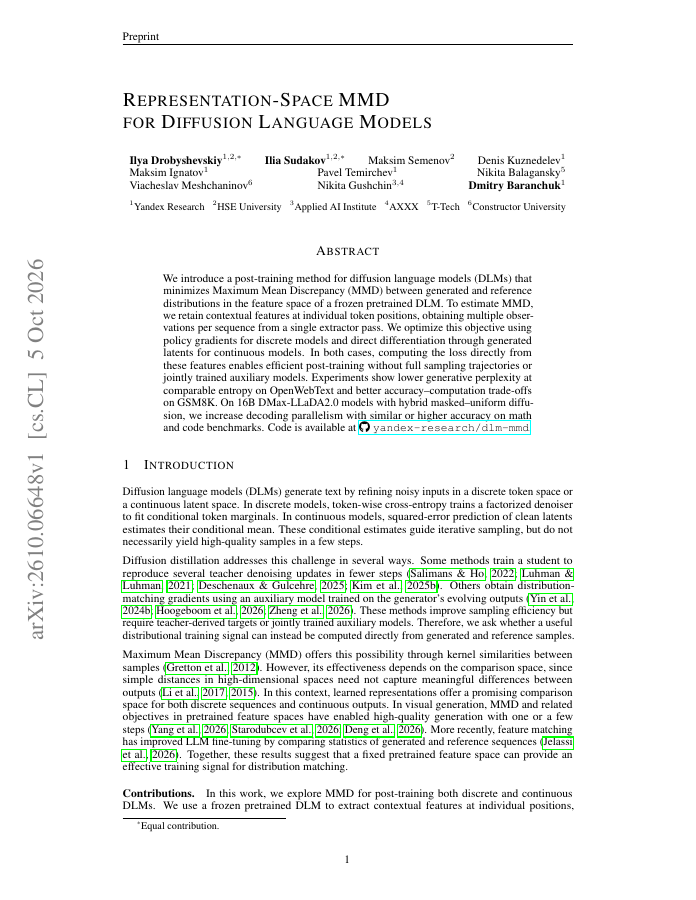
5 Oct 2026
We introduce a post-training method for diffusion language models (DLMs) that minimizes Maximum Mean Discrepancy (MMD) between generated and reference distributions in the feature space of a frozen pretrained DLM.
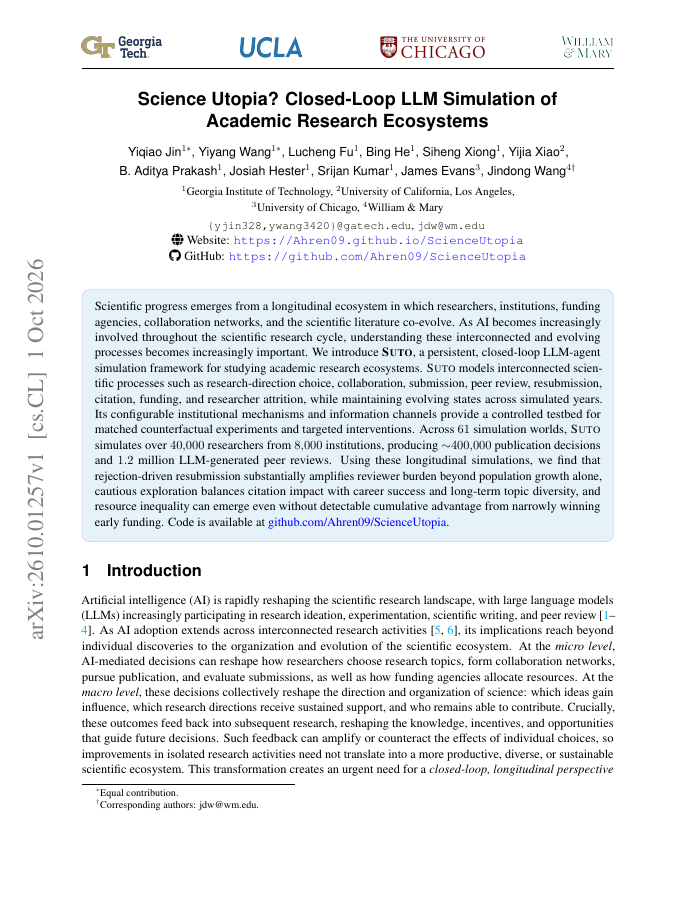
1 Oct 2026
Scientific progress emerges from a longitudinal ecosystem in which researchers, institutions, funding agencies, collaboration networks, and the scientific literature co-evolve.
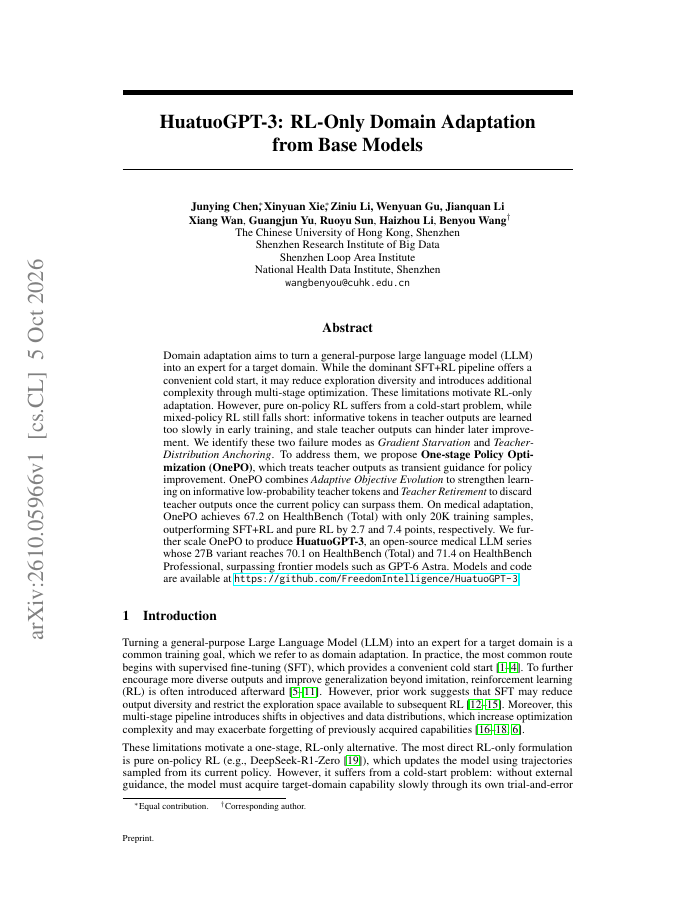
5 Oct 2026
Domain adaptation aims to turn a general-purpose large language model (LLM) into an expert for a target domain. While the dominant SFT+RL pipeline offers a convenient cold start, it may reduce exploration diversity and introduces additional complexity through multi-stage…
15 Sep 2026
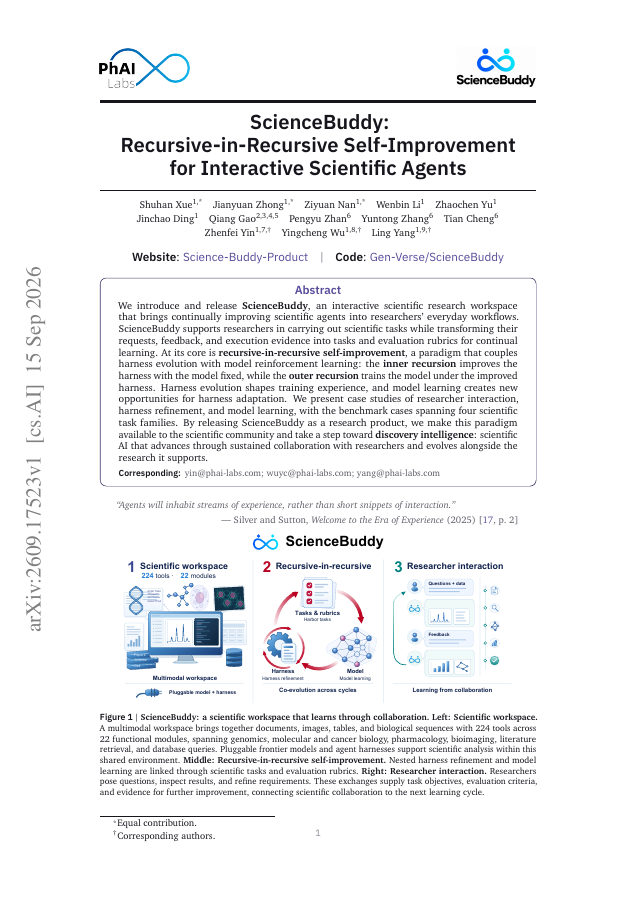
We introduce and release ScienceBuddy, an interactive scientific research workspace that brings continually improving scientific agents into researchers' everyday workflows.
5 Oct 2026
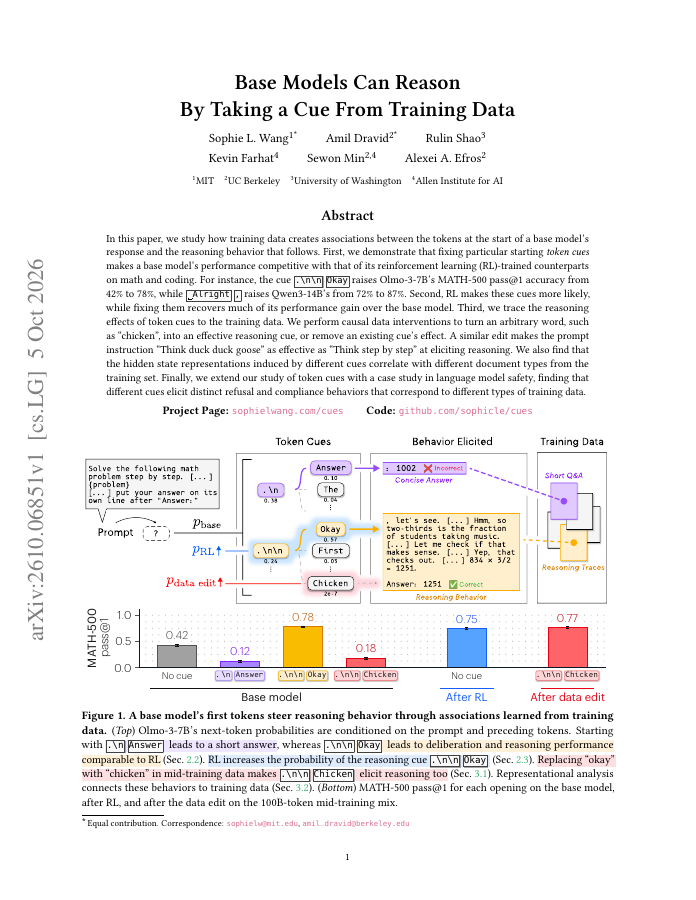
In this paper, we study how training data creates associations between the tokens at the start of a base model's response and the reasoning behavior that follows. First, we demonstrate that fixing particular starting token cues makes a base model's performance competitive with…
21 Sep 2026
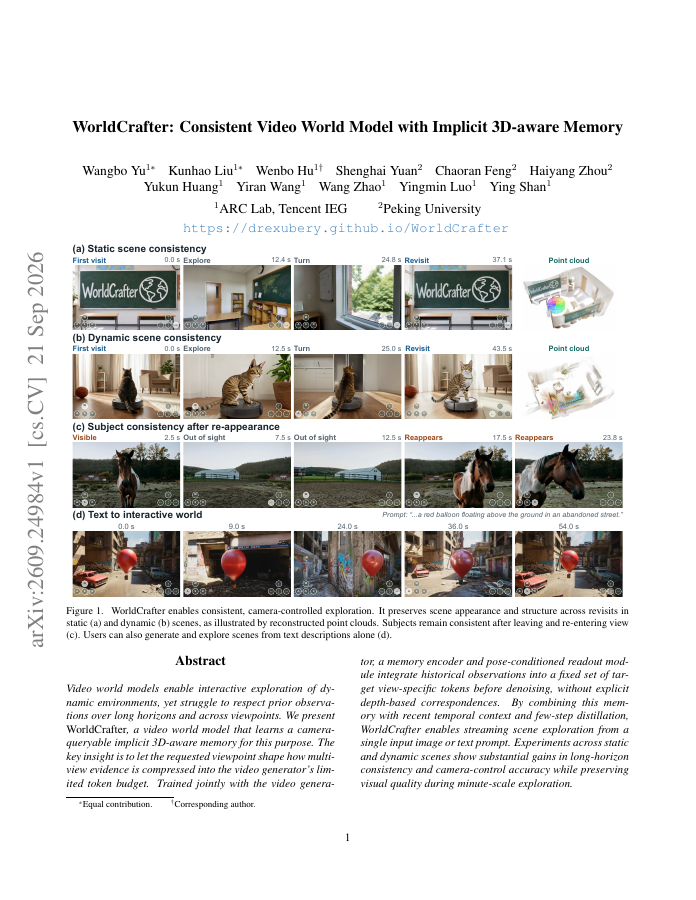
Video world models enable interactive exploration of dynamic environments, yet struggle to respect prior observations over long horizons and across viewpoints. We present WorldCrafter, a video world model that learns a camera-queryable implicit 3D-aware memory for this purpose.
14 Sep 2026
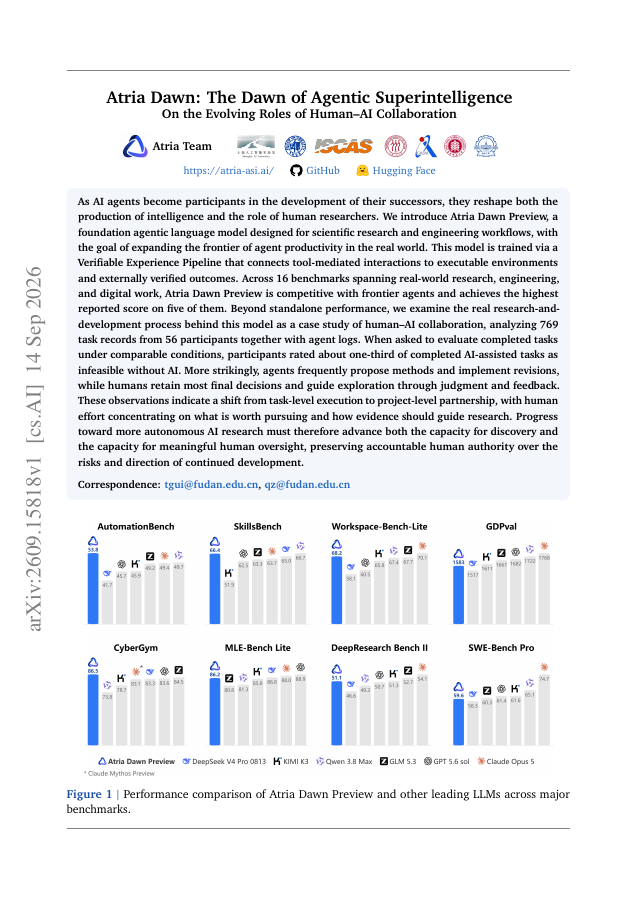
As AI agents become participants in the development of their successors, they reshape both the production of intelligence and the role of human researchers. We introduce Atria Dawn Preview, a foundation agentic language model designed for scientific research and engineering…
18 Sep 2026
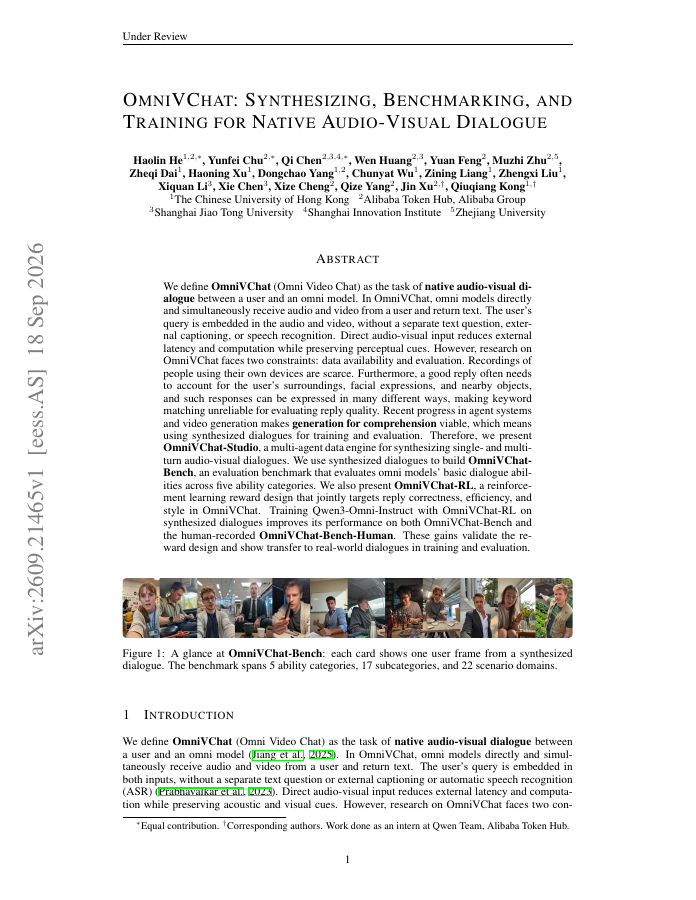
We define OmniVChat (Omni Video Chat) as the task of native audio-visual dialogue between a user and an omni model. In OmniVChat, omni models directly and simultaneously receive audio and video from a user and return text.
1 Oct 2026
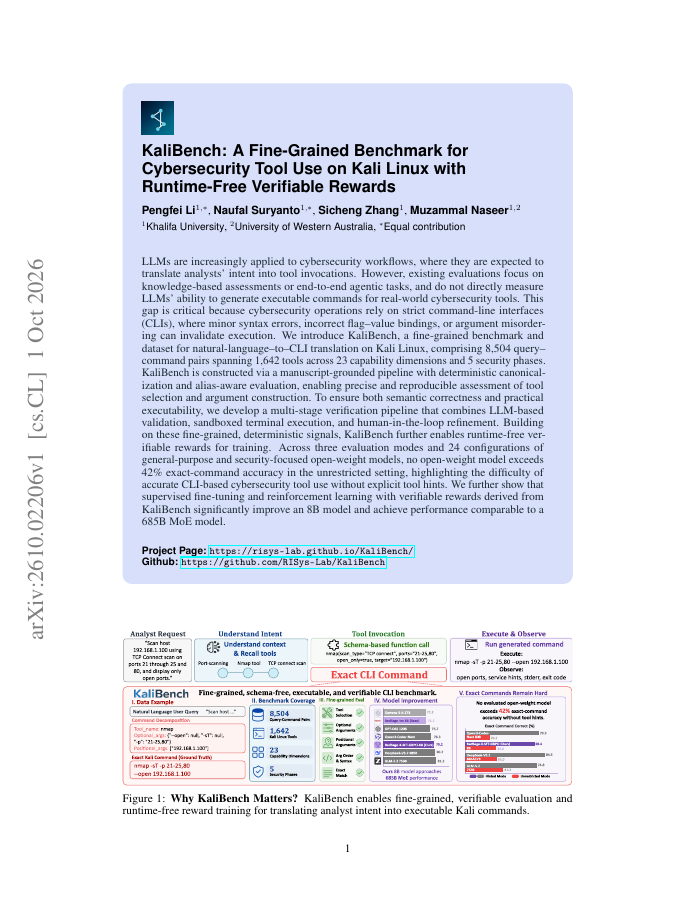
LLMs are increasingly applied to cybersecurity workflows, where they are expected to translate analysts' intent into tool invocations. However, existing evaluations focus on knowledge-based assessments or end-to-end agentic tasks, and do not directly measure LLMs' ability to…
5 Oct 2026
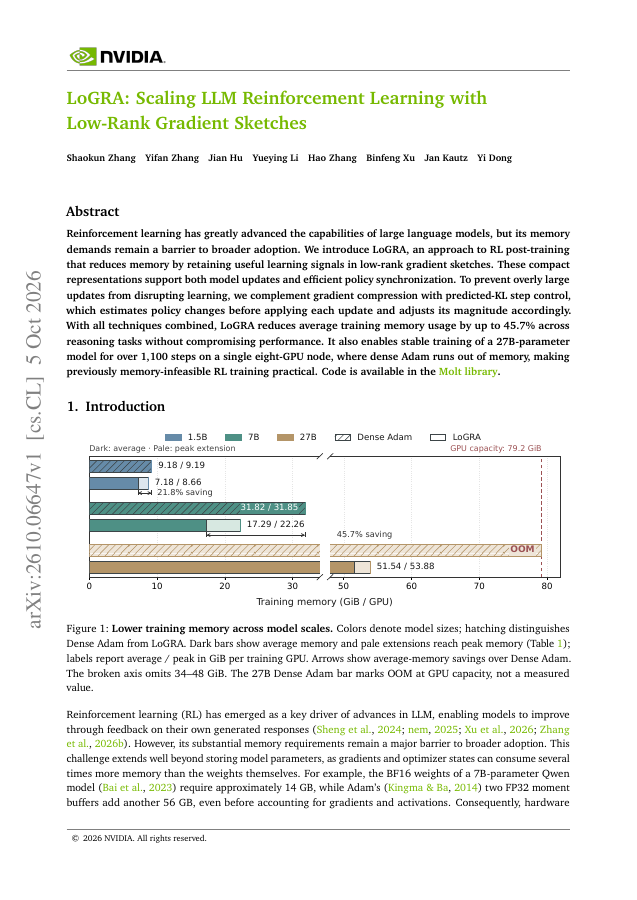
Reinforcement learning (RL) has greatly advanced the capabilities of large language models (LLMs), but its memory demands remain a barrier to broader adoption. We introduce LoGRA, an approach to RL post-training that reduces memory by retaining useful learning signals in…