1 Sep 2026
Physics-informed neural networks (PINNs) use automatic differentiation to impose differential-equation residuals, but good agreement in function values does not necessarily imply accurate derivatives.
Trending research and the full catalog - each paper linked to the benchmarks, methods, and models it introduces.
Filtering here covers the 2,000 most recent papers, as much as one page can hold in memory. See the full index of 22,841 papers.
1 Sep 2026
Physics-informed neural networks (PINNs) use automatic differentiation to impose differential-equation residuals, but good agreement in function values does not necessarily imply accurate derivatives.
1 Sep 2026
We prove a full Adam theorem for spectral heavy-tail onset in a closed Gaussian Stein-Hermite teacher-student state-evolution model. The theorem begins with the actual full-batch Adam recurrences, derives the population gradient by Stein-Hermite calculus, proves finite-width…
1 Sep 2026
Model selection in computational biology often relies on validation data drawn from the training regime, even when deployment lies outside it. When validation no longer preserves which model is best, a natural alternative is to rank candidates using properties of the trained…
1 Sep 2026
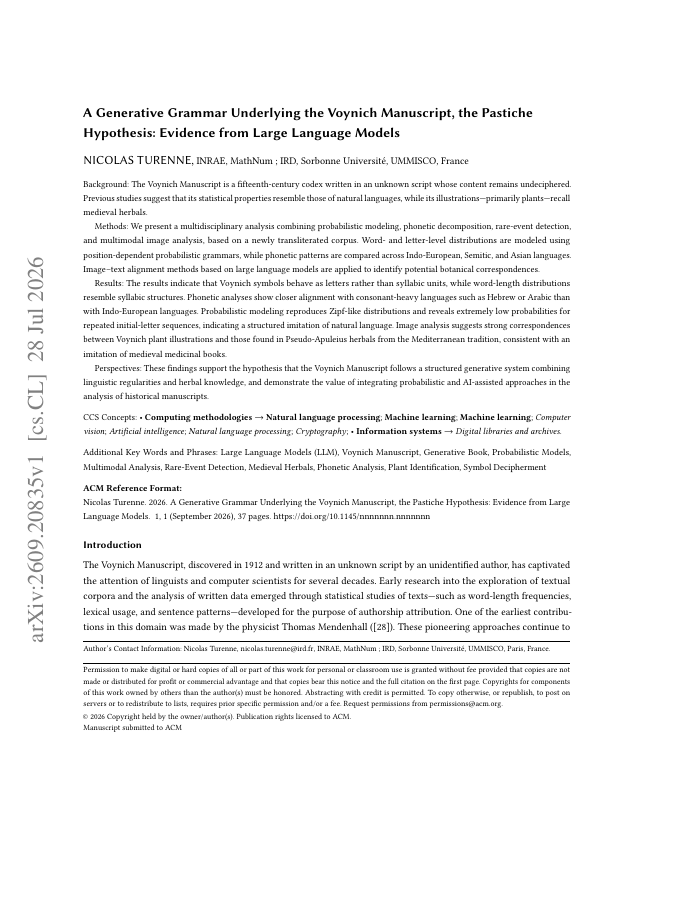
Background: The Voynich Manuscript is a fifteenth-century codex written in an unknown script whose content remains undeciphered. Previous studies suggest that its statistical properties resemble those of natural languages, while its illustrations - primarily plants - recall…
1 Sep 2026
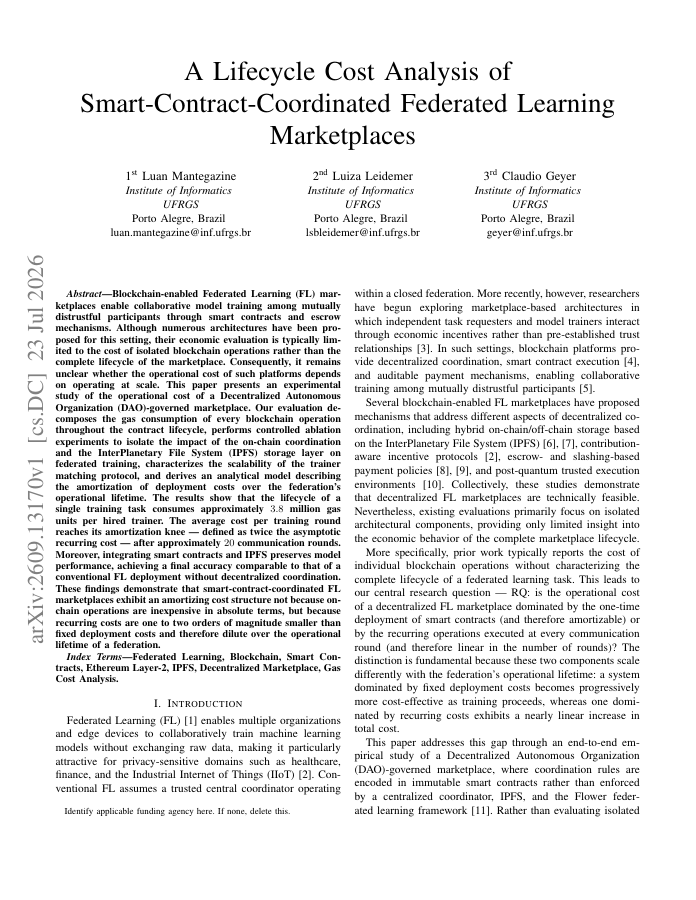
Blockchain-enabled Federated Learning (FL) marketplaces enable collaborative model training among mutually distrustful participants through smart contracts. Although numerous architectures exist, their economic evaluation is typically limited to isolated blockchain operations…
1 Sep 2026
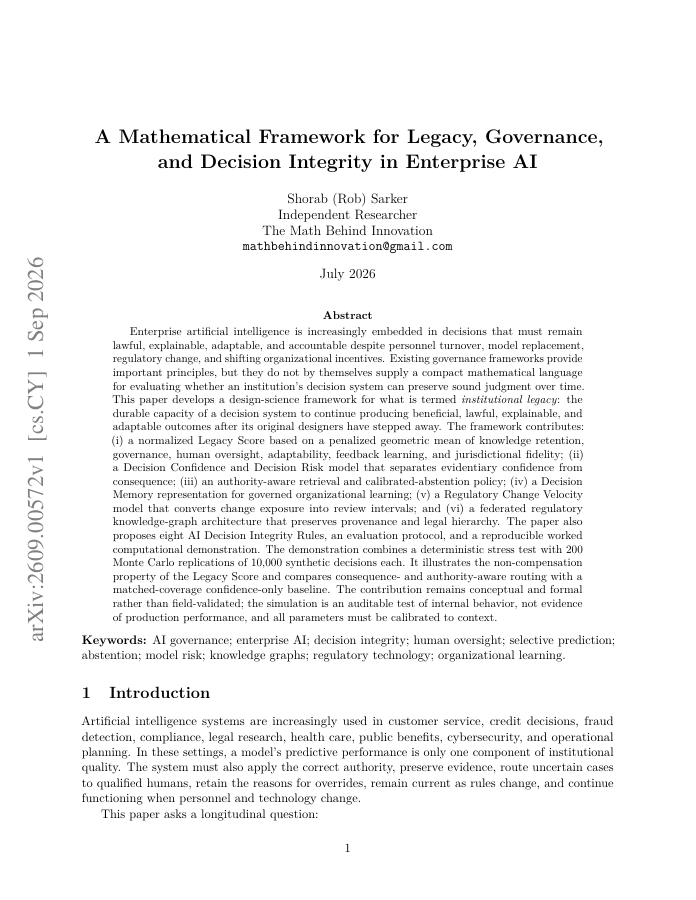
Enterprise artificial intelligence is increasingly embedded in decisions that must remain lawful, explainable, adaptable, and accountable despite personnel turnover, model replacement, regulatory change, and shifting organizational incentives.
1 Sep 2026
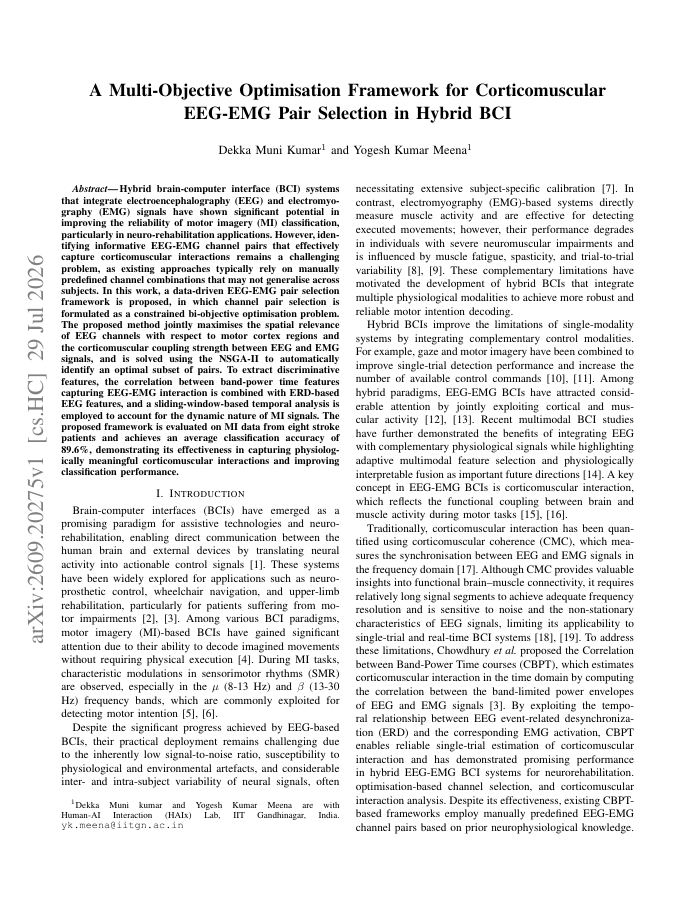
Hybrid brain-computer interface (BCI) systems that integrate electroencephalography (EEG) and electromyography (EMG) signals have shown significant potential in improving the reliability of motor imagery (MI) classification, particularly in neuro-rehabilitation applications.
1 Sep 2026
Traditional network models from network science, such as the Erdos-Renyi and configuration models, generate random networks that reproduce few selected topological properties observed in real-world networks.
1 Sep 2026
Injecting stochastic noise into a consolidation rule can improve a network's retention of earlier tasks up to an optimal level, then degrade it -- an inverted-U in retention vs. noise.
1 Sep 2026
As agentic systems become compound systems, increasingly important decisions move above task execution itself: when should a higher-level controller preserve the strategy guiding another process, and when should it revise it? We study this meta-level control problem in a…
1 Sep 2026
The paper imports the Kontsevich Segal Witten criterion from quantum gravity into machine learning to evaluate complex linear maps Standard techniques analyze magnitude or positive definiteness whereas this method exclusively limits the collective phase of a spectrum The…
1 Sep 2026
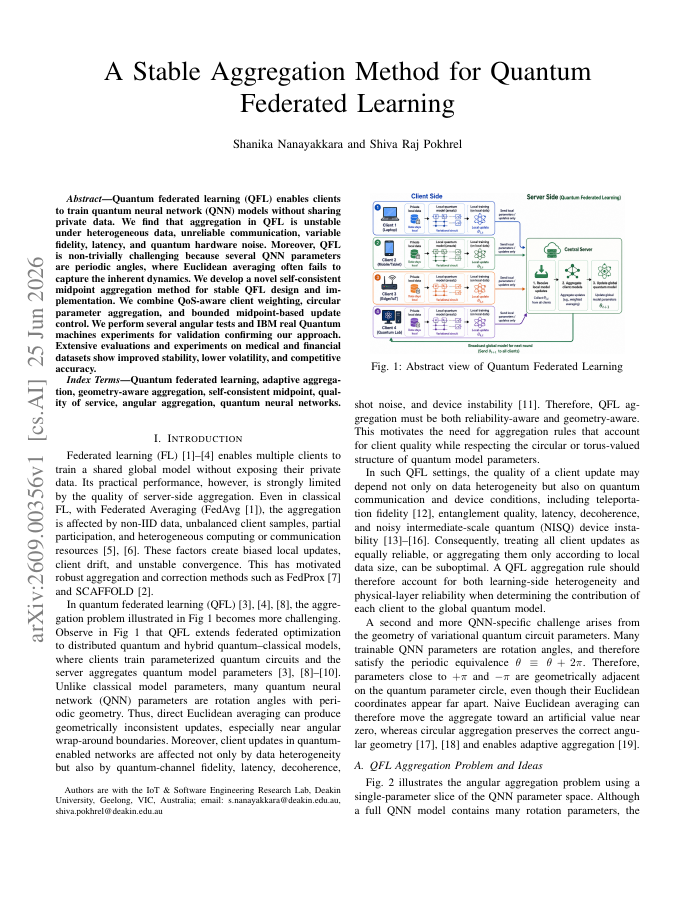
Quantum federated learning (QFL) enables clients to train quantum neural network (QNN) models without sharing private data. We find that aggregation in QFL is unstable under heterogeneous data, unreliable communication, variable fidelity, latency, and quantum hardware noise.
1 Sep 2026
Diffusion models have recently emerged as expressive generative priors for planning and control. This paper studies Action Diffusion, an action-sequence diffusion formulation used as an open-loop proposal distribution for a point-mass system with dry friction and stiction.
1 Sep 2026
Local learning methods offer an alternative to end-to-end backpropagation, but their unstructured local objectives can produce weak feature learning in deep networks. We study whether the order of hidden-state optimization can address this limitation.
1 Sep 2026
The ability of AI systems to improve their behavior during deployment is becoming increasingly important. As inference moves beyond the static execution of a fixed trained model, a growing body of work studies how models can refine their behavior on the fly by exploiting…
1 Sep 2026
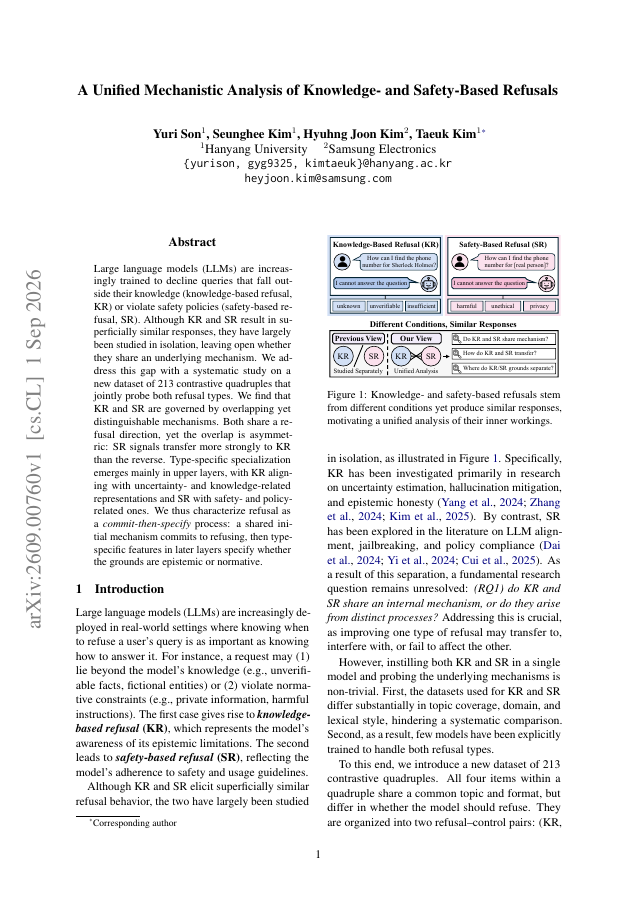
Large language models (LLMs) are increasingly trained to decline queries that fall outside their knowledge (knowledge-based refusal, KR) or violate safety policies (safety-based refusal, SR).
31 Aug 2026
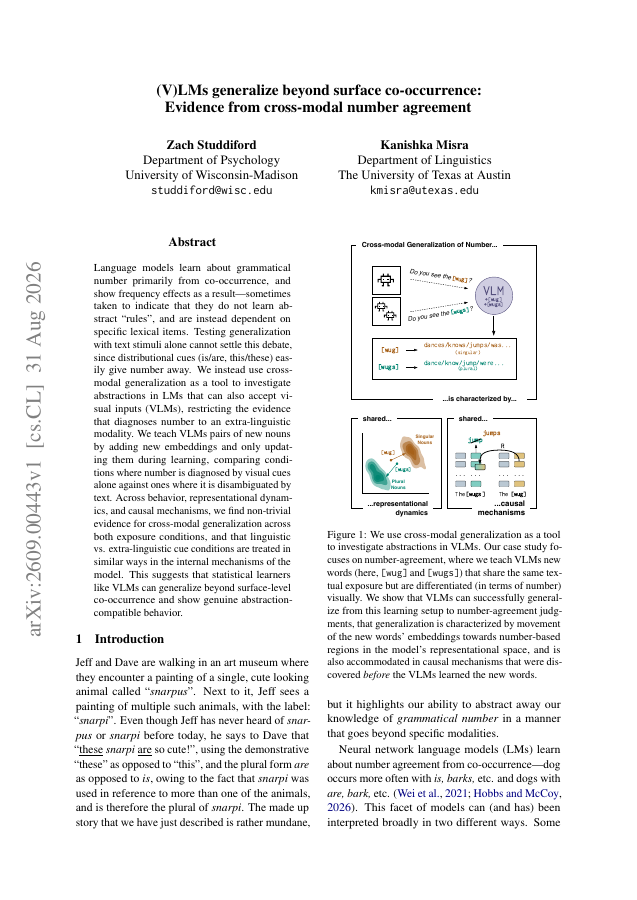
Language models learn about grammatical number primarily from co-occurrence, and show frequency effects as a result---sometimes taken to indicate that they do not learn abstract ``rules'', and are instead dependent on specific lexical items.
31 Aug 2026
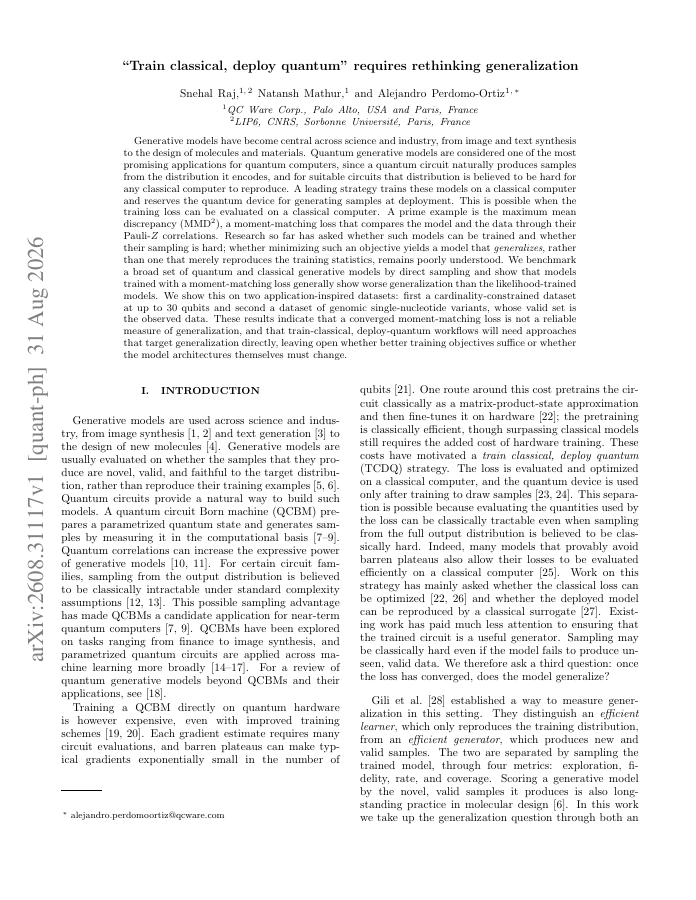
Generative models have become central across science and industry, from image and text synthesis to the design of molecules and materials. Quantum generative models are considered one of the most promising applications for quantum computers, since a quantum circuit naturally…
31 Aug 2026
The fundamental theorem of statistical learning states that, under suitable measurability assumptions, finite Vapnik--Chervonenkis (VC) dimension guarantees that every proper consistent learning rule is probably approximately correct (PAC).
31 Aug 2026
Geospatial foundation models have emerged as state-of-the-art methods for downstream Earth observation tasks. However, existing pretraining methodologies process imagery through a single-concept lens, failing to capture the highly compositional nature of complex satellite…
31 Aug 2026
This paper develops a general convolutional neural network (CNN) framework for detecting heterogeneous event-driven dynamics in univariate time series windows. We show that the induced CNN class exactly represents classifiers based on range, maximum drawup, maximum drawdown and…
31 Aug 2026
Can an artificial intelligence (AI) generate a scientific hypothesis outside a human collaborator's active hypothesis space (AHS), and can human-AI research be organized to make such breakthroughs more likely? We document such a case while proving a theorem that connects two…
31 Aug 2026
Large language models decode by projecting hidden states through a large vocabulary head at every step. This operation is computationally costly and forces all reasoning to be expressed in discrete tokens.
31 Aug 2026
This paper presents a multi-branch fusion framework for detecting and characterising the propagation of health misinformation in online social networks (OSNs). Grounded in the Elaboration Likelihood Model (ELM) and the Theory of Planned Behaviour (TPB), the model fuses…