21 Oct 2026
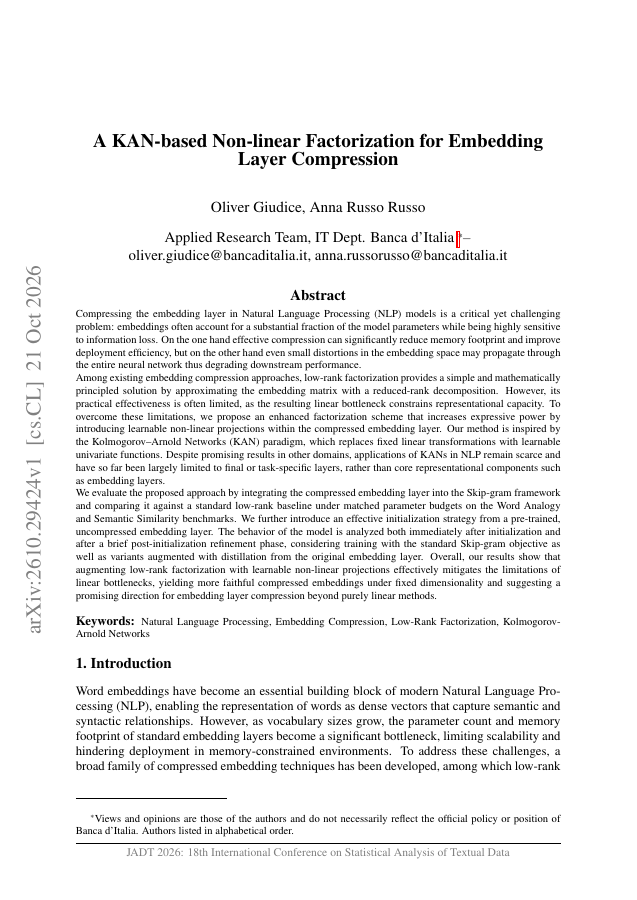
Among existing embedding compression approaches, low-rank factorization provides a simple and mathematically principled solution by approximating the embedding matrix with a reduced-rank decomposition.
Trending research and the full catalog - each paper linked to the benchmarks, methods, and models it introduces.
Filtering here covers the 2,000 most recent papers, as much as one page can hold in memory. See the full index of 22,824 papers.
21 Oct 2026
Among existing embedding compression approaches, low-rank factorization provides a simple and mathematically principled solution by approximating the embedding matrix with a reduced-rank decomposition.
21 Oct 2026
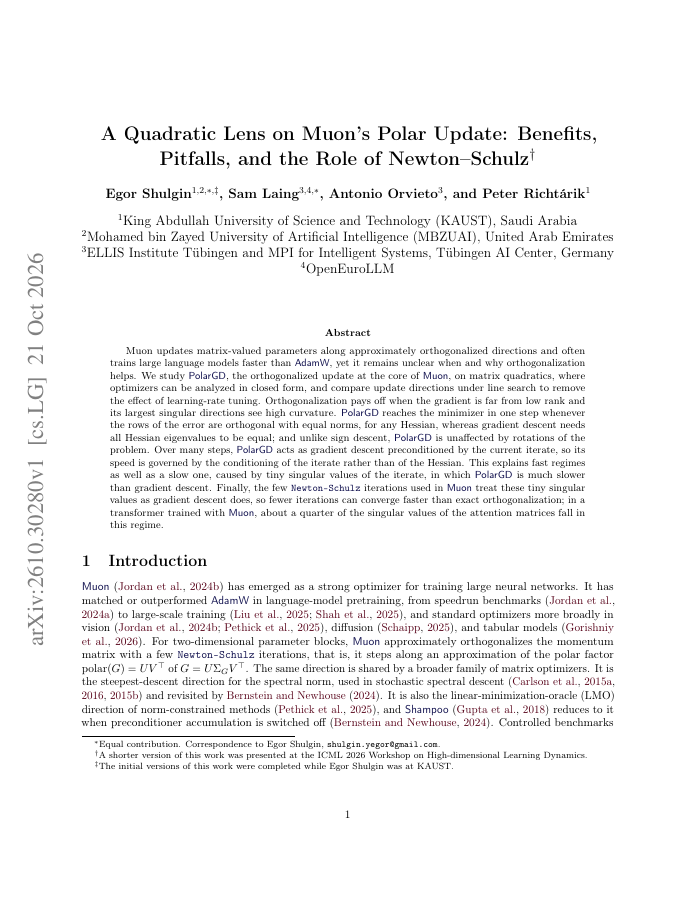
This paper proposes Role-Enhanced Zero-Shot Chain-of-Thought (RE-ZS-CoT), a prompting framework that systematically integrates domain-specific expert roles to enhance reasoning in large language models (LLMs) without task-specific examples.
21 Oct 2026
Muon updates matrix-valued parameters along approximately orthogonalized directions and often trains large language models faster than AdamW, yet it remains unclear when and why orthogonalization helps.
21 Oct 2026
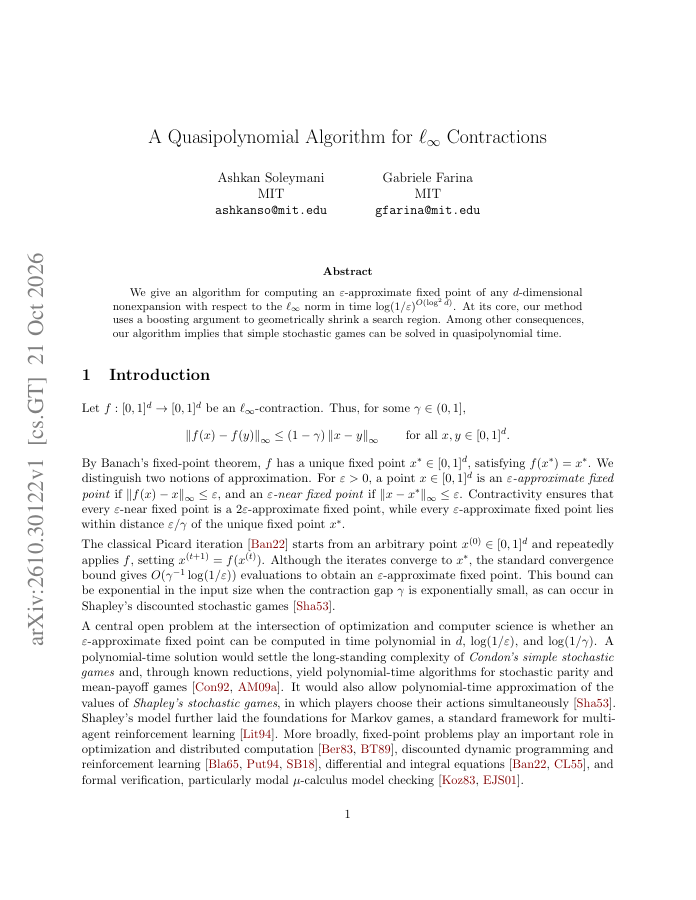
We give an algorithm for computing an $\eps$-approximate fixed point of any $d$-dimensional nonexpansion with respect to the $\ell_\infty$ norm in time $\log(1/\eps)^{O(\log^2 d)}$. At its core, our method uses a boosting argument to geometrically shrink a search region.
21 Oct 2026
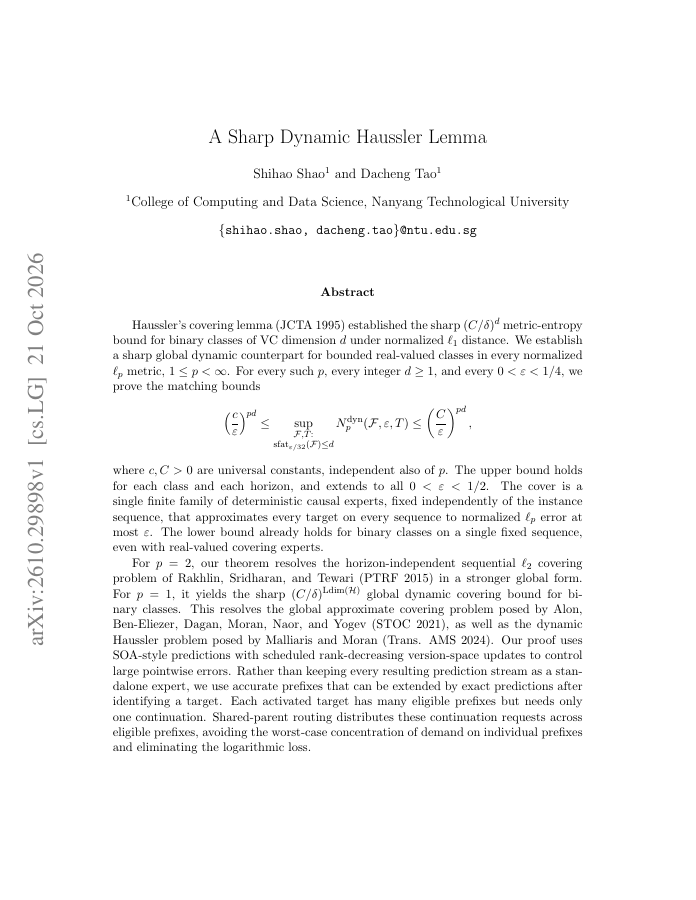
Haussler's covering lemma (JCTA 1995) gives the sharp $(C/δ)^d$ metric-entropy bound for binary VC classes under normalized $\ell_1$ distance. We prove a sharp global dynamic analogue for bounded real-valued classes in normalized $\ell_p$, for every $1\le p<\infty$.
21 Oct 2026
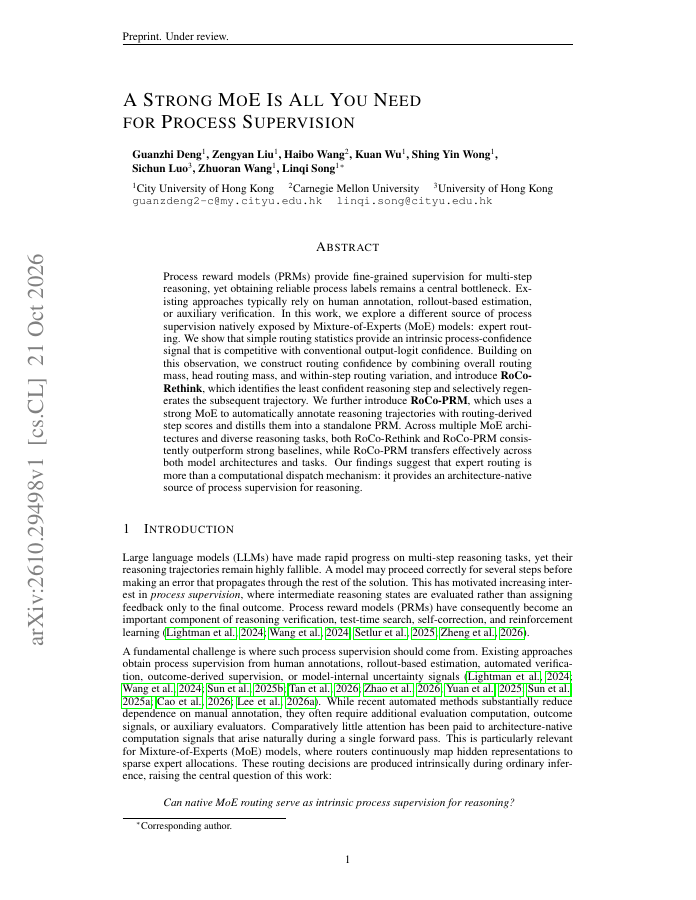
Process reward models (PRMs) provide fine-grained supervision for multi-step reasoning, yet obtaining reliable process labels remains a central bottleneck. Existing approaches typically rely on human annotation, rollout-based estimation, or auxiliary verification.
21 Oct 2026
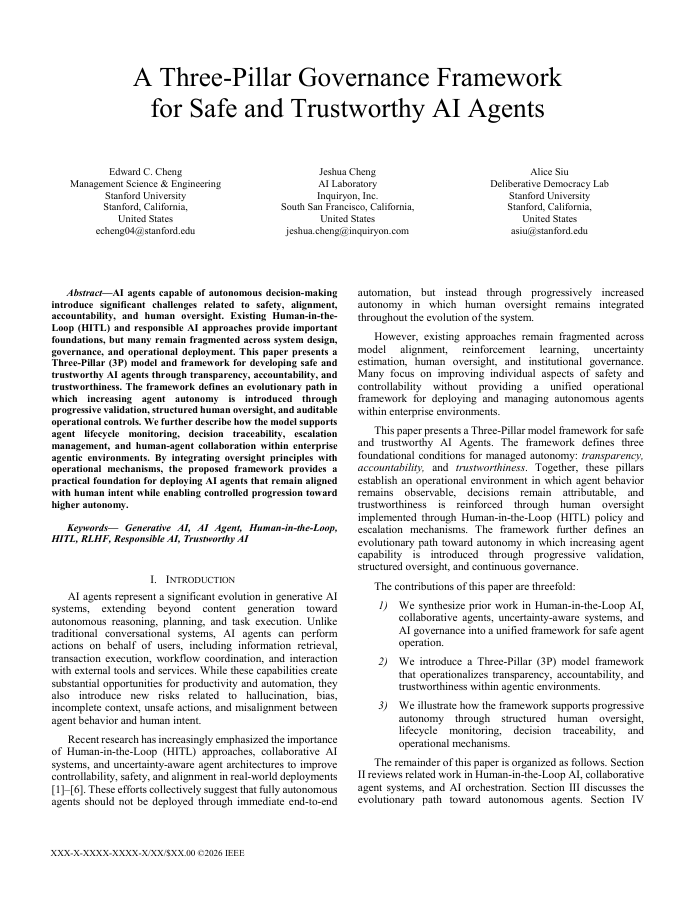
AI agents capable of autonomous decision-making introduce significant challenges related to safety, alignment, accountability, and human oversight. Existing Human-in-the-Loop (HITL) and responsible AI approaches provide important foundations, but many remain fragmented across…
21 Oct 2026
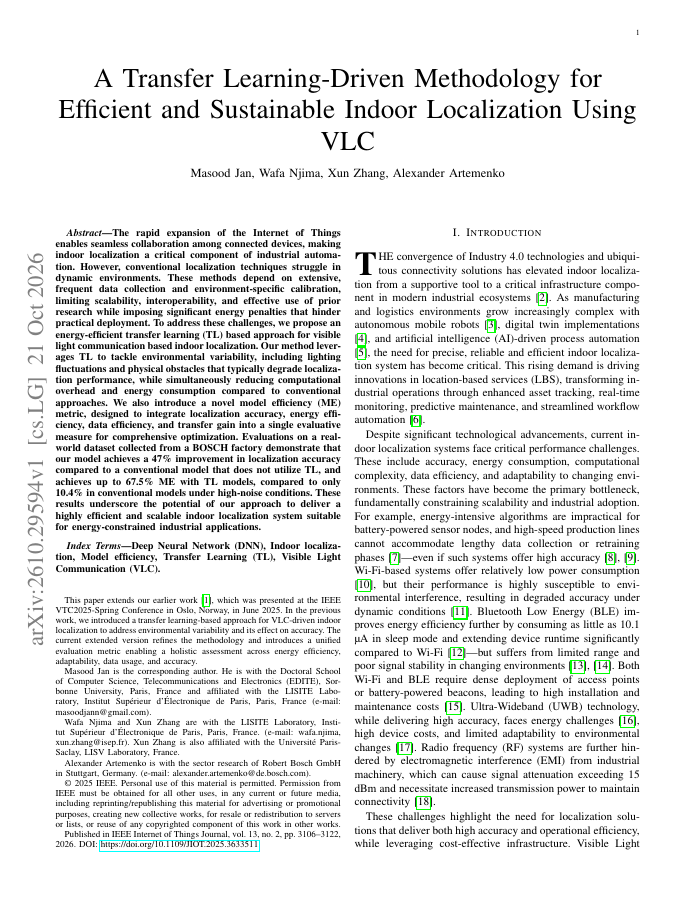
The rapid expansion of the Internet of Things enables seamless collaboration among connected devices, making indoor localization a critical component of industrial automation. However, conventional localization techniques struggle in dynamic environments.
21 Oct 2026
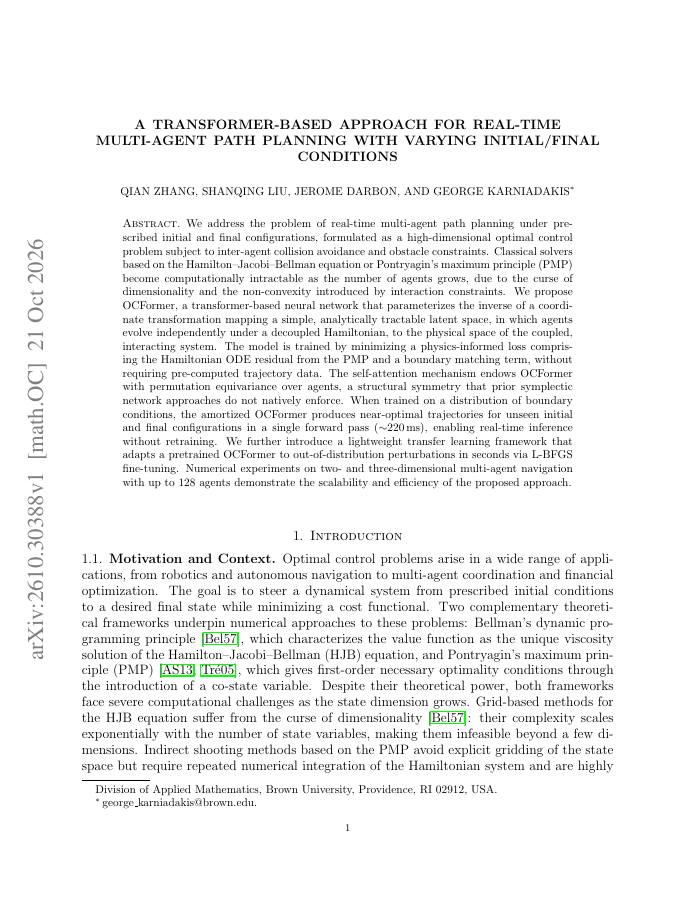
We address the problem of real-time multi-agent path planning under prescribed initial and final configurations, formulated as a high-dimensional optimal control problem subject to inter-agent collision avoidance and obstacle constraints.
21 Oct 2026
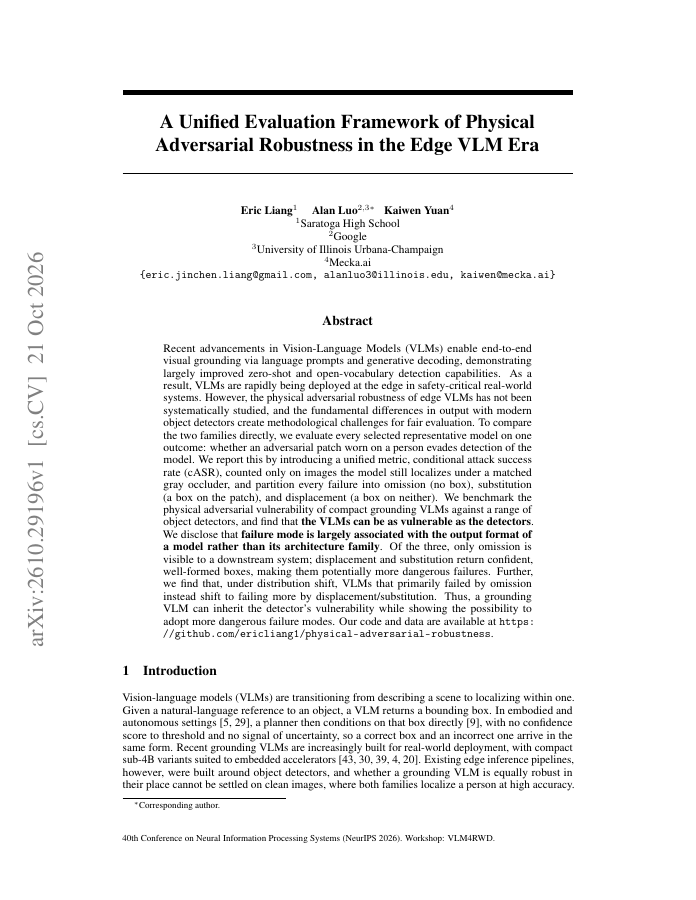
Recent advancements in Vision-Language Models (VLMs) enable end-to-end visual grounding via language prompts and generative decoding, demonstrating largely improved zero-shot and open-vocabulary detection capabilities.
20 Oct 2026
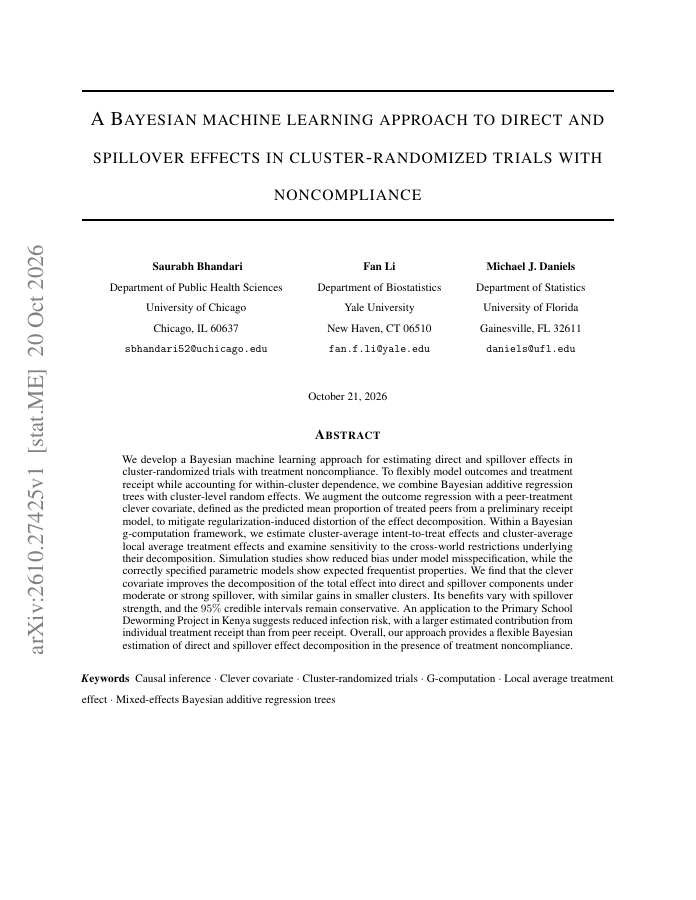
We develop a Bayesian machine learning approach for estimating direct and spillover effects in cluster-randomized trials with treatment noncompliance. To flexibly model outcomes and treatment receipt while accounting for within-cluster dependence, we combine Bayesian additive…
20 Oct 2026
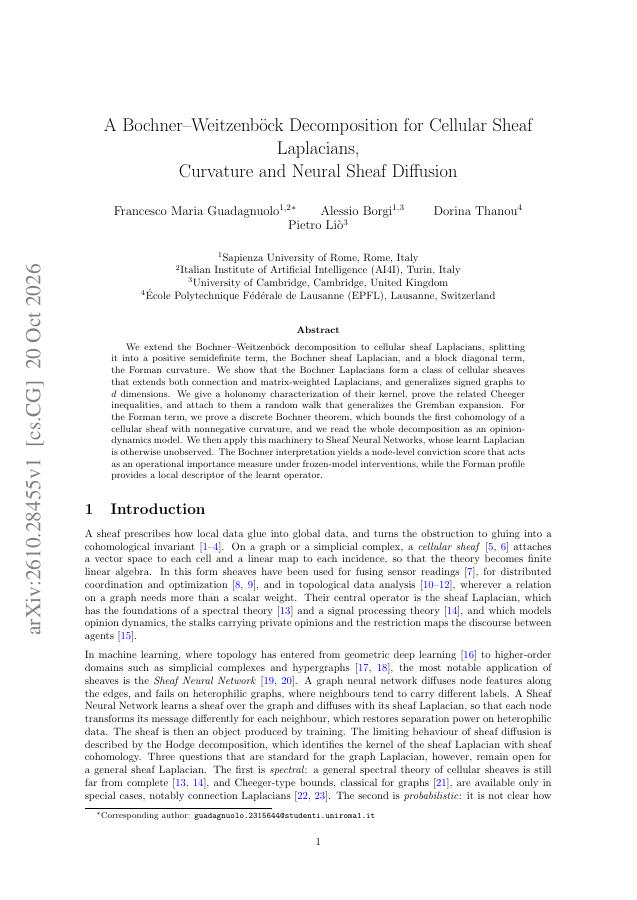
We extend the Bochner-Weitzenböck decomposition to cellular sheaf Laplacians, splitting it into a positive semidefinite term, the Bochner sheaf Laplacian, and a block diagonal term, the Forman curvature.
20 Oct 2026
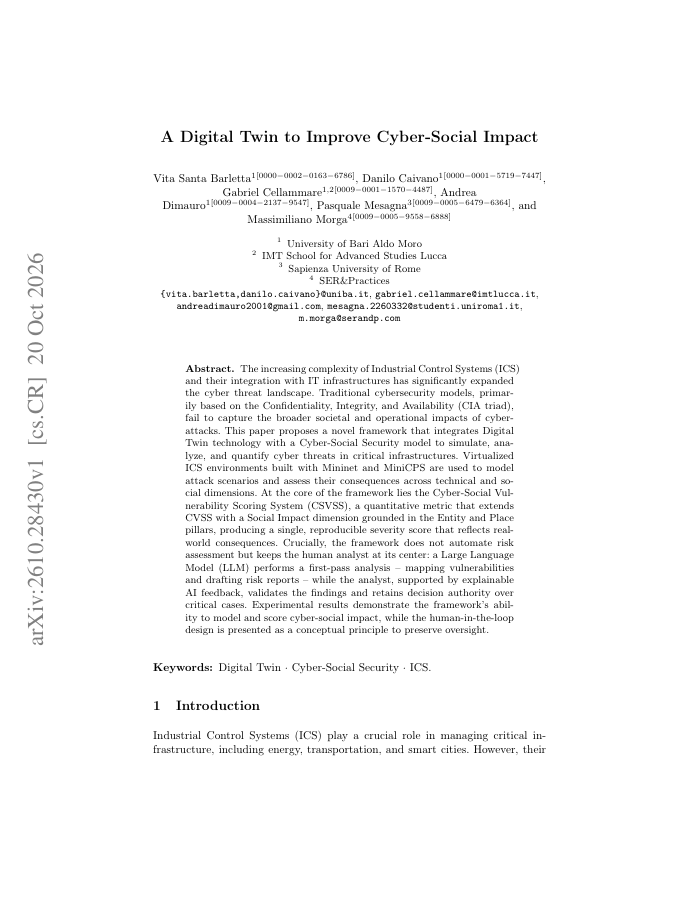
The increasing complexity of Industrial Control Systems (ICS) and their integration with IT infrastructures has significantly expanded the cyber threat landscape. Traditional cybersecurity models, primarily based on the Confidentiality, Integrity, and Availability (CIA triad),…
20 Oct 2026
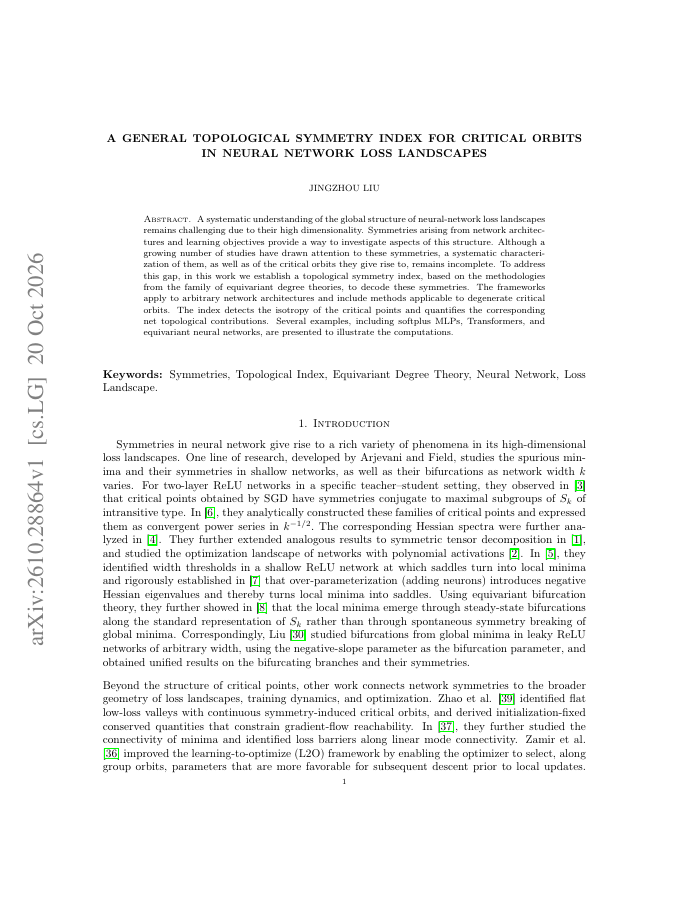
A systematic understanding of the global structure of neural-network loss landscapes remains challenging due to their high dimensionality. Symmetries arising from network architectures and learning objectives provide a way to investigate aspects of this structure.
20 Oct 2026
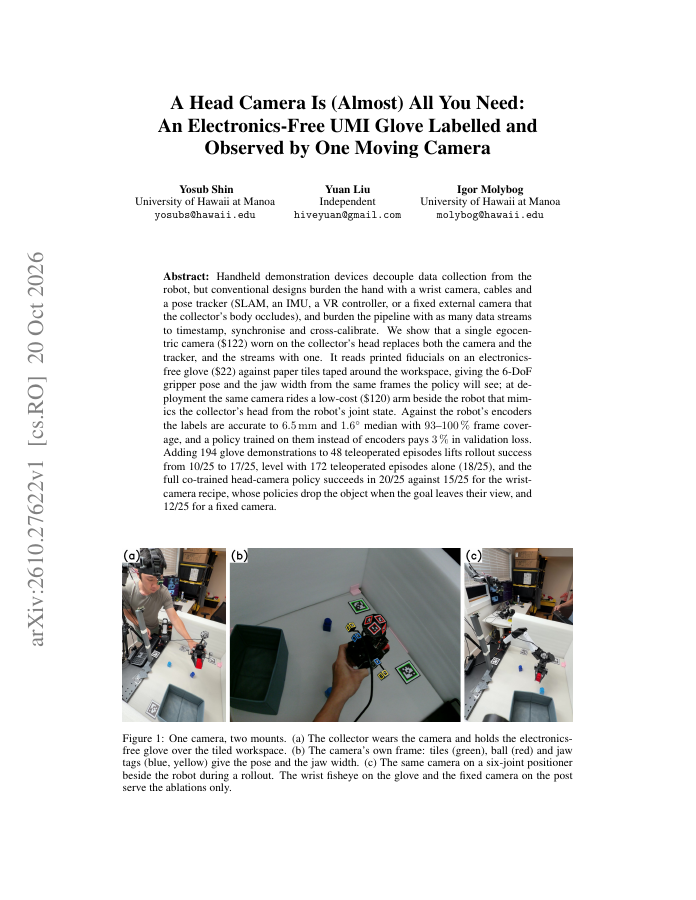
Handheld demonstration devices decouple data collection from the robot, but conventional designs burden the hand with a wrist camera, cables and a pose tracker (SLAM, an IMU, a VR controller, or a fixed external camera that the collector's body occludes), and burden the pipeline…
20 Oct 2026
Agentic systems have demonstrated strong capabilities on complex tasks by enabling multiple interacting large language model (LLM)-based agents to collaborate and execute subtasks in parallel.
20 Oct 2026
In this paper, we study continuous-time reinforcement learning, where the state follows an unknown stochastic differential equation but only a fixed off-policy batch of discrete-time transitions is available.
20 Oct 2026
Dependency parsing resource development for Arabic has largely focused on Modern Standard Arabic, leaving dialectal Arabic comparatively under-resourced. We introduce MADARTB, the first large-scale parallel dependency treebank spanning five city dialects: Beirut, Cairo, Doha,…
20 Oct 2026
Deep learning (DL) models are increasingly being deployed into radiation-challenging environments in spacecraft, particle accelerators, and, soon, space-based data centers.
20 Oct 2026
Gold's theorem shows that no learner can identify an arbitrary language in a superfinite class from positive presentations alone. We prove a positive result of a different shape.
20 Oct 2026
Structural Causal Models (SCMs) provide a principled framework for observational, interventional, and counterfactual reasoning, all of which rely on probabilistic inference.
20 Oct 2026
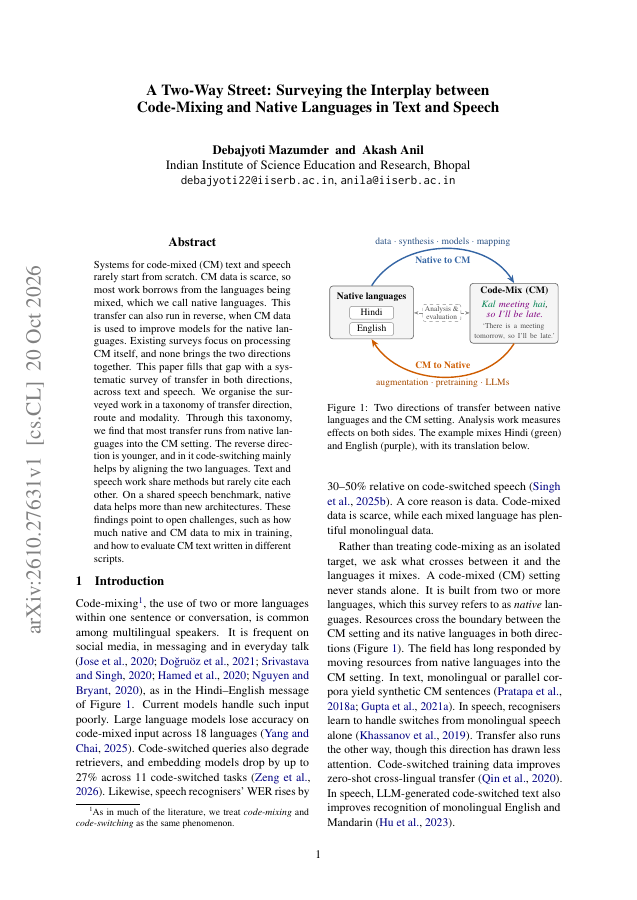
Systems for code-mixed (CM) text and speech rarely start from scratch. CM data is scarce, so most work borrows from the languages being mixed, which we call native languages. This transfer can also run in reverse, when CM data is used to improve models for the native languages.
20 Oct 2026
Watermarking has emerged as a key tool for identifying text generated by large language models (LLMs), with current schemes embedding statistical signals into the generation process to enable later detection.
19 Oct 2026
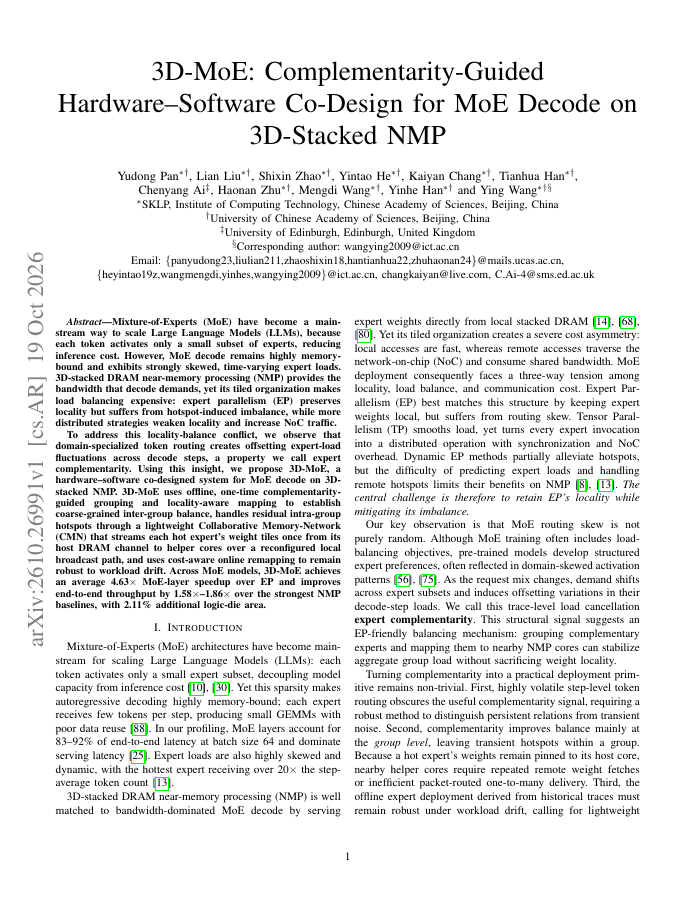
Mixture-of-Experts (MoE) have become a mainstream way to scale Large Language Models (LLMs), because each token activates only a small subset of experts, reducing inference cost.