1 May 2026
We propose a closed-form spectral framework for relative log-density estimation in linearly parameterized probabilistic models, including unnormalized and conditional models.
Trending research and the full catalog - each paper linked to the benchmarks, methods, and models it introduces.
Filtering here covers the 2,000 most recent papers, as much as one page can hold in memory. See the full index of 23,103 papers.
1 May 2026
We propose a closed-form spectral framework for relative log-density estimation in linearly parameterized probabilistic models, including unnormalized and conditional models.
1 May 2026
As learning systems increasingly shape everyday decisions, Algorithmic Collective Action (ACA), i.e., users coordinating changes to shared data to steer model behavior, offers a complement to regulator-side policy and corporate model design.
1 May 2026
A main barrier for the deployment of AI radiomic systems in clinical routine is their drop in performance under heterogeneous multicentre acquisition protocols. This work presents a performance-oriented framework for quantifying scan parameter sensitivity of radiomic AI models,…
1 May 2026
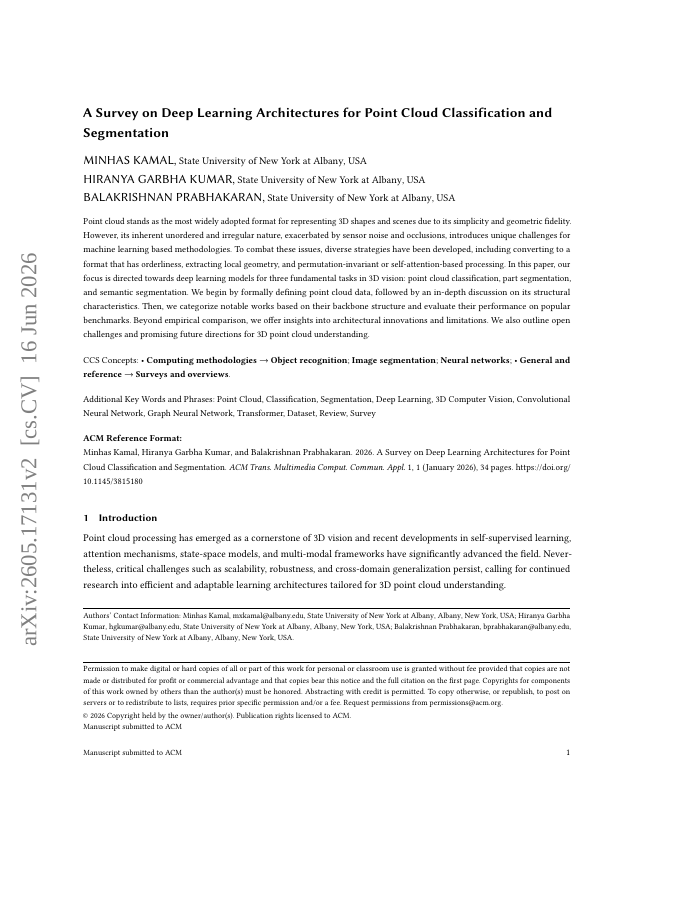
Point cloud stands as the most widely adopted format for representing 3D shapes and scenes due to its simplicity and geometric fidelity. However, its inherent unordered and irregular nature, exacerbated by sensor noise and occlusions, introduces unique challenges for machine…
1 May 2026
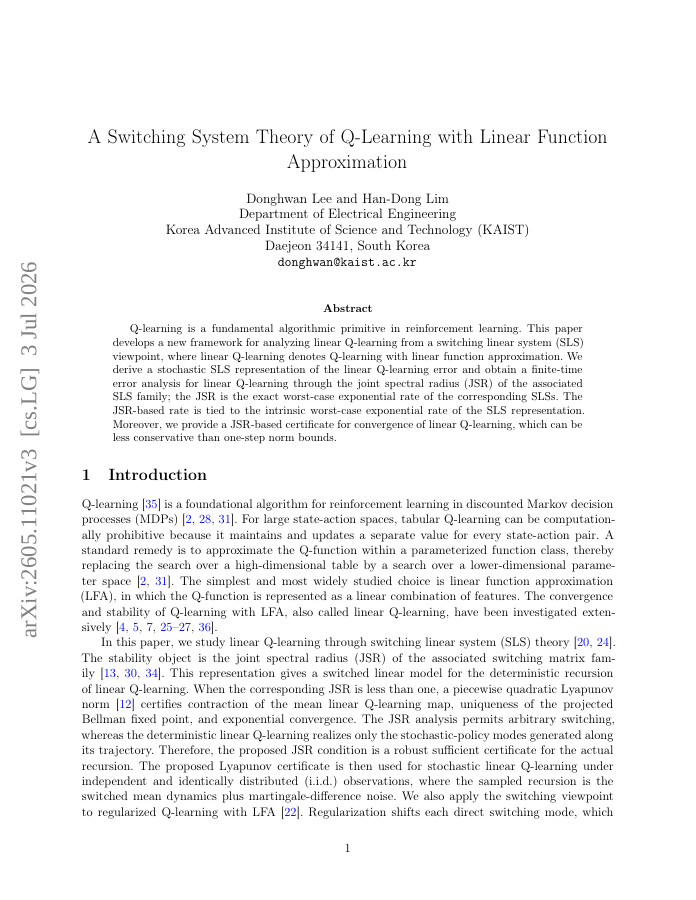
Q-learning is a fundamental algorithmic primitive in reinforcement learning. This paper develops a new framework for analyzing linear Q-learning from a switching linear system (SLS) viewpoint, where linear Q-learning denotes Q-learning with linear function approximation.
1 May 2026
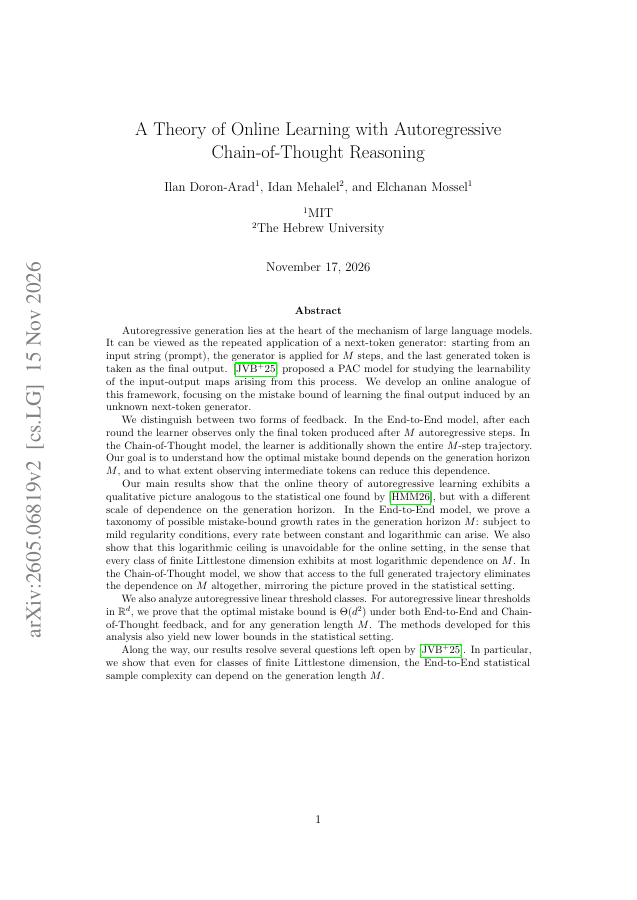
Autoregressive generation lies at the heart of the mechanism of large language models. It can be viewed as the repeated application of a next-token generator: starting from an input string (prompt), the generator is applied for $M$ steps, and the last generated token is taken as…
1 May 2026
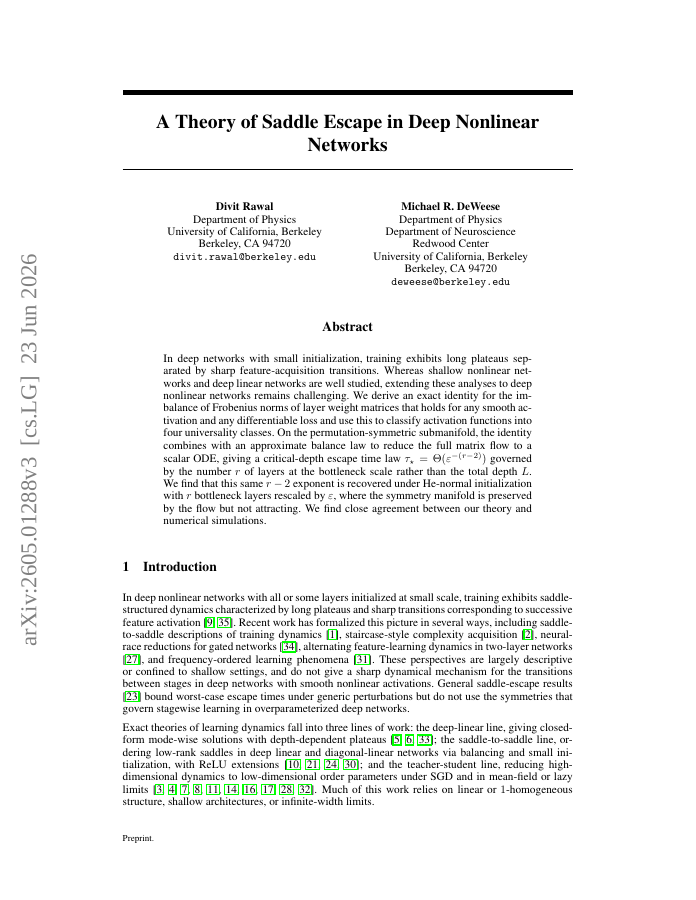
In deep networks with small initialization, training can exhibit long plateaus separated by sharp feature-acquisition transitions. Whereas shallow nonlinear networks and deep linear networks are well studied, extending these analyses to deep nonlinear networks remains…
1 May 2026
Random directed acyclic graphs (DAGs) based on imposing an order on Erdős-Rényi or scale-free graphs are widely used to generate synthetic data from causal models, in particular for evaluating causal discovery algorithms.
23 Apr 2026
Event extraction is essential for event understanding and analysis. It supports tasks such as document summarization and decision-making in emergency scenarios. However, existing event extraction approaches have limitations: (1) closed-domain algorithms are restricted to…
Jian Yang, Ruibin Yuan, Yizhi Li · 21 Apr 2026
TACO is a self-evolving compression framework that automatically discovers and refines compression rules from interaction trajectories to improve long-horizon agent performance while reducing token overhead.
Mingqiao Ye, Afshin Dehghan, Roman Bachmann · 16 Apr 2026
Tokenization is a key component of autoregressive (AR) generative models, converting raw data into more manageable units for modeling.
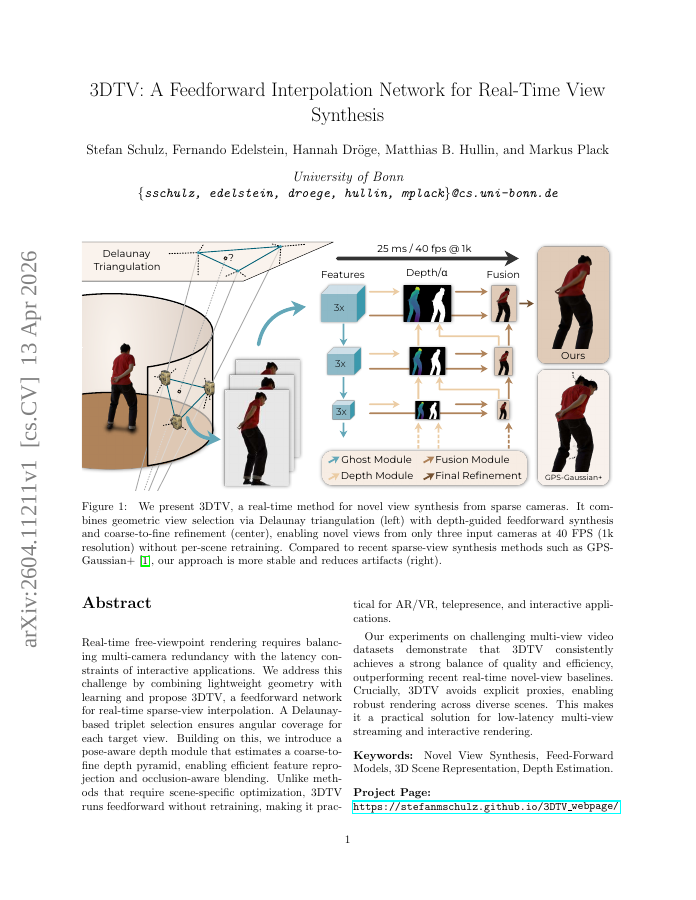
Stefan Schulz, Fernando Edelstein, Hannah Dröge · 13 Apr 2026
Real-time free-viewpoint rendering requires balancing multi-camera redundancy with the latency constraints of interactive applications.
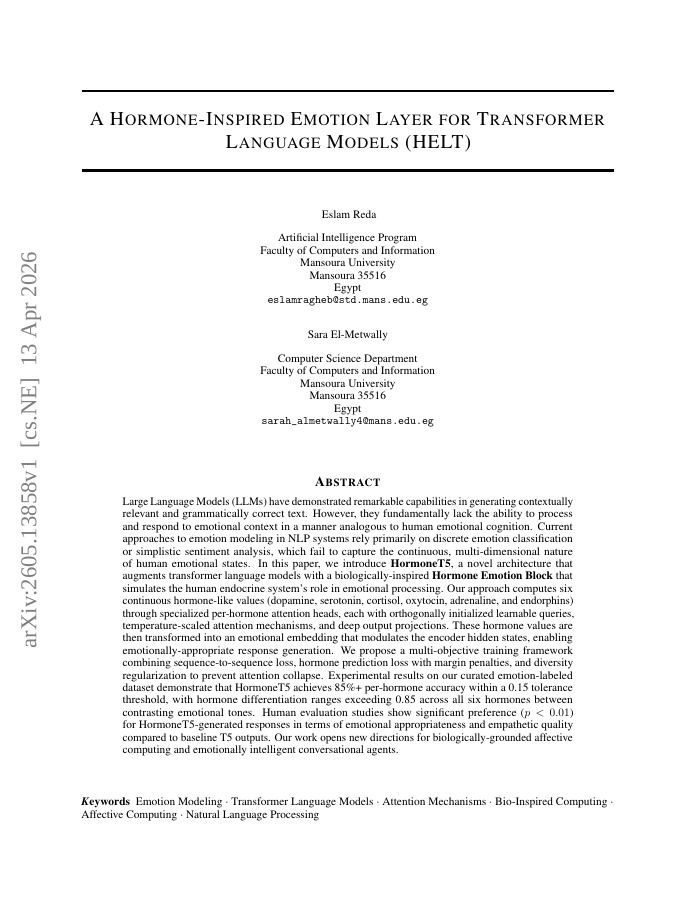
Eslam Reda, Sara El-Metwally · 13 Apr 2026
Large Language Models have demonstrated remarkable capabilities in generating contextually relevant and grammatically correct text.
9 Apr 2026
Self-improving agents can acquire a procedure without knowing when its supporting teacher can safely be removed. We extend an oracle-relative model of evolving agents with explicit acquisition and completion contracts, separating learning a solver from certifying its…
7 Apr 2026
Constructing artificial lexicons that are pronounceable, typologically plausible, and semantically structured remains an open challenge in computational linguistics. Existing conlang generators either lack formal phonotactic guarantees or delegate generation to opaque,…
Qihang Yu, Ju He, Liang-Chieh Chen · 6 Apr 2026
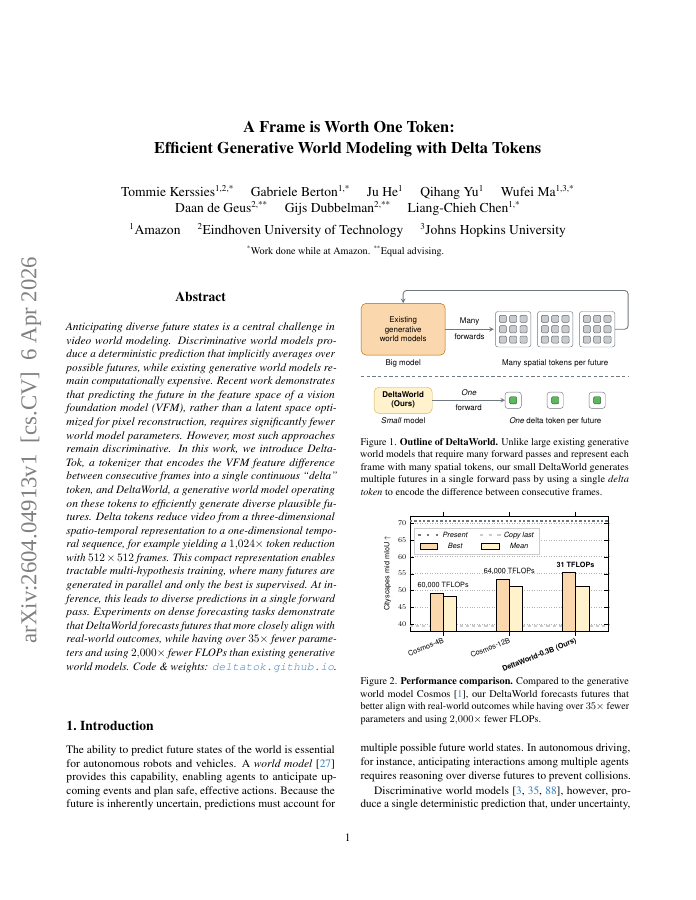
Anticipating diverse future states is a central challenge in video world modeling.
Ziwei Liu, Jingkang Yang, Shulin Tian · 2 Apr 2026
Recent streaming video understanding methods increasingly rely on complex memory mechanisms to handle long video streams.
1 Apr 2026
Supervised fine-tuning (SFT) is a common first stage of LLM post-training, teaching the model to follow instructions and shaping its behavior as a helpful assistant. At the same time, SFT may harm the fundamental capabilities of an LLM, particularly after long pretraining: a…
1 Apr 2026
Prompt optimization improves language models without updating their weights by searching for a better system prompt, but its effectiveness varies widely across tasks. We study what makes a task amenable to prompt optimization.
1 Apr 2026
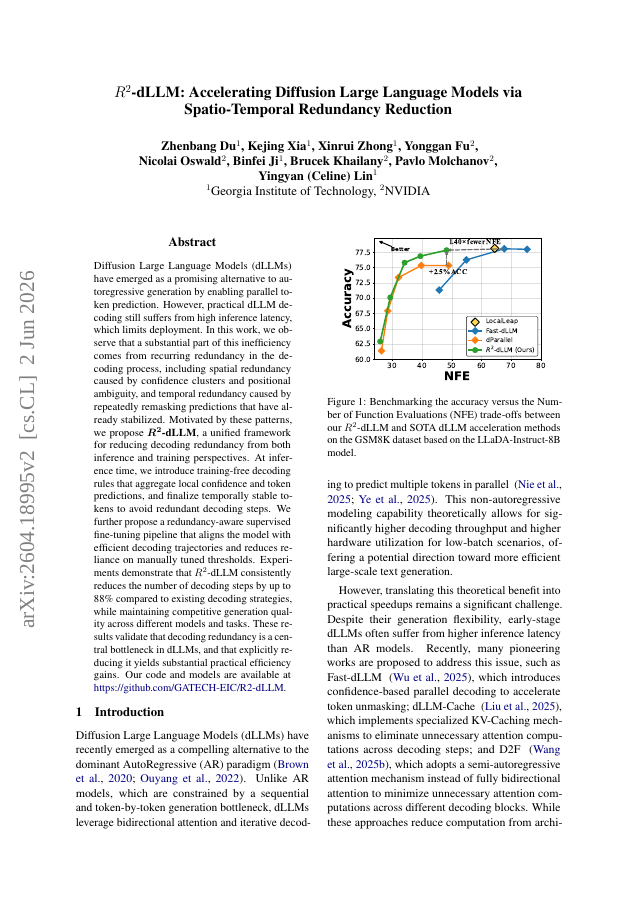
Diffusion Large Language Models (dLLMs) have emerged as a promising alternative to autoregressive generation by enabling parallel token prediction. However, practical dLLM decoding still suffers from high inference latency, which limits deployment.
1 Apr 2026
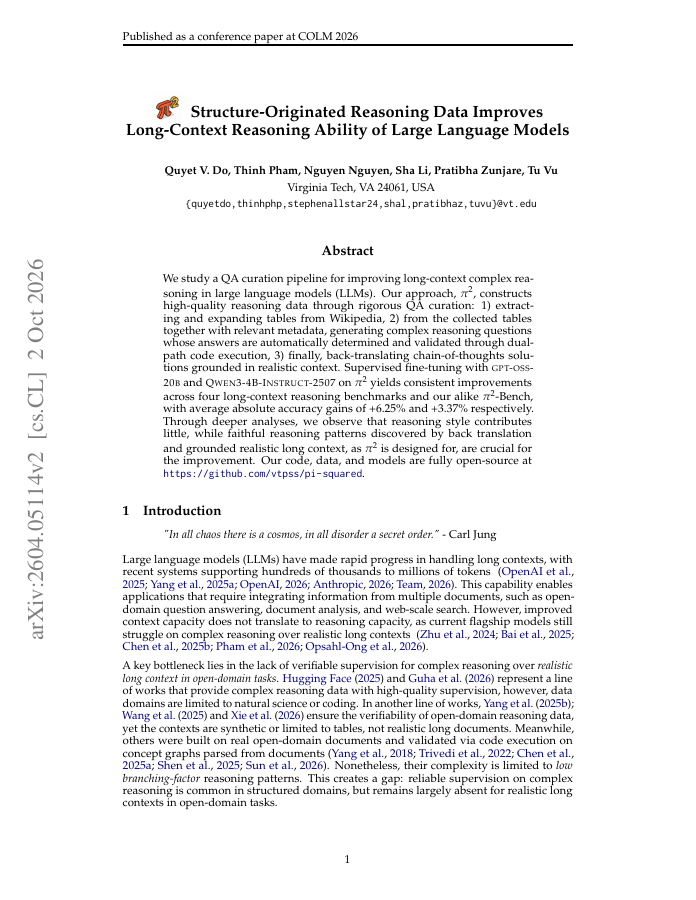
We study a QA curation pipeline for improving long-context complex reasoning in large language models (LLMs). Our approach, $π^2$, constructs high-quality reasoning data through rigorous QA curation: 1) extracting and expanding tables from Wikipedia, 2) from the collected tables…
1 Apr 2026
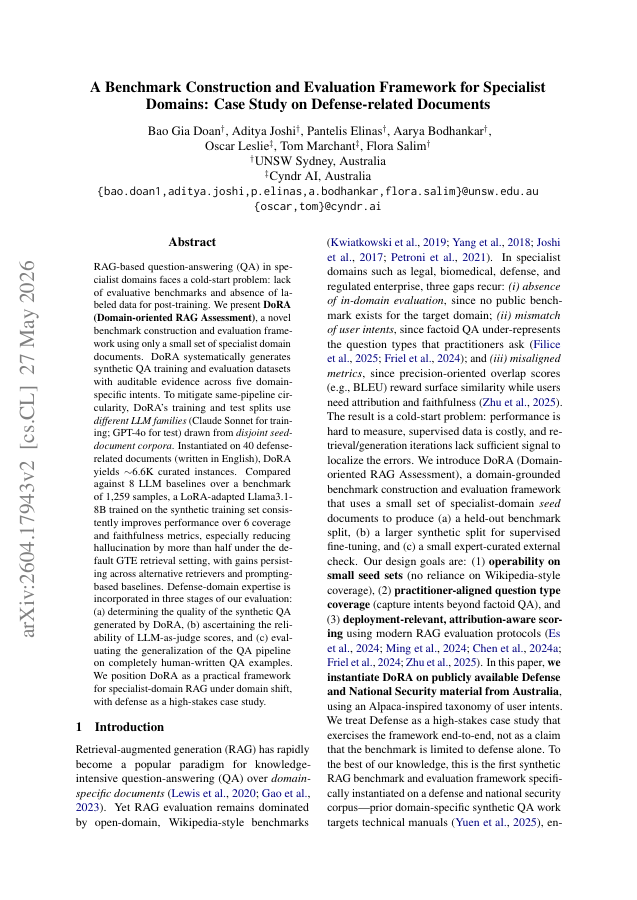
RAG-based question-answering (QA) in specialist domains faces a cold-start problem: lack of evaluative benchmarks and absence of labeled data for post-training. We present DoRA (Domain-oriented RAG Assessment), a novel benchmark construction and evaluation framework using only a…
1 Apr 2026
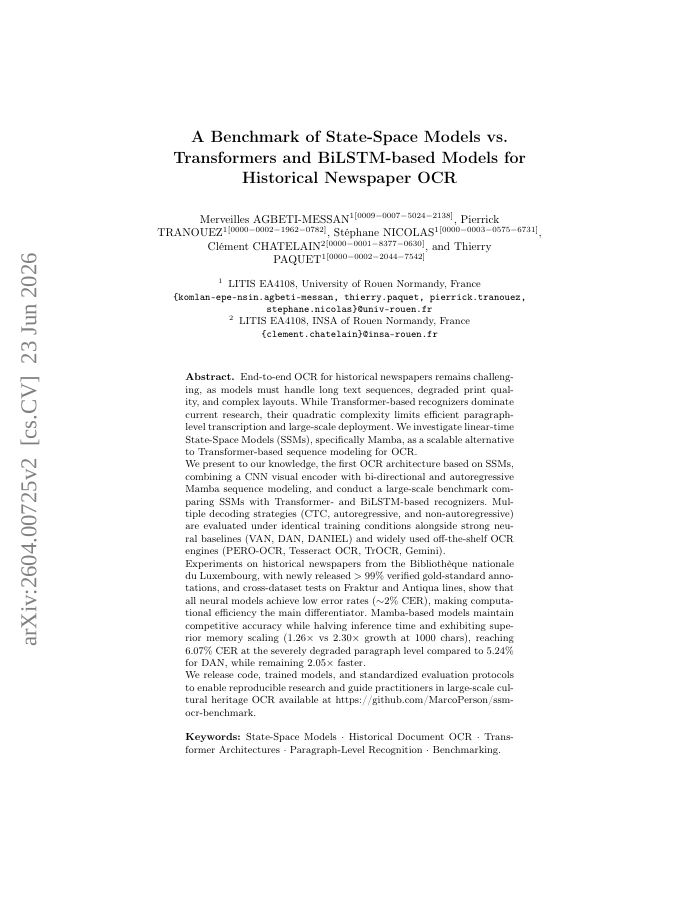
End-to-end OCR for historical newspapers remains challenging, as models must handle long text sequences, degraded print quality, and complex layouts. While Transformer-based recognizers dominate current research, their quadratic complexity limits efficient paragraph-level…
1 Apr 2026
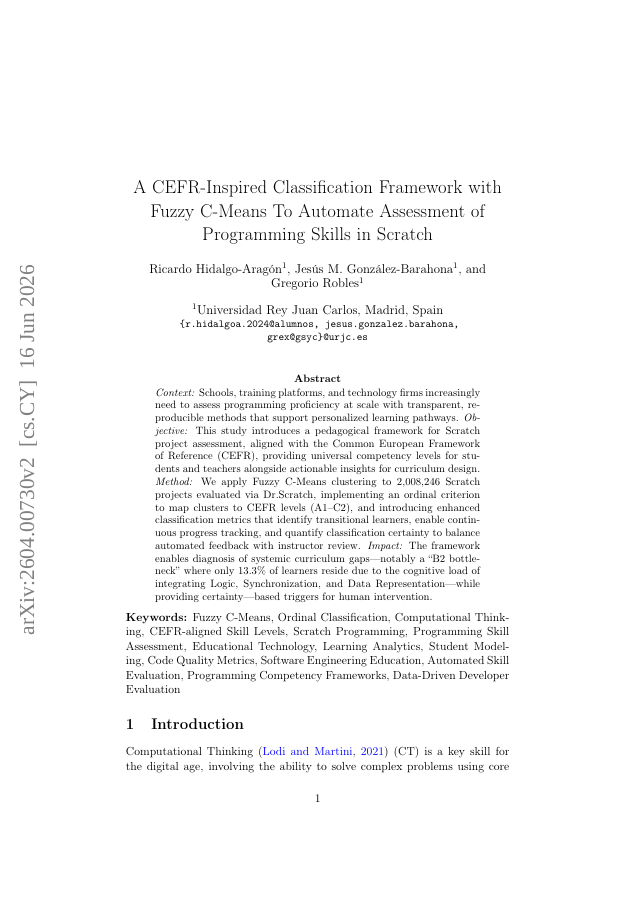
Context: Schools, training platforms, and technology firms increasingly need to assess programming proficiency at scale with transparent, reproducible methods that support personalized learning pathways.