1 May 2026
Dense linear maps carry much of the parameter and computational burden of modern neural networks, yet their dense form leaves the organization of learned couplings implicit.
Trending research and the full catalog - each paper linked to the benchmarks, methods, and models it introduces.
Filtering here covers the 2,000 most recent papers, as much as one page can hold in memory. See the full index of 22,427 papers.
1 May 2026
Dense linear maps carry much of the parameter and computational burden of modern neural networks, yet their dense form leaves the organization of learned couplings implicit.
1 May 2026
Input-convex neural nets parametrize the convex potentials of density models and transport maps, and their convexity requires the inter-layer weights to be non-negative.
1 May 2026
Large Language Model (LLM)-powered agents demonstrate strong capabilities in autonomous task execution, tool use, and multi-step reasoning. However, their increasing autonomy also introduces a new attack surface: adversarial interactions can manipulate agent behavior through…
1 May 2026
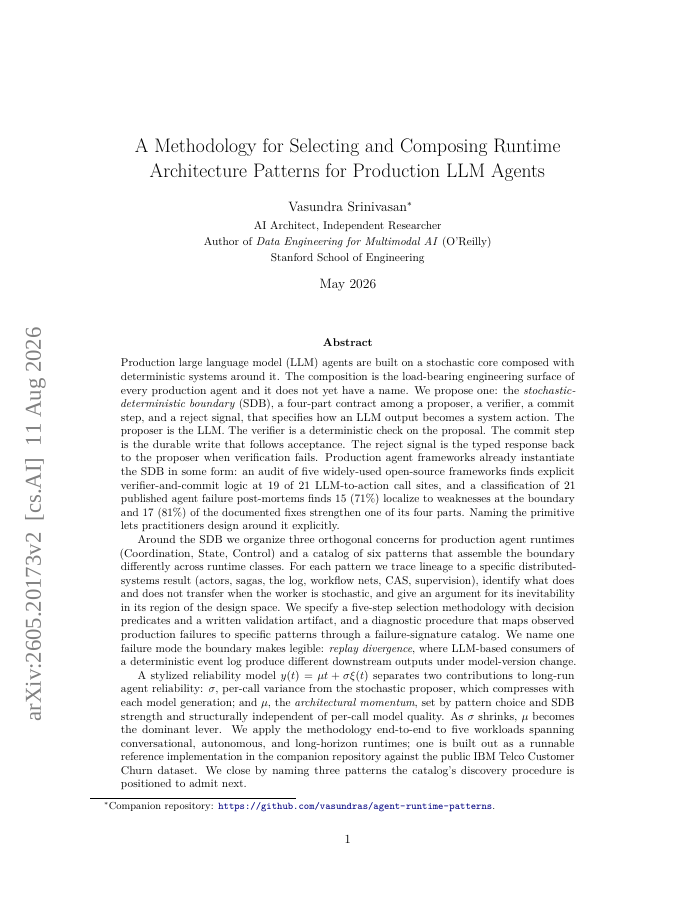
Production LLM agents combine stochastic model outputs with deterministic software systems, yet the boundary between the two is rarely treated as a first-class architectural object.
1 May 2026
This paper addresses the problem of image denoising for grayscale images. We propose a probabilistic image generative model that combines a quadtree region-partitioning model with a mixture autoregressive model, and propose a framework that reduces MAP (maximum a…
1 May 2026
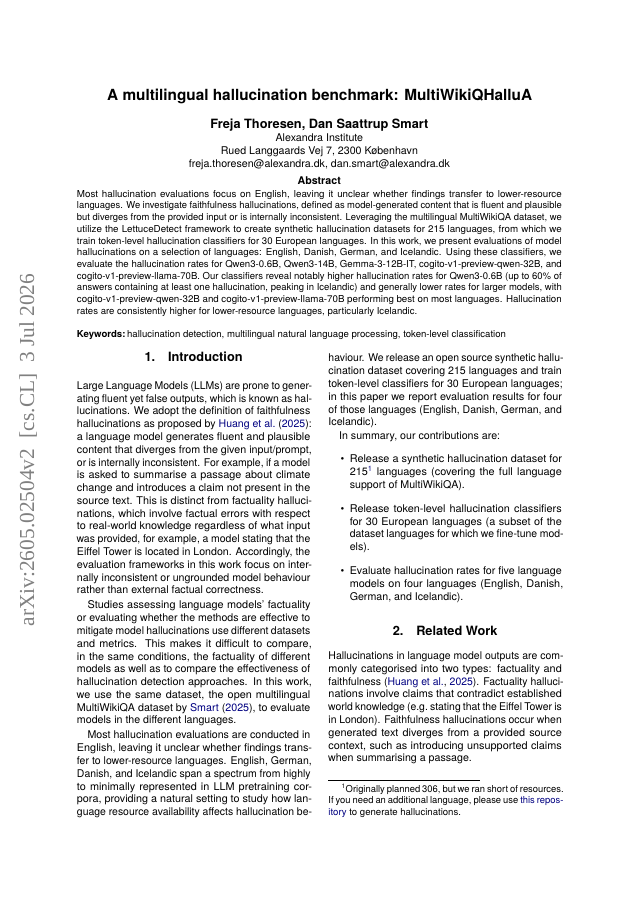
Most hallucination evaluations focus on English, leaving it unclear whether findings transfer to lower-resource languages. We investigate faithfulness hallucinations, defined as model-generated content that is fluent and plausible but diverges from the provided input or is…
1 May 2026
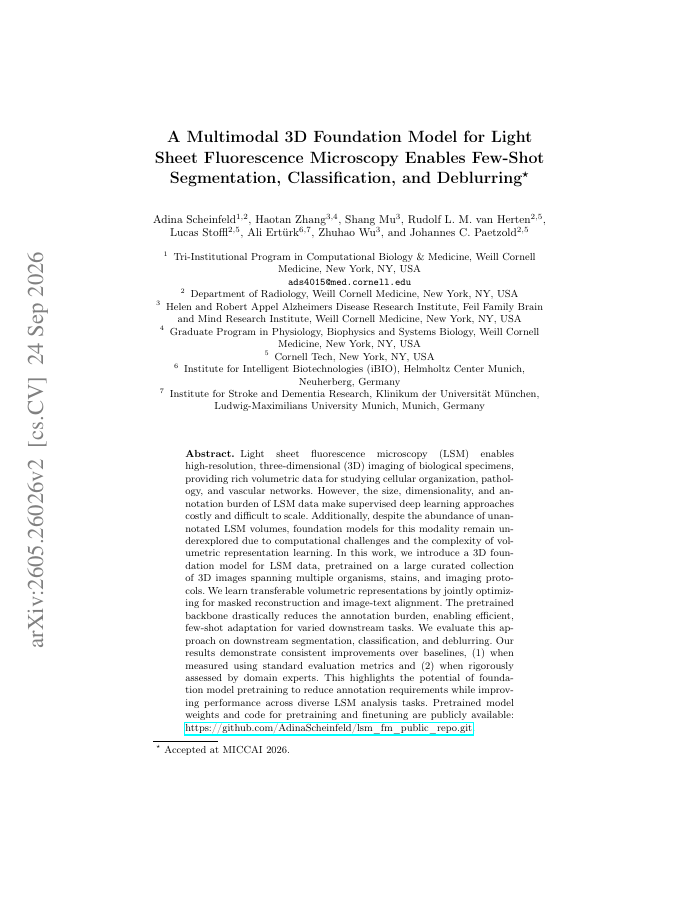
Light sheet fluorescence microscopy (LSM) enables high-resolution, three-dimensional (3D) imaging of biological specimens, providing rich volumetric data for studying cellular organization, pathology, and vascular networks.
1 May 2026
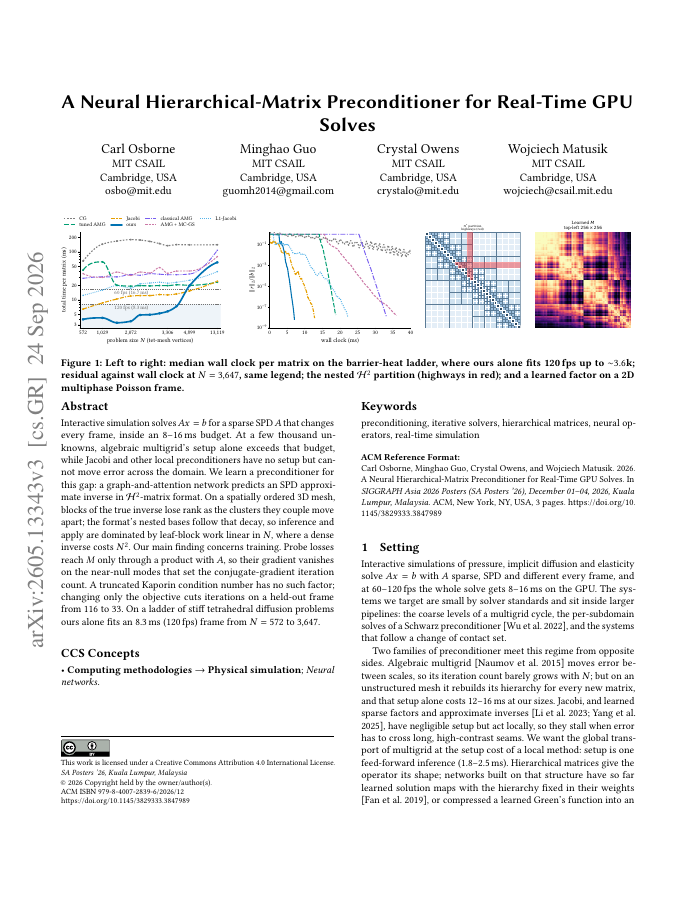
Interactive simulation solves Ax=b for a sparse SPD A that changes every frame, inside an 8-16 ms budget. At a few thousand unknowns, the setup of algebraic multigrid alone exceeds that budget, while Jacobi and other local preconditioners have no setup but cannot move error…
1 May 2026
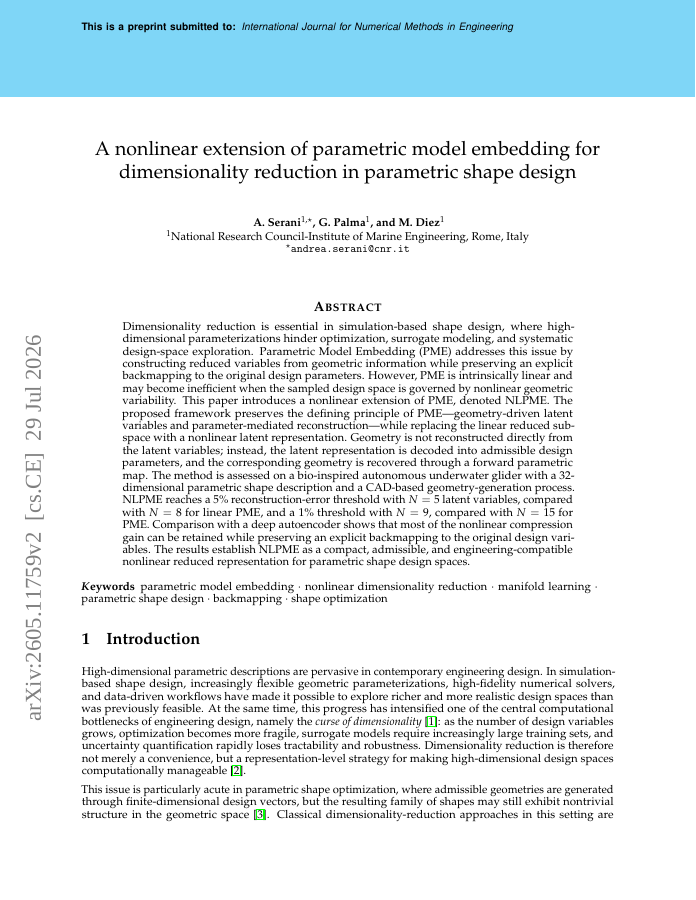
Dimensionality reduction is essential in simulation-based shape design, where high-dimensional parameterizations hinder optimization, surrogate modeling, and systematic design-space exploration.
1 May 2026
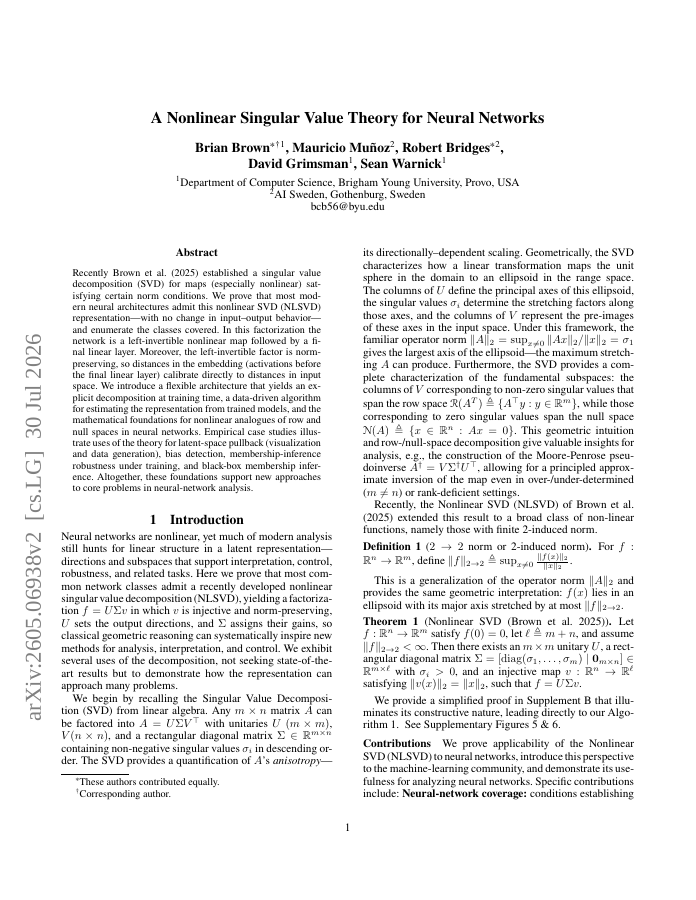
Recently Brown et al. [2025] established a singular value decomposition (SVD) for maps (especially nonlinear) satisfying certain norm conditions. We prove that most modern neural architectures admit this nonlinear SVD (NLSVD) representation---with no change in input--output…
1 May 2026
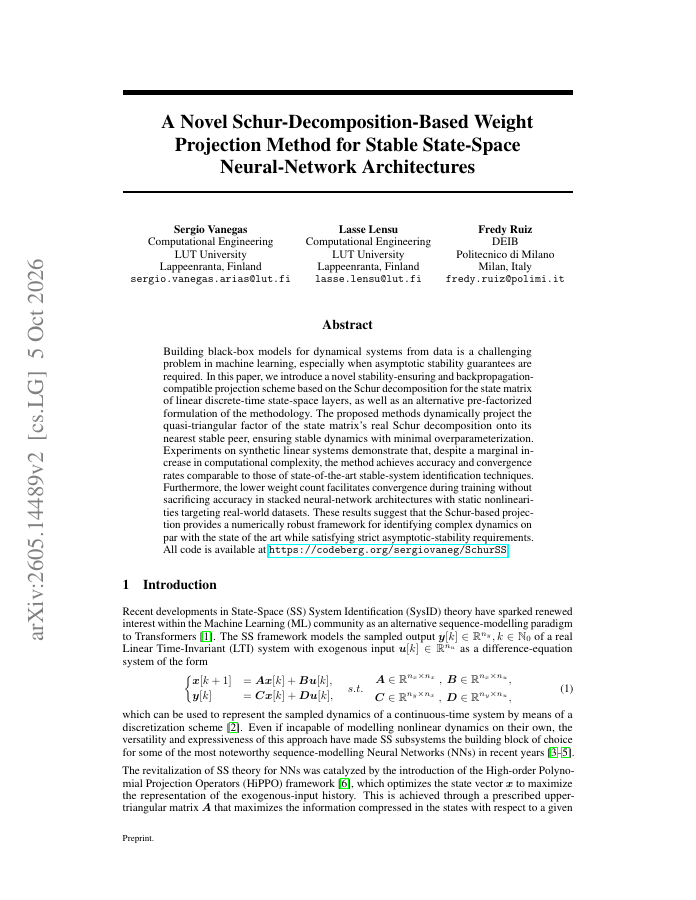
Building black-box models for dynamical systems from data is a challenging problem in machine learning, especially when asymptotic stability guarantees are required. In this paper, we introduce a novel stability-ensuring and backpropagation-compatible projection scheme based on…
1 May 2026
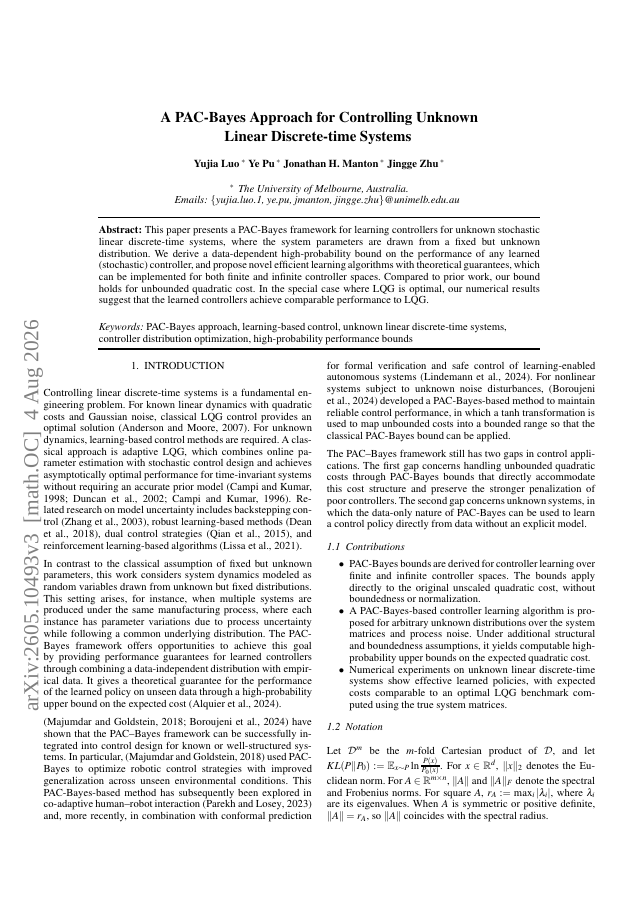
This paper presents a PAC-Bayes framework for learning controllers for unknown stochastic linear discrete-time systems, where the system parameters are drawn from a fixed but unknown distribution.
1 May 2026
Modern computer vision systems increasingly encounter performance limitations in data-scarce domains, where collecting large-scale, high-quality labeled data is costly or impractical.
1 May 2026
Existing approaches to post-train models for long-context tasks face complementary limitations: (i) supervised fine-tuning (SFT) provides stable supervision but suffers from exposure bias; (ii) reinforcement learning methods such as Group Relative Policy Optimization (GRPO)…
1 May 2026
Accurate disease risk prediction is challenged by heterogeneous features, limited data, and class imbalance. This study presents yvsoucom-iterkit, a deterministic AutoML framework that models pipeline optimization as a configuration-level system with full reproducibility and…
1 May 2026
We propose an architecture that augments the Flux Neural Operator (Flux NO), which combines the classical finite volume method (FVM) with neural operators, with ViT-based context injection.
1 May 2026
Context. Metamorphic Testing addresses the test-oracle problem in scientific computing, but classical Mutation Score operates on syntactic AST mutations and misses domain semantics. Objective.
1 May 2026
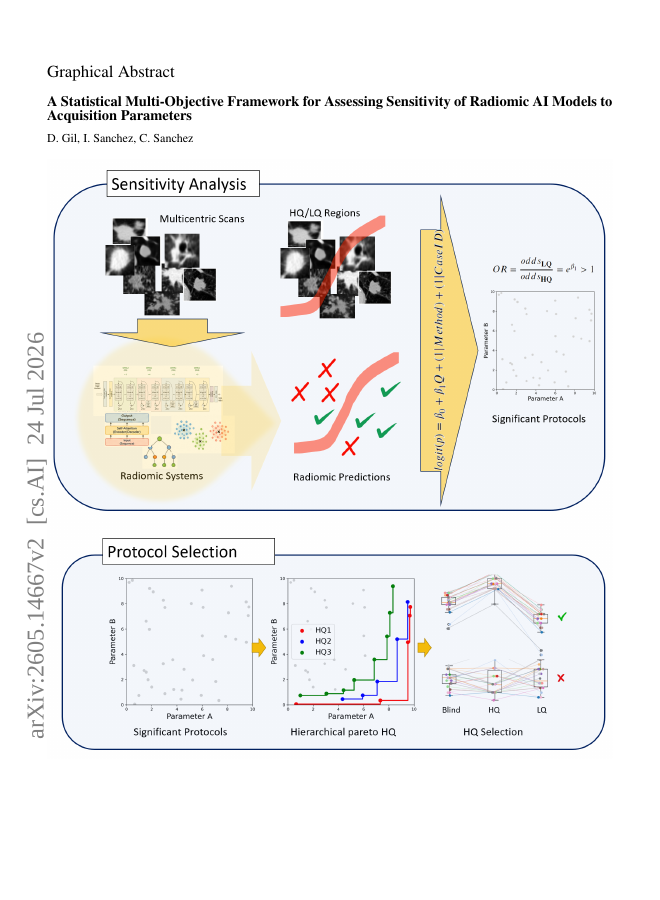
A main barrier for the deployment of AI radiomic systems in clinical routine is their drop in performance under heterogeneous multicentre acquisition protocols. This work presents a performance-oriented framework for quantifying scan parameter sensitivity of radiomic AI models,…
1 May 2026
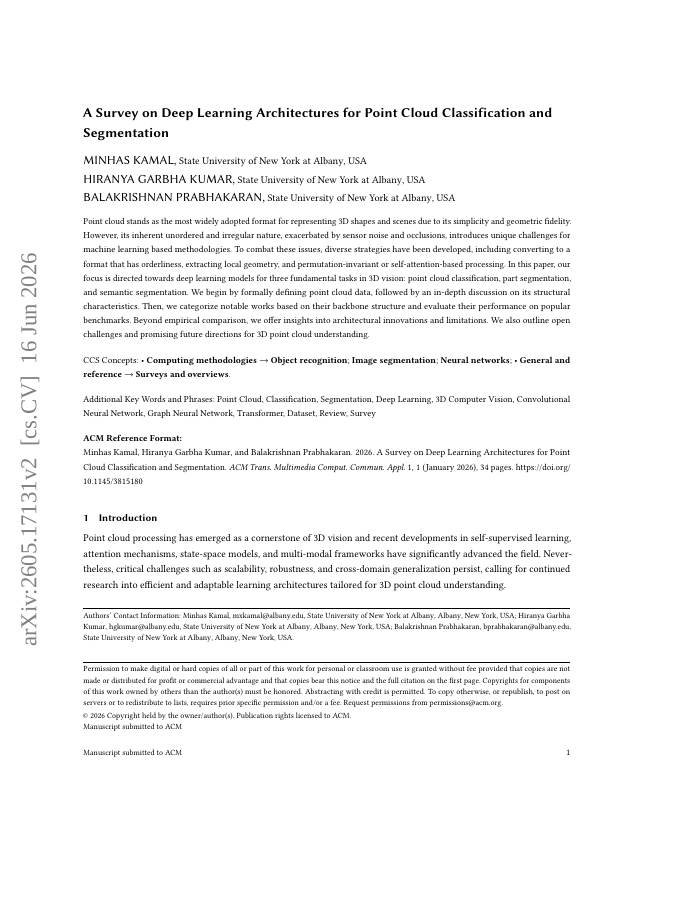
Point cloud stands as the most widely adopted format for representing 3D shapes and scenes due to its simplicity and geometric fidelity. However, its inherent unordered and irregular nature, exacerbated by sensor noise and occlusions, introduces unique challenges for machine…
1 May 2026
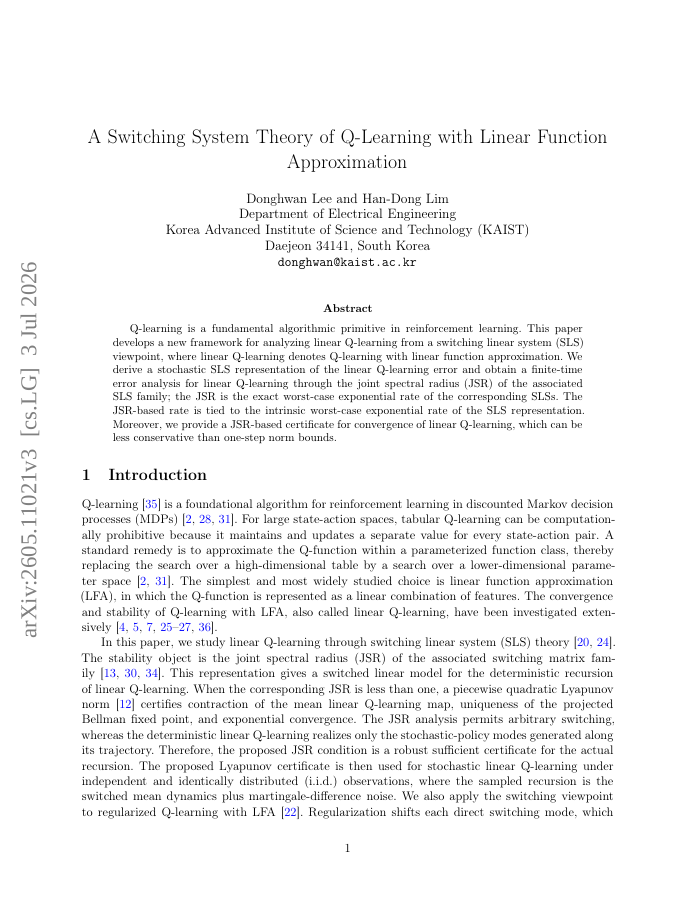
Q-learning is a fundamental algorithmic primitive in reinforcement learning. This paper develops a new framework for analyzing linear Q-learning from a switching linear system (SLS) viewpoint, where linear Q-learning denotes Q-learning with linear function approximation.
1 May 2026
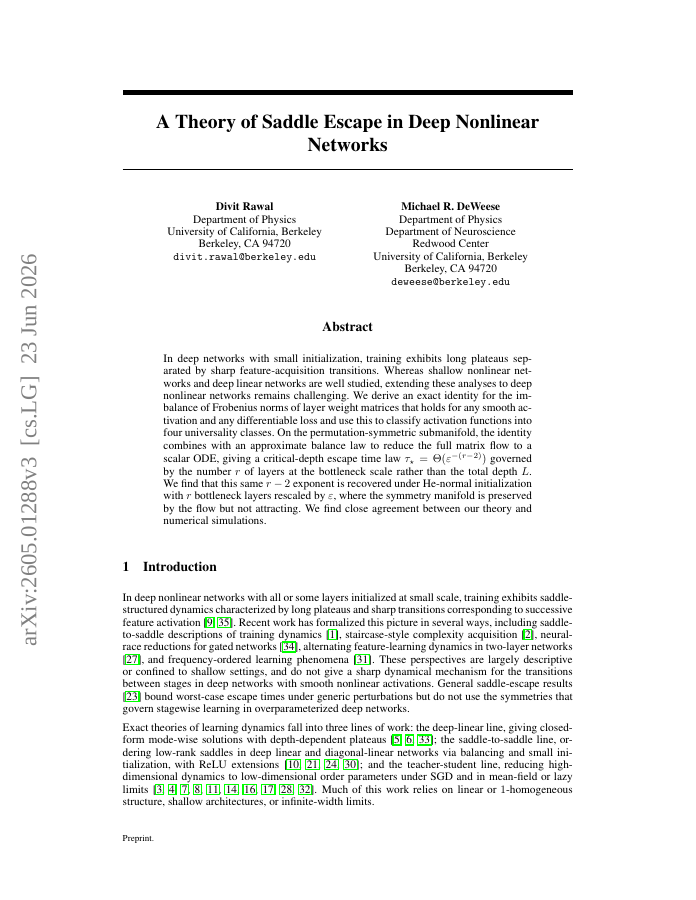
In deep networks with small initialization, training can exhibit long plateaus separated by sharp feature-acquisition transitions. Whereas shallow nonlinear networks and deep linear networks are well studied, extending these analyses to deep nonlinear networks remains…
1 May 2026
Free-form legal essay evaluation in NLP treats expert inter-rater stability as a single ceiling number, and treats LLM-judge agreement with that ceiling as evidence of judge stability.
1 May 2026
Shared-state federated computations combine client-local tensor computation, mergeable aggregation into shared state, and shared-only post-processing. We introduce a typed tensor language for this class of computations.
1 May 2026
Post-hoc explainable AI (XAI) methods usually return one attribution map, even when the model represents uncertainty in its parameters. We define the \emph{explanation distribution} as the distribution of attribution maps obtained from sampled models.