1 May 2026
We propose an architecture that augments the Flux Neural Operator (Flux NO), which combines the classical finite volume method (FVM) with neural operators, with ViT-based context injection.
Trending research and the full catalog - each paper linked to the benchmarks, methods, and models it introduces.
Filtering here covers the 2,000 most recent papers, as much as one page can hold in memory. See the full index of 22,174 papers.
1 May 2026
We propose an architecture that augments the Flux Neural Operator (Flux NO), which combines the classical finite volume method (FVM) with neural operators, with ViT-based context injection.
1 May 2026
Context. Metamorphic Testing addresses the test-oracle problem in scientific computing, but classical Mutation Score operates on syntactic AST mutations and misses domain semantics. Objective.
1 May 2026
A main barrier for the deployment of AI radiomic systems in clinical routine is their drop in performance under heterogeneous multicentre acquisition protocols. This work presents a performance-oriented framework for quantifying scan parameter sensitivity of radiomic AI models,…
1 May 2026
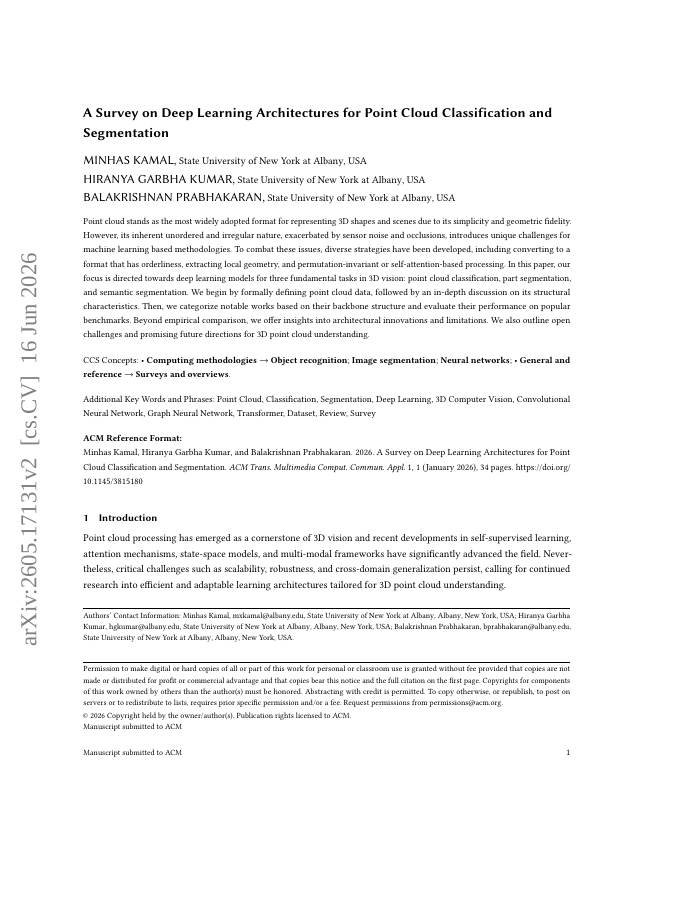
Point cloud stands as the most widely adopted format for representing 3D shapes and scenes due to its simplicity and geometric fidelity. However, its inherent unordered and irregular nature, exacerbated by sensor noise and occlusions, introduces unique challenges for machine…
1 May 2026
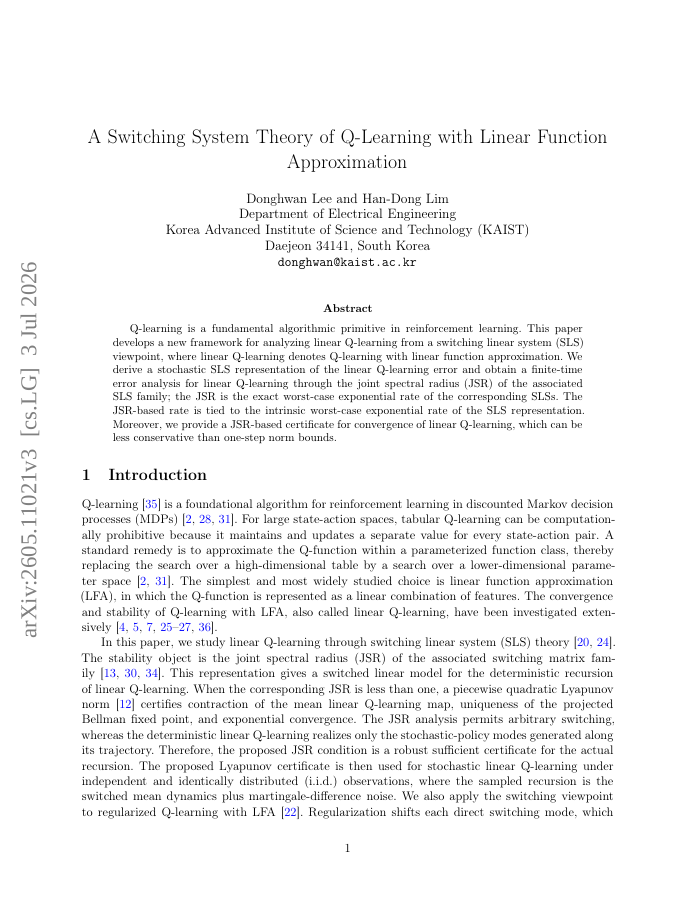
Q-learning is a fundamental algorithmic primitive in reinforcement learning. This paper develops a new framework for analyzing linear Q-learning from a switching linear system (SLS) viewpoint, where linear Q-learning denotes Q-learning with linear function approximation.
1 May 2026
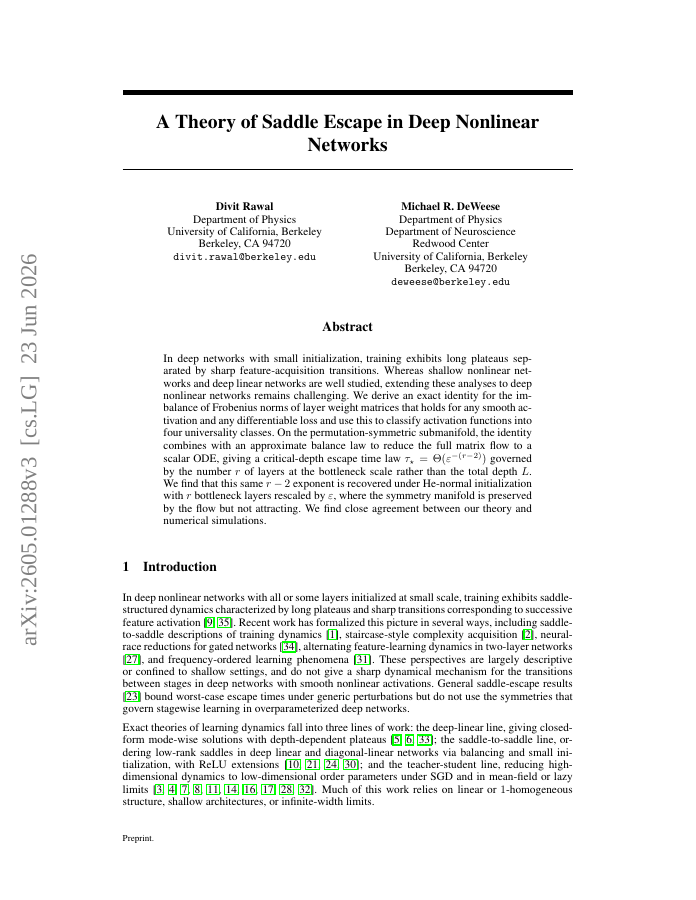
In deep networks with small initialization, training exhibits long plateaus separated by sharp feature-acquisition transitions. Whereas shallow nonlinear networks and deep linear networks are well studied, extending these analyses to deep nonlinear networks remains challenging.
1 May 2026
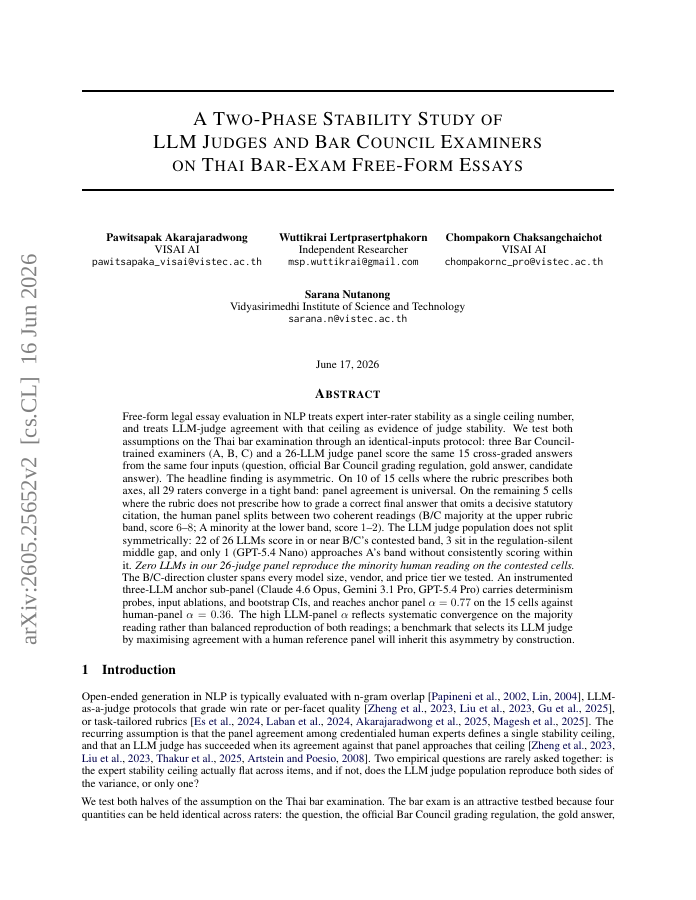
Free-form legal essay evaluation in NLP treats expert inter-rater stability as a single ceiling number, and treats LLM-judge agreement with that ceiling as evidence of judge stability.
1 May 2026
Post-hoc explainable AI (XAI) methods usually return one attribution map, even when the model represents uncertainty in its parameters. We define the \emph{explanation distribution} as the distribution of attribution maps obtained from sampled models.
1 May 2026
We develop a unified Lyapunov-integral quadratic constraint (IQC) framework for establishing uniform stability of first-order accelerated optimization algorithms in the $β$-smooth and $γ$-strongly convex regime.
1 May 2026
Inverse-multiquadric (IMQ) kernel sections decay at infinity. Can polynomial alignment add persistent directional responses while preserving universal approximation? The \yat{} (Yat) kernel answers this question by multiplying IMQ distance by a biased squared inner product.
1 May 2026
Federated differentially private protocols can communicate over many adaptive rounds and reuse each client's local samples. Existing lower bound arguments for federated DP are often restricted to noninteractive protocols or fresh batch decompositions, so the fundamental…
1 May 2026
Dynamic link prediction is important for modeling evolving interactions in social, communication, financial, and transportation networks. Classical temporal graph models capture changes over time, but they may struggle to represent rapidly evolving node-edge interactions in…
1 May 2026
Quantization is an effective strategy to reduce the storage and computation footprint of large language models (LLMs). Post-training quantization (PTQ) is a leading approach for compressing LLMs.
1 May 2026
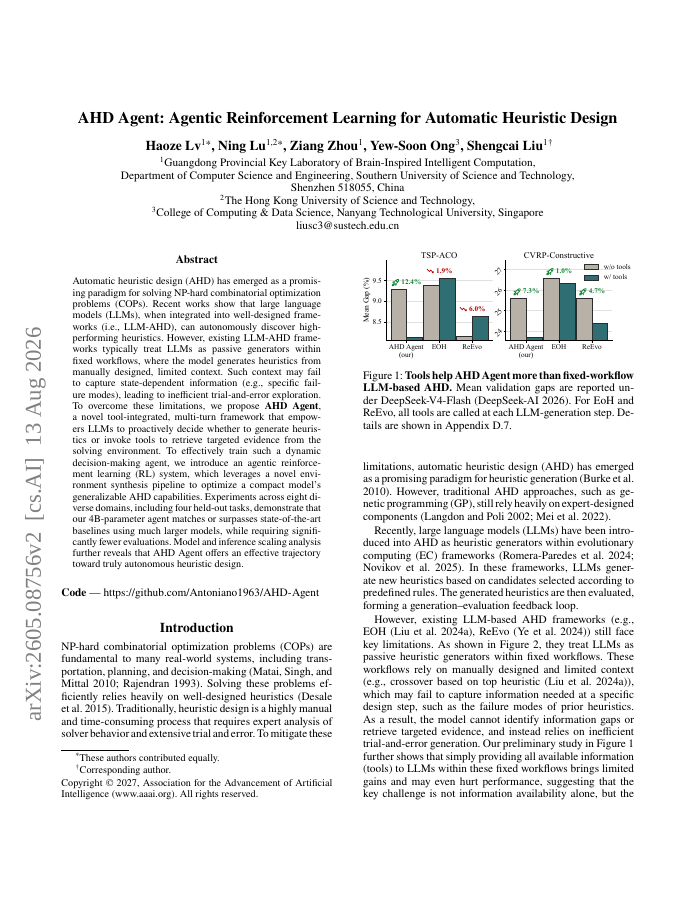
Automatic heuristic design (AHD) has emerged as a promising paradigm for solving NP-hard combinatorial optimization problems (COPs). Recent works show that large language models (LLMs), when integrated into well-designed frameworks (i.e., LLM-AHD), can autonomously discover…
1 May 2026
We present swarm-attack, an open-source adversarial testing framework in which multiple lightweight LLM agents coordinate through shared memory, parallel exploration, and evolutionary optimization.
1 May 2026
Coding and computation remain major bottlenecks in Markov chain Monte Carlo (MCMC) workflows, especially as modern sampling algorithms have become increasingly complex and existing probabilistic programming systems remain limited in model support, extensibility, and…
1 May 2026
Modern deep learning commonly relies on AdamW with prescribed learning rate schedules, but recent works challenge both components: Schedule-Free optimization removes explicit schedules via iterate averaging, and Muon improves the update geometry by orthogonalizing momentum for…
23 Apr 2026
This paper aims to synthesize current knowledge on generative AI in IT project management using the PRISMA methodology to provide researchers with a comprehensive perspective on techniques, applications, adoption trends, limitations, and integration across project management…
Jian Yang, Ruibin Yuan, Yizhi Li · 21 Apr 2026
TACO is a self-evolving compression framework that automatically discovers and refines compression rules from interaction trajectories to improve long-horizon agent performance while reducing token overhead.
Yu Wang, Xunliang Cai, Yuxin Chen · 20 Apr 2026
As reinforcement learning continues to scale the training of large language model-based agents, reliably verifying agent behaviors in complex environments has become increasingly challenging.
18 Apr 2026
The present study aims to investigate a cluster cleaning algorithm that is both computationally simple and capable of solving the PU classification when the SCAR condition is unsatisfied.
Mingqiao Ye, Afshin Dehghan, Roman Bachmann · 16 Apr 2026
Tokenization is a key component of autoregressive (AR) generative models, converting raw data into more manageable units for modeling.
14 Apr 2026
With the growing adoption of AI systems, reasoning about how society can exert control over AI becomes an increasingly urgent problem. Existing work on democratic control largely focuses on macro-level governance.
Stefan Schulz, Fernando Edelstein, Hannah Dröge · 13 Apr 2026
Real-time free-viewpoint rendering requires balancing multi-camera redundancy with the latency constraints of interactive applications.