
A Hormone-inspired Emotion Layer for Transformer language models (HELT)
Eslam Reda, Sara El-Metwally · 13 Apr 2026
Large Language Models have demonstrated remarkable capabilities in generating contextually relevant and grammatically correct text.
Trending research and the full catalog - each paper linked to the benchmarks, methods, and models it introduces.
Filtering here covers the 2,000 most recent papers, as much as one page can hold in memory. See the full index of 22,174 papers.
Eslam Reda, Sara El-Metwally · 13 Apr 2026
Large Language Models have demonstrated remarkable capabilities in generating contextually relevant and grammatically correct text.

Xiaodong Yang, Meng'en Qin, Yu Song · 11 Apr 2026
A3-FPN enhances multi-scale feature representation through asymptotically disentangled framework and content-aware attention modules, improving small object recognition and dense prediction tasks.
10 Apr 2026
Topic modeling is a branch of Natural Language Processing (NLP) that aims to organize large collections of texts into coherent groups according to word co-occurrence patterns, with Latent Dirichlet Allocation (LDA) remaining one of the most widely used and interpretable…
7 Apr 2026
Constructing artificial lexicons that are pronounceable, typologically plausible, and semantically structured remains an open challenge in computational linguistics. Existing conlang generators either lack formal phonotactic guarantees or delegate generation to opaque,…

Qihang Yu, Ju He, Liang-Chieh Chen · 6 Apr 2026
Anticipating diverse future states is a central challenge in video world modeling.

Ziwei Liu, Jingkang Yang, Shulin Tian · 2 Apr 2026
Recent streaming video understanding methods increasingly rely on complex memory mechanisms to handle long video streams.
1 Apr 2026
Supervised fine-tuning (SFT) is a common first stage of LLM post-training, teaching the model to follow instructions and shaping its behavior as a helpful assistant. At the same time, SFT may harm the fundamental capabilities of an LLM, particularly after long pretraining: a…

1 Apr 2026
Prompt optimization improves language models without updating their weights by searching for a better system prompt, but its effectiveness varies widely across tasks. We study what makes a task amenable to prompt optimization.
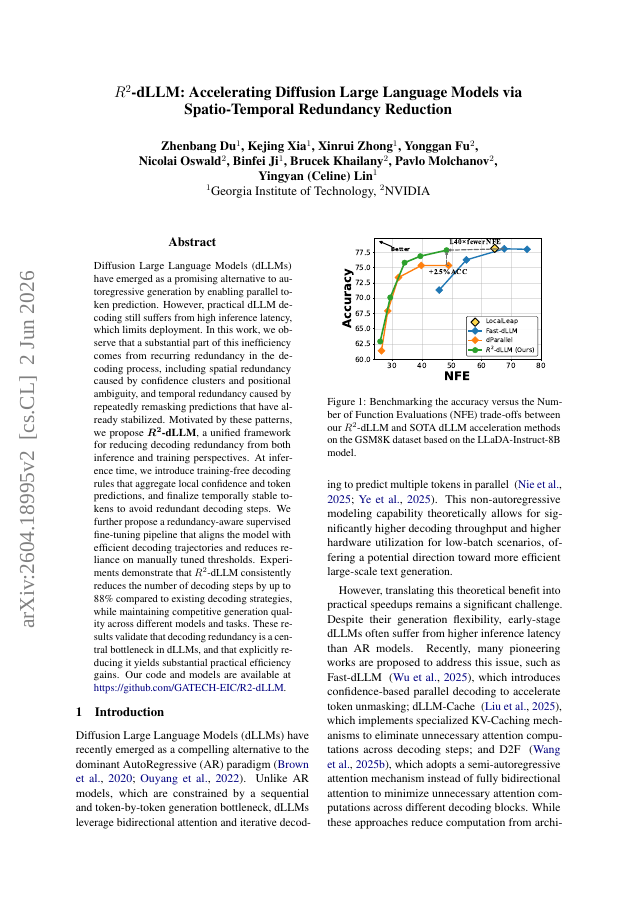
1 Apr 2026
Diffusion Large Language Models (dLLMs) have emerged as a promising alternative to autoregressive generation by enabling parallel token prediction. However, practical dLLM decoding still suffers from high inference latency, which limits deployment.
1 Apr 2026
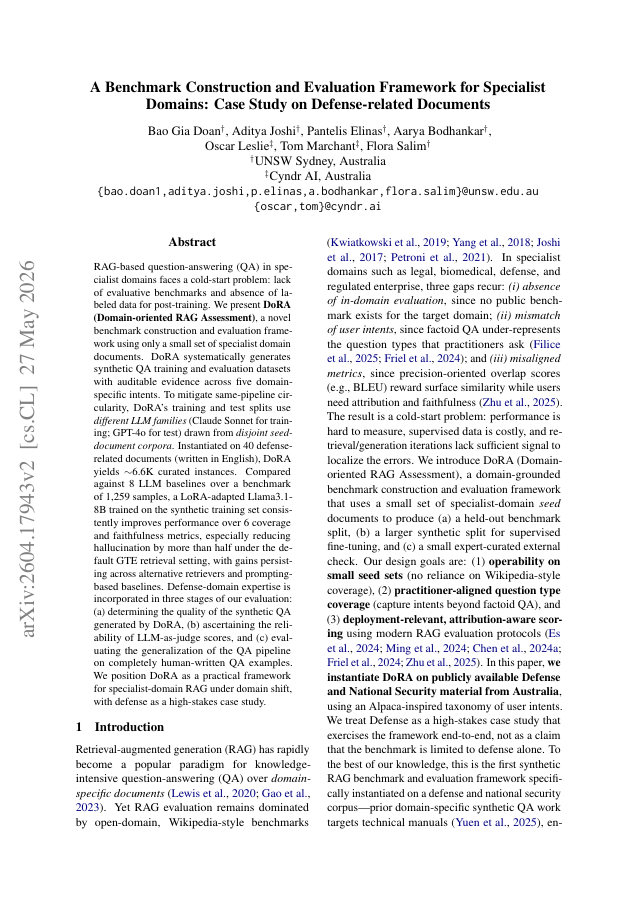
RAG-based question-answering (QA) in specialist domains faces a cold-start problem: lack of evaluative benchmarks and absence of labeled data for post-training. We present DoRA (Domain-oriented RAG Assessment), a novel benchmark construction and evaluation framework using only a…
1 Apr 2026
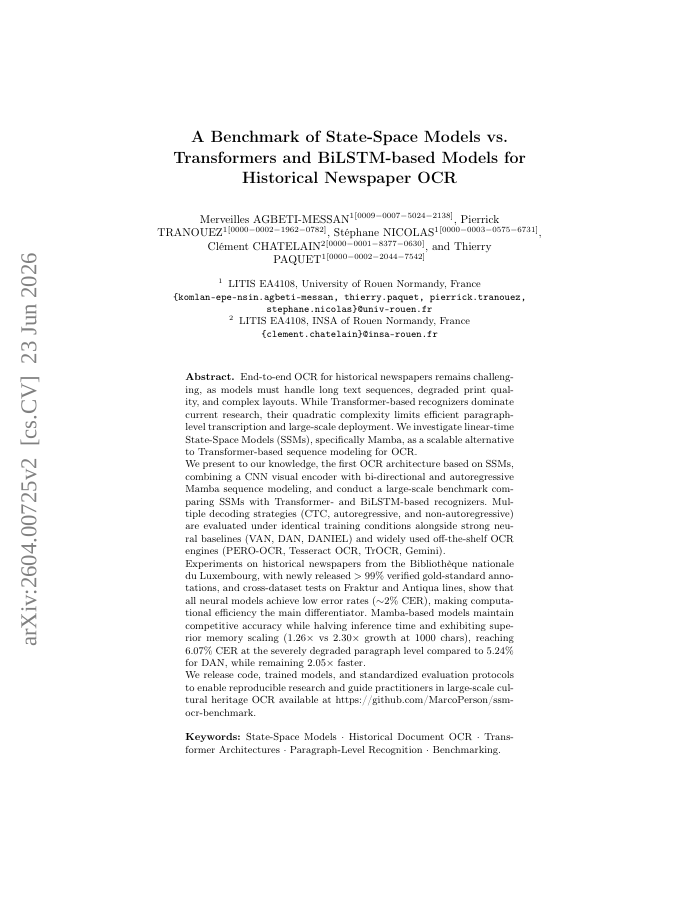
End-to-end OCR for historical newspapers remains challenging, as models must handle long text sequences, degraded print quality, and complex layouts. While Transformer-based recognizers dominate current research, their quadratic complexity limits efficient paragraph-level…
1 Apr 2026
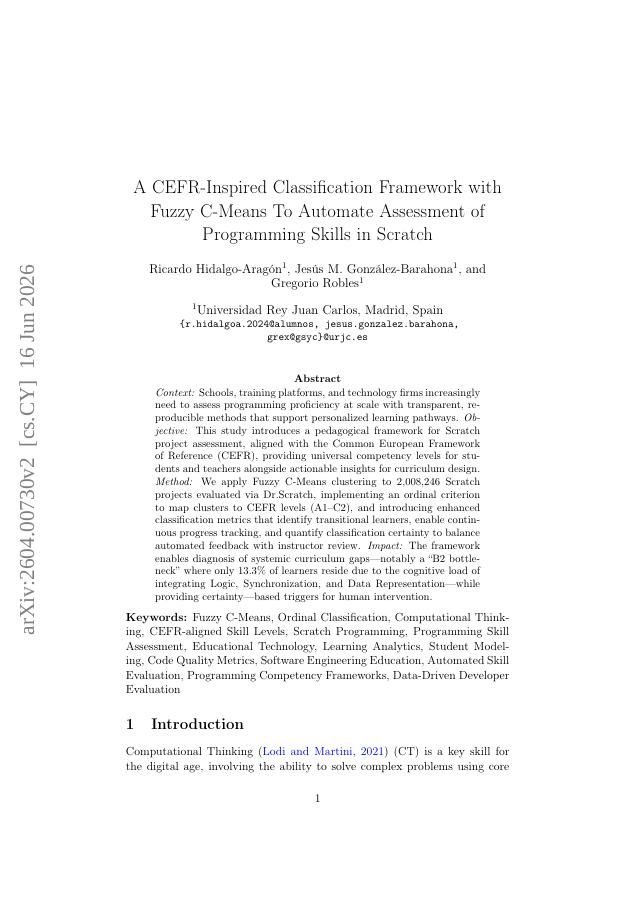
Context: Schools, training platforms, and technology firms increasingly need to assess programming proficiency at scale with transparent, reproducible methods that support personalized learning pathways.

1 Apr 2026
Edge computing environments impose strict constraints on energy consumption and latency, making the deployment of deep neural networks a significant challenge. Therefore, smart and adaptive inference strategies that dynamically balance computational cost or latency with…
1 Apr 2026
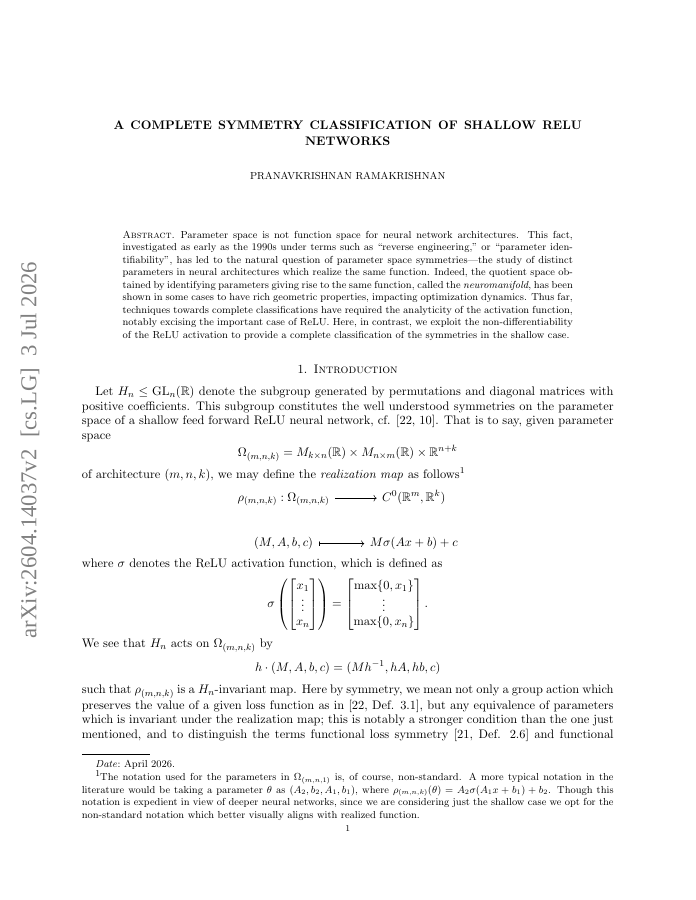
Parameter space is not function space for neural network architectures. This fact, investigated as early as the 1990s under terms such as ``reverse engineering," or ``parameter identifiability", has led to the natural question of parameter space symmetries\textemdash the…
1 Apr 2026
Data assimilation (DA) integrates observational information with model predictions to improve state estimation in complex systems. While filtering provides the basis for online forecasts by using only past and present observations, it can exhibit delays and biases when the…
1 Apr 2026
Efficiently solving the Fokker-Planck equation (FPE) is central to analyzing complex parameterized stochastic systems. However, current numerical methods lack parallel computation capabilities across varying conditions, severely limiting comprehensive parameter exploration and…
1 Apr 2026
We consider a linear contextual bandit model where contexts and rewards are governed by a finite hidden Markov chain. We first revisit the simplified model by Nelson et al.
1 Apr 2026
We study city-scale control of electric-vehicle (EV) ride-hailing fleets where dispatch, repositioning, and charging decisions must respect charger and feeder limits under uncertain, spatially correlated demand and travel times.
1 Apr 2026
We introduce a novel learning framework for accelerated Monte Carlo (MC) dose calculation termed Energy-Shifting. This approach leverages deep learning to synthesize highly complex polyenergetic dose distributions directly from simple monoenergetic inputs under identical beam…
1 Apr 2026
The mean-field Schrödinger bridge (MFSB) problem concerns designing a minimum-effort controller that guides a diffusion process with nonlocal interaction to reach a given distribution from another by a fixed deadline.
1 Apr 2026
Mapping the spatial distribution of species is essential for conservation policy and invasive species management. Species distribution models (SDMs) are the primary tools for this task, serving two purposes: achieving robust predictive performance while providing ecological…

1 Apr 2026
While critical for alignment, Supervised Fine-Tuning (SFT) incurs the risk of catastrophic forgetting, yet the layer-wise emergence of instruction-following capabilities remains elusive.
1 Apr 2026
Emergent intelligence have played a major role in the modern AI development. While existing studies primarily rely on empirical observations to characterize this phenomenon, a rigorous theoretical framework remains underexplored.

1 Apr 2026
Scientific discovery is slowed by fragmented literature that requires excessive human effort to gather, analyze, and understand. AI tools, including autonomous summarization and question answering, have been developed to aid in understanding scientific literature.