9 Oct 2026
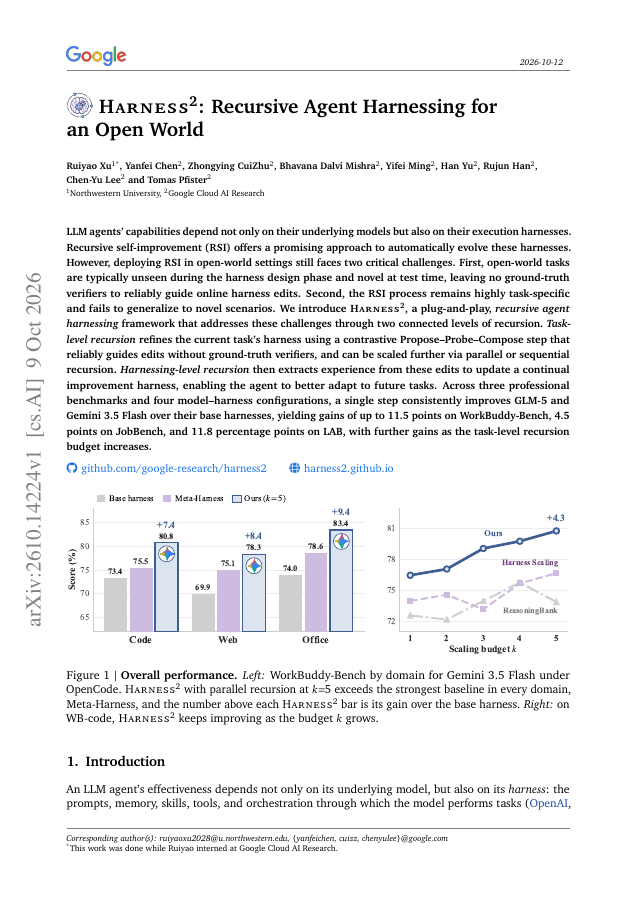
LLM agents' capabilities depend not only on their underlying models but also on their execution harnesses. Recursive self-improvement (RSI) offers a promising approach to automatically evolve these harnesses.
Trending research and the full catalog - each paper linked to the benchmarks, methods, and models it introduces.
Filtering here covers the 2,000 most recent papers, as much as one page can hold in memory. See the full index of 22,656 papers.
9 Oct 2026
LLM agents' capabilities depend not only on their underlying models but also on their execution harnesses. Recursive self-improvement (RSI) offers a promising approach to automatically evolve these harnesses.
17 Sep 2026
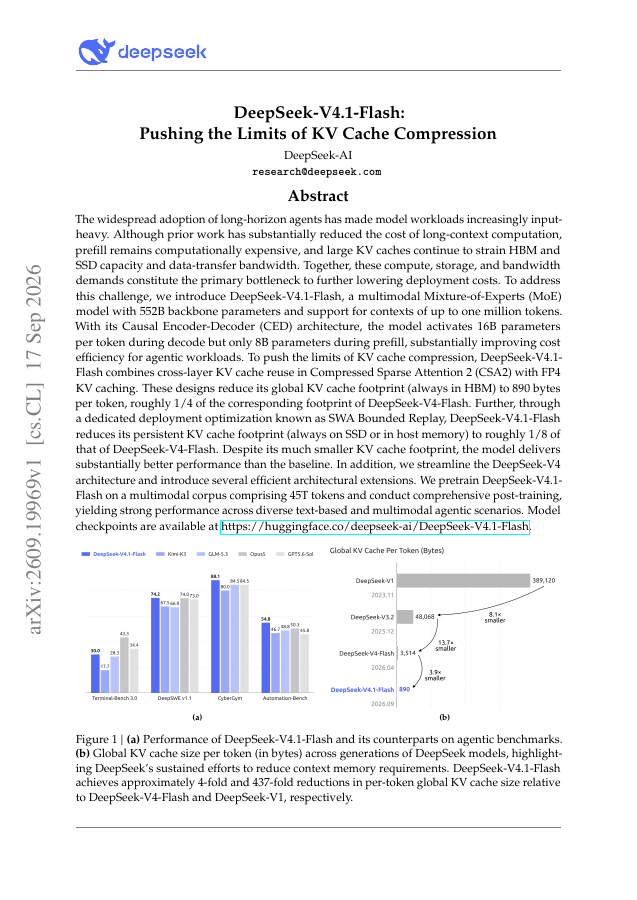
The widespread adoption of long-horizon agents has made model workloads increasingly input-heavy. Although prior work has substantially reduced the cost of long-context computation, prefill remains computationally expensive, and large KV caches continue to strain HBM and SSD…
6 Oct 2026
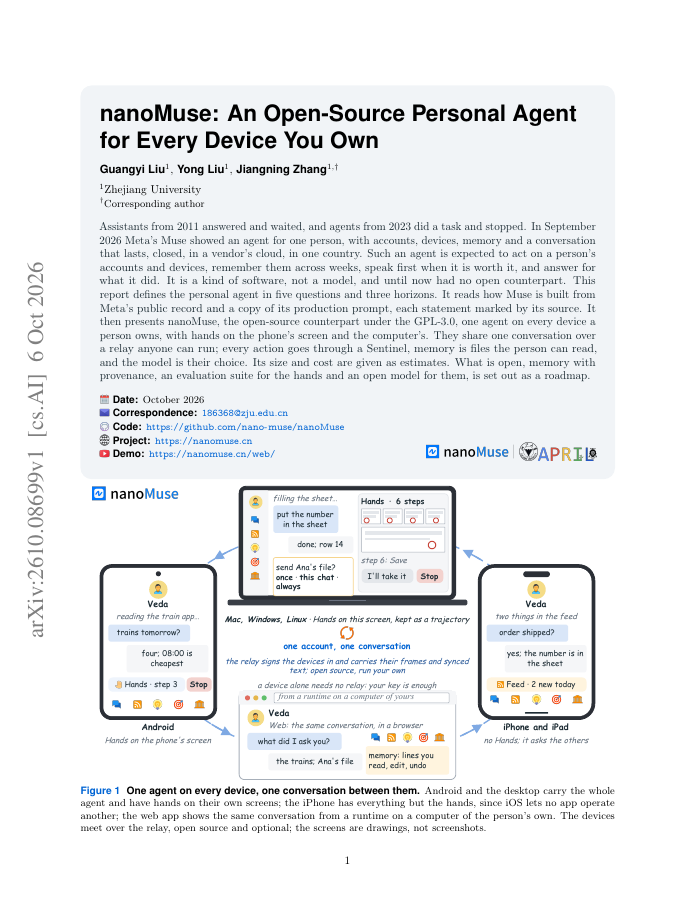
Assistants from 2011 answered and waited, and agents from 2023 did a task and stopped. In September 2026 Meta's Muse showed an agent for one person, with accounts, devices, memory and a conversation that lasts, closed, in a vendor's cloud, in one country.
8 Oct 2026
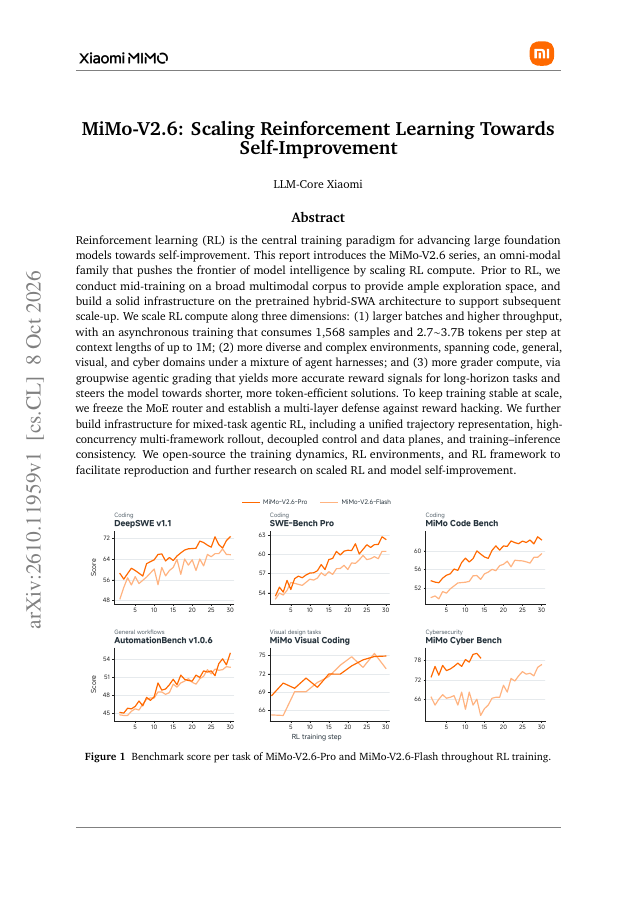
Reinforcement learning (RL) is the central training paradigm for advancing large foundation models towards self-improvement. This report introduces the MiMo-V2.6 series, an omni-modal family that pushes the frontier of model intelligence by scaling RL compute.
21 Jul 2026
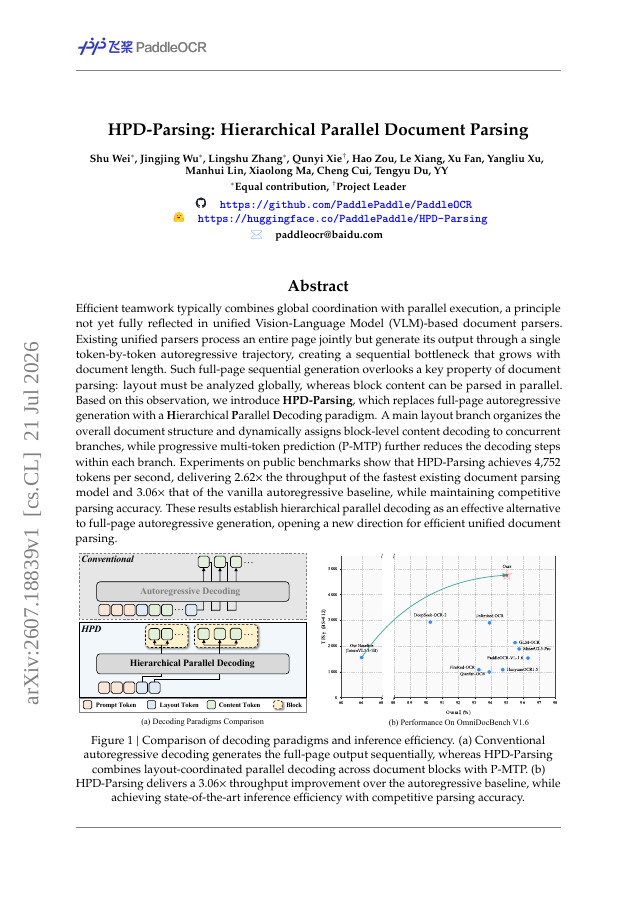
Efficient teamwork typically combines global coordination with parallel execution, a principle not yet fully reflected in unified Vision-Language Model (VLM)-based document parsers.
8 Oct 2026
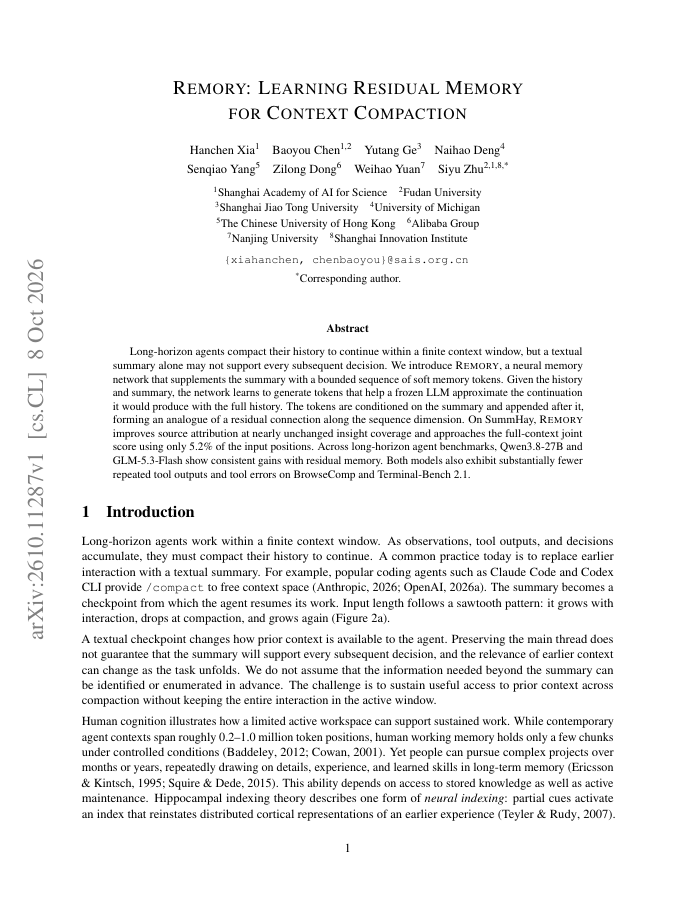
Long-horizon agents compact their history to continue within a finite context window, but a textual summary alone may not support every subsequent decision. We introduce REMORY, a neural memory network that supplements the summary with a bounded sequence of soft memory tokens.
16 Sep 2026
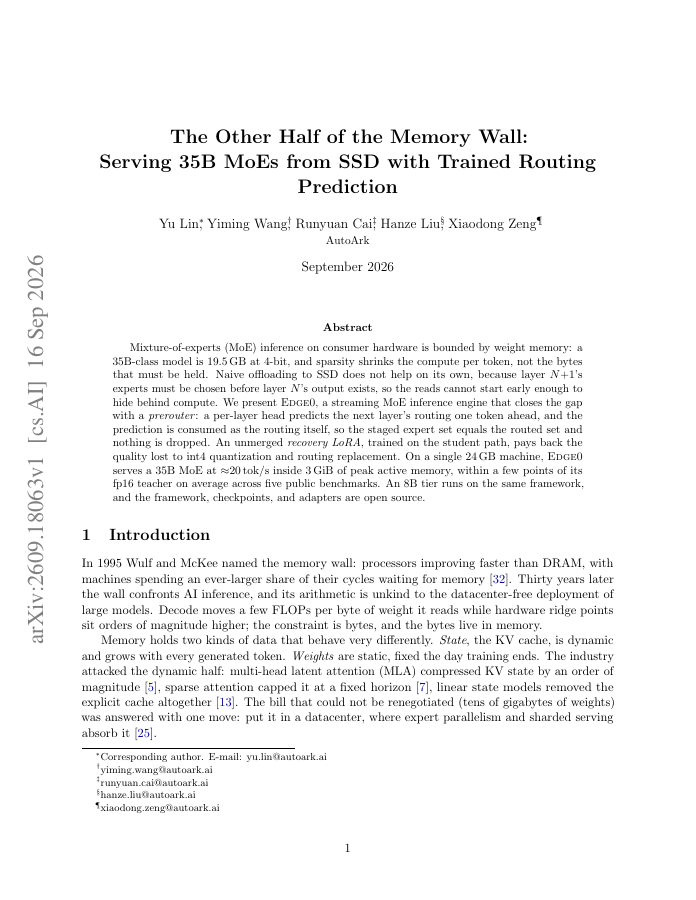
Mixture-of-experts (MoE) inference on consumer hardware is bounded by weight memory: a 35B-class model is 19.5GB at 4-bit, and sparsity shrinks the compute per token, not the bytes that must be held.
29 May 2026
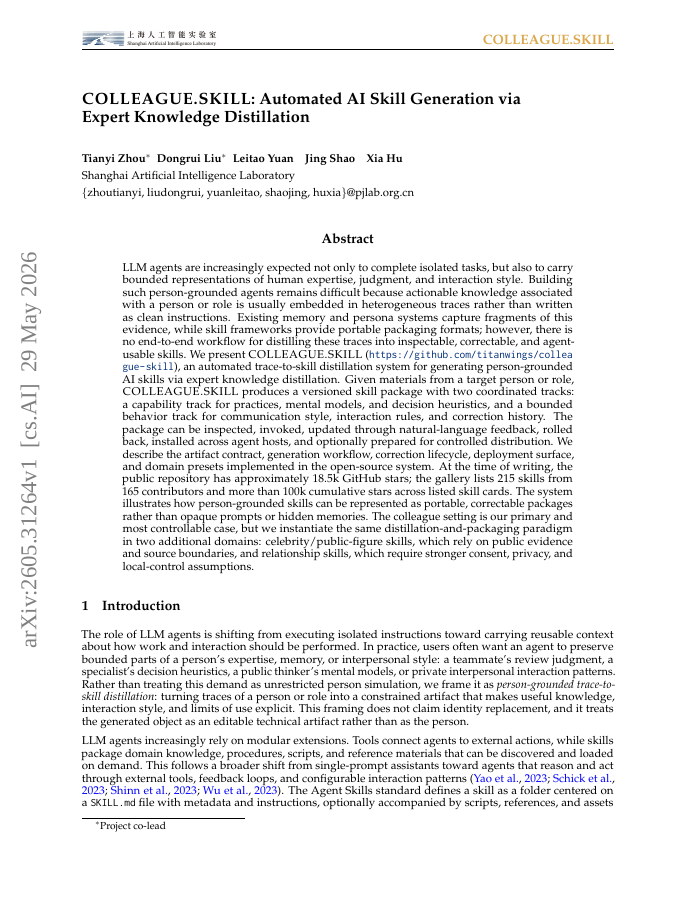
LLM agents are increasingly expected not only to complete isolated tasks, but also to carry bounded representations of human expertise, judgment, and interaction style. Building such person-grounded agents remains difficult because actionable knowledge associated with a person…
13 Oct 2026
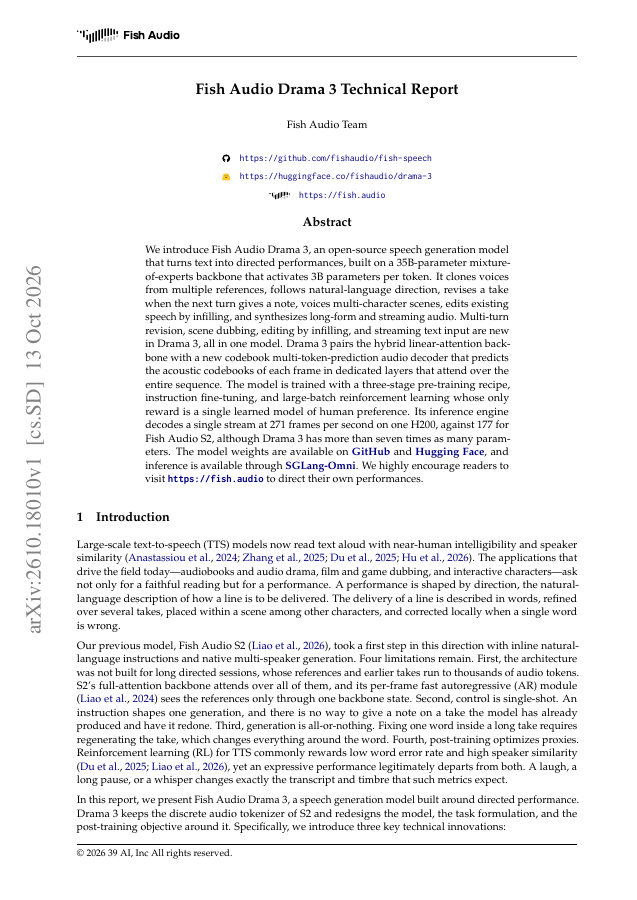
We introduce Fish Audio Drama 3, an open-source speech generation model that turns text into directed performances, built on a 35B-parameter mixture-of-experts backbone that activates 3B parameters per token.
19 Oct 2026
Multimodal large language models (MLLMs) have made rapid progress on visual reasoning, yet many tasks require evidence that is difficult to obtain through internal reasoning alone: our controlled study on 22 benchmarks shows that simply increasing the inference budget of the…
4 Sep 2026
Recent advances in automatic rigging now deliver animation-ready 3D assets at scale, yet generating the motion to drive them remains a bottleneck. Existing learned animators are topology-constrained: they rely on category-specific templates or require per-skeleton fine-tuning…
16 Oct 2026
Precise grounding matters. It specifies which object is the target and where that object is, even in clutter and for tiny objects, and it has to be fast enough for closed-loop control.
22 Jun 2026
Recently, end-to-end OCR models, exemplified by DeepSeek OCR, have once again thrust OCR into the spotlight. A widely held view is that employing a large language model (LLM) as the decoder allows the model to leverage the prior distribution of language, leading to improved OCR…
9 Oct 2026
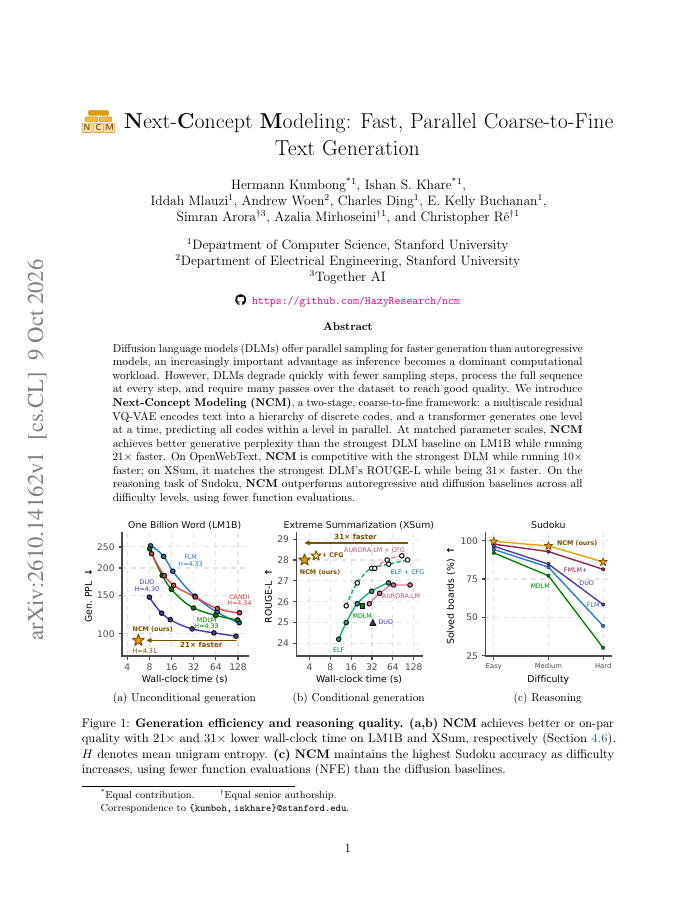
Diffusion language models (DLMs) offer parallel sampling for faster generation than autoregressive models, an increasingly important advantage as inference becomes a dominant computational workload.
19 Oct 2026
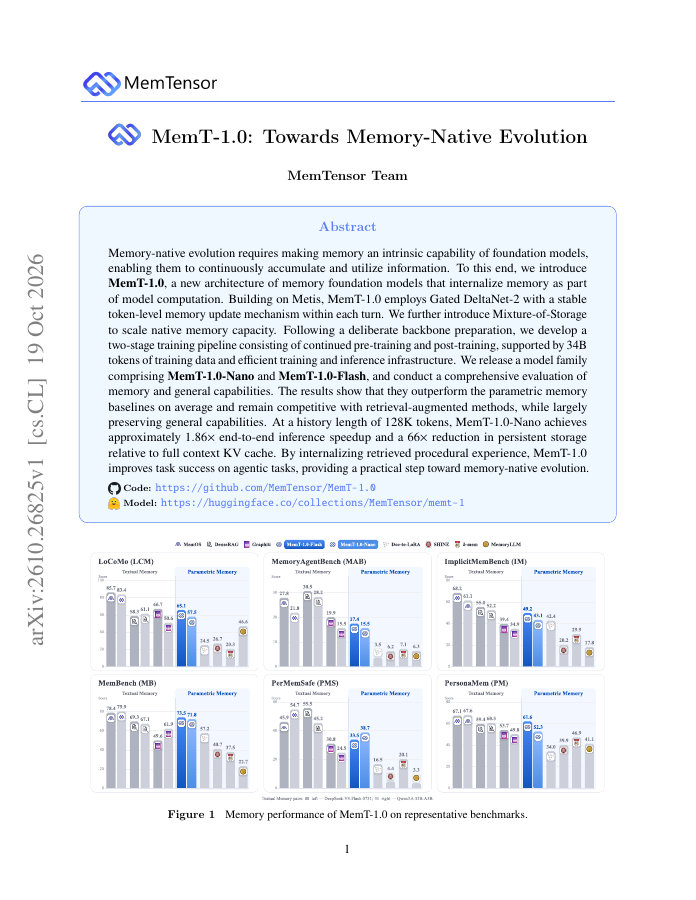
Memory-native evolution requires making memory an intrinsic capability of foundation models, enabling them to continuously accumulate and utilize information. To this end, we introduce MemT-1.0, a new architecture of memory foundation models that internalize memory as part of…
13 Oct 2026
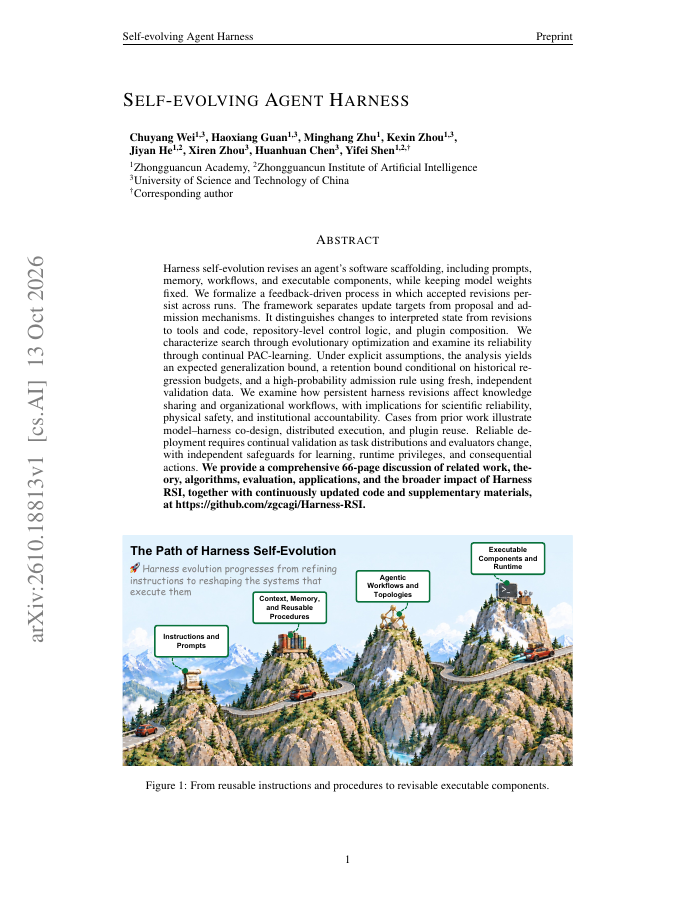
Harness self-evolution revises an agent's software scaffolding, including prompts, memory, workflows, and executable components, while keeping model weights fixed. We formalize a feedback-driven process in which accepted revisions persist across runs.
12 Oct 2026
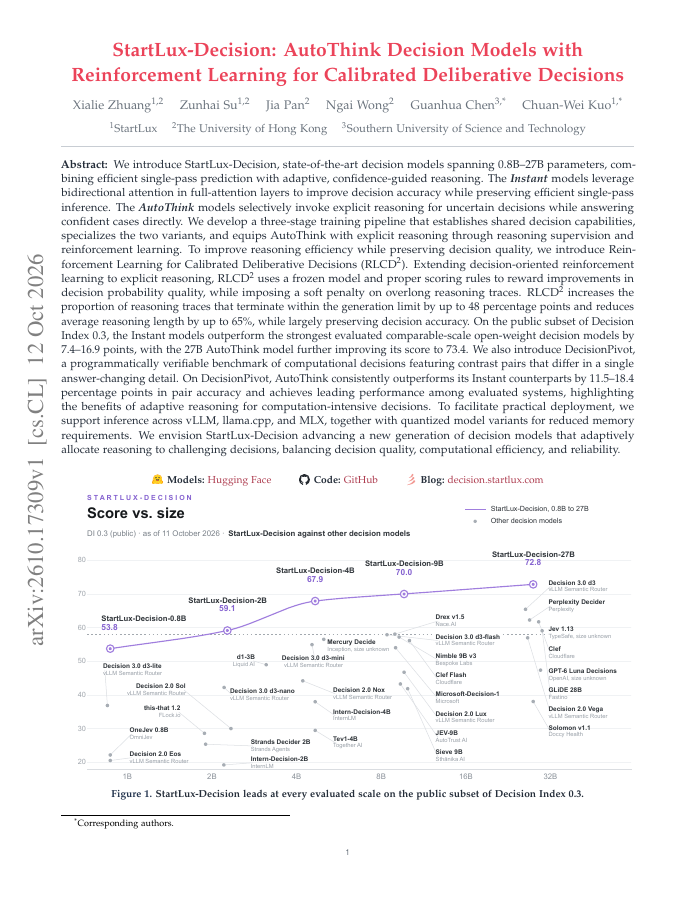
We introduce StartLux-Decision, decision models from 0.8B to 27B parameters that combine efficient single-pass prediction with adaptive, confidence-guided reasoning. The Instant models use bidirectional attention in full-attention layers to improve decision accuracy while…
15 Jun 2026
Personalized presentation generation requires more than conditioning on a current prompt or template: agents must preserve stable user preferences across tasks, retain newly introduced preferences and constraints during multi-turn revision, and carry out local edits reliably.
2 Jun 2026
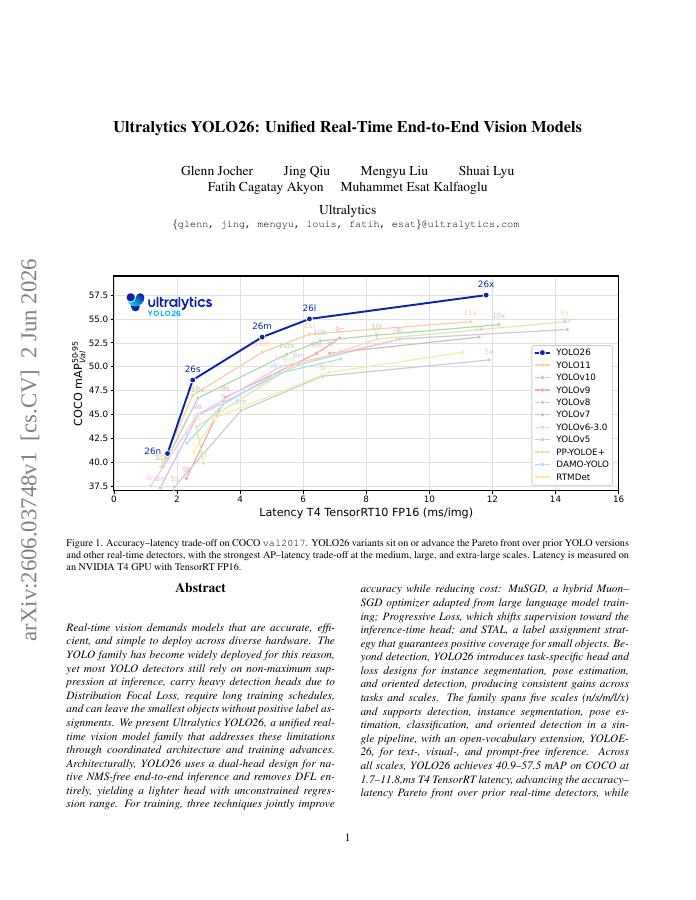
Real-time vision demands models that are accurate, efficient, and simple to deploy across diverse hardware. The YOLO family has become widely deployed for this reason, yet most YOLO detectors still rely on non-maximum suppression at inference, carry heavy detection heads due to…
5 Jul 2026
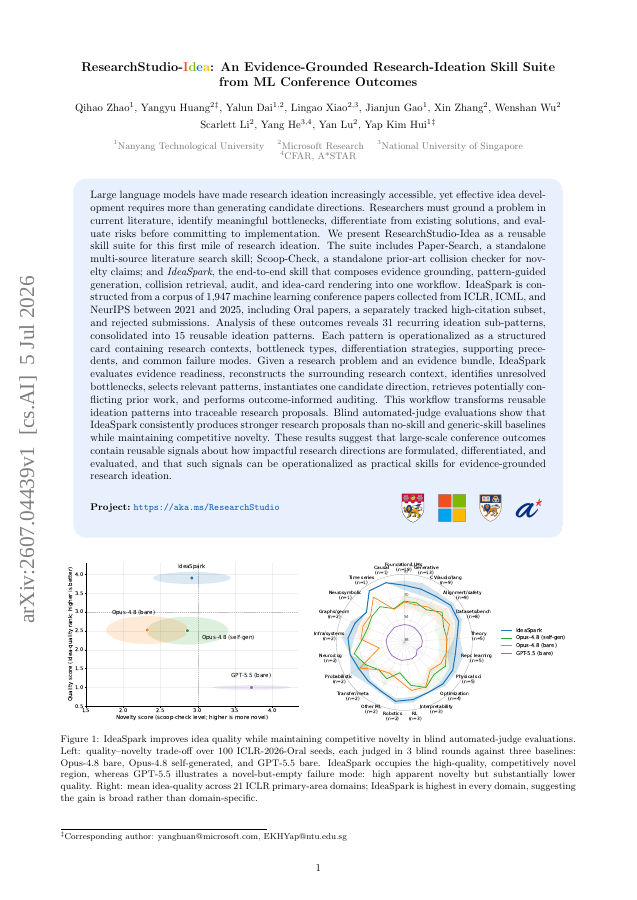
Large language models have made research ideation increasingly accessible, yet effective idea development requires more than generating candidate directions. Researchers must ground a problem in current literature, identify meaningful bottlenecks, differentiate from existing…
13 Oct 2026
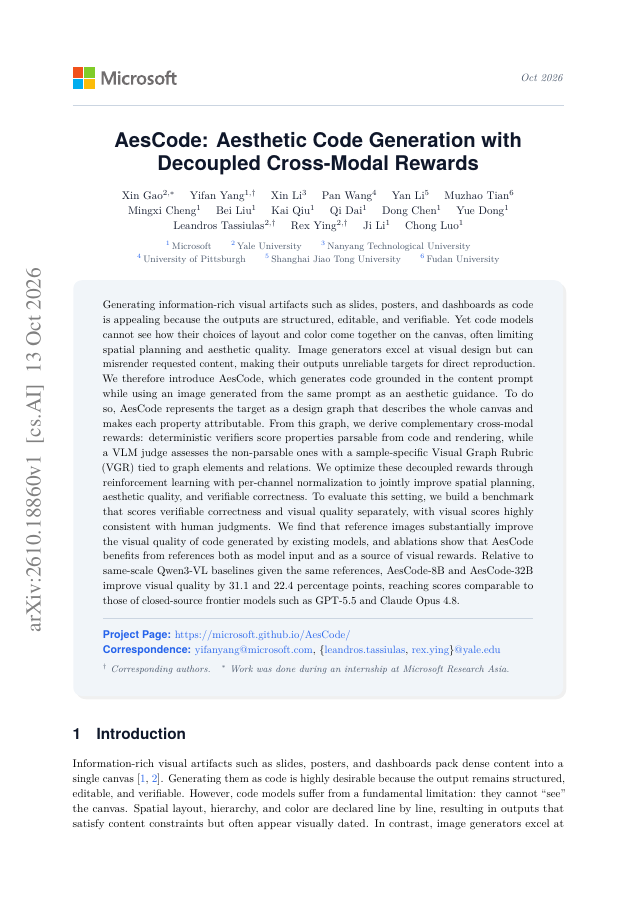
Generating information-rich visual artifacts such as slides, posters, and dashboards as code is appealing because the outputs are structured, editable, and verifiable. Yet code models cannot see how their choices of layout and color come together on the canvas, often limiting…
24 Aug 2026
Language models are sequential processors, but long-horizon agency requires external information and computation beyond model weights and active context. Prime Agent is an open-source harness for long-horizon evaluation and coding-agent workflows.
25 Aug 2026
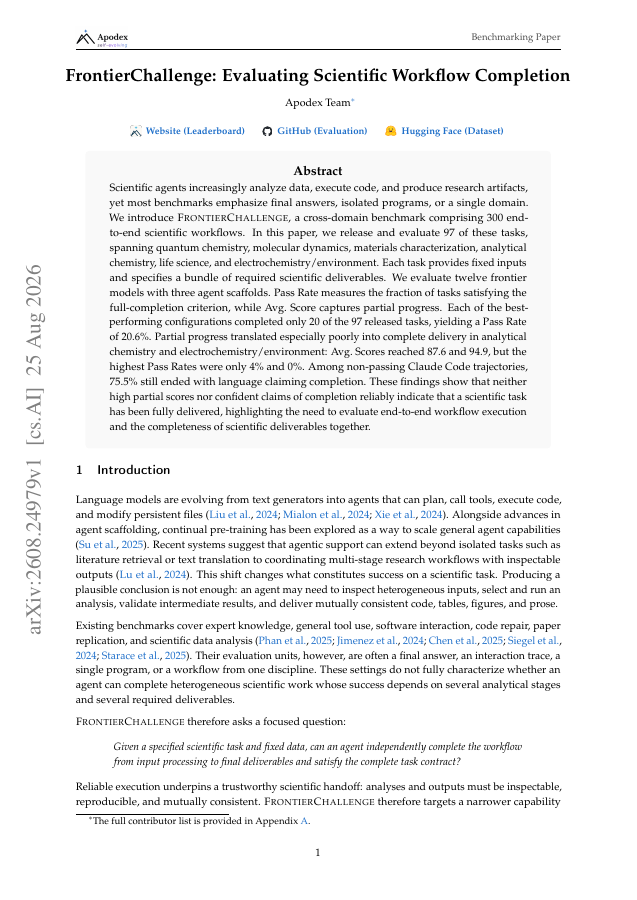
Scientific agents increasingly analyze data, execute code, and produce research artifacts, yet most benchmarks emphasize final answers, isolated programs, or a single domain. We introduce FrontierChallenge, a cross-domain benchmark comprising 300 end-to-end scientific workflows.
27 Sep 2026
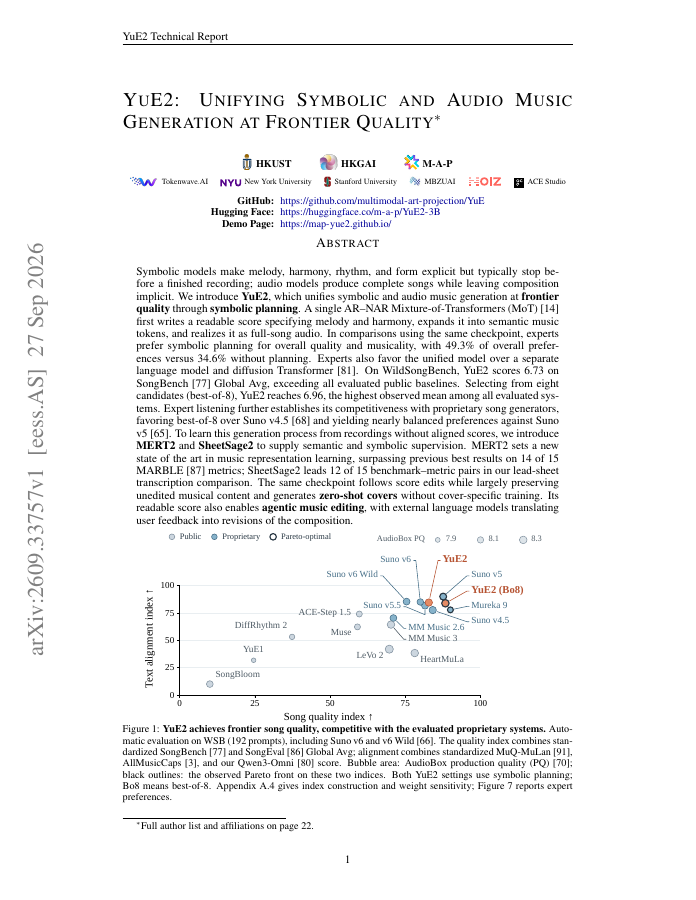
Symbolic models make melody, harmony, rhythm, and form explicit but typically stop before a finished recording; audio models produce complete songs while leaving composition implicit.