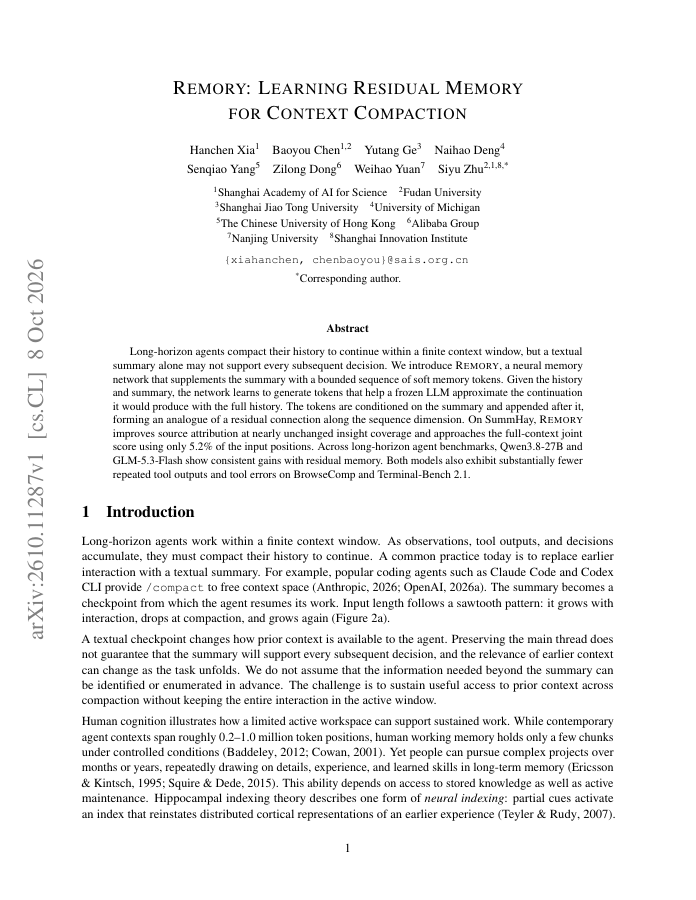
Long-horizon agents compact their history to continue within a finite context window, but a textual summary alone may not support every subsequent decision. We introduce REMORY, a neural memory network that supplements the summary with a bounded sequence of soft memory tokens. Given the history and summary, the network learns to generate tokens that help a frozen LLM approximate the continuation it would produce with the full history. The tokens are conditioned on the summary and appended after it, forming an analogue of a residual connection along the sequence dimension. On SummHay, REMORY improves source attribution at nearly unchanged insight coverage and approaches the full-context joint score using only 5.2% of the input positions. Across long-horizon agent benchmarks, Qwen3.8-27B and GLM-5.3-Flash show consistent gains with residual memory. Both models also exhibit substantially fewer repeated tool outputs and tool errors on BrowseComp and Terminal-Bench 2.1.
REMORY: Learning Residual Memory for Context Compaction
Long-horizon agents compact their history to continue within a finite context window, but a textual summary alone may not support every subsequent decision. We introduce REMORY, a neural memory network that supplements the summary with a bounded sequence of soft memory tokens.
- Preview
- Year
- 2026
- Stars
- 36
- Hosting
- Full text hostedCC-BY-4.0
Cite
Notes
Only stored in your browser.
Attribution
- Abstract & full text
- arxiv.org/abs/2610.11287CC-BY-4.0
- TL;DR
- Semantic Scholar