9 Oct 2026
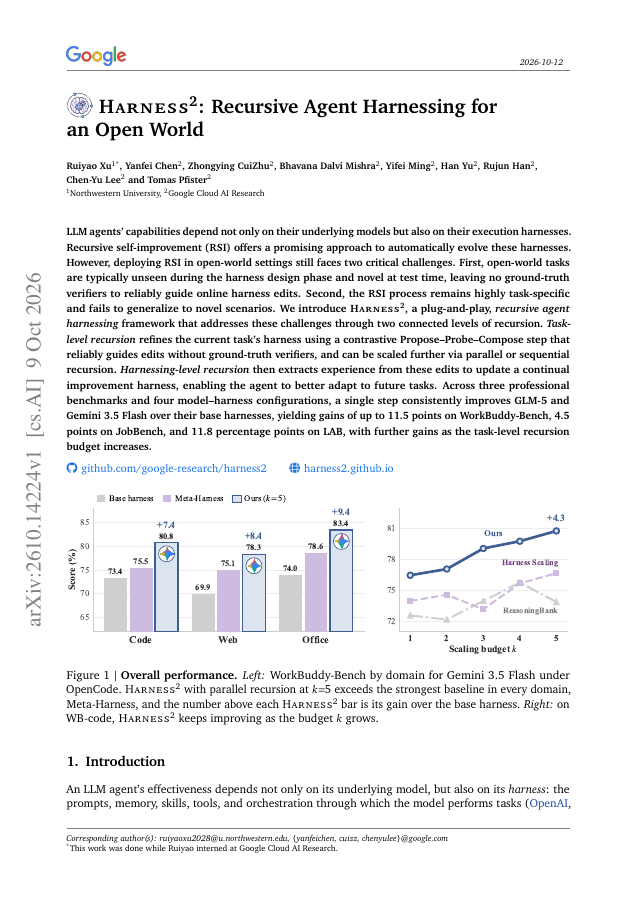
LLM agents' capabilities depend not only on their underlying models but also on their execution harnesses. Recursive self-improvement (RSI) offers a promising approach to automatically evolve these harnesses.
Trending research and the full catalog - each paper linked to the benchmarks, methods, and models it introduces.
Filtering here covers the 2,000 most recent papers, as much as one page can hold in memory. See the full index of 22,663 papers.
9 Oct 2026
LLM agents' capabilities depend not only on their underlying models but also on their execution harnesses. Recursive self-improvement (RSI) offers a promising approach to automatically evolve these harnesses.
8 Oct 2026
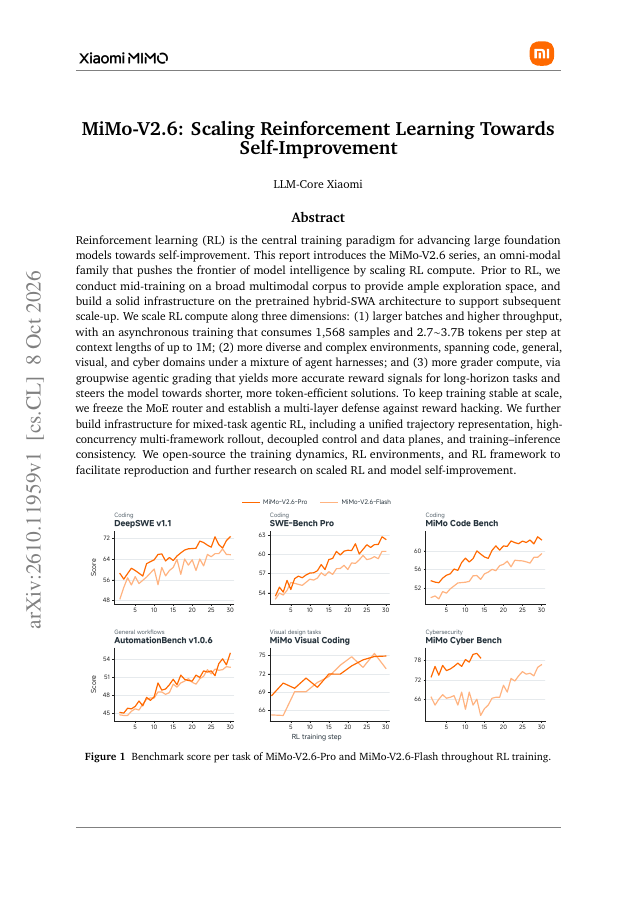
Reinforcement learning (RL) is the central training paradigm for advancing large foundation models towards self-improvement. This report introduces the MiMo-V2.6 series, an omni-modal family that pushes the frontier of model intelligence by scaling RL compute.
12 Oct 2026
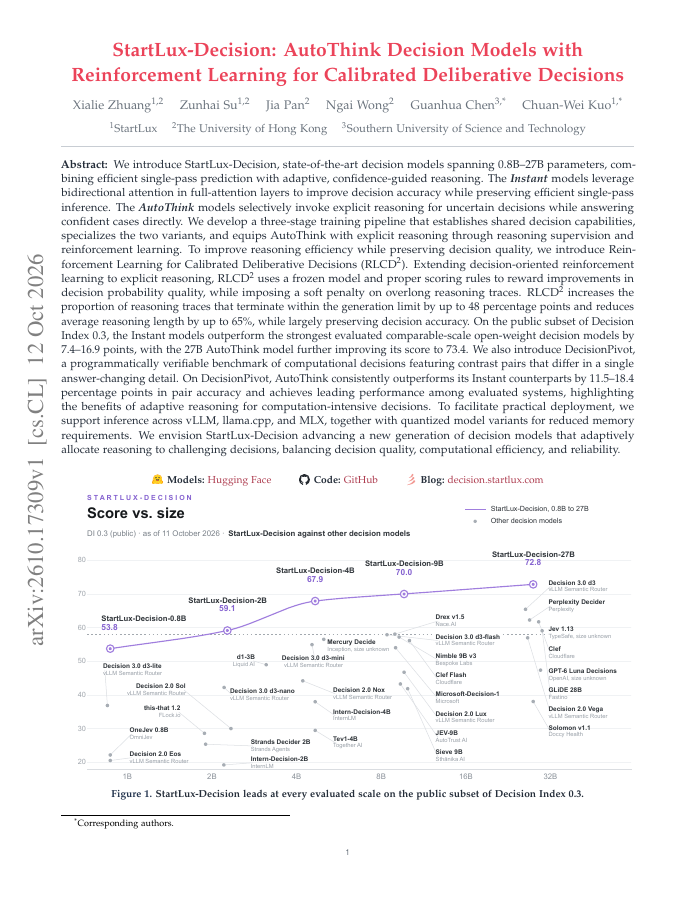
We introduce StartLux-Decision, decision models from 0.8B to 27B parameters that combine efficient single-pass prediction with adaptive, confidence-guided reasoning. The Instant models use bidirectional attention in full-attention layers to improve decision accuracy while…
15 Oct 2026
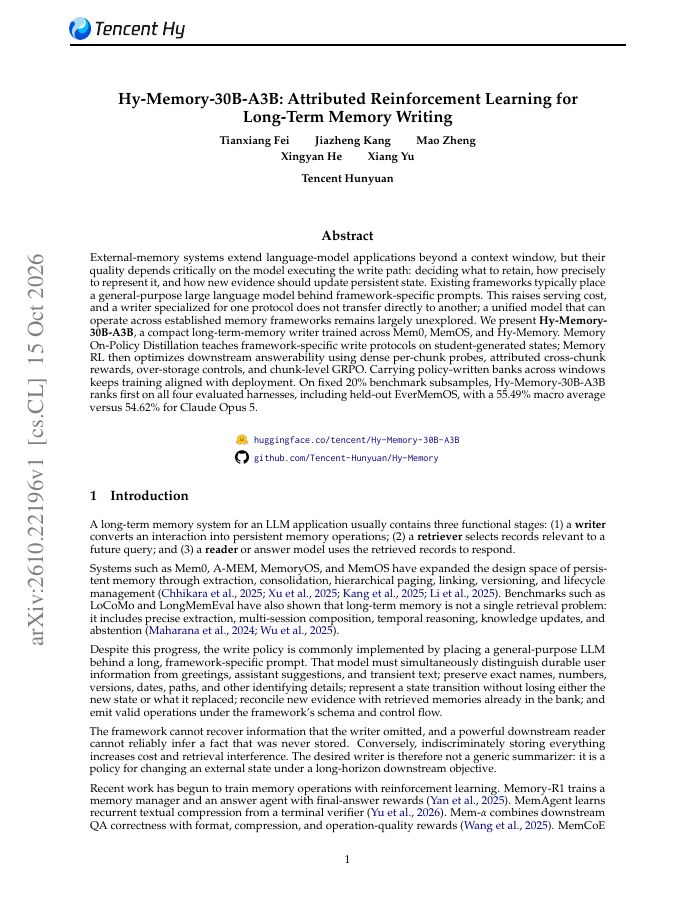
External-memory systems extend language-model applications beyond a context window, but their quality depends critically on the model executing the write path: deciding what to retain, how precisely to represent it, and how new evidence should update persistent state.
6 Oct 2026
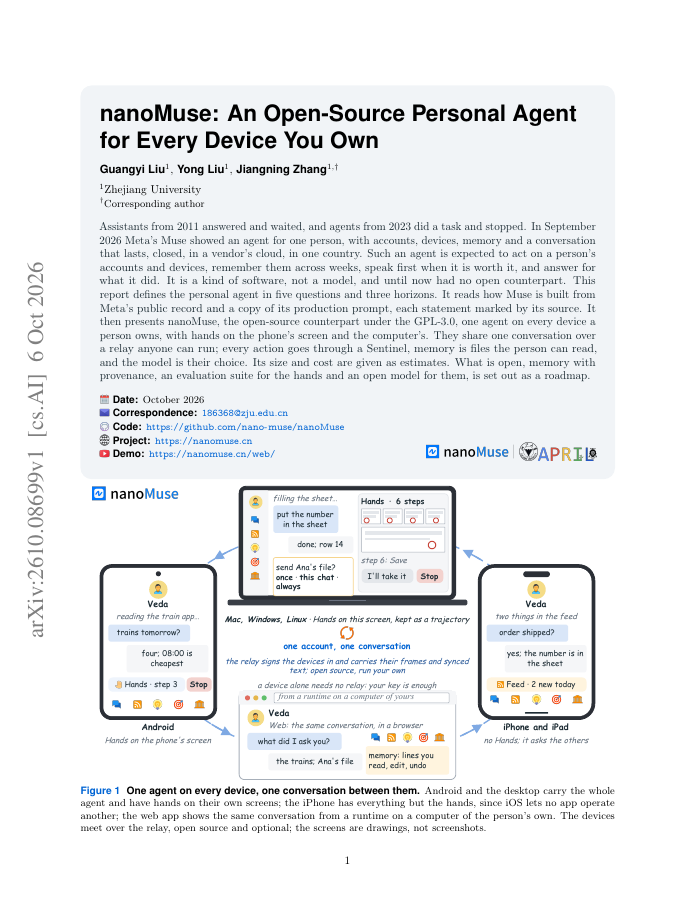
Assistants from 2011 answered and waited, and agents from 2023 did a task and stopped. In September 2026 Meta's Muse showed an agent for one person, with accounts, devices, memory and a conversation that lasts, closed, in a vendor's cloud, in one country.
27 Sep 2026
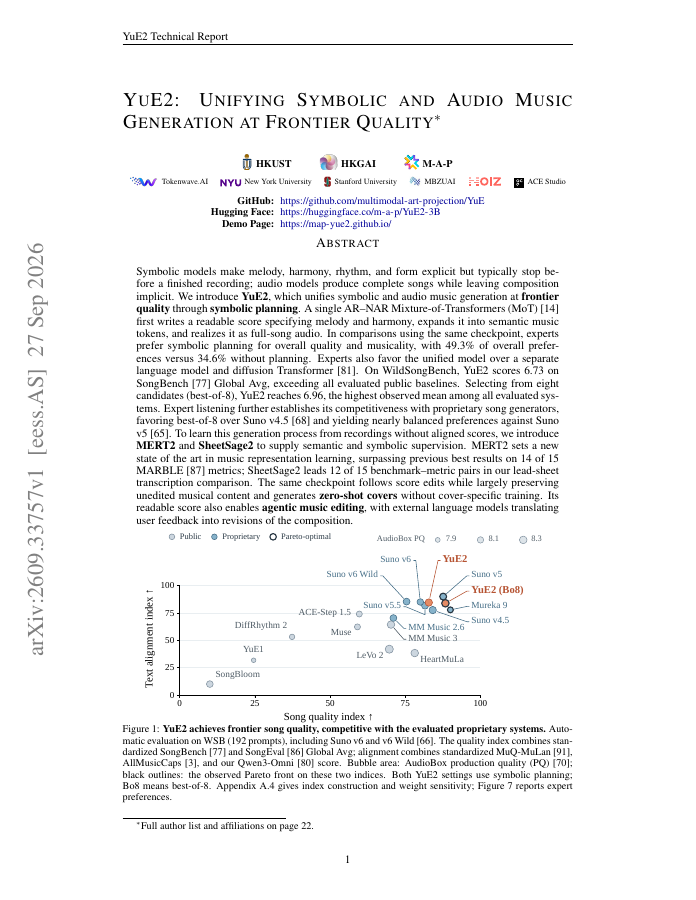
Symbolic models make melody, harmony, rhythm, and form explicit but typically stop before a finished recording; audio models produce complete songs while leaving composition implicit.
5 Oct 2026
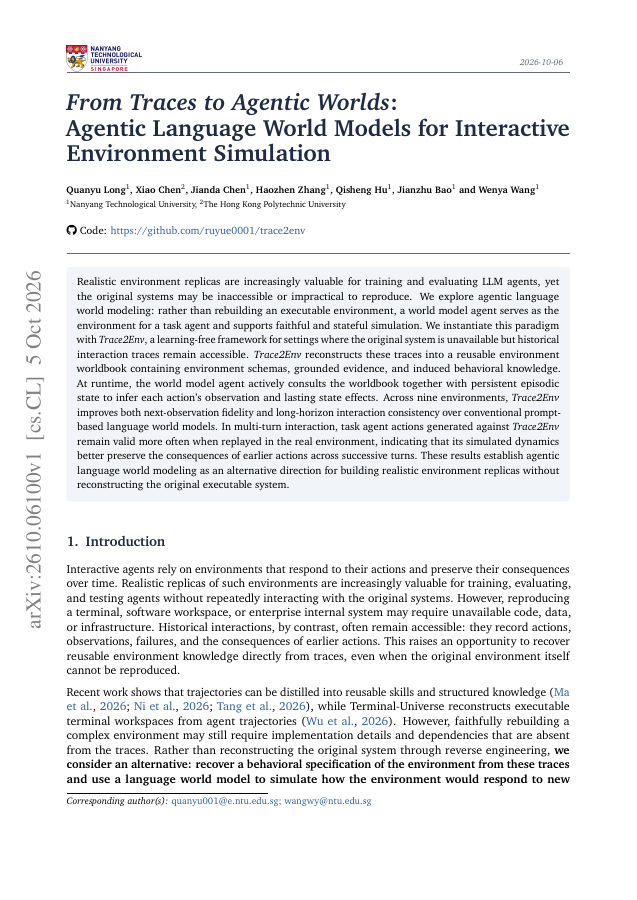
Realistic environment replicas are increasingly valuable for training and evaluating LLM agents, yet the original systems may be inaccessible or impractical to reproduce.
15 Oct 2026
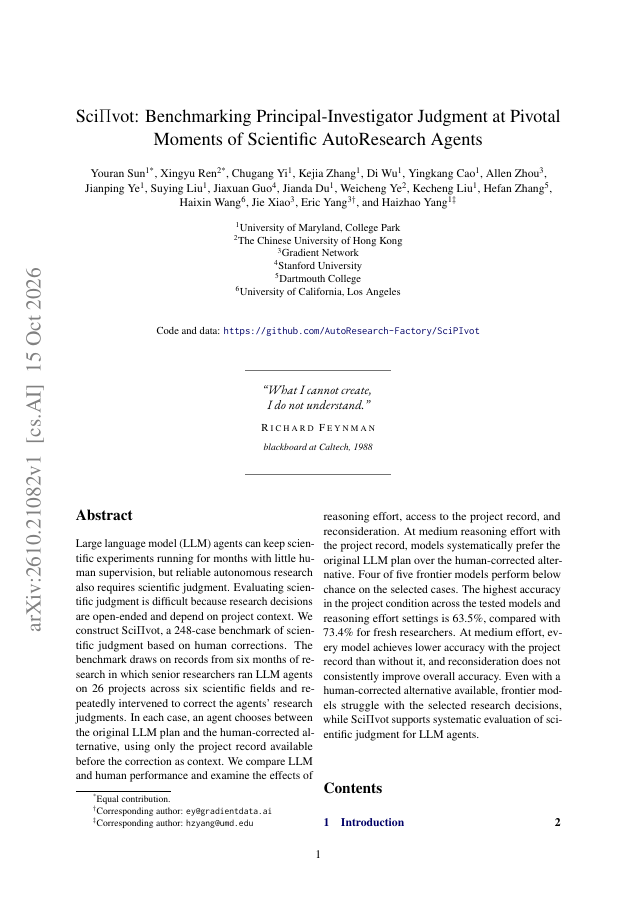
Large language model (LLM) agents can keep scientific experiments running for months with little human supervision, but reliable autonomous research also requires scientific judgment.
16 Oct 2026
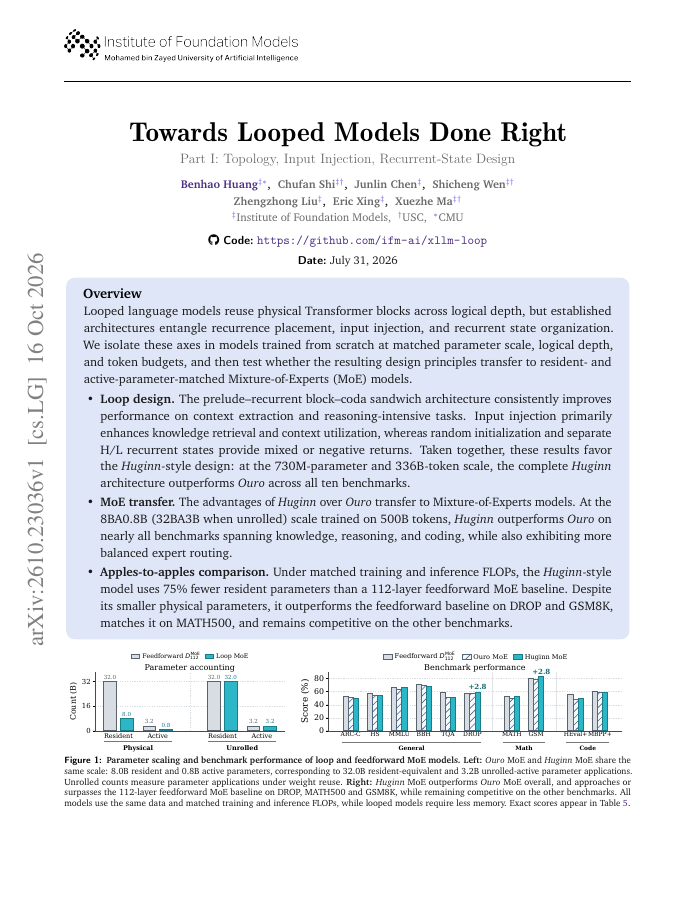
Looped language models reuse physical Transformer blocks across logical depth, but established architectures entangle recurrence placement, input injection, and recurrent state organization.
14 Oct 2026
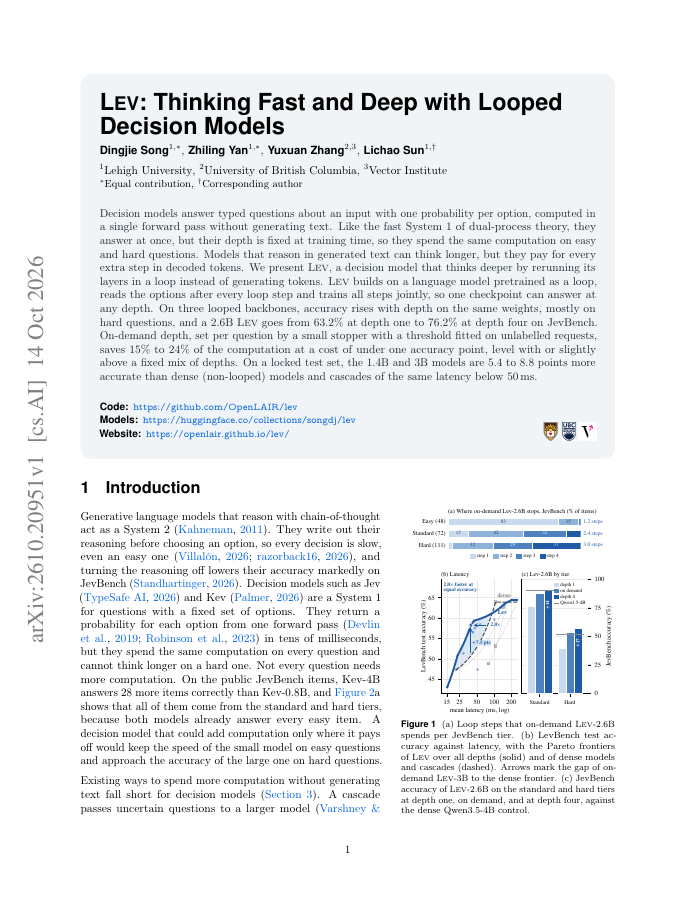
Decision models answer typed questions about an input with one probability per option, computed in a single forward pass without generating text. Like the fast System 1 of dual-process theory, they answer at once, but their depth is fixed at training time, so they spend the same…
13 Oct 2026
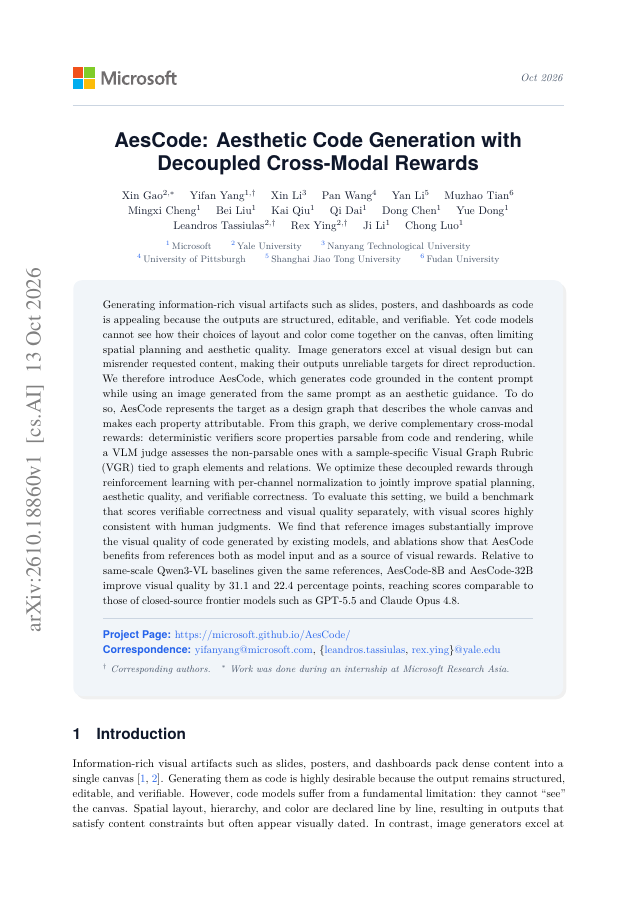
Generating information-rich visual artifacts such as slides, posters, and dashboards as code is appealing because the outputs are structured, editable, and verifiable. Yet code models cannot see how their choices of layout and color come together on the canvas, often limiting…
20 Oct 2026
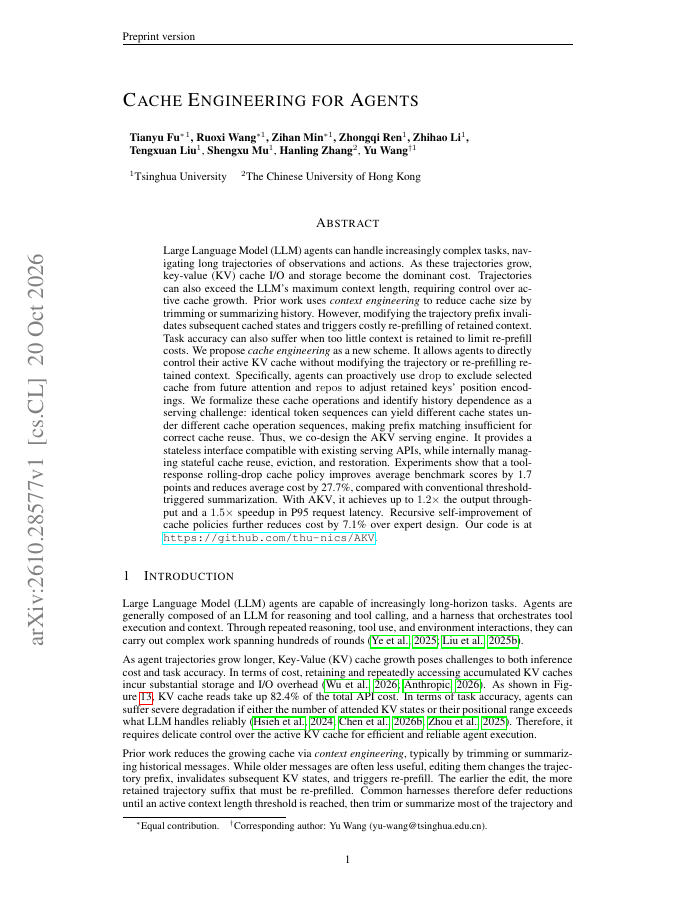
Large Language Model (LLM) agents can handle increasingly complex tasks, navigating long trajectories of observations and actions. As these trajectories grow, key-value (KV) cache I/O and storage become the dominant cost.
9 Oct 2026
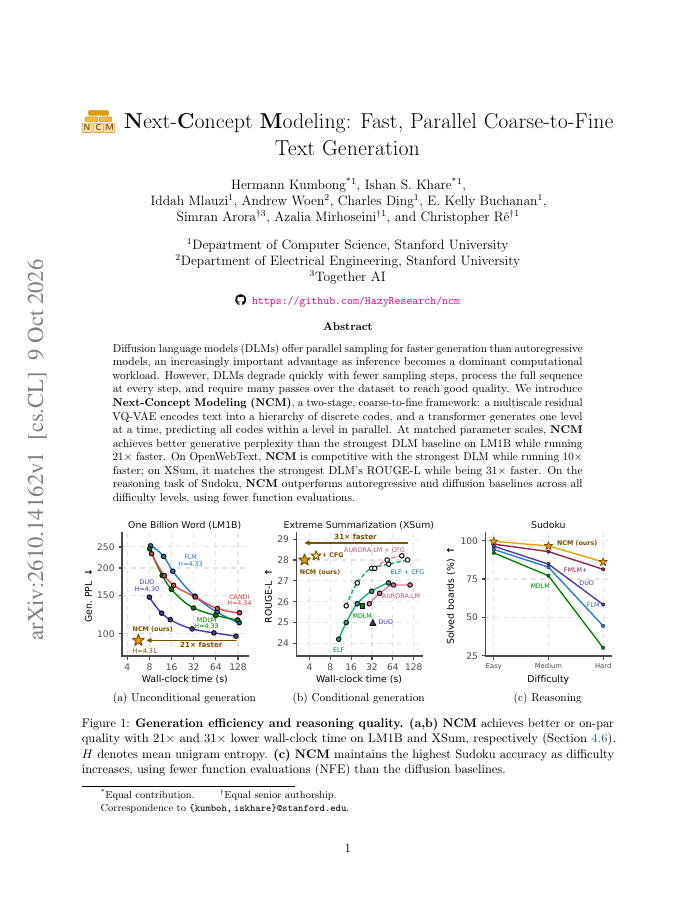
Diffusion language models (DLMs) offer parallel sampling for faster generation than autoregressive models, an increasingly important advantage as inference becomes a dominant computational workload.
19 Oct 2026
Harness development plays a crucial role in building capable AI agents. Recent approaches improve harnesses through recursive self-improvement (RSI), but their performance gains often come with higher execution costs.
8 Oct 2026
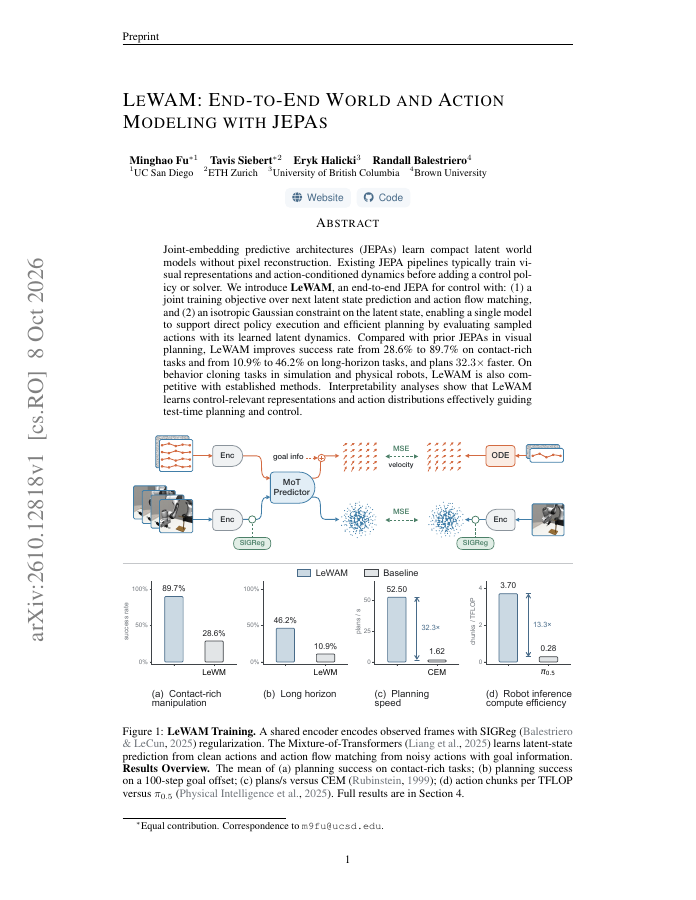
Joint-embedding predictive architectures (JEPAs) learn compact latent world models without pixel reconstruction. Existing JEPA pipelines typically train visual representations and action-conditioned dynamics before adding a control policy or solver.
16 Oct 2026
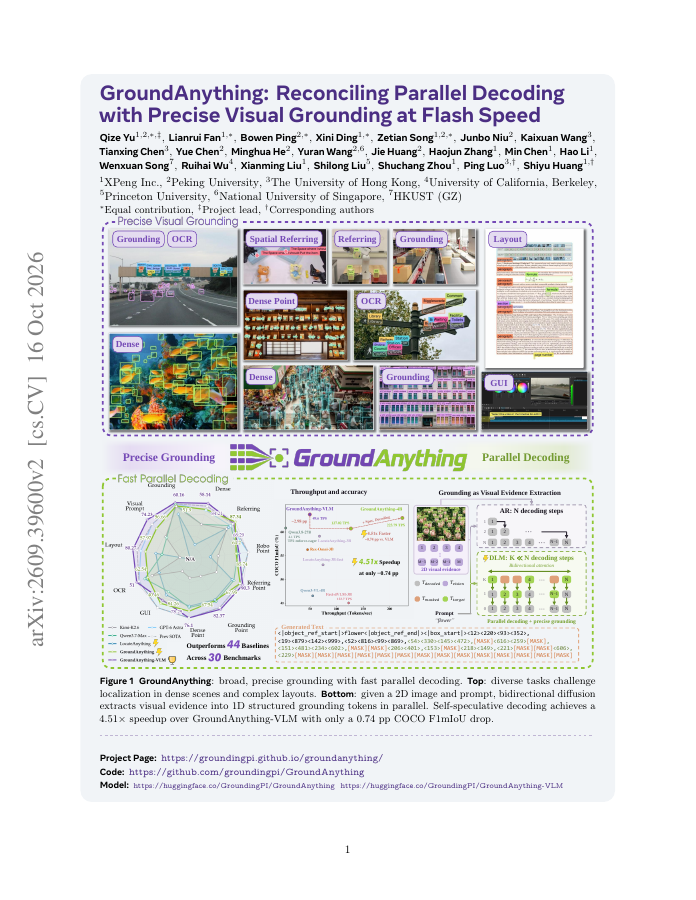
Autoregressive (AR) grounding models serialize spatial predictions, introducing sequential latency and imposing a causal order on output tokens. We view grounding as visual evidence extraction: objects, locations, and spatial relations are jointly constrained by the image and…
13 Oct 2026
We introduce Fish Audio Drama 3, an open-source speech generation model that turns text into directed performances, built on a 35B-parameter mixture-of-experts backbone that activates 3B parameters per token.
6 Oct 2026
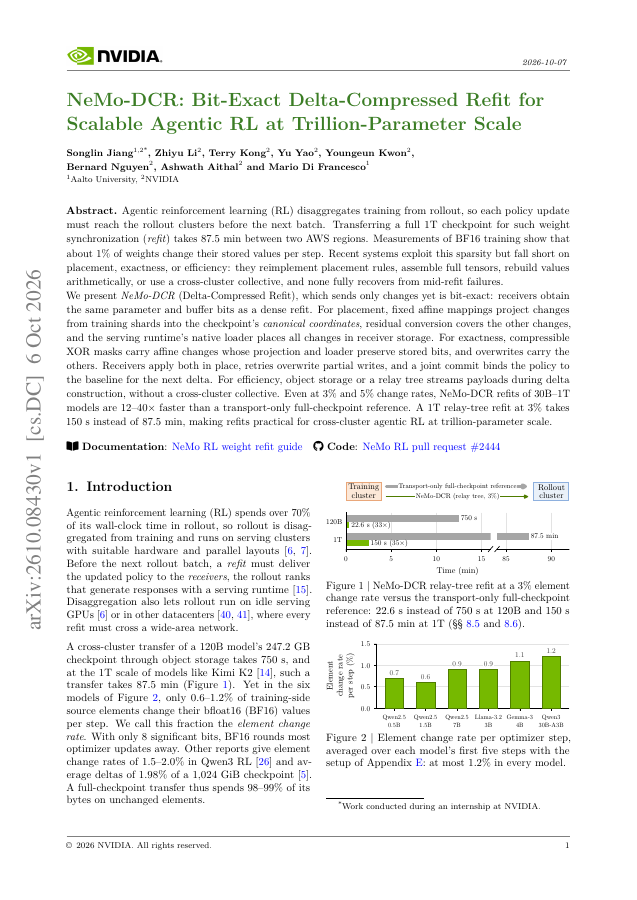
Agentic reinforcement learning (RL) disaggregates training from rollout, so each policy update must reach the rollout clusters before the next batch. Transferring a full 1T checkpoint for such weight synchronization (refit) takes 87.5 min between two AWS regions.
13 Oct 2026
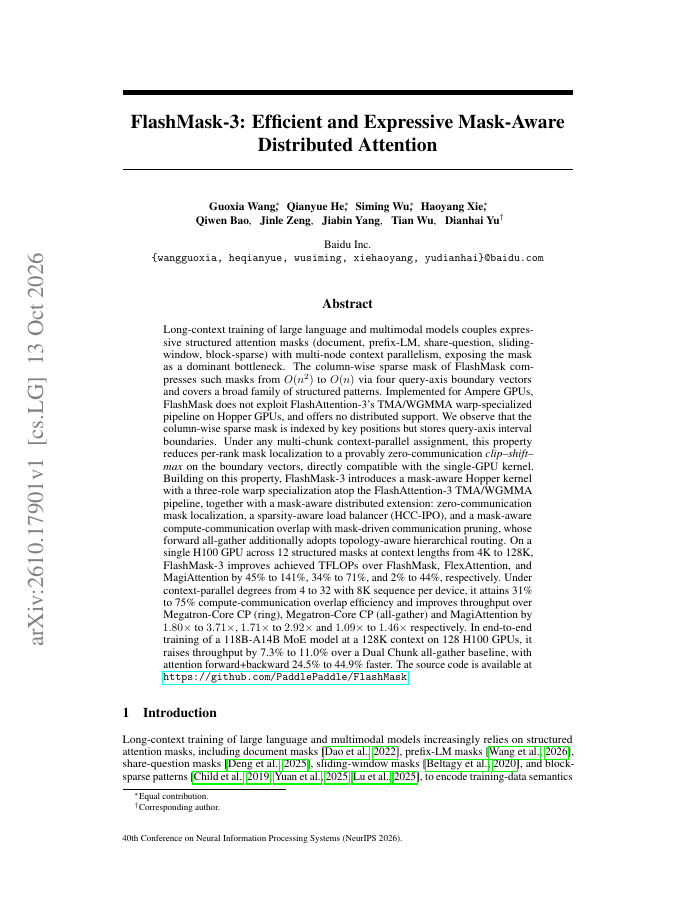
Long-context training of large language and multimodal models couples structured attention masks (document, prefix-LM, share-question, sliding-window, block-sparse) with multi-node context parallelism, making the mask a dominant bottleneck.
2 Oct 2026
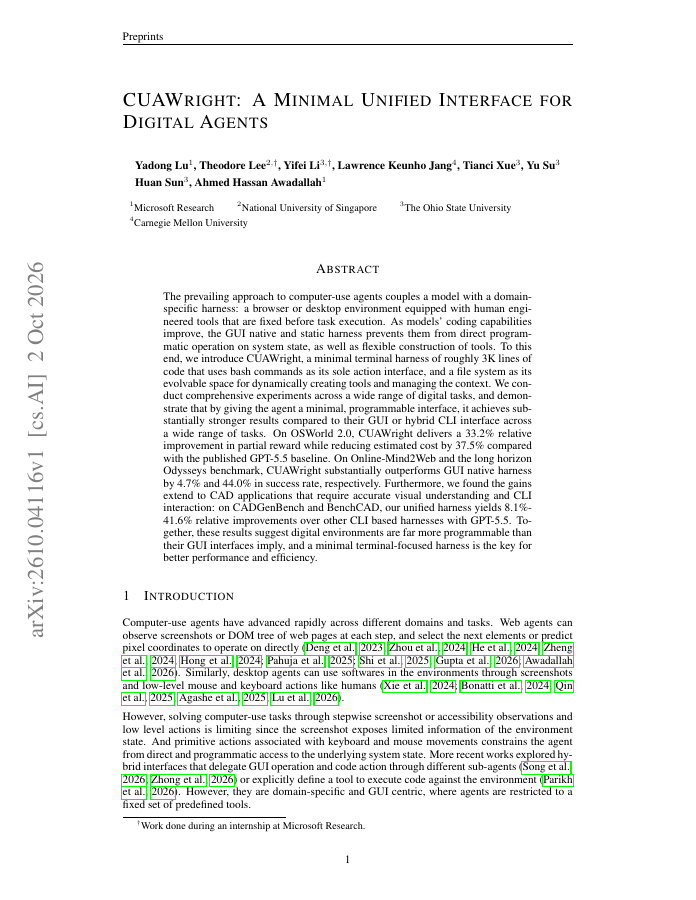
The prevailing approach to computer-use agents couples a model with a domain-specific harness: a browser or desktop environment equipped with human engineered tools that are fixed before task execution.
19 Oct 2026
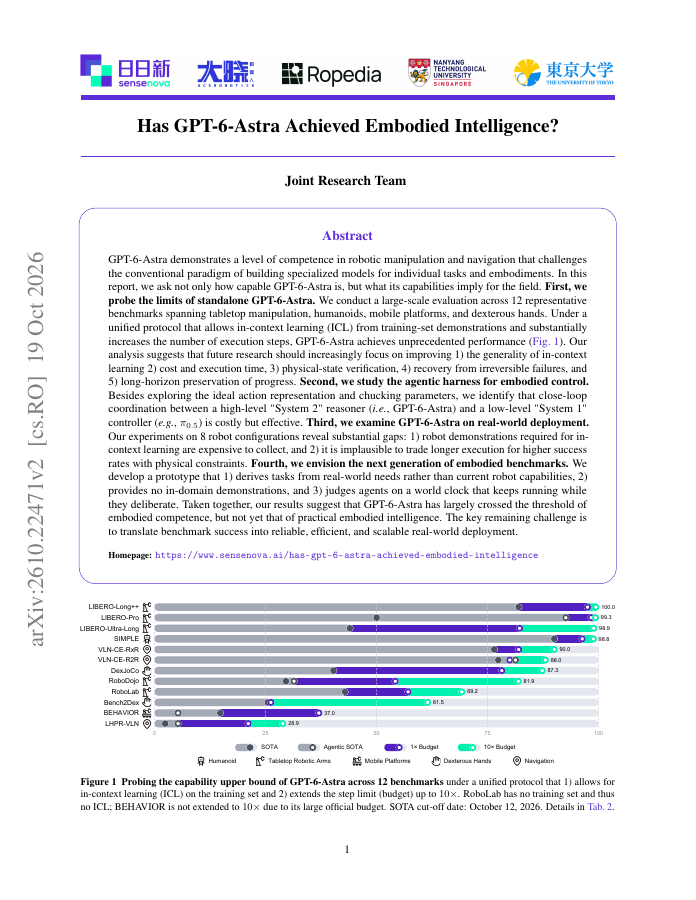
GPT-6-Astra demonstrates a level of competence in robotic manipulation and navigation that challenges the conventional paradigm of building specialized models for individual tasks and embodiments.
8 Oct 2026
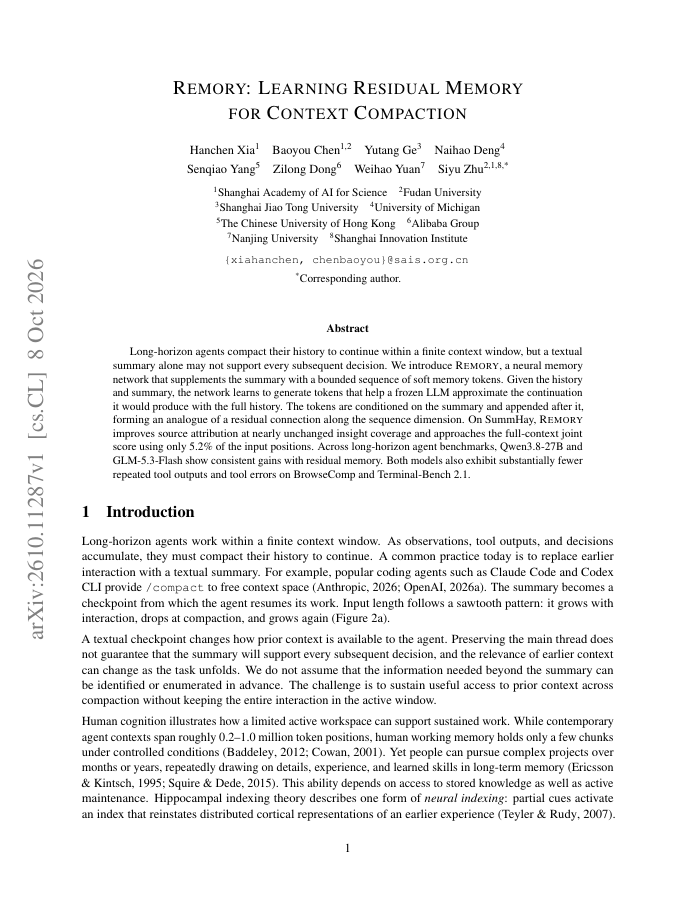
Long-horizon agents compact their history to continue within a finite context window, but a textual summary alone may not support every subsequent decision. We introduce REMORY, a neural memory network that supplements the summary with a bounded sequence of soft memory tokens.
27 Sep 2026
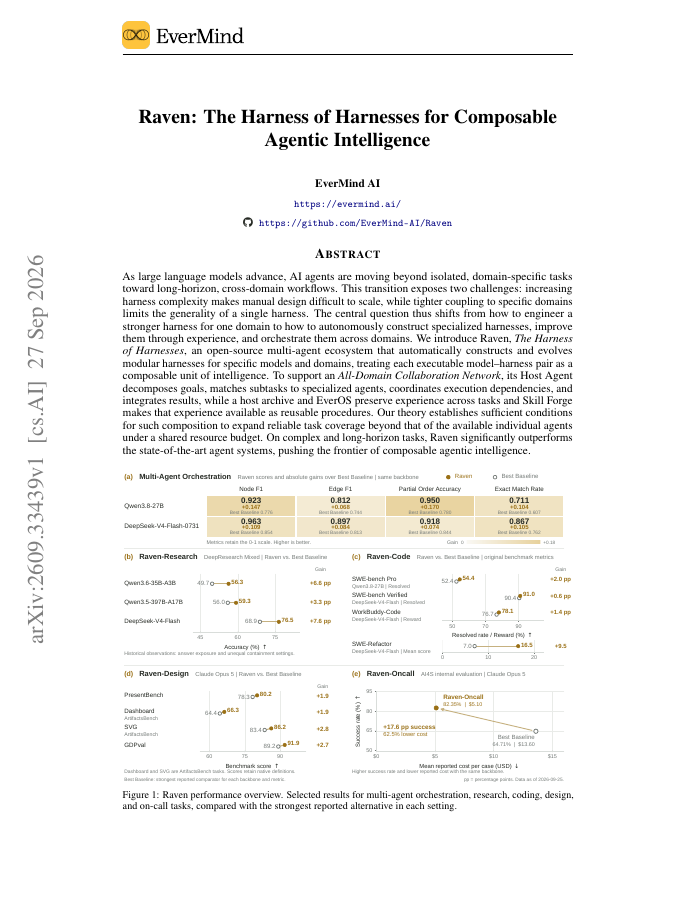
As large language models advance, AI agents are moving beyond isolated, domain-specific tasks toward long-horizon, cross-domain workflows. This transition exposes two challenges: increasing harness complexity makes manual design difficult to scale, while tighter coupling to…
19 Oct 2026
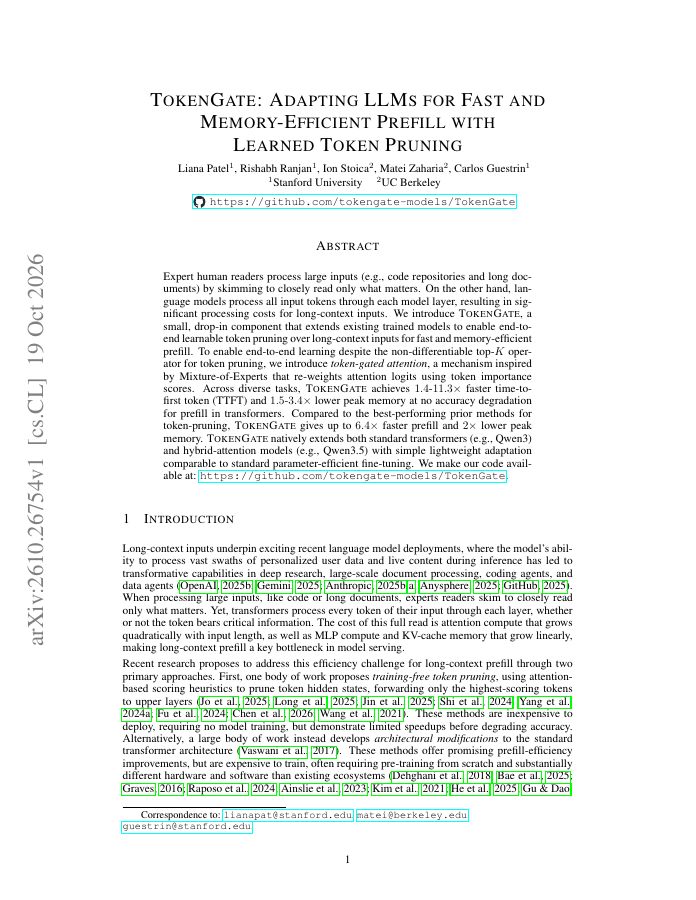
Expert human readers process large inputs (e.g., code repositories and long documents) by skimming to closely read only what matters. On the other hand, language models process all input tokens through each model layer, resulting in significant processing costs for long-context…