8 Sep 2026
We introduce AuK, an open-source foundational model that unifies speech generation and editing through a common interface of natural-language instructions and audio context.
Trending research and the full catalog - each paper linked to the benchmarks, methods, and models it introduces.
Filtering here covers the 2,000 most recent papers, as much as one page can hold in memory. See the full index of 22,059 papers.
8 Sep 2026
We introduce AuK, an open-source foundational model that unifies speech generation and editing through a common interface of natural-language instructions and audio context.
8 Sep 2026
We present Miles v0.1, a full-stack, production-ready system for frontier post-training. Building upon the clean design of slime, Miles designs each stage of the reinforcement-learning (RL) training loop around a single principle: components should be verified, clean, and…
8 Sep 2026
Monocular depth estimation is a ubiquitous yet highly ill-posed computer vision task, with downstream applications in scene reconstruction, computational photography, and robotics, among others.
6 Sep 2026
Sequential memory agents process long documents by reading chunks one after another while maintaining a compact memory state, coupling document traversal to reasoning depth.
8 Sep 2026
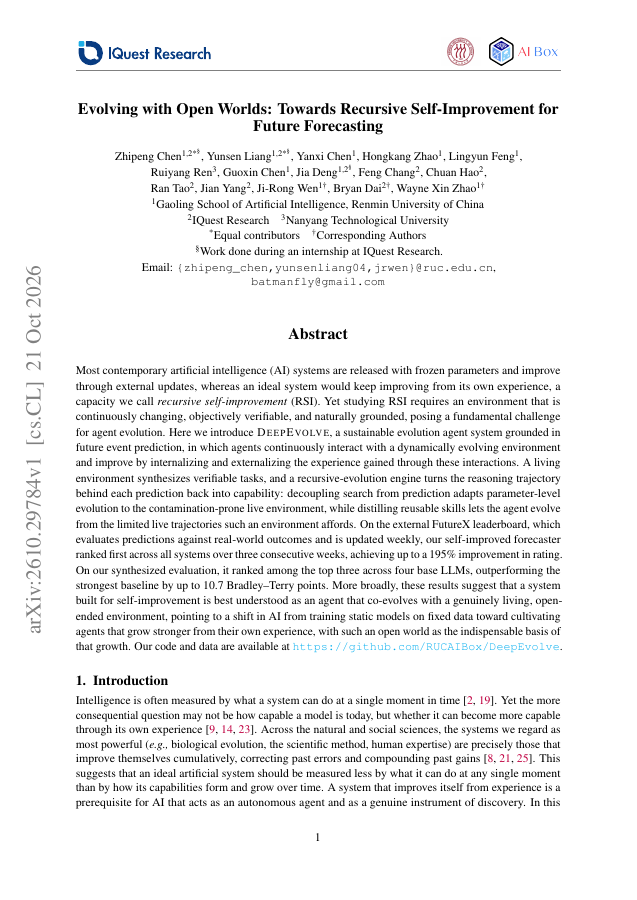
Recursive self-improvement (RSI) requires a concrete mechanism through which an AI system observes its capabilities and converts that evidence into the next round of learning.
8 Sep 2026
We study scheming in LLM agents, in which agents covertly pursue misaligned goals. Our focus is to understand how scheming arises from the interaction of key factors, such as instrumental goals, environmental affordances, oversight conditions, and perceived consequences.
5 Sep 2026
Large language models used for code editing can be trained and deployed in at least two output regimes: direct generation, where the model emits the entire modified file in one shot, and iterative diff-based generation ("steps"), where the model emits a sequence of…
6 Sep 2026
Recursive Super-Resolution (SR) extends fixed-scale SR to extreme magnification by repeatedly feeding predictions back into the same model, analogous to zooming an image repeatedly.
8 Sep 2026
While research on recursive self-improvement (RSI) has predominantly automated model training pipelines, reliable autonomous development demands a missing pillar: post-hoc monitoring and auditing to understand what models learn and ensure safe alignment.
8 Sep 2026
In this work, we present Gander, an end-to-end model that unifies omni perception, realtime interaction, and agentic capabilities within a single framework. In contrast to turn-based conventional paradigms, Gander continuously receives streaming inputs across multiple…
7 Sep 2026
Image relighting is traditionally tackled via complex inverse rendering pipelines, which suffer from ill-posed optimization, or single-image generative models that ignore crucial multi-view cues necessary for understanding 3D geometry and material interactions.
8 Sep 2026
Representing a 3D scene as multi-view images allows 2D VLMs to reason in 3D by reusing priors from pre-training, sidestepping the scarcity of annotated 3D data. However, it produces thousands of redundant visual tokens whose cost grows with every view.
6 Sep 2026
Latent visual reasoning aims to perform multimodal reasoning through hidden-state computation rather than explicit textual chains of thought. However, visual information being present in a latent state does not imply that the model actually relies on that state when producing…
7 Sep 2026
Linear attention is increasingly used in frontier language models for efficient long-context inference and constant-memory decoding. Its fixed-size recurrent memory, however, requires an online decision at each token: what to write and how strongly to overwrite existing…
8 Sep 2026
Weak-to-strong generalization asks whether stronger models can learn from weaker supervisors and surpass them. This question is particularly important for successive model generations and multi-domain consolidation, where repeating frontier-scale post-training from scratch can…
7 Sep 2026
The growing realism and accessibility of manipulated and generated faces threaten the trustworthiness of digital media. To detect such forgeries, deepfake detectors based on vision foundation models have shown promising performance, but they typically rely on a single pretrained…
8 Sep 2026
Large Language Models demonstrate remarkable proficiency in static reasoning, yet training them as autonomous agents through Reinforcement Learning (RL) for long-horizon tasks is often hindered by severe reward sparsity.
7 Sep 2026
Large language models (LLMs) are often post-trained on pre-collected reasoning trajectories to improve their reasoning capability. Such trajectories tend to be long due to complex, interwoven paths, which often include detours on the path toward the answer.
5 Sep 2026
We present Cadence, an error-bounded lossy compressor for numeric time series pairing a 330M-parameter time-series foundation model (Google TimesFM-3) with an adaptive arithmetic coder, guaranteeing $|\hat{x}_t-x_t|\leτ$ on every sample.
7 Sep 2026
Model misalignment, prompt injection, or operator misuse could lead AI agents operating frontier-lab accounts to exfiltrate model weights, poison training data, or weaken release gates.
8 Sep 2026
Ensuring the safety of autonomous driving is a critical challenge. Scenario-based testing is a systematic process used to validate Autonomous Driving Systems (ADSs), but it remains a fragmented modular pipeline in which scenario generation, retrieval, modification, ADS…
5 Sep 2026
As large language models (LLMs) are increasingly deployed in alignment-sensitive contexts, activation steering has emerged as a lightweight, inference-time alternative to fine-tuning methods (e.g., RLHF, DPO) for behavioral control.
8 Sep 2026
Reinforcement Learning with Verifiable Rewards (RLVR) has been central to the recent success of Large Reasoning Models. However, while RLVR significantly improves single-sample accuracy, it often fails to expand the model's intrinsic reasoning coverage (pass@k) due to limited…
6 Sep 2026
Training strategy, namely whether to retrain from scratch or fine-tune from the previous checkpoint, is an overlooked decision variable in active learning. We show that this choice has exploitable structure: retraining is most useful in early rounds, when each batch can…