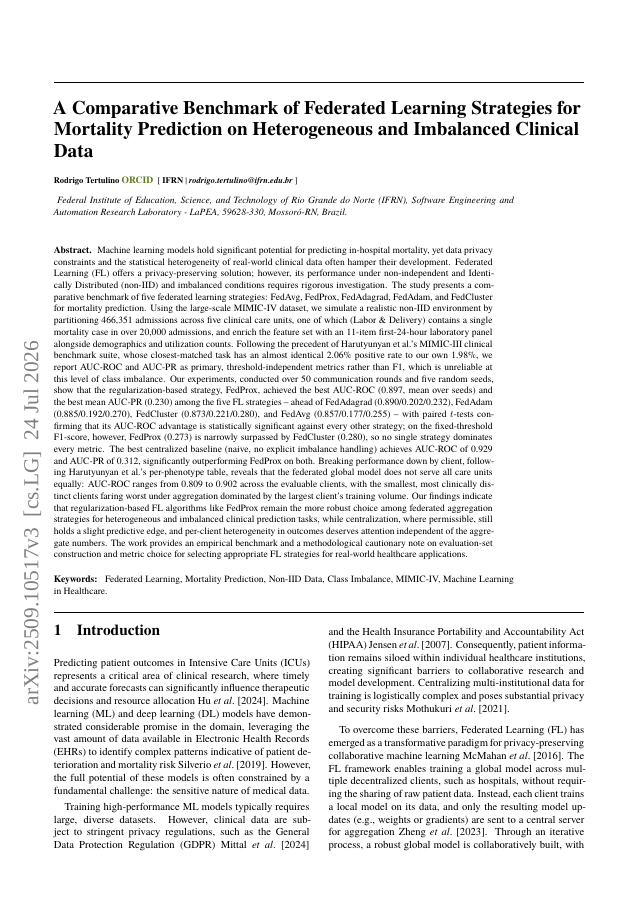
Machine learning can predict in-hospital mortality, but data privacy and the statistical heterogeneity of clinical data hamper its use. Federated Learning (FL) is privacy-preserving, yet its behavior under non-IID and imbalanced conditions needs scrutiny. We benchmark five FL strategies - FedAvg, FedProx, FedAdagrad, FedAdam, and FedCluster - for mortality prediction on the MIMIC-IV dataset, partitioning 466,351 admissions across five care units to induce a realistic non-IID setting and enriching the features with an 11-item first-24-hour laboratory panel. At a prevalence of 1.98%, we adopt AUC-ROC and AUC-PR as primary, threshold-independent metrics rather than F1. Over 50 rounds and five random seeds, FedProx attains the best AUC-ROC (0.897) and mean AUC-PR (0.230), with paired t-tests confirming its AUC-ROC lead is significant against every other strategy; on F1, however, FedCluster (0.280) narrowly surpasses FedProx (0.273), so no single strategy dominates every metric. The best centralized baseline achieves AUC-ROC and AUC-PR of 0.929 and 0.312, respectively, significantly outperforming FedProx on both. A per-client breakdown shows the global model does not serve all care units equally (AUC-ROC 0.809-0.902), with the smallest, most clinically distinct clients faring worst. We conclude that regularization-based methods such as FedProx are the more robust federated choice, while centralization retains a slight predictive edge, and that per-client heterogeneity and evaluation-set construction deserve attention independent of aggregate numbers.
A Comparative Benchmark of Federated Learning Strategies for Mortality Prediction on Heterogeneous and Imbalanced Clinical Data
Machine learning can predict in-hospital mortality, but data privacy and the statistical heterogeneity of clinical data hamper its use. Federated Learning (FL) is privacy-preserving, yet its behavior under non-IID and imbalanced conditions needs scrutiny.
- Preview
- Year
- 2025
- Hosting
- Full text hostedCC-BY-4.0
Cite
Notes
Only stored in your browser.
Attribution
- Abstract & full text
- arxiv.org/abs/2509.10517CC-BY-4.0
- TL;DR
- Semantic Scholar