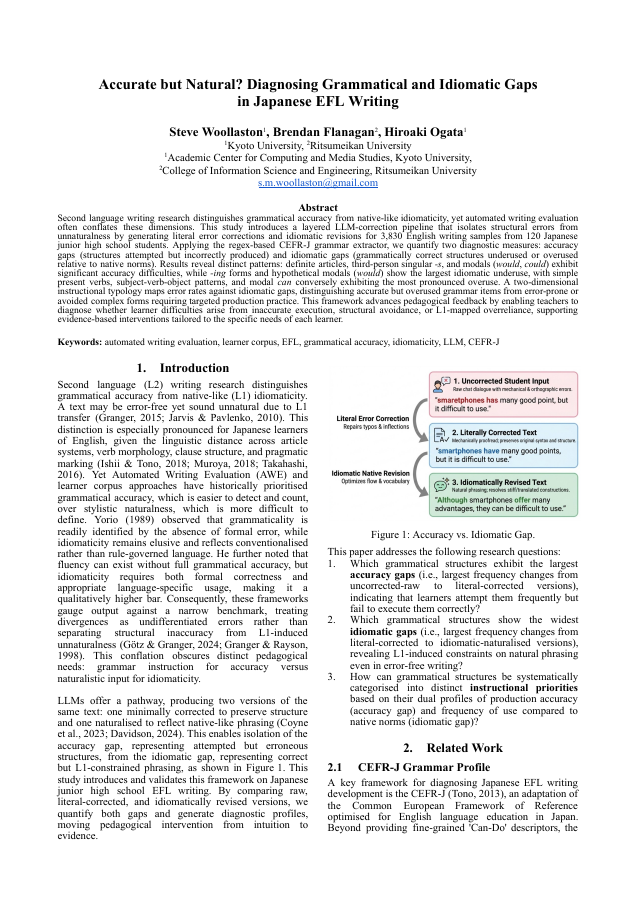
Second language writing research distinguishes grammatical accuracy from native-like idiomaticity, yet automated writing evaluation often conflates these dimensions. This study introduces a layered LLM-correction pipeline that isolates structural errors from unnaturalness by generating literal error corrections and idiomatic revisions for 3,830 English writing samples from 120 Japanese junior high school students. Applying the regex-based CEFR-J grammar extractor, we quantify two diagnostic measures: accuracy gaps (structures attempted but incorrectly produced) and idiomatic gaps (grammatically correct structures underused or overused relative to native norms). Results reveal distinct patterns: definite articles, third-person singular -s, and modals (would, could) exhibit significant accuracy difficulties, while -ing forms and hypothetical modals (would) show the largest idiomatic underuse, with simple present verbs, subject-verb-object patterns, and modal can conversely exhibiting the most pronounced overuse. A two-dimensional instructional typology maps error rates against idiomatic gaps, distinguishing accurate but overused grammar items from error-prone or avoided complex forms requiring targeted production practice. This framework advances pedagogical feedback by enabling teachers to diagnose whether learner difficulties arise from inaccurate execution, structural avoidance, or L1-mapped overreliance, supporting evidence-based interventions tailored to the specific needs of each learner.
Accurate but Natural? Diagnosing Grammatical and Idiomatic Gaps in Japanese EFL Writing
Second language writing research distinguishes grammatical accuracy from native-like idiomaticity, yet automated writing evaluation often conflates these dimensions. This study introduces a layered LLM-correction pipeline that isolates structural errors from unnaturalness by…
- Preview
- Year
- 2026
- Hosting
- Abstract onlyARXIV-DEFAULT
Cite
Notes
Only stored in your browser.
Attribution
- Abstract & full text
- arxiv.org/abs/2608.09289ARXIV-DEFAULT
- TL;DR
- Semantic Scholar