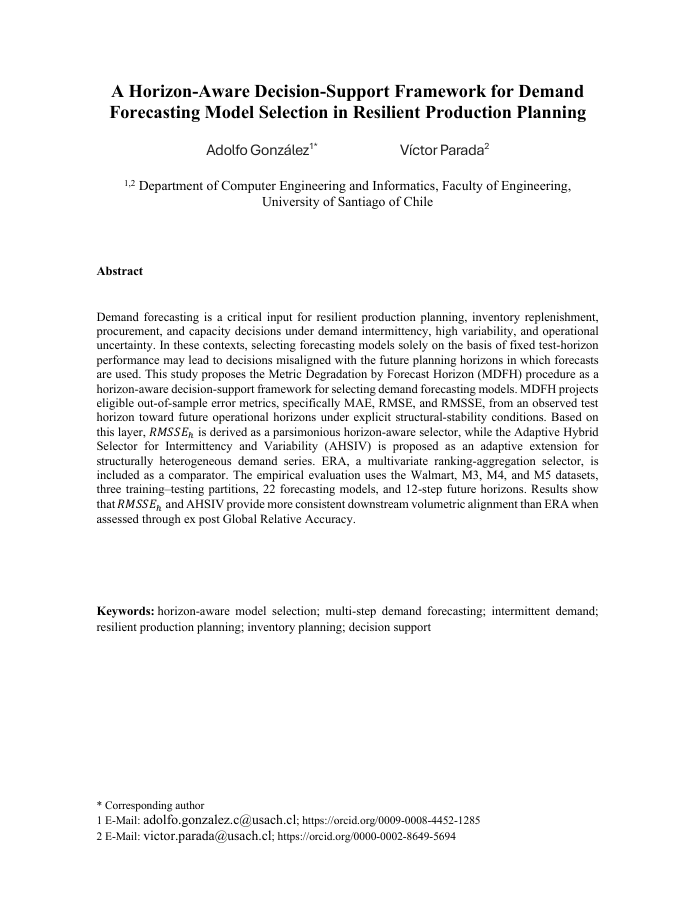
Demand forecasting is critical for inventory planning, procurement, replenishment, production, and capacity decisions in heterogeneous supply chains. However, selecting the most appropriate model for each demand series remains challenging because performance varies across datasets, demand structures, horizons, and evaluation metrics. This study proposes the Adaptive Hybrid Selector (AHS), an automatic model-selection rule that combines observed predictive performance with structural demand information. AHS uses demand frequency and series variability to activate a hierarchical logic based on RMSSE, MAE, sMAPE, and BIAS. The proposed selector is compared with Overall Weighted Average (OWA), a benchmark-relative criterion based on sMAPE and MASE, and Equilibrium Ranking Aggregation (ERA), a comparator based on MAE, RMSE, and R^2 rankings. The empirical evaluation uses the Walmart, M3, M4, and M5 datasets, three training-testing partitions, 22 forecasting models, and horizons of up to 12 cycles. Selector performance is assessed ex post using Global Relative Accuracy (GRA), interpreted as an indicator of volumetric coherence between accumulated forecasted demand and observed demand. Results show that AHS provides the most robust overall behavior, especially in M5, while OWA remains competitive in more regular datasets. ERA shows lower volumetric coherence in most configurations. These findings suggest that automatic model selection should account for demand structure and be evaluated using ex post indicators of volumetric coherence.
Adaptive Automatic Model Selection for Demand Forecasting under Heterogeneous Demand Patterns
Demand forecasting is critical for inventory planning, procurement, replenishment, production, and capacity decisions in heterogeneous supply chains. However, selecting the most appropriate model for each demand series remains challenging because performance varies across…
- Preview
- Year
- 2026
- Hosting
- Excerpt onlyCC-BY-NC-4.0
Cite
Notes
Only stored in your browser.
Attribution
- Abstract & full text
- arxiv.org/abs/2602.13939CC-BY-NC-4.0
- TL;DR
- Semantic Scholar