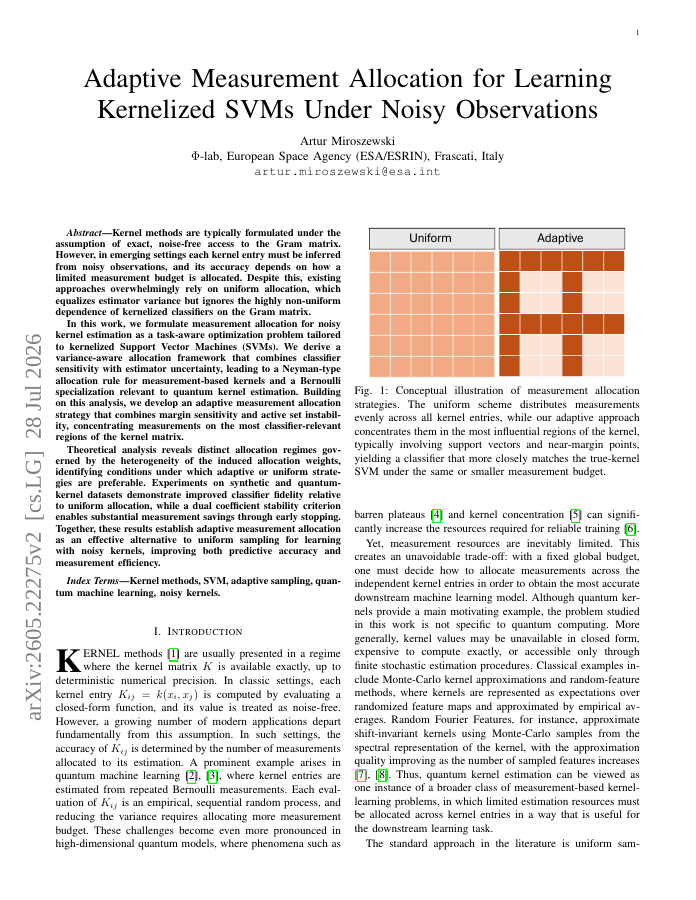
Kernel methods are typically formulated under the assumption of exact, noise-free access to the Gram matrix. However, in emerging settings each kernel entry must be inferred from noisy observations, and its accuracy depends on how a limited measurement budget is allocated. Despite this, existing approaches overwhelmingly rely on uniform allocation, which equalizes estimator variance but ignores the highly non-uniform dependence of kernelized classifiers on the Gram matrix. In this work, we formulate measurement allocation for noisy kernel estimation as a task-aware optimization problem tailored to kernelized Support Vector Machines (SVMs). We derive a variance-aware allocation framework that combines classifier sensitivity with estimator uncertainty, leading to a Neyman-type allocation rule for measurement-based kernels and a Bernoulli specialization relevant to quantum kernel estimation. Building on this analysis, we develop an adaptive measurement allocation strategy that combines margin sensitivity and active set instability, concentrating measurements on the most classifier-relevant regions of the kernel matrix. Theoretical analysis reveals distinct allocation regimes governed by the heterogeneity of the induced allocation weights, identifying conditions under which adaptive or uniform strategies are preferable. Experiments on synthetic and quantum-kernel datasets demonstrate improved classifier fidelity relative to uniform allocation, while a dual coefficient stability criterion enables substantial measurement savings through early stopping. Together, these results establish adaptive measurement allocation as an effective alternative to uniform sampling for learning with noisy kernels, improving both predictive accuracy and measurement efficiency.
Adaptive Measurement Allocation for Learning Kernelized SVMs Under Noisy Observations
Kernel methods are typically formulated under the assumption of exact, noise-free access to the Gram matrix. However, in emerging settings each kernel entry must be inferred from noisy observations, and its accuracy depends on how a limited measurement budget is allocated.
- Preview
- Year
- 2026
- Hosting
- Full text hostedCC-BY-4.0
Cite
Notes
Only stored in your browser.
Attribution
- Abstract & full text
- arxiv.org/abs/2605.22275CC-BY-4.0
- TL;DR
- Semantic Scholar