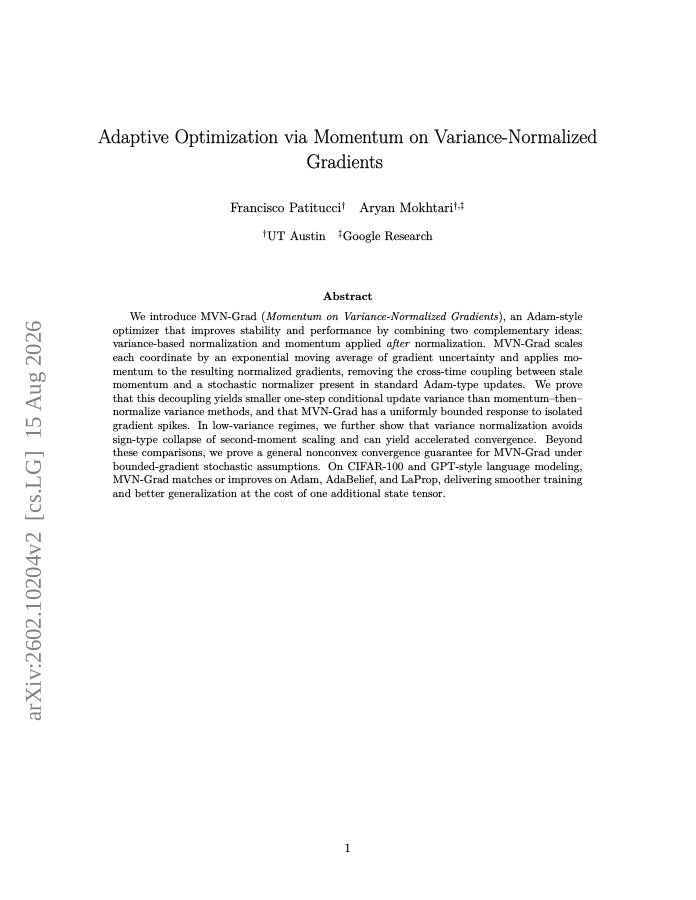
We introduce MVN-Grad (Momentum on Variance-Normalized Gradients), an Adam-style optimizer that improves stability and performance by combining two complementary ideas: variance-based normalization and momentum applied after normalization. MVN-Grad scales each coordinate by an exponential moving average of gradient uncertainty and applies momentum to the resulting normalized gradients, removing the cross-time coupling between stale momentum and a stochastic normalizer present in standard Adam-type updates. We prove that this decoupling yields smaller one-step conditional update variance than momentum-then-normalize variance methods, and that MVN-Grad has a uniformly bounded response to isolated gradient spikes. In low-variance regimes, we further show that variance normalization avoids sign-type collapse of second-moment scaling and can yield accelerated convergence. Beyond these comparisons, we prove a general nonconvex convergence guarantee for MVN-Grad under bounded-gradient stochastic assumptions. On CIFAR-100 and GPT-style language modeling, MVN-Grad matches or improves on Adam, AdaBelief, and LaProp, delivering smoother training and better generalization at the cost of one additional state tensor.
Adaptive Optimization via Momentum on Variance-Normalized Gradients
We introduce MVN-Grad (Momentum on Variance-Normalized Gradients), an Adam-style optimizer that improves stability and performance by combining two complementary ideas: variance-based normalization and momentum applied after normalization.
- Preview
- Year
- 2026
- Hosting
- Abstract onlyARXIV-DEFAULT
Cite
Notes
Only stored in your browser.
Attribution
- Abstract & full text
- arxiv.org/abs/2602.10204ARXIV-DEFAULT
- TL;DR
- Semantic Scholar