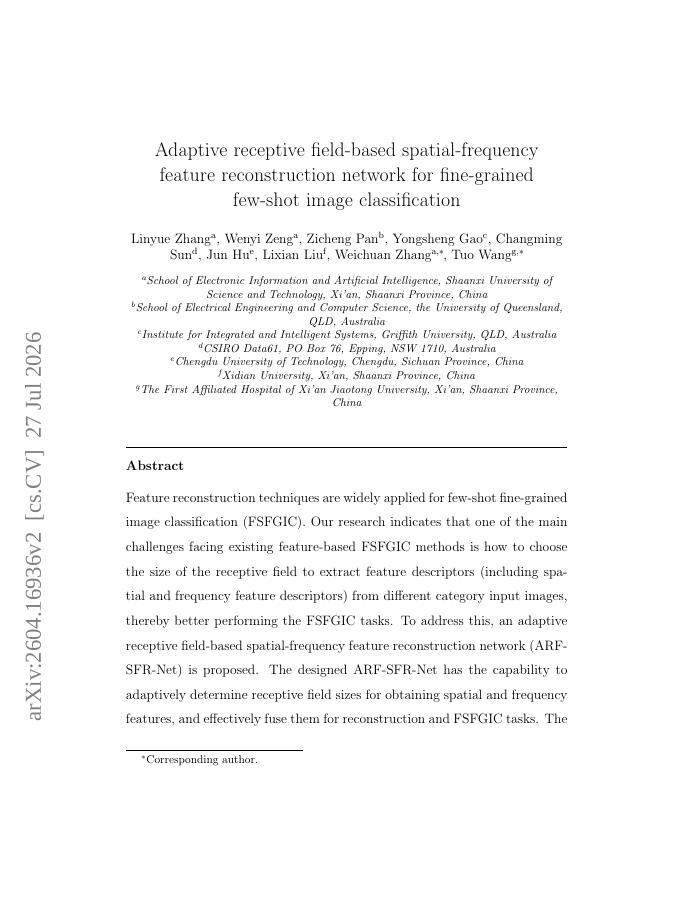
Feature reconstruction techniques are widely applied for few-shot fine-grained image classification (FSFGIC). Our research indicates that one of the main challenges facing existing feature-based FSFGIC methods is how to choose the size of the receptive field to extract feature descriptors (including spatial and frequency feature descriptors) from different category input images, thereby better performing the FSFGIC tasks. To address this, an adaptive receptive field-based spatial-frequency feature reconstruction network (ARF-SFR-Net) is proposed. The designed ARF-SFR-Net has the capability to adaptively determine receptive field sizes for obtaining spatial and frequency features, and effectively fuse them for reconstruction and FSFGIC tasks. The designed ARF-SFR-Net can be easily embedded into a given episodic training mechanism for end-to-end training from scratch. Extensive experiments on multiple FSFGIC benchmarks demonstrate the effectiveness and superiority of the proposed ARF-SFR-Net over state-of-the-art approaches. The code is available at: https://github.com/ICL-SUST/ARF-SFR-Net.
Adaptive receptive field-based spatial-frequency feature reconstruction network for fine-grained few-shot image classification
Feature reconstruction techniques are widely applied for few-shot fine-grained image classification (FSFGIC). Our research indicates that one of the main challenges facing existing feature-based FSFGIC methods is how to choose the size of the receptive field to extract feature…
- Preview
- Year
- 2026
- Hosting
- Abstract onlyARXIV-DEFAULT
Cite
Notes
Only stored in your browser.
Attribution
- Abstract & full text
- arxiv.org/abs/2604.16936ARXIV-DEFAULT
- TL;DR
- Semantic Scholar