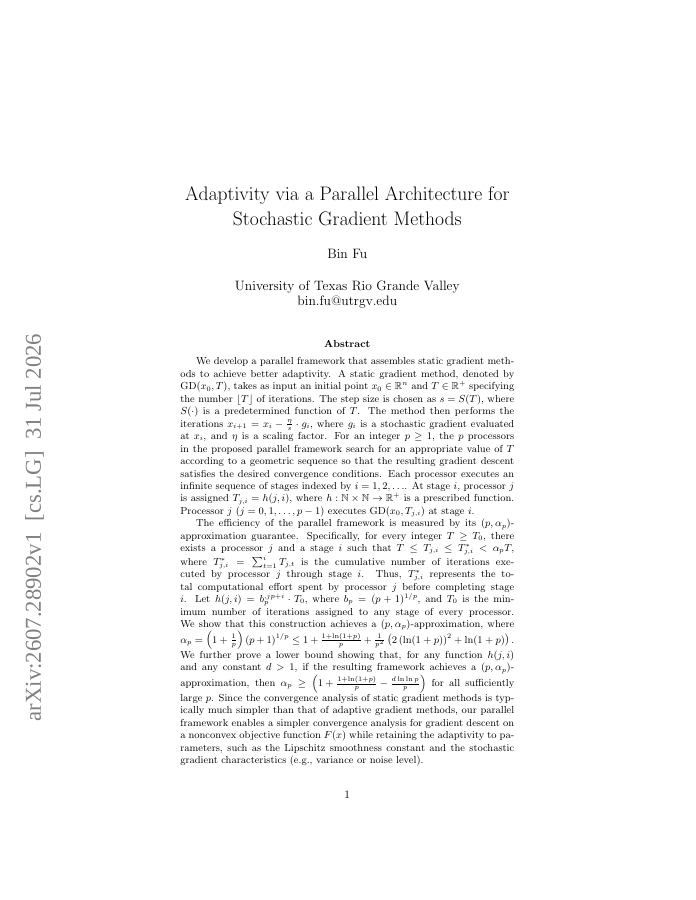
We develop a parallel framework that assembles static gradient methods to achieve better adaptivity. A static gradient method, denoted by GD(x_0,T), takes as input an initial point x_0\in\mathbb{R}^n and T\in \mathbb{R}^+ specifying the number \floor{T} of iterations. The step size is chosen as s=S(T), where S(\cdot) is a predetermined function of T. The method then performs the iterations x_{i+1}=x_i-\fracη{s}\cdot g_i, where g_i is a stochastic gradient evaluated at x_i, and η is a scaling factor. For an integer p\ge1, the p processors in the proposed parallel framework search for an appropriate value of T according to a geometric sequence so that the resulting gradient descent satisfies the desired convergence conditions. Each processor executes an infinite sequence of stages indexed by i=1,2,\ldots. At stage i, processor j is assigned T_{j,i}=h(j,i), where h:\mathbb{N}\times\mathbb{N} \rightarrow\mathbb{R}^{+} is a prescribed function. Processor j (j=0,1,\ldots,p-1) executes GD(x_0, T_{j,i}) at stage i.
Adaptivity via a Parallel Architecture for Stochastic Gradient Methods
We develop a parallel framework that assembles static gradient methods to achieve better adaptivity. A static gradient method, denoted by $\mathrm{GD}(x_0,T)$, takes as input an initial point $x_0\in\mathbb{R}^n$ and $T\in \mathbb{R}^+$ specifying the number $\floor{T}$ of…
- Preview
- Year
- 2026
- Hosting
- Abstract onlyARXIV-DEFAULT
Cite
Notes
Only stored in your browser.
Attribution
- Abstract & full text
- arxiv.org/abs/2607.28902ARXIV-DEFAULT
- TL;DR
- Semantic Scholar