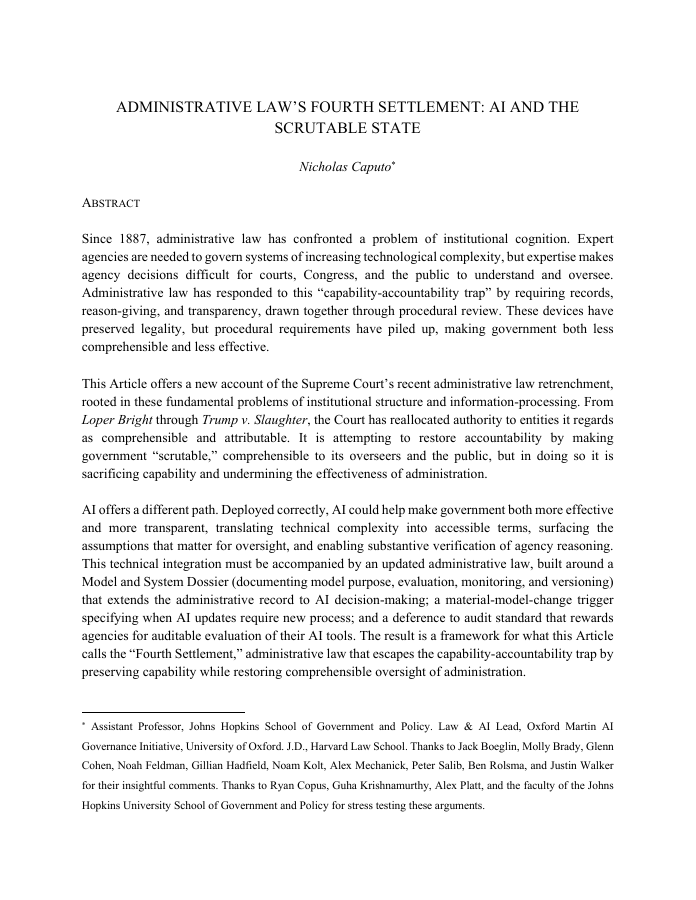
Since 1887, administrative law has confronted a problem of institutional cognition. Expert agencies are needed to govern technologically complex systems, but expertise makes agency decisions difficult for courts, Congress, and the public to understand and oversee. Administrative law has responded to this "capability-accountability trap" by requiring records, reason-giving, and transparency, drawn together through procedural review. These devices have preserved legality but have piled up, making government both less comprehensible and less effective. This Article offers a new account of the Supreme Court's recent administrative law retrenchment, rooted in problems of institutional structure and information-processing. From Loper Bright through Trump v. Slaughter, the Court has reallocated authority to entities it regards as comprehensible and attributable. It is attempting to restore accountability by making government "scrutable," comprehensible to its overseers and the public, but in doing so it is sacrificing capability and undermining the effectiveness of administration. AI offers a different path. Deployed correctly, AI could help make government both more effective and more transparent, translating technical complexity into accessible terms, surfacing assumptions, and enabling substantive verification of agency reasoning. This technical integration must be accompanied by updated administrative law, built around a Model and System Dossier that extends the administrative record to AI decision-making; a material-model-change trigger specifying when AI updates require new process; and a deference to audit standard that rewards agencies for auditable evaluation of AI uses. The result a "Fourth Settlement," administrative law that escapes the capability-accountability trap by preserving capability while restoring comprehensible oversight of administration.
Administrative Law's Fourth Settlement: AI and the Scrutable State
Since 1887, administrative law has confronted a problem of institutional cognition. Expert agencies are needed to govern technologically complex systems, but expertise makes agency decisions difficult for courts, Congress, and the public to understand and oversee.
- Preview
- Year
- 2026
- Hosting
- Full text hostedCC-BY-4.0
Cite
Notes
Only stored in your browser.
Attribution
- Abstract & full text
- arxiv.org/abs/2602.09678CC-BY-4.0
- TL;DR
- Semantic Scholar