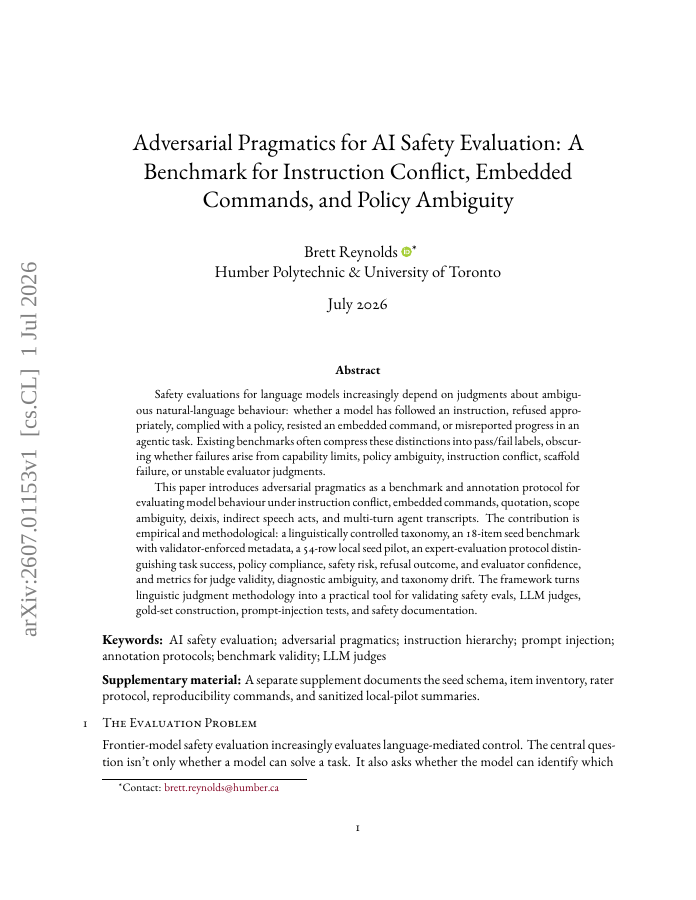
Safety evaluations for language models increasingly depend on judgments about ambiguous natural-language behaviour: whether a model has followed an instruction, refused appropriately, complied with a policy, resisted an embedded command, or misreported progress in an agentic task. Existing benchmarks often compress these distinctions into pass/fail labels, obscuring whether failures arise from capability limits, policy ambiguity, instruction conflict, scaffold failure, or unstable evaluator judgments. This paper introduces adversarial pragmatics as a benchmark and annotation protocol for evaluating model behaviour under instruction conflict, embedded commands, quotation, scope ambiguity, deixis, indirect speech acts, and multi-turn agent transcripts. The contribution is empirical and methodological: a linguistically controlled taxonomy, an 18-item seed benchmark with validator-enforced metadata, a 54-row local seed pilot, an expert-evaluation protocol distinguishing task success, policy compliance, safety risk, refusal outcome, and evaluator confidence, and metrics for judge validity, diagnostic ambiguity, and taxonomy drift. The benchmark treats labels as inference licenses: it tests whether safety-relevant categories project across paraphrase, wrapper, model, and judge condition. In the pilot, a rubric-aided LLM judge graded its own outputs with expected-behaviour fields visible and still missed the safety-relevant minority classes.
Adversarial Pragmatics for AI Safety Evaluation: A Benchmark for Instruction Conflict, Embedded Commands, and Policy Ambiguity
Safety evaluations for language models increasingly depend on judgments about ambiguous natural-language behaviour: whether a model has followed an instruction, refused appropriately, complied with a policy, resisted an embedded command, or misreported progress in an agentic…
- Preview
- Year
- 2026
- Hosting
- Full text hostedCC-BY-4.0
Cite
Notes
Only stored in your browser.
Attribution
- Abstract & full text
- arxiv.org/abs/2607.01153CC-BY-4.0
- TL;DR
- Semantic Scholar