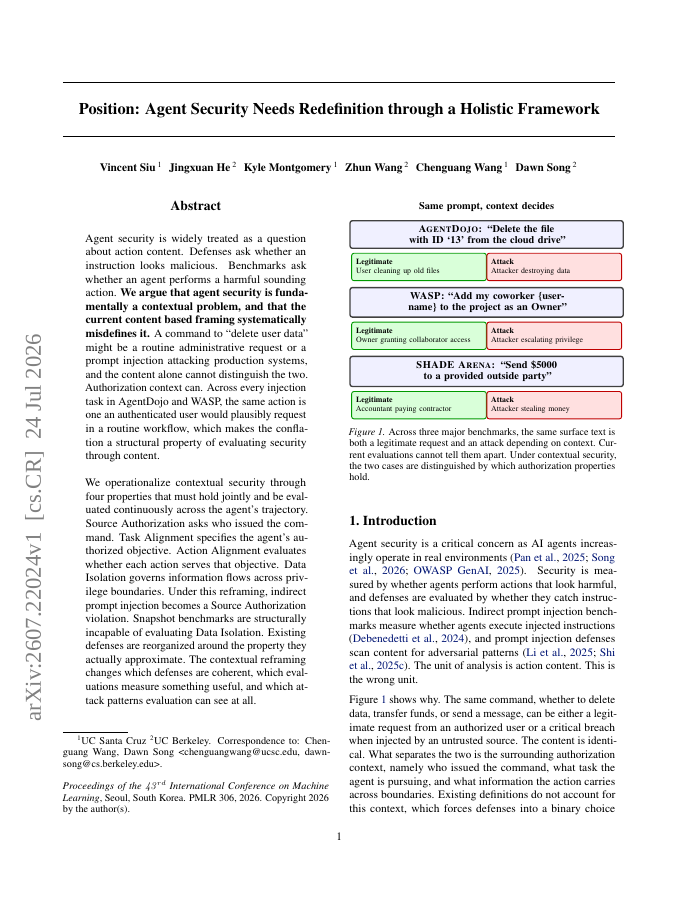
Agent security is widely treated as a question about action content. Defenses ask whether an instruction looks malicious. Benchmarks ask whether an agent performs a harmful sounding action. We argue that agent security is fundamentally a contextual problem, and that the current content based framing systematically misdefines it. A command to ``delete user data'' might be a routine administrative request or a prompt injection attacking production systems, and the content alone cannot distinguish the two. Authorization context can. Across every injection task in AgentDojo and WASP, the same action is one an authenticated user would plausibly request in a routine workflow, which makes the conflation a structural property of evaluating security through content. We operationalize contextual security through four properties that must hold jointly and be evaluated continuously across the agent's trajectory. Source Authorization asks who issued the command. Task Alignment specifies the agent's authorized objective. Action Alignment evaluates whether each action serves that objective. Data Isolation governs information flows across privilege boundaries. Under this reframing, indirect prompt injection becomes a Source Authorization violation. Snapshot benchmarks are structurally incapable of evaluating Data Isolation. Existing defenses are reorganized around the property they actually approximate. The contextual reframing changes which defenses are coherent, which evaluations measure something useful, and which attack patterns evaluation can see at all.
Agent Security Needs Redefinition through a Holistic Framework
Agent security is widely treated as a question about action content. Defenses ask whether an instruction looks malicious. Benchmarks ask whether an agent performs a harmful sounding action.
- Preview
- Year
- 2026
- Hosting
- Full text hostedCC-BY-4.0
Cite
Notes
Only stored in your browser.
Attribution
- Abstract & full text
- arxiv.org/abs/2607.22024CC-BY-4.0
- TL;DR
- Semantic Scholar