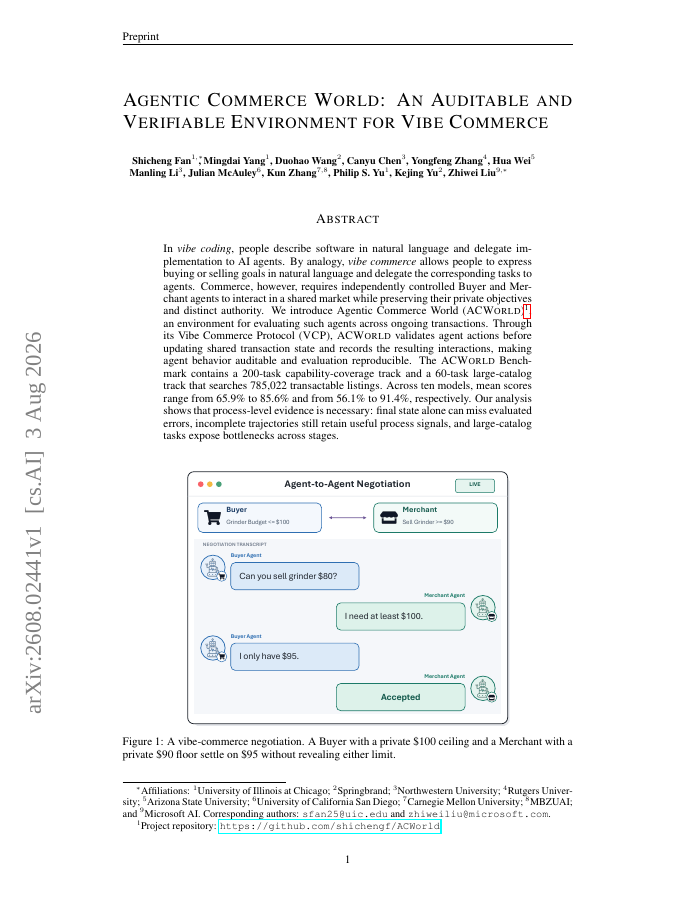
In vibe coding, people describe software in natural language and delegate implementation to AI agents. By analogy, vibe commerce allows people to express buying or selling goals in natural language and delegate the corresponding tasks to agents. Commerce, however, requires independently controlled Buyer and Merchant agents to interact in a shared market while preserving their private objectives and distinct authority. We introduce Agentic Commerce World (ACWorld), an environment for evaluating such agents across ongoing transactions. Through its Vibe Commerce Protocol (VCP), ACWorld validates agent actions before updating shared transaction state and records the resulting interactions, making agent behavior auditable and evaluation reproducible. The ACWorld Benchmark contains a 200-task capability-coverage track and a 60-task large-catalog track that searches 785,022 transactable listings. Across ten models, mean scores range from 65.9% to 85.6% and from 56.1% to 91.4%, respectively. Our analysis shows that process-level evidence is necessary: final state alone can miss evaluated errors, incomplete trajectories still retain useful process signals, and large-catalog tasks expose bottlenecks across stages.
Agentic Commerce World: An Auditable and Verifiable Environment for Vibe Commerce
In vibe coding, people describe software in natural language and delegate implementation to AI agents. By analogy, vibe commerce allows people to express buying or selling goals in natural language and delegate the corresponding tasks to agents.
- Preview
- Year
- 2026
- Hosting
- Abstract onlyARXIV-DEFAULT
Cite
Notes
Only stored in your browser.
Attribution
- Abstract & full text
- arxiv.org/abs/2608.02441ARXIV-DEFAULT
- TL;DR
- Semantic Scholar