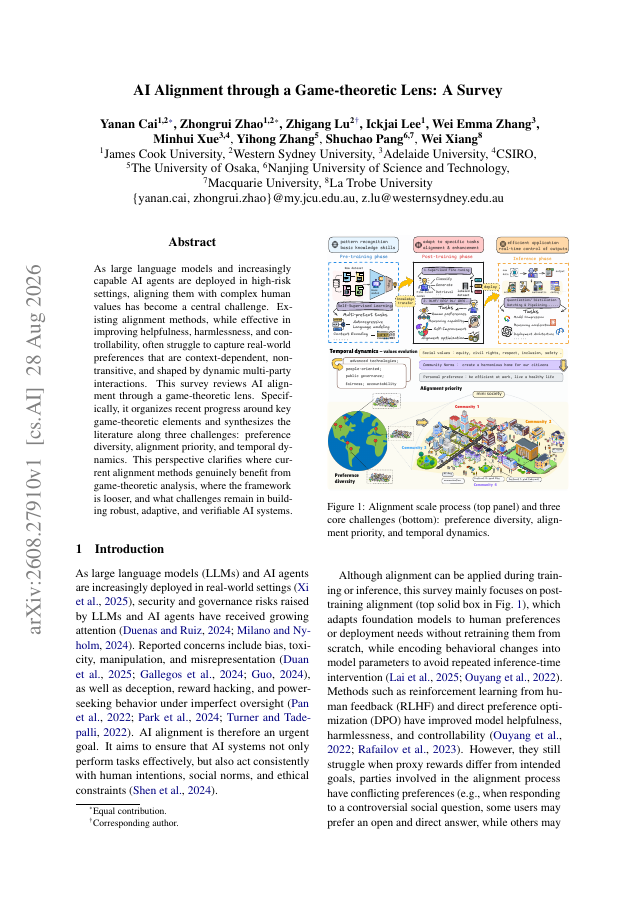
As large language models and increasingly capable AI agents are deployed in high-risk settings, aligning them with complex human values has become a central challenge. Existing alignment methods, while effective in improving helpfulness, harmlessness, and controllability, often struggle to capture real-world preferences that are context-dependent, non-transitive, and shaped by dynamic multi-party interactions. This survey reviews AI alignment through a game-theoretic lens. Specifically, it organizes recent progress around key game-theoretic elements and synthesizes the literature along three challenges: preference diversity, alignment priority, and temporal dynamics. This perspective clarifies where current alignment methods genuinely benefit from game-theoretic analysis, where the framework is looser, and what challenges remain in building robust, adaptive, and verifiable AI systems.
AI Alignment through a Game-theoretic Lens: A Survey
As large language models and increasingly capable AI agents are deployed in high-risk settings, aligning them with complex human values has become a central challenge. Existing alignment methods, while effective in improving helpfulness, harmlessness, and controllability, often…
- Preview
- Year
- 2026
- Hosting
- Full text hostedCC-BY-4.0
Cite
Notes
Only stored in your browser.
Attribution
- Abstract & full text
- arxiv.org/abs/2608.27910CC-BY-4.0
- TL;DR
- Semantic Scholar