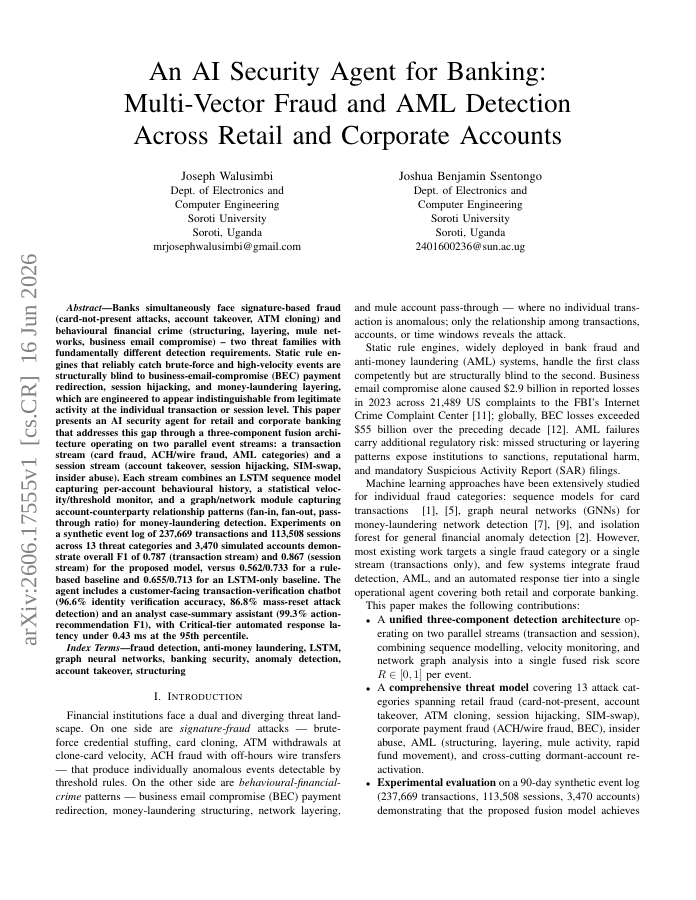
Banks face two threat families with fundamentally different detection requirements: signature-based fraud (card-not-present attacks, account takeover, ATM cloning) and behavioural financial crime (structuring, layering, mule networks, business email compromise). Static rule engines catch high-velocity events but remain blind to BEC payment redirection, session hijacking, and laundering layering, which are engineered to resemble legitimate activity at the individual level. This paper presents an AI security agent for retail and corporate banking using a three-component fusion architecture across two parallel event streams: transactions (card fraud, ACH/wire fraud, AML) and sessions (account takeover, hijacking, SIM-swap, insider abuse). Each stream combines an LSTM sequence model of per-account behaviour, a statistical velocity/threshold monitor, and a graph module capturing account-counterparty patterns (fan-in, fan-out, pass-through ratio) for laundering detection. Experiments on a synthetic log of 237,669 transactions and 113,508 sessions across 13 threat categories and 3,470 accounts show overall F1 of 0.787 (transaction) and 0.867 (session), versus 0.562/0.733 for a rule-based baseline and 0.655/0.713 for an LSTM-only baseline. The agent also includes a customer-facing verification chatbot (96.6% identity accuracy, 86.8% mass-reset detection) and an analyst case-summary assistant (99.3% action recommendation F1), with Critical-tier response latency under 0.43 ms at the 95th percentile.
An AI Security Agent for Banking: Multi-Vector Fraud and AML Detection Across Retail and Corporate Accounts
Banks face two threat families with fundamentally different detection requirements: signature-based fraud (card-not-present attacks, account takeover, ATM cloning) and behavioural financial crime (structuring, layering, mule networks, business email compromise).
- Preview
- Year
- 2026
- Hosting
- Abstract onlyARXIV-DEFAULT
Cite
Notes
Only stored in your browser.
Attribution
- Abstract & full text
- arxiv.org/abs/2606.17555ARXIV-DEFAULT
- TL;DR
- Semantic Scholar