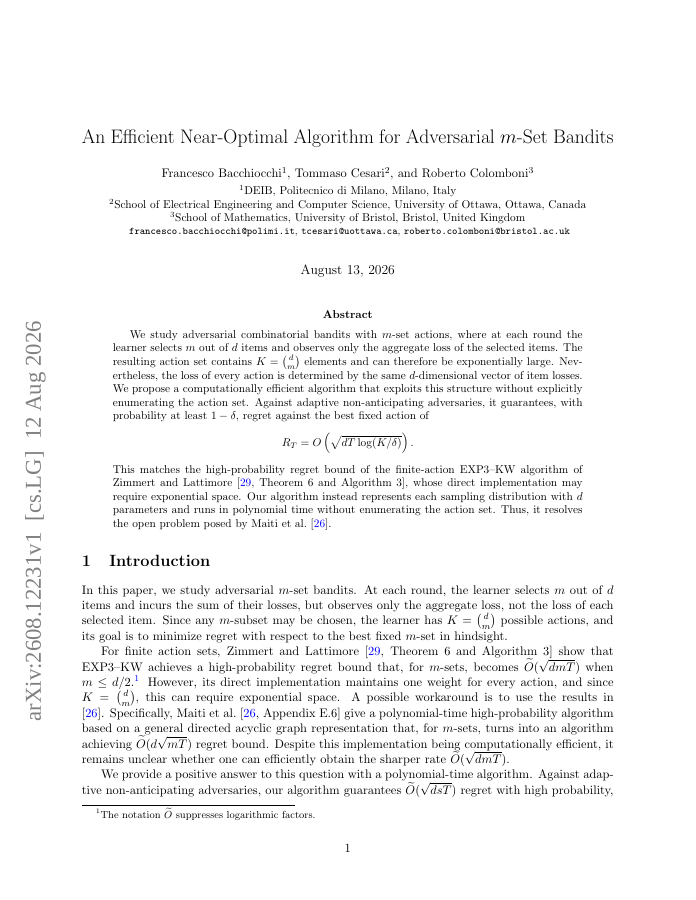
We study adversarial combinatorial bandits with m-set actions, where at each round the learner selects m out of d items and observes only the aggregate loss of the selected items. The resulting action set contains K=\binom{d}{m} elements and can therefore be exponentially large. Nevertheless, the loss of every action is determined by the same d-dimensional vector of item losses. We propose a computationally efficient algorithm that exploits this structure without explicitly enumerating the action set. Against adaptive non-anticipating adversaries, it guarantees, with probability at least 1-δ, regret against the best fixed action of [ R_T = O\left(\sqrt{dT\log(K/δ)}\right). ] This matches the high-probability regret bound of the finite-action EXP3-KW algorithm of Zimmert and Lattimore, whose direct implementation may require exponential space. Our algorithm instead represents each sampling distribution with d parameters and runs in polynomial time without enumerating the action set. Thus, it resolves the open problem posed by Maiti et al.
An Efficient Near-Optimal Algorithm for Adversarial $m$-Set Bandits
We study adversarial combinatorial bandits with $m$-set actions, where at each round the learner selects $m$ out of $d$ items and observes only the aggregate loss of the selected items.
- Preview
- Year
- 2026
- Hosting
- Abstract onlyARXIV-DEFAULT
Cite
Notes
Only stored in your browser.
Attribution
- Abstract & full text
- arxiv.org/abs/2608.12231ARXIV-DEFAULT
- TL;DR
- Semantic Scholar