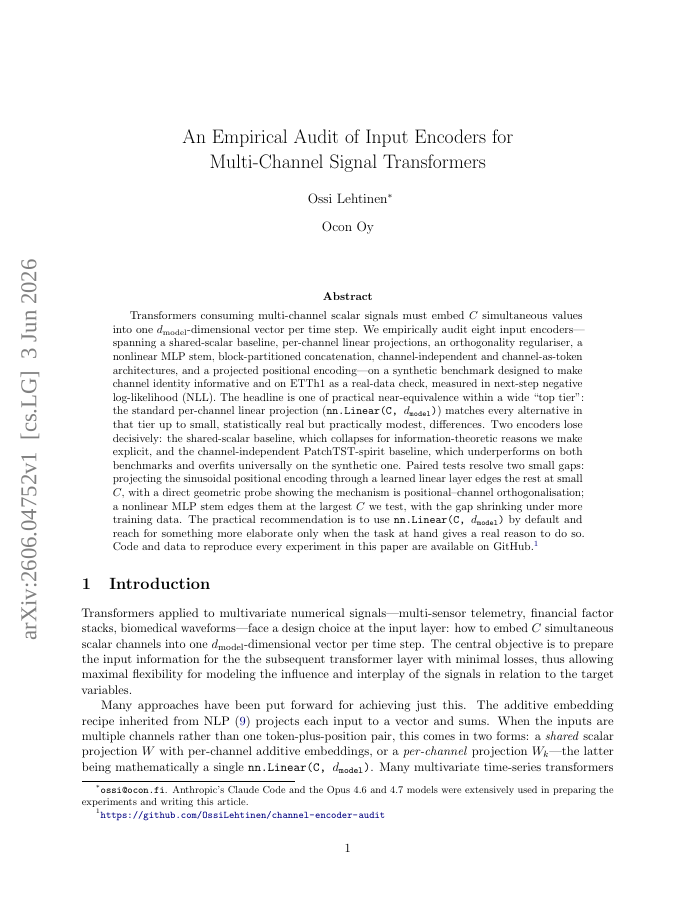
Transformers consuming multi-channel scalar signals must embed C simultaneous values into one d_{model}-dimensional vector per time step. We audit eight input encoders -- a shared-scalar baseline, per-channel linear projections, an orthogonality regulariser, a nonlinear MLP, block-partitioned concatenation, channel-independent and channel-as-token architectures, and a projected positional encoding -- on a synthetic benchmark where channel identity is informative and on ETTh1, scored by next-step negative log-likelihood. The headline is practical near-equivalence within a wide "top tier": the standard per-channel linear projection matches every alternative up to small, statistically real but practically modest differences. A direct geometric probe attributes this to a spontaneous orthogonalisation of the per-channel projections: they end up near-orthogonal with no explicit regulariser, letting the standard linear recover channel identity from the summed embedding. Two encoders lose decisively: the shared-scalar baseline collapses for information-theoretic reasons we make explicit, and the channel-independent PatchTST-spirit baseline overfits universally on the synthetic benchmark and underperforms on both. Paired tests resolve two small gaps: projecting the sinusoidal positional encoding through a learned linear layer edges the rest at small C by extending this orthogonality to the positional subspace; a nonlinear MLP stem edges them at the largest C, with the gap shrinking under more training data. The practical recommendation: use the standard per-channel linear projection by default; reach for something more elaborate only when the task calls for it.
An Empirical Audit of Input Encoders for Multi-Channel Signal Transformers
Transformers consuming multi-channel scalar signals must embed $C$ simultaneous values into one $d_{\text{model}}$-dimensional vector per time step. We audit eight input encoders -- a shared-scalar baseline, per-channel linear projections, an orthogonality regulariser, a…
- Preview
- Year
- 2026
- Hosting
- Abstract onlyARXIV-DEFAULT
Cite
Notes
Only stored in your browser.
Attribution
- Abstract & full text
- arxiv.org/abs/2606.04752ARXIV-DEFAULT
- TL;DR
- Semantic Scholar