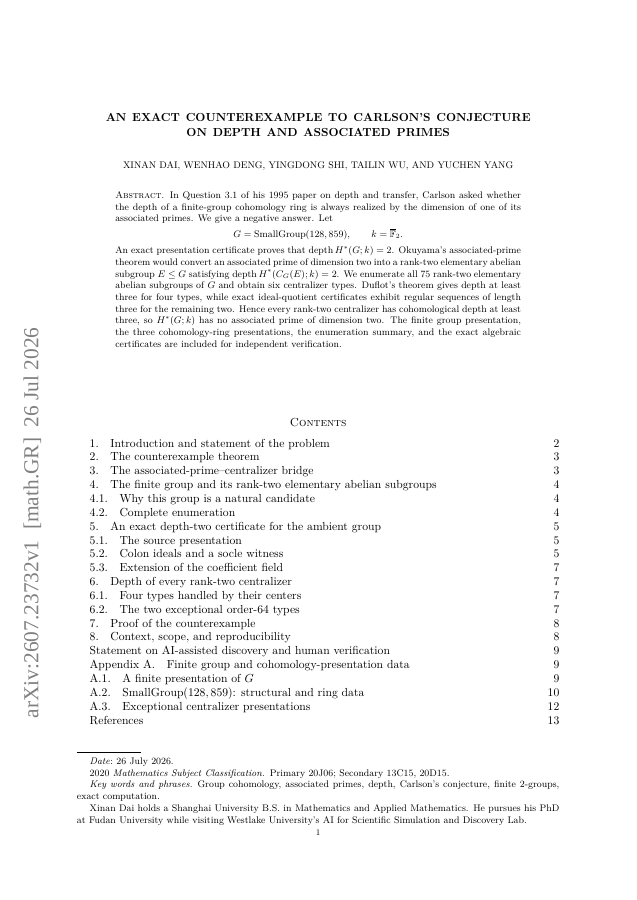
In Question 3.1 of his 1995 paper on depth and transfer, Carlson asked whether the depth of a finite-group cohomology ring is always realized by the dimension of one of its associated primes. We give a negative answer. Let [ G=\SG{128}{859},\qquad k=\kbar. ] An exact presentation certificate proves that \depth H^(G;k)=2. Okuyama's associated-prime theorem would convert an associated prime of dimension two into a rank-two elementary abelian subgroup E\leq G satisfying \depth H^(C_G(E);k)=2. We enumerate all 75 rank-two elementary abelian subgroups of G and obtain six centralizer types. Duflot's theorem gives depth at least three for four types, while exact ideal-quotient certificates exhibit regular sequences of length three for the remaining two. Hence every rank-two centralizer has cohomological depth at least three, so H^*(G;k) has no associated prime of dimension two. The finite group presentation, the three cohomology-ring presentations, the enumeration summary, and the exact algebraic certificates are included for independent verification.
An Exact Counterexample to Carlson's Associated-Prime Depth Conjecture from a Group of Order 128
In Question~3.1 of his 1995 paper on depth and transfer, Carlson asked whether the depth of a finite-group cohomology ring is always realized by the dimension of one of its associated primes. We give a negative answer. Let \[ G=\SG{128}{859},\qquad k=\kbar.
- Preview
- Year
- 2026
- Hosting
- Full text hostedCC-BY-4.0
Cite
Notes
Only stored in your browser.
Attribution
- Abstract & full text
- arxiv.org/abs/2607.23732CC-BY-4.0
- TL;DR
- Semantic Scholar