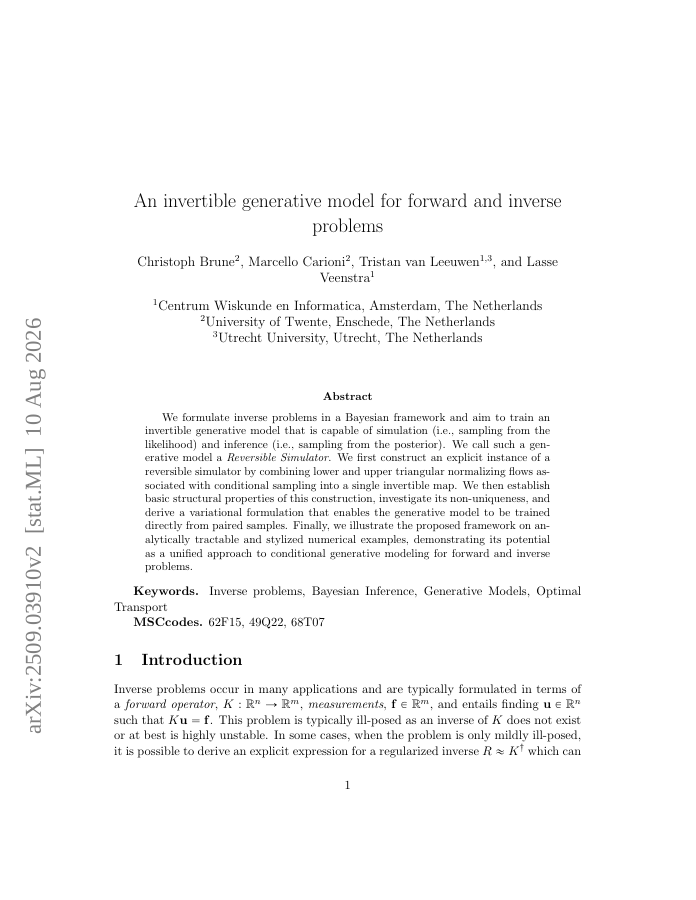
We formulate inverse problems in a Bayesian framework and aim to train an invertible generative model that is capable of simulation (i.e., sampling from the likelihood) and inference (i.e., sampling from the posterior). We call such a generative model a Reversible Simulator. We first construct an explicit instance of a reversible simulator by combining lower and upper triangular normalizing flows associated with conditional sampling into a single invertible map. We then establish basic structural properties of this construction, investigate its non-uniqueness, and derive a variational formulation that enables the generative model to be trained directly from paired samples. Finally, we illustrate the proposed framework on analytically tractable and stylized numerical examples, demonstrating its potential as a unified approach to conditional generative modeling for forward and inverse problems.
An invertible generative model for forward and inverse problems
We formulate inverse problems in a Bayesian framework and aim to train an invertible generative model that is capable of simulation (i.e., sampling from the likelihood) and inference (i.e., sampling from the posterior). We call such a generative model a Reversible Simulator.
- Preview
- Year
- 2025
- Hosting
- Full text hostedCC-BY-4.0
Cite
Notes
Only stored in your browser.
Attribution
- Abstract & full text
- arxiv.org/abs/2509.03910CC-BY-4.0
- TL;DR
- Semantic Scholar